
AI in Healthcare
HIPAA-Compliant AI: How to Use LLMs With PHI Safely
How to build HIPAA-compliant AI: when LLM providers need a BAA, data minimization, de-identification, audit controls and a reference architecture.
October 16, 2026Read more
Clinical insight alone isn’t enough. Explore how hospitals can operationalize AI to deliver safer care, smarter decisions, and measurable performance improvements.
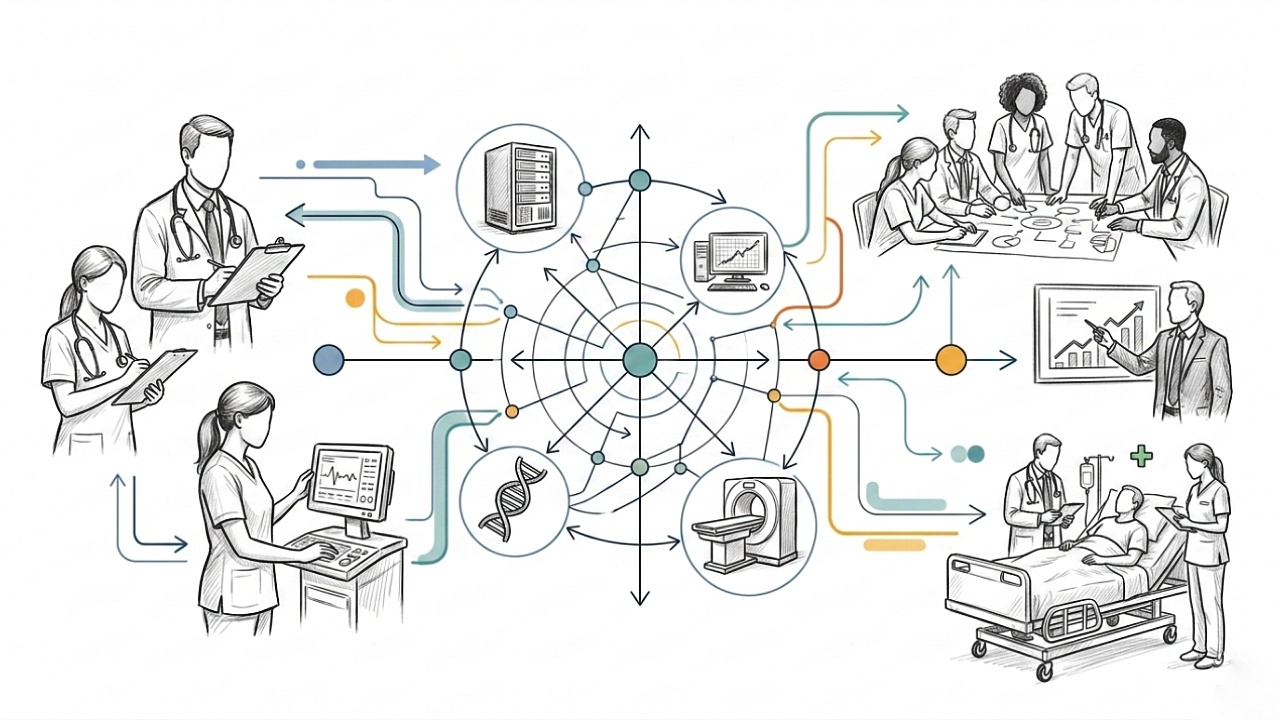
Hospitals create a huge amount of information every day. This includes patient records, medical images, test results, and monitor data. These large collections of details hold the promise to change how care is delivered. Finding useful patterns in the data is the first step. Real change happens when hospitals turn those insights into actual ones. These steps need to lead to clear, positive results for patients and smoother daily operations. Operationalizing AI in hospitals makes this possible. It moves artificial intelligence from a research idea into the daily routines of clinical work and hospital management. This shift takes raw data and creates practical plans that directly shape patient care.
Clinical insight is the deep understanding gained from analyzing complex healthcare information. This can involve identifying patterns in patient recovery, predicting the progression of a disease, or recognizing trends in treatment efficacy. These insights originate from various data sources, such as electronic health records and genetic databases. Healthcare AI services can examine all this information with speed and precision. They can find connections that a person might not see when reviewing the data alone.
Simply seeing trends is not enough. Hospitals need clear pathways that convert insights into actionable strategies. For example, predictive analytics might indicate a patient has a high risk of returning to the hospital. To act on that information, clinical teams must collaborate to adjust the patient's care plan. They offer tools and systems that help guide these decisions, while confirming the hospital complies with all medical rules and laws. Here, AI solutions support teams by organizing insights into actionable steps that fit with existing clinical workflows.
Clinical impact means real, positive changes in patient care and hospital performance. This can include fewer medication errors, improved staff allocation, reduced patient wait times, or more precise diagnoses. These results depend on a hospital's capacity to act on information both quickly and well. Operationalizing AI in healthcare makes sure these insights become a concrete part of daily routines and care processes.
We see practical examples of AI in nearly every part of a hospital. In the radiology department, image recognition systems help find issues in scans more quickly and accurately. In the emergency department, AI tools can predict patient inflow, assisting in staffing decisions. Pharmacy operations benefit from AI to track medicine supplies, which prevents shortages by reducing stockouts and waste. These real-world examples show a simple truth: AI delivers the greatest value when it operates in harmony with people and integrates into existing hospital workflows.
AI use cases in hospitals span across departments and functions. In radiology, image recognition algorithms support faster and more precise diagnosis. In the emergency department, predictive models anticipate patient inflow, assisting in staffing decisions. Pharmacy operations benefit from AI-driven inventory management, reducing stockouts and waste. These applications demonstrate that clinical impact is achieved when intelligent systems interact seamlessly with human decision-making and operational systems.

A systematic, thoughtful plan is necessary to introduce AI into a hospital. The process begins by building an AI strategy consulting framework. This aligns the use of new technology with key patient care goals. It involves evaluating a hospital's current capabilities, understanding existing clinical and administrative workflows, and pinpointing where AI can deliver meaningful improvements. An AI implementation partner offers vital support through this phase. They guide the hospital through the intricate steps of integration, applying their specialized knowledge to guarantee the technology directly serves clinical needs.
Clear governance forms the foundation of a successful AI program. This involves defining who is responsible, how information is governed, and which compliance standards apply. The real change happens when AI is integrated into the systems people use every day, such as electronic health records, patient monitors, and reporting dashboards. This moves insights from being isolated notes into active, usable intelligence. With clear accountability and AI woven into standard decision-making, hospitals can offer care that is consistent and reliable.
Hospitals that follow a structured plan for AI can track its effect with clear metrics. These measurements could reduce readmission rates, shorten procedure times, improve diagnostic accuracy, or enhance patient satisfaction. An AI maturity model also provides an organization with a way to assess its progress, refine its methods, and expand successful projects to other areas. Frequent evaluation supports ongoing refinement, confirming that AI contributes in a meaningful way to both daily operations and patient care objectives.
A comprehensive approach to AI requires more than just technical expertise. A custom AI strategy report can provide hospitals with the necessary clarity to focus their efforts and manage their resources effectively. Choosing a skilled partner for implementation creates alignment with clinical goals and a seamless integration into everyday routines. With careful planning, AI moves from a limited trial to a natural part of how a hospital works.
A hospital can start by evaluating its current position. Conducting an AI readiness assessment provides a clear picture of existing strengths and the areas that need attention. Following this, developing an AI adoption roadmap creates a practical, step-by-step plan for moving forward. Working with an experienced AI implementation partner throughout these phases maintains alignment with patient care goals and the hospital's daily operational needs.
Bringing AI into a hospital is more than a technical project. It needs teamwork between clinicians, administrators, and IT staff. Healthcare AI services support this collaboration. They offer solutions that connect what the technology can do with what clinical teams actually need. When these groups cooperate, the AI systems they develop accomplish more. They support smarter decisions, simplify daily tasks, and create a setting where insights consistently lead to real, measurable gains.
AI systems are only as good as the information they learn from. For AI outputs to be accurate and useful, they need high-quality data. This requires hospitals to set clear rules for how data is recorded, cleaned, and structured. Bringing together data from various sources, such as laboratory systems, imaging software, and wearable monitors, adds complexity. It is necessary to form a whole, reliable picture for insights.
Hospitals must carefully address ethics and rules when AI supports clinical decisions. Clear, explainable algorithms, strong protections for patient privacy, and strict adherence to healthcare standards are non-negotiable parts of the process. Operationalizing AI in healthcare depends on this careful attention, verifying that the technology supports clinical judgment responsibly and safely.
Introducing AI changes how people work and what they do. Training staff, adjusting certain roles, and maintaining clear communication are necessary. A thoughtful approach to change facilitates a smooth adoption process. It also fosters trust, giving clinical teams confidence to use AI-generated information as part of patient care.
The application of AI in healthcare is poised to increase, creating opportunities for more integrated systems and a wider reach. New advancements, such as natural language processing for clinical notes, more sophisticated predictive models, and real-time patient monitoring, are broadening what is possible. Hospitals that commit to a structured, deliberate plan for adopting AI will have a strong foundation. This prepares them to adopt these new tools effectively, converting insights into sustained improvements in patient care and hospital performance.
Operationalizing AI in healthcare shifts healthcare from analysis to action. It transforms clinical insight into clear, measurable gains in both patient outcomes and daily efficiency. A structured approach, built on solid governance and teamwork, allows hospitals to capture the full value of AI while prioritizing safety and meeting all regulations. Through careful planning and execution, AI can become a natural part of clinical routines, driving meaningful results for patients and staff. For support in adopting AI solutions and managing a successful integration, contact us to discuss strategies aligned with specific institutional goals.
Operationalizing AI in healthcare means embedding AI Solutions into daily hospital workflows so insights translate into measurable clinical and operational impact.
Healthcare AI services analyze complex data, identify valuable AI use cases, and help integrate intelligent tools into existing clinical systems.
Hospitals should involve an AI implementation partner during planning and deployment to ensure alignment with goals, compliance, and long-term scalability.
An AI readiness assessment evaluates current capabilities, while an AI maturity model measures progress and guides continuous improvement.
AI strategy consulting provides direction through a custom AI strategy report, and an AI adoption roadmap outlines clear steps for successful implementation.
How to build HIPAA-compliant AI: when LLM providers need a BAA, data minimization, de-identification, audit controls and a reference architecture.

Practical data migration planning guide for healthcare teams. Scope, mapping, compliance, validation, cutover and rollback decisions explained end to end.

Smart on FHIR guide for healthtech engineers. Learn the OAuth 2.0 launch model, scope syntax, backend services, and US regulatory requirements.
Connect with our team to explore how AI expertise can transform your business.