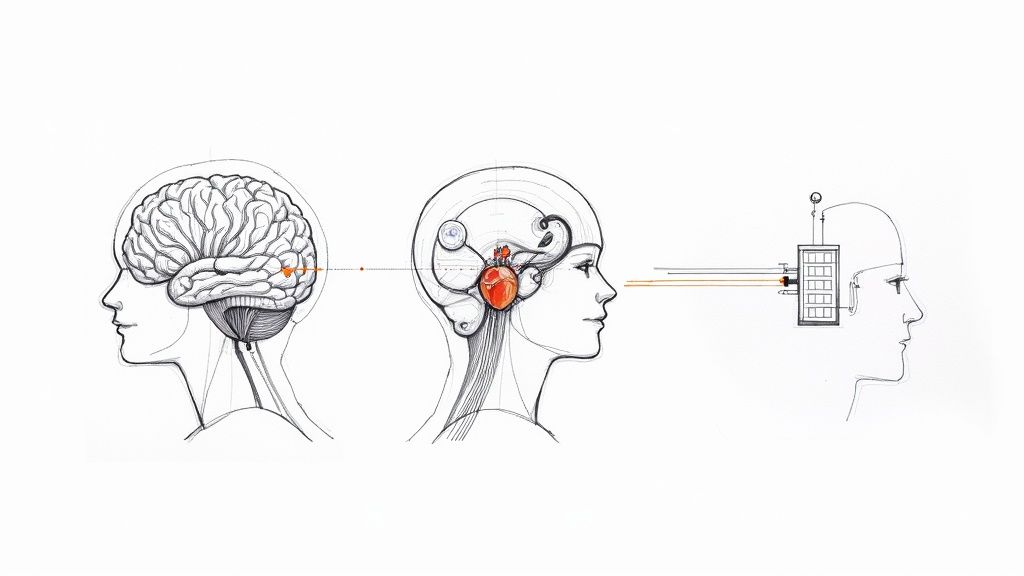
When we talk about healthcare AI change management, we're not just talking about installing new software. We're talking about a deliberate, people-focused plan for guiding your entire organization—from the C-suite to frontline clinicians—through the massive shift of integrating artificial intelligence. It’s about managing the human side of this change to make sure these powerful tools are actually used, used correctly, and ultimately improve patient care instead of causing more headaches.
The Reality of AI Adoption in Healthcare Today
For years, AI in healthcare felt more like a concept than a reality. We saw a lot of isolated, "shadow AI" projects popping up, but now things are getting serious. The industry is moving toward governed, large-scale AI systems, and it's happening fast. Why the sudden urgency? Two words: burnout and bureaucracy. Healthcare leaders are desperately looking for ways to ease the incredible strain on clinicians and cut through the operational red tape that slows everything down.

The numbers back this up. A recent report shows that AI adoption in specific healthcare domains is expected to jump from just 3% in 2023 to 22% by 2025. Health systems are leading the charge with a 27% adoption rate, which is more than double the pace we're seeing in the broader economy. This isn't a slow burn; it's an explosion.
Why You Can't Afford to Skip Change Management
With this kind of rapid growth, trying to implement AI without a formal healthcare AI change management strategy is a recipe for disaster. I've seen it happen: organizations pour money into incredible technology only to see it fail because of fragmented rollouts, low user adoption, and no clear return on investment.
You have to look beyond the tech itself and focus on the people, the clinical workflows, and the governance that will make or break the initiative.
For example, many systems are now exploring how AI in Healthcare: How Chatbots Can Help Your Team can take over routine administrative work or improve patient communication. These are fantastic applications, but they only work if the staff trusts the tool and it fits seamlessly into their day.
The goal is to make AI a trusted partner in care delivery, not another layer of complexity. Success hinges on turning ambitious AI goals into impactful realities through carefully planned and executed change.
This is where bringing in expert partners who offer specialized healthcare software solutions can be a game-changer. They help close the gap between what the technology can do and what your organization actually needs, ensuring AI projects are aligned with clinical goals from the start. If you're looking for a detailed guide on navigating this process, you can explore our dedicated Healthcare AI Services.
To get started, it helps to understand the main hurdles you'll face. The table below outlines the most common challenges I've encountered and the strategic pillars needed to overcome them.
Core AI Change Management Challenges And Solutions
This table summarizes the primary obstacles faced during AI integration in healthcare and the strategic pillars needed to overcome them.
| Challenge |
Strategic Solution |
Key Focus Area |
| Clinician Resistance & Skepticism |
Proactive Stakeholder Engagement |
Involving clinical staff in the selection and design process to build trust and ensure usability. |
| Workflow Disruption |
Human-Centered Integration |
Mapping existing workflows and co-designing AI tools to augment, not interrupt, daily tasks. |
| Data Silos & Security Concerns |
Robust Governance & Compliance |
Establishing a clear framework for data management, privacy, and HIPAA adherence from day one. |
| Unclear ROI & Value Proposition |
Pilot Programs with Defined KPIs |
Starting with small, measurable projects to prove value and build a business case for scaling. |
Tackling these issues head-on with a clear strategy is the only way to ensure your investment in AI pays off—for your organization, your staff, and your patients.
Building Your Foundation For AI Success
Long before you deploy a single algorithm, the groundwork for a successful healthcare AI change management program is laid with your people. We’ve seen it time and again: the technology is only one piece of the puzzle. What truly separates a stalled project from a game-changing one is getting everyone, from the C-suite to the front lines, aligned and on board.
This isn’t something that happens by accident. It takes a deliberate strategy to communicate clearly, establish solid governance, and earn genuine buy-in from every corner of your institution.

One of the first things you have to do is break down the departmental silos. Too often, an AI project gets pushed by IT or a single ambitious department. The result? A tool that misses the mark on clinical needs or ignores administrative realities. This is probably the most common—and preventable—reason AI initiatives fail to get off the ground.
Assembling Your AI Steering Committee
The best tool for building that crucial alignment is a cross-functional AI steering committee. Think of this group as the central command for all things AI, making sure every angle is considered before any big moves are made. A well-balanced committee not only prevents blind spots but also creates a powerful coalition of champions across the hospital or health system.
To be effective, your committee absolutely must include voices from these key areas:
- Clinical Leaders: The doctors, head nurses, and specialists who live the daily reality of patient care. They’re the ones who can vouch for a tool that will actually help, not hinder.
- IT and Data Specialists: Your technical backbone. These are the experts who will manage the infrastructure, security, and data integrity needed to make it all work.
- Administrators: People from finance, operations, and compliance who can speak to the financial viability and regulatory hurdles.
- Patient Advocates: This one is often overlooked but critical. Including a patient representative ensures the solutions you build are ethical and genuinely improve the patient experience.
Getting this diverse group together from the start ensures that any AI solution you consider is not just technically sound but also clinically useful, operationally practical, and ethically responsible. Some organizations find that proactive AI strategy consulting can help get this committee formed and a clear charter established right out of the gate.
Creating A Clear Vision And Robust Governance
Once your team is in place, the immediate next job is to define a clear and compelling vision for AI in your organization. This isn't the time for technical jargon. It’s about tying AI directly to your core mission. Instead of talking about algorithms, frame it in terms of real-world benefits, like "giving our nurses more time with patients by automating charting" or "boosting diagnostic accuracy to catch diseases earlier."
A clear vision answers the "why" behind the change, turning fear of the unknown into a shared sense of purpose. It has to connect with everyone, from executives to frontline staff, by answering the one question on everyone’s mind: "What's in this for us and for our patients?"
Right alongside that vision, you have to build a rock-solid governance framework. This is non-negotiable. This framework sets the rules of the road for AI, spelling out everything from data privacy and ethical guidelines to strict HIPAA compliance. It needs to be crystal clear about who is responsible for what, how decisions are made, and how you’ll manage risk.
For any organization building this from scratch, a Custom AI Strategy report can provide an indispensable blueprint.
This governance structure is what prevents the "wild west" of rogue AI projects from popping up, ensuring every initiative is secure, compliant, and true to your organization's values. When you build this strong foundation of people, vision, and governance first, the technology can finally become a powerful force for positive change, not just another disruption.
Weaving AI into the Fabric of Clinical Workflows
This is where the rubber meets the road. All the strategy and planning for AI in healthcare comes down to one critical question: will clinicians actually use it? The best AI tool is one that doesn't feel like a tool at all. It should operate so smoothly in the background that it becomes an invisible, indispensable part of a clinician's day.
Making that happen is tough, especially when you're working with the notoriously rigid world of Electronic Health Records (EHRs). Getting this right is a top priority, with nearly 80% of healthcare organizations actively trying to mesh new technologies with their existing EHR systems.
This isn’t just a technical puzzle; it’s a deeply human one. The goal is to enhance care, not add another layer of complexity to a clinician's already overloaded day.
Find the Friction by Walking the Floors
Before a single line of code is written, you have to understand the day-to-day reality of the clinic. Forget just looking at process flowcharts. The real insights come from putting on some comfortable shoes and shadowing your end-users—doctors, nurses, medical assistants, and administrative staff.
By watching them work, you start to see the real-world friction points where AI could make a genuine difference.
- Where is valuable time lost to repetitive tasks? Think about the hours spent on manual data entry or hunting through a patient’s history for one specific lab value.
- What simple tasks are surprisingly prone to error? This could be anything from transcribing spoken notes to ensuring medical codes are accurate. An AI can act as a reliable safety net.
- Where do information bottlenecks slow things down? If a doctor has to log into three different systems to get a full picture, that’s a perfect opportunity for an AI-powered solution, like better internal tooling.
A proper AI requirements analysis isn't about asking people what AI they want. It’s about understanding their daily frustrations so well that you can propose a solution that actually solves a problem they care about.
I’ve seen it time and again: the most successful integrations aren't dreamed up in a boardroom. They're co-created right there in the clinic. When your users help design the solution, they become its most passionate champions.
Build for Humans, Not for the System
Once you've pinpointed the real pain points, you can start designing an integration that works for the clinician, not the other way around. Introducing new technologies, like advanced AI agents, demands a people-first approach to ensure they truly augment the workflow instead of disrupting it.
A fantastic example of this in action is the rise of ambient AI scribes. Instead of interrupting the patient conversation to type notes, the doctor can focus entirely on the person in front of them. The AI listens, drafts the clinical note, and intelligently files it into the correct EHR fields. This doesn't add a new step; it removes several tedious ones.
In the same way, other AI tools for business have been adapted to automate the prior authorization nightmare, flag potential drug interactions in real-time, or generate quick summaries of sprawling patient records. These tools succeed because they remove a burden, freeing up both time and mental energy for clinicians.
Following a structured AI Product Development Workflow is non-negotiable for keeping these complex projects on track. Much like the disciplined process for custom healthcare software development, this framework ensures that the technical build stays firmly tethered to clinical needs. It helps manage everything from data readiness to interoperability, ultimately delivering a tool that feels less like a piece of tech and more like a trusted colleague.
2. Designing and Launching Your First AI Pilot Program
Before you even think about a system-wide AI rollout, you have to start small. I've seen countless organizations stumble because they tried to do too much, too soon. The right approach is a carefully designed pilot program. This is your sandbox—a controlled environment where you can test theories, collect hard evidence, and slowly build the confidence needed for a larger investment. A successful pilot is your single best tool for winning over the skeptics.
The entire endeavor rests on picking the right project. It's tempting to go after the biggest, most complex challenge, but that's usually a mistake. Instead, look for a win that's both achievable and highly visible. What’s a process that everyone on staff complains about? A manual, soul-crushing task that’s ripe for a change?
That’s your starting point. Often, the lowest-hanging fruit is in administrative workflows. Think about automating the back-and-forth of prior authorizations or finding eligible patients for clinical trials more quickly. These projects offer clear, measurable results without getting into the weeds of acute care decisions, which makes them much lower-risk. And whatever you choose, make sure you have a clinical champion—a respected physician or nurse who is genuinely excited about the idea and can rally their peers.
Defining What Success Actually Looks Like
You have to know what a "win" looks like before you start. Vague goals like “improving efficiency” won't cut it. You need to establish concrete metrics that are directly tied to the problem you’re solving.
I recommend a balanced scorecard approach for any AI pilot:
- Operational Efficiency: This is where you'll often see the most immediate ROI. Track things like hours saved per clinician each week, a reduction in charting errors, or a faster revenue cycle.
- User Adoption and Satisfaction: It doesn't matter how great the tech is if nobody uses it. You need to track active usage rates and, just as importantly, gather direct feedback through surveys and quick chats to understand what’s working and what isn't.
- Clinical Outcomes: If your pilot touches clinical work, you’ll want to measure things like improvements in diagnostic accuracy, lower readmission rates, or better adherence to established care protocols.
This isn't just about crunching numbers. It’s about building a powerful story backed by both data and personal testimonials. The goal is to create a compelling business case that showcases tangible benefits from real-world use cases happening within your own health system.
Remember, an AI pilot is as much a social experiment as it is a technical one. You're not just testing an algorithm; you're testing how that algorithm fits into your team's culture and daily work. Success is measured in adoption just as much as it is in output.
The core of any pilot is transforming a broken workflow into an AI-driven solution.

This flow—understanding the current state, designing a better way, and then integrating the tool—is the blueprint for getting your pilot right.
The Pilot Readiness Checklist
A pilot can be doomed from the start if the groundwork isn't properly laid. Before you press go, run through these essential checks to make sure you’re ready.
Is your technical foundation solid? You need more than just an idea; you need the right infrastructure. Does your network have the bandwidth? Is there enough computing power, and is your cloud environment secure and ready to handle the load?
Can you get the right data? AI is nothing without good data. Have you secured all the necessary permissions to access clean, relevant, and properly de-identified data sets? Even more, is that data structured in a way the AI model can actually use?
Is your team prepared? A pilot can’t succeed without the people. You need a clear training plan for every single participant. Just as crucial is having a dedicated support system in place to answer questions and fix problems the moment they arise.
Is the scope locked down? Scope creep is the number one pilot killer. The project's goals, boundaries, and timeline must be crystal clear to everyone involved. Set a firm start and end date, and resist every temptation to add "just one more thing."
Getting these foundational pieces right can be a challenge, which is why some organizations look to partners. Services like our AI Automation as a Service can de-risk these early stages by bringing in the technical know-how and ready-made infrastructure to get a pilot running correctly and quickly. By starting with a small, well-defined project, you can learn fast, adapt based on real feedback, and build a solid foundation for scaling AI across your organization.
4. Winning Over Your Workforce: From Training to True Adoption
Let's be honest: you can have the most brilliant AI tool in the world, but if your clinical team doesn't use it—or worse, actively resists it—your project is dead on arrival. Getting people on board is the single most important part of any AI implementation. This isn't about a one-off training webinar; it's about fundamentally shifting mindsets from skepticism to genuine buy-in.

The biggest mistake I see is a one-size-fits-all training approach. Your staff is a mix of people: eager early adopters, wait-and-see pragmatists, and hardened skeptics. You have to meet each of them where they are.
Design Training for Real People and Real Workflows
Forget generic user manuals. Effective training shows people exactly how a new tool solves their specific, daily frustrations. It has to connect directly to their job.
A layered approach works best:
- For your early adopters: Give them the keys to the kingdom. Let them play with advanced features and make them your beta testers for new updates. Their excitement is your best marketing tool.
- For the pragmatic majority: Keep it simple and direct. They need clear instructions and real-world examples that show them the "what's in it for me." Focus on time saved, errors reduced, or frustrations eliminated.
- For your skeptics: Don't dismiss their concerns—address them head-on. Offer one-on-one coaching, find quick wins that prove the tool’s value, and give them a safe space to ask tough questions.
One of the most effective tactics we’ve seen for bridging this gap is appointing clinical champions.
The Undeniable Impact of "Super-Users"
A super-user, or clinical champion, is a respected clinician who becomes the go-to expert on the new AI tool. They are, without a doubt, your most powerful asset for driving adoption from the ground up.
These champions aren't just tech support. They are advocates who translate technical jargon into practical, on-the-floor advice. They provide peer-to-peer coaching, answer questions in the moment, and act as a critical bridge between the frontline staff and the project leadership. The credibility of a trusted colleague can defuse fear and build momentum in a way no formal memo ever will.
Nothing wins over a hesitant team like showing them tangible, immediate results. Consider this: recent reports show that 20% of healthcare workers spend over 20 hours a month just fixing billing errors. That's a massive drain on time and morale. Predictive AI for automated billing has seen its use skyrocket from 36% to 61% between 2023 and 2024 precisely because it solves problems like this. When you can show a nurse or an administrator exactly how an AI tool gives them that time back, resistance often melts away.
Your goal is to make this feel like a shared journey, not a top-down mandate. Build a culture where feedback is a gift, not a complaint.
This requires creating a continuous improvement cycle. You need simple, easy-to-use channels for users to report bugs, ask for help, and suggest improvements. More importantly, you need to act on that feedback and communicate what you've changed. This shows you're listening and that the AI will evolve with their needs, which is the bedrock of long-term trust.
Ultimately, successful adoption comes down to making your team’s daily work better. For more tailored strategies, consider joining our AI strategy workshop, where we offer hands-on guidance for navigating these very challenges.
Your Questions On Healthcare AI Change Management Answered
Whenever we talk with healthcare leaders about bringing AI into their organizations, the same handful of questions always comes up. They're good questions, too, because the stakes are high.
Let's tackle some of the most common concerns we hear from the field to give you the clarity you need to move forward with confidence.
What Is The Biggest Mistake To Avoid In Healthcare AI Change Management
Without a doubt, the biggest misstep is getting mesmerized by the tech and forgetting about the people who have to use it. We've seen it happen time and again: a hospital invests in powerful AI tools for business but doesn't put in the hard work of aligning teams, rethinking workflows, and actually training people.
The result is always the same—frustrated clinicians, abysmal adoption rates, and zero return on investment.
The most successful projects don't start with the technology. They start by identifying a real-world problem, getting buy-in from the people on the front lines, and designing the solution with them. The tech should always serve the strategy, never the other way around.
How Do We Measure The ROI Of An AI Implementation In A Clinical Setting
Measuring the return on an AI investment in a clinical setting is about more than just cutting costs. To really prove the value and build a case for future projects, you need to look at the impact across the board.
A balanced approach is key. We recommend tracking metrics across four main areas:
- Operational Efficiency: This is often where you'll see the quickest wins. Track things like the hours clinicians get back from reduced administrative work, faster billing cycles, or a more optimized patient schedule. This is your hard data.
- Clinical Outcomes: This is the long game. Look for improvements in diagnostic accuracy, a drop in specific medical errors, or better patient adherence to treatment plans. While these results take time to surface, they represent the most meaningful impact.
- Financial Impact: Don't forget the direct bottom-line numbers. Calculate the cost savings from things like a decrease in denied claims or the revenue boost from better patient throughput.
- People & Patient Satisfaction: Is your team happier? Use surveys and even informal chats to see if burnout is down and job satisfaction is up. A more engaged workforce is a powerful, and often overlooked, indicator of success.
Our Healthcare AI Services are designed to help you pinpoint these key performance indicators right from the start, so you know exactly what you're aiming for.
How Can We Ensure Our AI Initiatives Are Compliant With HIPAA
Compliance can't be a box you check at the end of a project; it has to be baked in from day one. When you're dealing with protected health information (PHI), a solid governance framework isn't optional.
Here are the non-negotiables:
- Run a Data Protection Impact Assessment (DPIA) before deploying any new AI system. This helps you spot and fix risks early on.
- De-identify or anonymize all data whenever you can. Stick to the principle of using the minimum amount of data necessary to get the job done.
- Lock down access. Use strict role-based access controls to make sure only authorized people can see sensitive information.
- Vet your vendors. Only work with partners who will sign a Business Associate Agreement (BAA) and can clearly show they understand and follow HIPAA's safeguards.
Your governance committee—which absolutely must include legal and compliance experts—needs to have eyes on every AI project from start to finish. An expert AI strategy consulting tool can help make these critical compliance steps a natural part of your process.
Where Should A Healthcare Organization Start Its AI Journey
Our advice is nearly always the same: start small. Pick a problem that has a big impact but low complexity. Don't try to overhaul the entire system at once. Instead, find a nagging administrative headache that everyone hates dealing with.
The back office is often a goldmine for these kinds of projects. Automating prior authorizations, improving the accuracy of medical coding, or smoothing out the revenue cycle are all fantastic starting points. These use cases have a clear, measurable ROI and don't carry the same direct patient care risks as clinical applications.
As we covered in our AI adoption guide, nailing that first project is everything. A quick win builds momentum, proves the value of AI, and gives your organization the confidence to tackle bigger, more complex challenges down the road. That initial success is your best internal marketing campaign.
We hope these answers bring some clarity to your planning. A successful AI journey is built on a smart strategy, strong leadership, and a real commitment to supporting your people. For more hands-on guidance, our expert team is here to help turn your vision into a reality.
At Ekipa AI, we help businesses build and execute AI strategies that actually work. Our platform delivers a Custom AI Strategy report in just 24 hours, giving you the clear roadmap you need to transform your operations and drive real impact.