AI in Healthcare
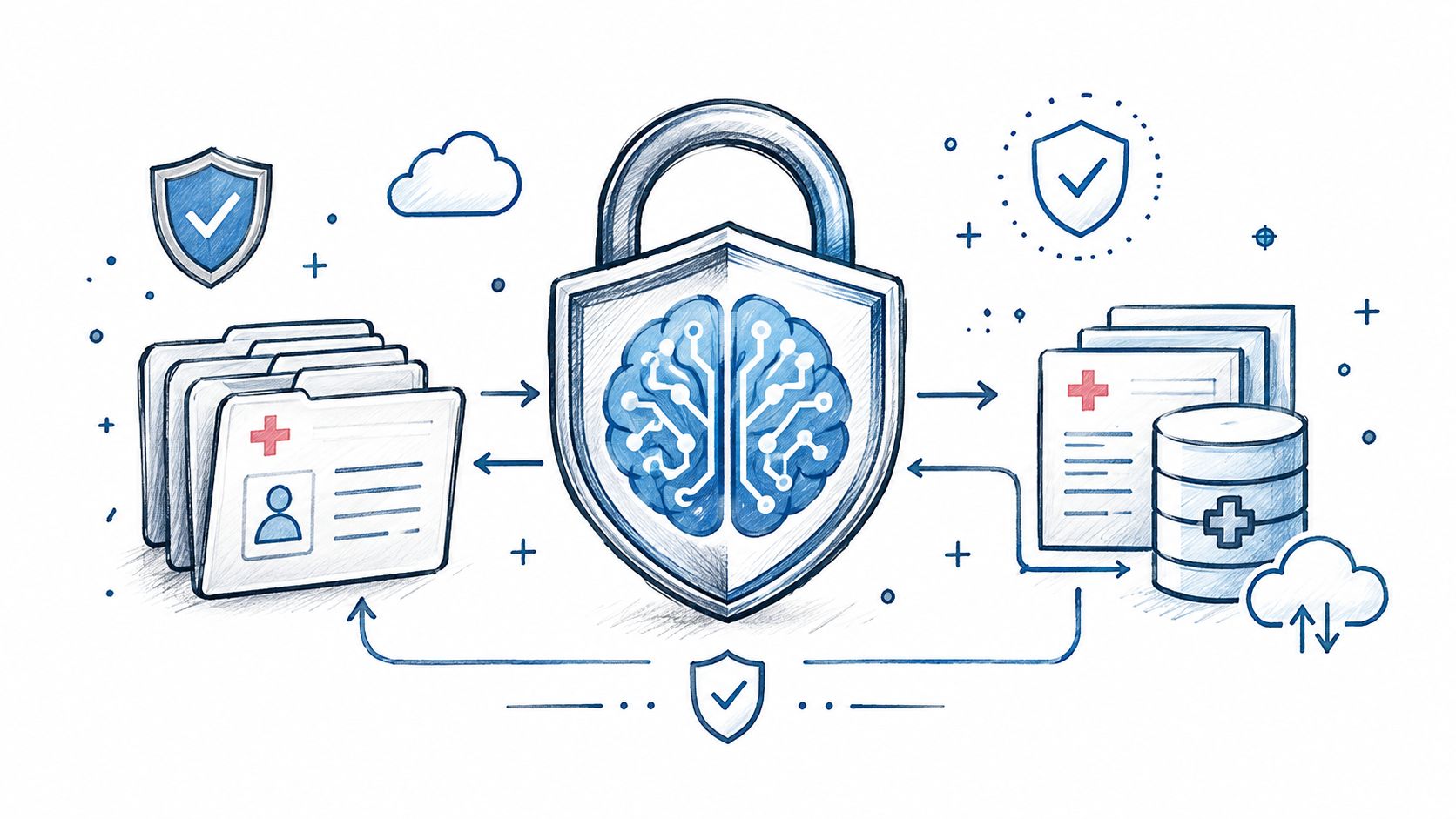
HIPAA-Compliant AI: How to Use LLMs With PHI Safely
How to build HIPAA-compliant AI: when LLM providers need a BAA, data minimization, de-identification, audit controls and a reference architecture.
October 16, 2026Read more
Unlock transformative growth with Healthcare AI Enablement Services. This guide covers strategy, data, ROI, and vendor selection for healthcare leaders.

Healthcare leaders no longer need convincing that AI matters. They need a way to make it work inside real care delivery, real compliance boundaries, and real operating constraints.
That urgency is hard to ignore when the global AI in healthcare market was valued at $22.4 billion in 2023 and is projected to reach $208.2 billion by 2030, with a 36.1% CAGR, while healthcare organizations are deploying AI at 2.2x the rate of the broader economy (Open and Affordable). The strategic question is no longer whether AI belongs in healthcare. It is whether your organization can operationalize it faster, more safely, and more effectively than peers.
Most organizations do not fail because they picked the wrong demo. They stall because implementation in healthcare is never just a model problem. It is a workflow problem, a governance problem, an interoperability problem, and often a trust problem.
Healthcare AI enablement services bridge the distance between a promising use case and a production system that clinicians, operators, compliance teams, and finance leaders will accept. Good enablement is not abstract innovation theater. It is the practical work of aligning goals, preparing data, selecting the right model approach, integrating with EHR and revenue systems, and managing adoption without disrupting care.
The difference between an AI pilot and an AI capability usually comes down to execution discipline. In my experience, organizations that treat enablement as a strategic function make better decisions earlier. They choose narrower initial use cases, define success more clearly, and avoid expensive detours.
Healthcare leaders are making AI decisions in a market that is expanding fast. The AI in healthcare market reached $22.4 billion in 2023 and is projected to reach $208.2 billion by 2030, with healthcare organizations deploying AI at 2.2x the rate of the broader economy (Open and Affordable). That finding changes how leaders should think about timing. Waiting for the market to settle often means giving competitors time to build implementation muscle, governance habits, and frontline trust that are hard to catch up to later.
A true competitive advantage is no longer mere interest in AI. It is the ability to turn a valid use case into a working capability inside a regulated care environment.
That sounds obvious, yet many health systems and digital health companies get stuck here. Executive teams often agree on the target areas. Ambient documentation, prior authorization support, patient access, coding, denial prevention, care management, staffing coordination. The friction starts when those priorities have to fit existing workflows, compliance review, EHR constraints, data quality issues, and clinical accountability.
In practice, the hard part is rarely choosing a model in isolation. The hard part is deciding where AI should sit in the workflow, who owns the decision if the output is wrong, how exceptions are handled, and whether the tool saves time for frontline staff or adds another layer of review.
Those are operating model decisions, not just technology decisions.
That is why AI adoption in healthcare tends to separate into two groups. One group buys tools and accumulates pilots. The other builds a repeatable method for prioritization, governance, integration, measurement, and change management. The second group usually learns faster, scales earlier, and wastes less budget on experiments that never survive contact with real operations.
A focused approach to Healthcare AI Services helps close that gap. It gives leaders a practical structure for connecting board-level goals, such as margin improvement, access expansion, clinician retention, and quality performance, to the implementation work required on the ground.
Healthcare does not reward rushing unsafe systems into production. It does reward organizations that can evaluate, approve, deploy, and refine useful AI applications without letting every decision stall in committee.
The strongest programs I have seen start narrower than leadership expects. They pick one workflow with clear pain, available data, measurable value, and an acceptable risk profile. Then they prove three things quickly. The tool fits the workflow. Staff will use it. The organization can govern it without creating new operational drag.
That approach creates an advantage that compounds in practical ways. Teams gain a reusable review process. Security and compliance groups stop reinventing the same assessment. Clinical leaders become more willing to sponsor the next use case because they have seen one succeed under real conditions.
Healthcare leaders can also borrow lessons from adjacent governance-heavy functions. The discipline described in navigating AI ethics, EPPA compliance, and human resources risk management is not a direct template for clinical AI, but the underlying point holds. AI programs scale more safely when risk ownership, review criteria, and escalation paths are defined before deployment.
Competitive advantage in healthcare AI comes from disciplined execution. Organizations that can select the right use case, implement it cleanly, and prove business and clinical value will outperform organizations that stay stuck in evaluation mode.
Most vendors use the word “enablement” loosely. In practice, healthcare AI enablement services are not a feature set. They are a delivery model.

If buying a standalone AI product is like purchasing a pallet of high-end building materials, enablement is hiring the architect, construction crew, electricians, inspectors, and site manager needed to build a new clinical wing that passes inspection and serves patients.
That distinction matters. Healthcare organizations do not just need tools. They need a way to decide what to build, how to integrate it, who owns risk, and what success looks like after go-live.
An effective enablement partner typically works across several layers at once:
This is why enablement should be viewed as an operating model, not a one-time installation.
It is not merely:
Those moves can all be part of the journey, but none of them alone qualifies as healthcare AI enablement.
A second misunderstanding is treating healthcare AI as purely a technical domain. It is not. Legal, HR, compliance, and operational leaders often shape whether a deployment succeeds. For teams thinking about policy guardrails more broadly, this discussion of navigating AI ethics, EPPA compliance, and human resources risk management is useful because it reflects the same underlying truth. AI governance breaks down when organizations isolate it inside IT.
Healthcare AI enablement services create shared accountability. Instead of a vendor handing off software and waiting for support tickets, the partner helps define the roadmap, pressure-test the workflow, and sequence deployment in a way the organization can absorb.
That matters most in healthcare because one bad implementation can poison trust for the next three good ideas.
Key distinction: A product answers, “What does the tool do?” Enablement answers, “How do we make this useful, safe, integrated, and sustainable in our environment?”
That is the difference executives should evaluate when they assess partnership options.
Healthcare organizations that scale AI well usually build operating discipline before they expand model usage. In consulting work, I often see teams start with a promising pilot and then stall because ownership, governance, or workflow fit was never settled.

These six pillars give leaders a practical way to connect enterprise goals to implementation decisions. That matters because board priorities such as margin protection, access, clinician retention, and quality do not fail at the strategy slide. They fail in the handoff to operations.
The first pillar is problem selection.
Organizations get better results when they rank AI opportunities against business impact, clinical sensitivity, workflow ownership, data readiness, and decision risk. In practice, this means asking harder questions earlier. Which team will own the workflow? What metric should improve within the first quarter after launch? What level of human review is required? Which use case can survive contact with real staffing constraints?
The central trade-off is ambition versus proof. A wide AI portfolio can satisfy executive curiosity, but a tightly scoped first deployment usually earns trust faster. In healthcare, trust is the limiting factor more often than model capability.
A library of real-world use cases can help teams compare options against actual workflow conditions instead of abstract AI potential.
Data readiness determines how much rework the organization will absorb later.
Many health systems assume the data problem is volume. It is usually reliability. Source systems conflict. Key fields are missing. Timestamps do not line up with workflow reality. Unstructured notes carry the context, but operational systems still depend on coded fields.
Before any build begins, teams should answer a short list of operational questions:
For clinical use cases, the work often spans EHR data, document streams, imaging context, and workflow events. For operational use cases, it may involve scheduling, coding, claims, call center, and prior authorization data. The point is not to perfect the entire estate. It is to establish whether the target use case has enough signal to support a safe and useful workflow.
Governance sets the boundaries of safe use.
In healthcare, governance decisions shape architecture, approval paths, user permissions, audit design, and monitoring plans long before launch. Teams that treat governance as a final checkpoint usually discover expensive redesign issues late in the process.
A workable governance model defines:
This is also where leaders should distinguish assistive AI from decision-support systems that carry higher operational and regulatory scrutiny. That distinction affects deployment speed, stakeholder involvement, and the amount of validation required before production use.
Model selection should follow the workflow, not the other way around.
Some healthcare use cases need custom modeling. Many do not. I have seen teams overinvest in model development when the primary bottleneck was retrieval quality, business rules, interface design, or poor exception handling. A simpler stack often performs better because it is easier to monitor, explain, and maintain.
A practical architecture may include:
The trade-off is straightforward. Custom systems can match a workflow more closely. Standardized tools usually reduce time to value and operational burden. Strong enablement teams make that choice based on outcome requirements, not engineering preference.
Integration determines whether AI changes work or stays separate from it.
McKinsey notes that modular healthcare AI architectures and HL7 FHIR-based connectivity can reduce implementation friction by making it easier to connect AI capabilities to core systems over time (McKinsey). That matters in environments where the EHR, revenue cycle platforms, contact center tools, and departmental applications all hold part of the workflow.
The practical question is simple. Can the AI system fit into the actual point of work without forcing users to swivel between tools, re-enter data, or create side processes?
For some organizations, this layer also requires strong custom healthcare software development to build adapters, orchestration logic, workflow-specific interfaces, and controls that off-the-shelf products do not provide.
Tip: If a vendor cannot explain how data moves between the AI layer, the EHR, and the operational system of record, you are evaluating a demo, not an implementation plan.
Adoption is operational, not cosmetic.
Clinicians, coders, revenue teams, and service line operators will use AI when it saves time, reduces friction, and produces outputs they can verify. Announcements do not create adoption. Reliable workflow improvement does.
The strongest programs train people by role and decision point. They identify who can act on the output, who must review it, what happens when the system is wrong, and when the fallback process takes over. That level of specificity prevents a common failure pattern: a technically sound system that staff bypass because the accountability model is unclear.
These six pillars work together because healthcare AI succeeds only when strategy, workflow, controls, and delivery choices line up. That is the bridge many organizations need. Executive intent has to connect to frontline execution, or the initiative stays stuck at pilot stage.
ROI conversations in healthcare often go wrong in two ways. Some teams make the case too narrowly and focus only on labor reduction. Others make it too broadly and promise transformation before the workflow has proven itself.
The better approach is to measure value across four lanes: throughput, revenue integrity, clinical support, and workforce experience.

Not every use case is equally measurable. Revenue cycle and documentation are attractive first targets because they produce visible operational signals.
The revenue cycle is already a lower-risk AI opportunity, with 24% of healthcare organizations adopting AI for claims adjudication and coding, while ambient speech technology is used by 79% of organizations to support clinical documentation (Menlo Ventures).
Those adoption patterns are instructive. They show where leaders are finding enough confidence to move beyond curiosity. In both cases, the work is repetitive, high-friction, and easier to monitor than more autonomous clinical use cases.
A sound ROI model should include questions like these:
Here, models like AI Automation as a Service can fit. The value is often less about replacing staff and more about removing rework, reducing queue buildup, and improving readiness for the next task in the chain.
Three things often get mislabeled as value:
Those signals are useful, but they are not enough.
Key takeaway: The most credible healthcare AI business case links one use case to one operational bottleneck, one accountable owner, and one measurement plan that finance and operations both accept.
That discipline matters more than inflated projections. If a system improves documentation quality but slows clinician review, it has not produced net value. If a coding assistant improves suggestions but creates audit uncertainty, the ROI story is incomplete.
In healthcare AI enablement services, the intensive win is not “AI adoption.” It is validated improvement in the flow of care, cash, and staff effort.
A strong roadmap makes AI adoption feel manageable because it turns a broad transformation topic into a sequence of decisions. The most effective healthcare AI enablement services do this in phases, each with a clear owner and exit criteria.
The first phase is about choosing where to act, not rushing to build.
In the opening weeks, leadership teams should align on the business objective, workflow target, data dependencies, and risk level. That usually involves AI requirements analysis, stakeholder interviews, and focused AI strategy consulting to avoid picking a flashy use case with poor implementation conditions.
A useful output at this stage is a shortlist of use cases ranked by feasibility, impact, workflow fit, and governance complexity. For organizations that want a structured starting point, a Custom AI Strategy report can serve as an initial decision artifact.
The mistake to avoid is trying to approve three or four pilots at once. One high-value pilot with clear ownership is usually more productive than a broad portfolio of partially defined ideas.
This phase should focus on one use case with visible operational pain and manageable clinical risk.
Good pilot candidates often sit in documentation, intake, coding support, prior authorization workflows, or internal staff copilots. The goal is not to prove that AI can generate output. That is already obvious. The goal is to validate whether the output improves a real workflow under real constraints.
During pilot design, teams should define:
One useful external reference for teams structuring this stage is SAI’s Artificial Intelligence Enablement Playbook, which is helpful as a general implementation lens.
Once the pilot has demonstrated operational value, the intensive engineering work starts. This is the point where many programs discover that the model was the easiest part.
Scaled integration means embedding the capability into production systems, approval flows, audit processes, and frontline interfaces. That often includes routing logic, role-based access, monitoring, prompt management, and exception handling.
This is also where an AI Product Development Workflow becomes critical. Without a structured delivery motion, organizations end up with brittle handoffs between strategy, data, engineering, security, and business owners.
The practical questions in this phase are concrete:
After go-live, mature programs shift from implementation to portfolio management.
They monitor output quality, workflow impact, user behavior, and edge cases. Then they decide whether to refine the current use case or extend into adjacent workflows. This is also where organizations often invest in internal tooling to support prompt governance, review queues, analytics, or domain-specific staff interfaces.
A single successful deployment can also become a pattern. Once the organization has a repeatable architecture, review model, and change process, expansion gets easier.
Tip: Expansion should follow workflow adjacency, not executive enthusiasm. If one AI use case succeeds in a given process, the next candidate should usually sit next to it, share data dependencies, or reuse the same governance pattern.
That phased approach is less glamorous than a sweeping AI announcement. It works better in healthcare because it respects operational reality.
Choosing a partner for healthcare AI enablement services is not the same as buying software. You are selecting a team that will influence architecture, workflow design, governance, and operational trust.
That means the evaluation should go beyond feature lists and sales demos.
Healthcare domain fluency matters because generic AI competence is not enough. A strong partner should understand how clinical workflows, compliance reviews, revenue operations, and interoperability constraints affect delivery decisions.
They should also be comfortable working across business and technical layers at the same time. If a partner can only speak to engineers, or only to executives, important implementation issues will surface too late.
Another signal is whether they can explain how they move from strategy to deployment. A defined AI Product Development Workflow is often a better indicator of delivery maturity than a long list of possible use cases.
| Criteria | Why It Matters | Key Questions to Ask |
|---|---|---|
| Healthcare workflow expertise | AI fails when it ignores how clinicians, operators, or billers work | Which healthcare workflows have you supported end to end? |
| Interoperability capability | Integration determines adoption | How do you handle HL7 FHIR, EHR connectivity, and cross-system orchestration? |
| Governance approach | Risk ownership must be clear before launch | How do you define human review, auditability, and escalation? |
| Data readiness discipline | Poor source data undermines even strong models | How do you assess source quality and production readiness? |
| Build versus buy judgment | Not every use case deserves custom development | When do you recommend off-the-shelf tools instead of custom work? |
| Change management support | Adoption depends on frontline fit | How do you train users and monitor post-launch behavior? |
| Operating model fit | The partner must match internal team capacity | What responsibilities stay with our team, and what do you own? |
In procurement conversations, three warning signs appear repeatedly:
A good HealthTech engineering partner should be able to talk through trade-offs. Not just what is possible, but what should wait, what should be piloted, and what should not be automated yet.
Practical advice: Ask potential partners to walk through one use case from intake to production support. If they cannot explain ownership, integration, review logic, and adoption planning in sequence, they are probably selling capability they have not operationalized.
The right partner does not reduce complexity by pretending it is simple. They reduce it by managing it well.
Yes, but the approach has to be narrower and more disciplined. Smaller organizations usually benefit from a focused use case, lighter governance structure, and clear operational ownership rather than a broad AI roadmap.
That is consistent with work from the Health AI Partnership, which supports under-resourced organizations through practical frameworks and best practice guides, showing that successful implementation is possible without massive internal teams (Healthcare IT News).
For smaller clinics or community providers, the smart move is usually to start with one operational bottleneck and one workflow owner.
A product purchase solves a narrower problem. Enablement addresses the surrounding conditions that determine whether any AI system works inside your environment.
If you are evaluating regulated clinical applications, SaMD solutions may be part of the answer. But they do not replace the need for workflow design, data preparation, governance, integration, and adoption planning across the rest of the organization.
That is why leaders should evaluate the full operating context, not just the product category.
The best first use cases tend to share a few traits. They create visible friction, rely on accessible data, and allow meaningful human oversight.
Examples often include documentation support, coding assistance, intake summarization, internal staff copilots, or administrative workflow orchestration. In contrast, highly autonomous clinical decision flows usually require more maturity, stronger governance, and tighter evidence thresholds before scale.
Early governance should be practical, not bloated.
Teams need clarity on who approves the use case, what data can be used, how output is reviewed, when humans must override or verify, and how changes are logged. If those basics are not defined, rollout will be slower later because trust and accountability will remain unclear.
Most organizations need a mix. Buy when the workflow is common and the product fit is strong. Build when the workflow is differentiated, integration is complex, or control requirements are unusually high.
In the article body, one option among many is Ekipa AI, which provides strategy, use case discovery, and execution support for organizations moving from AI planning into deployment. The main question is not vendor preference. It is whether the operating model fits your internal capacity and risk profile.
Scale after the first use case shows durable value in live workflow, not just promising output in testing.
That means the organization has a stable review process, working integration, an accountable owner, and evidence that users are relying on the system in a controlled way. At that point, adding adjacent use cases becomes much more realistic.
Start with a use case decision, not a platform decision.
Clarify the bottleneck, the owner, the workflow, the risk level, and the data dependencies. Then evaluate partners who can bridge strategy and execution without oversimplifying healthcare realities. If you want to assess fit, capabilities, and delivery approach, connect with our expert team.
If your organization is trying to connect AI ambition to operational execution, Ekipa AI can help frame the right use cases, shape a practical roadmap, and support delivery decisions that fit healthcare workflows, governance needs, and internal team capacity.
How to build HIPAA-compliant AI: when LLM providers need a BAA, data minimization, de-identification, audit controls and a reference architecture.

Practical data migration planning guide for healthcare teams. Scope, mapping, compliance, validation, cutover and rollback decisions explained end to end.

Smart on FHIR guide for healthtech engineers. Learn the OAuth 2.0 launch model, scope syntax, backend services, and US regulatory requirements.
Connect with our team to explore how AI expertise can transform your business.