AI in Healthcare
HIPAA-Compliant AI: How to Use LLMs With PHI Safely
How to build HIPAA-compliant AI: when LLM providers need a BAA, data minimization, de-identification, audit controls and a reference architecture.
October 16, 2026Read more
Unlock the future of care with healthcare AI transformation services. Our guide details key strategies, use cases, and how to partner for scalable impact.

When people talk about healthcare AI transformation services, they're not just talking about plugging in a new piece of software. It’s a complete reimagining of how a healthcare organization works, using artificial intelligence to fundamentally improve everything from patient care to back-office administration.
Think of it less as a one-off tech purchase and more as a deep, strategic partnership. The goal is to weave AI into the very fabric of your operations to create a system that is smarter, faster, and more attuned to the needs of both patients and clinicians.

Let's be honest: the healthcare industry is straining under immense pressure. Administrative overhead is ballooning, accounting for nearly 30% of all U.S. healthcare spending. At the same time, clinicians are facing unprecedented levels of burnout, and operational logjams are slowing down care delivery.
AI has graduated from a buzzword to a practical tool that can directly address these challenges. Because of this, the conversation among hospital and health system leaders has shifted. It’s no longer if they should bring in AI, but how to do it right. This is precisely the problem healthcare AI transformation services are designed to solve.
It's easy to get distracted by shiny new AI tools for business, but a true transformation goes much deeper. It involves a top-to-bottom strategic effort to deliver tangible results, not just new dashboards. This is a journey best taken with a dedicated HealthTech engineering partner who knows the intricate, and often unforgiving, landscape of medicine.
Together, the aim is to build a healthcare system that is:
The integration of AI into healthcare operations is a progressive evolution, not a single event. Advancing AI adoption requires a deliberate approach that aligns technology with each organization’s readiness and strategy, ensuring that as maturity grows, so does the value delivered.
Simply put, the old way of doing things is becoming unsustainable. Chronic staffing shortages and a constantly shifting web of compliance rules mean providers and payers can't grow without costs spiraling out of control. AI provides a direct path to break this cycle by automating repetitive work and sharpening clinical and operational decision-making.
As we explored in our AI adoption guide, getting the strategy right is everything. The numbers speak for themselves. For health insurers, AI-powered systems can slash administrative costs by $150 million to $300 million for every $10 billion in revenue by optimizing tasks like claims processing and member services.
Ultimately, this is about turning a flood of data into clear, actionable intelligence and embedding that intelligence into every workflow. It’s about creating a future where technology works alongside human experts, giving them the tools they need to achieve better patient outcomes and build a more resilient healthcare model. Embracing healthcare AI transformation services is the first step in making that future a reality.

When people hear "AI transformation," their minds often jump to futuristic robots roaming hospital hallways. But the reality is far more practical. Think of it less like science fiction and more like building a smart, modern city. You can't just drop in skyscrapers; you first have to lay the roads, power grids, and plumbing. Healthcare AI transformation services follow the same principle: methodically building essential infrastructure and then layering intelligent systems on top.
It's a journey, not a one-off project. The goal is to evolve from disconnected legacy systems into a fully connected, predictive, and automated ecosystem. This means moving beyond isolated AI experiments and weaving intelligence directly into the fabric of your core workflows, always with a sharp focus on real-world business value.
Before any algorithm can predict a single patient outcome, the groundwork has to be perfect. This is where a genuine transformation starts, by focusing on the core components that make intelligent operations possible. A comprehensive approach addresses this from the ground up.
The key pillars include:
A successful AI transformation is built on a structured, iterative approach. It starts with identifying a clear, high-value problem and then architecting a solution that integrates seamlessly into the organization's daily reality, ensuring adoption and measurable results.
With a solid foundation in place, the focus shifts to activating all that potential. This is where the true value of healthcare AI transformation services becomes tangible, as the insights generated by AI start driving better decisions and automating tedious work.
This activation stage is all about putting intelligence into action. It’s about creating systems that empower your people, augmenting their skills rather than just trying to replace them.
Services in this phase often include:
This end-to-end approach guarantees that AI isn't just an interesting concept. It becomes a practical, working asset that delivers measurable gains in efficiency, cost savings, and, most importantly, patient care.
Forget the far-off, futuristic promises of AI. The most powerful case for AI in healthcare isn't about what could happen—it's about the tangible results being delivered today. These aren't just experimental pilots anymore. We're talking about proven solutions generating immediate, measurable value across the entire healthcare system, from the front lines of patient care to the engine room of the back office.
The secret isn't some grand, all-encompassing AI strategy. The organizations winning with AI are the ones who start small and focused. They pinpoint specific, high-friction processes and target them with dedicated AI tools. This could be anything from a sophisticated algorithm that helps doctors spot disease to a simple bot that liberates staff from mind-numbing paperwork.
By focusing on these practical applications, health systems can build momentum, show a clear return on investment, and make a compelling case for wider adoption. Let's look at some of the real-world use cases that are actively reshaping the industry.
In the clinical world, AI is becoming an invaluable partner for doctors and nurses. It helps them make faster, more informed decisions while clawing back time previously lost to administrative tasks. The biggest impacts are being felt in diagnostics and the development of intelligent medical software.
Here are a few key examples:
One of the most valuable tools in this space is Clinical NLP. This technology is finally unlocking the wealth of information trapped in unstructured clinical notes, turning disorganized text into structured, actionable data for better care and research.
If you're looking for the fastest return on your AI investment, the administrative back office is the place to start. This is where operational bottlenecks and hidden costs pile up. By applying intelligent automation, hospitals are achieving truly dramatic efficiency gains.
The data shows this isn't a niche trend—it's a full-blown movement. Analysis showed that by 2024, an incredible 71% of U.S. non-federal acute-care hospitals had already integrated predictive AI into their EHRs. The adoption for administrative tasks has been particularly explosive. The use of AI for billing automation, for instance, jumped +25 percentage points to reach roughly 80% of hospitals using AI, while scheduling tools saw a +16 point increase.
"The quickest path to realizing value from AI in healthcare is to automate the work that is repetitive, rule-based, and high-volume. By taking administrative friction off the table, you free up your most valuable resource—your people—to focus on patient care."
This is precisely where you can see immediate results. Instead of building a massive internal team from scratch, you can zero in on specific administrative headaches right away.
Some of the most common high-value use cases include:
These Healthcare AI Services deliver more than just cost savings. By removing the daily operational sludge, they directly improve patient throughput and boost staff morale, creating a better experience for everyone.
A successful AI transformation in healthcare isn't something that just happens. It's the result of a deliberate, phased approach that moves from a smart idea to a flawlessly executed reality. Without a clear map, organizations often find themselves funding scattered projects that never quite deliver the value they promised. This roadmap breaks the journey down into manageable steps, offering a practical playbook for leaders to implement their vision with confidence.
Taking on this kind of change is a major commitment, but the payoff can be huge. The optimism is palpable—a staggering 92% of healthcare executives expect AI to give them a significant competitive edge. This isn't just wishful thinking; 68% anticipate a moderate-to-high return on their investment. It's part of a larger movement, with 65% of U.S. organizations already rethinking their entire business model around generative AI.
This momentum is backed by serious investment, with projected spending expected to hit $1.4 billion in 2026, tripling 2025's figures and paving the way for new market leaders. You can dive deeper into these numbers by checking out the full KPMG GenAI report.
To navigate this journey effectively, we've broken it down into a clear, four-phase plan. Think of it as building a house: you need a blueprint and a solid foundation before you can start putting up the walls.
This table provides a high-level overview of the entire process, outlining the distinct phases, their primary goals, and the essential activities involved.
| Phase | Key Objective | Critical Activities | Ekipa AI Enabler |
|---|---|---|---|
| Phase 1: Strategy | Identify high-impact, achievable AI opportunities that align with core business goals. | Analyze workflows, prioritize use cases, and define clear success metrics. | Custom AI Strategy report |
| Phase 2: Foundations | Build the secure data infrastructure and governance framework necessary for AI. | Establish data governance policies (HIPAA), unify data sources, and create a modern data platform. | Expert AI strategy consulting |
| Phase 3: Development & Integration | Develop, test, and integrate pilot AI solutions into existing workflows. | Build models, run small-scale pilots on high-priority use cases, and integrate with EHR/billing systems. | AI Product Development Workflow |
| Phase 4: Scale & Change Management | Roll out proven solutions across the organization and ensure widespread user adoption. | Train staff, monitor performance, gather feedback for continuous improvement, and manage the human side of change. | Guidance on real-world use cases |
Each phase builds on the last, creating a structured path that minimizes risk and maximizes the chances of a successful, organization-wide transformation.
The first, and frankly most important, step is to figure out where to focus. You can't solve every problem at once. The goal here is to pinpoint the opportunities that promise the highest return and solve your most pressing challenges, whether clinical or administrative.
This requires a deep dive into your existing workflows to find the points of friction, high costs, or inefficiency. It’s about asking the hard questions and being honest about where the biggest logjams are. The result should be a clear, prioritized list of initiatives that will become the backbone of your AI journey.
This simple chart shows how organizations typically find value, applying AI across diagnostics, back-office administration, and research.

As you can see, a well-planned journey doesn't just focus on one area. It targets different parts of the operation to ensure the benefits are felt across the board.
Once you know what you want to do, it's time to build the foundation. An AI model is only as smart as the data it learns from, and in healthcare, that data must be handled with the utmost care. This phase is all about two things:
This groundwork is absolutely non-negotiable. Trying to build AI on a shaky data foundation is one of the most common reasons projects never get out of the pilot phase.
Now for the exciting part: you can start building. The key here is to be agile and iterative. Forget about a massive, "big bang" launch. The smart approach is to start with small pilot projects to prove the concept, demonstrate value, and build momentum.
The core activities in this phase include:
After a pilot project proves its value, the final step is to scale it across the wider organization. This is where many initiatives stumble, because it's not just a technical problem—it's a human one. Managing the change is absolutely critical for getting people to actually use the new tools.
A successful AI rollout is as much about people as it is about technology. Clear communication, comprehensive training, and celebrating early wins are essential for getting teams on board and turning initial resistance into enthusiastic adoption.
This final phase is about training your staff, keeping a close eye on the performance of the new system, and constantly refining it based on real-world use. By following this structured roadmap, you can de-risk your investment and ensure your healthcare AI transformation services deliver real, sustainable value. This is how you build an organization that isn't just dabbling in AI, but is truly powered by it.
In most industries, a faulty AI model might cost you a sale or skew your inventory forecast. In healthcare, the consequences are measured in human lives and the fragile trust between a patient and their doctor. This is why getting compliance and security right isn't just a step in the process—it's the entire foundation of any healthcare AI transformation services project.
Every single AI tool that interacts with patient data has to be built with an obsessive focus on privacy and regulation. There's no room for error. You can't bolt on compliance at the end; it has to be baked in from the very beginning. As you innovate, you must remain absolutely committed to protecting the people you serve.
In the United States, the Health Insurance Portability and Accountability Act (HIPAA) is the rulebook. When you introduce AI, interpreting that rulebook becomes far more complex. It's no longer just about encrypting a database. Now, you have to think about every single point where data moves—from the initial data pull for training a model to the final recommendation an AI tool makes.
A crucial tactic here is rigorous data anonymization and de-identification. Before any patient information ever sees an algorithm, all personally identifiable information (PII) must be completely scrubbed. The goal is a dataset that’s statistically rich for training but makes it impossible to trace any piece of data back to a specific person. This isn't just a good idea; it's a non-negotiable step for any responsible AI development in medicine.
True compliance in healthcare AI isn't a feature you add at the end; it's a principle embedded in the design from the very first line of code. It requires a partner who understands that security-first development isn't just best practice—it's the only way to operate.
This is where having a team that lives and breathes custom healthcare software development is critical. An expert partner knows how to build secure cloud infrastructures and data pipelines that are compliant by design, not by chance.
But it's not just about the letter of the law. You also have to clear some critical ethical hurdles. For a doctor or a patient to ever trust an AI’s recommendation, they have to understand how it got there. This is the whole point of Explainable AI (XAI).
A "black box" algorithm that spits out a diagnosis with zero context is clinically useless—and frankly, dangerous. An XAI system, on the other hand, acts like a helpful colleague. It might highlight the exact spots on a medical image or the specific lab values in an EHR that led it to a conclusion, allowing the clinician to use their own expertise to confirm or question the finding.
Just as important is the ongoing battle against algorithmic bias. AI models are only as good as the data they learn from. If that data reflects existing biases in society or gaps in medical history, the AI will not only learn those biases but can actually make them worse. To prevent this, any serious healthcare AI transformation services initiative must include:
Successfully navigating this challenging environment means finding a partner who is just as fluent in healthcare regulations as they are in AI. Our expert team brings this dual expertise to every project, ensuring your AI initiatives are as principled as they are powerful.
Picking a partner for your healthcare AI transformation services is probably the single most important decision you'll make in this entire process. The right one can shave years off your timeline and help you leapfrog competitors. The wrong one? Well, that's a recipe for expensive delays, cookie-cutter solutions, and pilots that never see the light of day.
Many of us have seen the old consulting playbook: long, costly engagements that end with a hundred-page report gathering dust. That model just doesn't work anymore. The approach today has to be faster, more agile, and focused on building real things from day one.
The pace of AI in healthcare is just blistering. In 2025, we saw adoption explode, with 22% of healthcare organizations rolling out specialized AI tools. That’s a staggering 7x jump from just 2024. This surge means healthcare is now deploying AI at 2.2x the rate of the general economy. If you're a leader in this space, you know that moving quickly is no longer optional. You can dig into these trends in the latest research from Menlo Ventures.
To keep up, you need a partner who operates at the speed of the market. This means ditching the old way of thinking and finding a partner that blends automated, platform-driven analysis with genuine human expertise. The best partners don't just give you advice; they hand you the tools and the talent to turn that advice into a working reality.
This new partnership model is built on three pillars:
At Ekipa AI, we designed our whole approach to sidestep the usual headaches of AI adoption. We start by using our platform to quickly pinpoint the highest-value opportunities in your organization, focusing on practical, real-world use cases that deliver a clear return on investment. Then, our team of experts gets to work.
The best AI partners act as an extension of your team. They bring not just algorithms and software, but a shared commitment to solving your specific problems and achieving your business goals.
Our structured AI Product Development Workflow ensures every project is planned and executed with precision. We have a clear process, whether we’re automating tedious administrative tasks with our AI Automation as a Service or developing a sophisticated new clinical decision support tool. You can see exactly how this framework operates in our post on the AI Product Development Workflow.
This blend of a powerful platform for speed and hands-on guidance from our expert team is what makes a successful AI initiative possible. It’s about more than just the tech—it's about having a true partner in your corner, one who is as committed to your success as you are.
The first step isn't about technology at all. It's about a clear-eyed diagnosis of your organization's biggest pain points. Too many initiatives fail because they start with the solution ("We need to use AI!") instead of the problem ("Our appointment no-show rate is costing us millions."). Before a single line of code is written, you have to pinpoint a specific business or clinical challenge. A thorough AI requirements analysis is the only way to begin. That’s precisely why we created our Custom AI Strategy report to help you zero in on those high-impact opportunities and ensure your first project is built for success.
You can't bolt on compliance at the end. It has to be baked in from the very first conversation. Adopting a "compliance by design" approach is non-negotiable in healthcare. This means building every step of the process around patient privacy and data security. This involves concrete actions like using fully de-identified or anonymized data whenever possible for training models, enforcing strict role-based access to sensitive information, and implementing end-to-end encryption. Your AI partner's AI Product Development Workflow should have built-in checkpoints to guarantee every stage meets or exceeds HIPAA standards.
You don't have to wait years. The trick is to start with "quick wins" that generate tangible value almost immediately. For example, deploying AI Automation as a Service to handle repetitive administrative tasks like billing or scheduling can show measurable cost savings and efficiency gains within just a few months. These smaller wins prove the value of AI, build crucial momentum, and secure the buy-in you need for larger, more ambitious clinical initiatives down the road.
Absolutely. In fact, trying to build a world-class AI team from scratch is often a distraction from your core mission. One of the main reasons to work with a firm specializing in healthcare AI transformation services is to get immediate access to top-tier talent without the immense cost and time sink of hiring them yourself. By working with our expert team, you get the strategists, data scientists, and engineers you need, precisely when you need them, allowing your own staff to stay focused on what they do best: providing exceptional patient care.
Ready to turn your AI vision into a reality? At Ekipa AI, we combine platform speed with human expertise to help you identify and execute high-impact AI opportunities. Get started with a tailored AI strategy in just 24 hours.
How to build HIPAA-compliant AI: when LLM providers need a BAA, data minimization, de-identification, audit controls and a reference architecture.

Practical data migration planning guide for healthcare teams. Scope, mapping, compliance, validation, cutover and rollback decisions explained end to end.
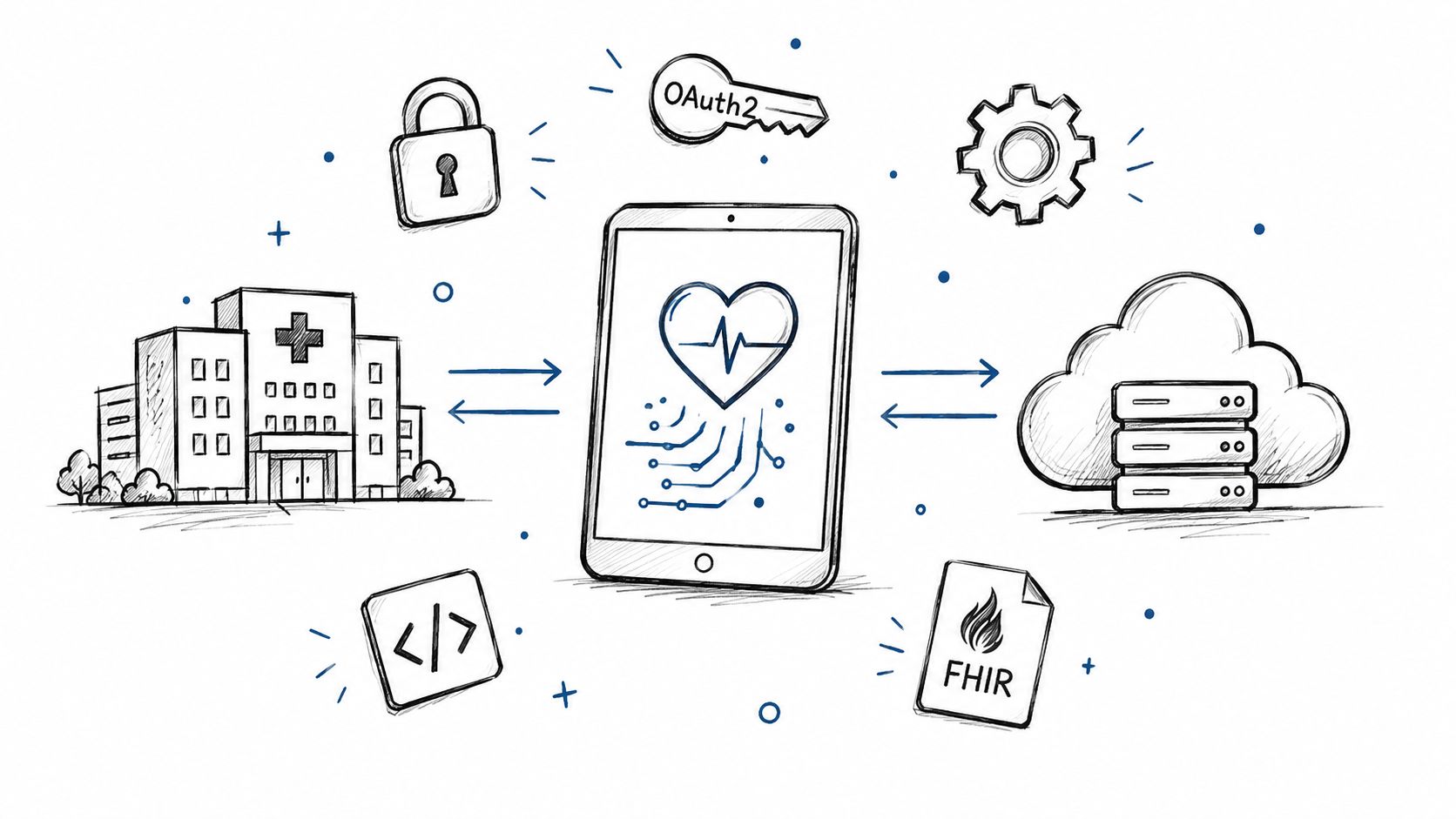
Smart on FHIR guide for healthtech engineers. Learn the OAuth 2.0 launch model, scope syntax, backend services, and US regulatory requirements.
Connect with our team to explore how AI expertise can transform your business.