
AI in Healthcare
HIPAA-Compliant AI: How to Use LLMs With PHI Safely
How to build HIPAA-compliant AI: when LLM providers need a BAA, data minimization, de-identification, audit controls and a reference architecture.
October 16, 2026Read more
A practical guide to healthcare automation using AI tools. Learn to identify opportunities, navigate compliance, and scale real-world solutions.

Let’s be honest: healthcare automation isn't some far-off idea anymore. It's the go-to solution for the real, pressing challenges hospitals and clinics face every single day. By handing off routine administrative and clinical tasks to smart AI tools, we’re freeing up our healthcare professionals to do what they do best: focus on patients. It's about giving human experts a major assist, not trying to replace them.
The healthcare industry is caught in a perfect storm. We're all feeling the squeeze from rising operational costs, ongoing staff shortages, and a seemingly endless increase in patient demand. The old way of doing things—relying on manual, often repetitive workflows—simply isn't cutting it anymore. This is exactly where artificial intelligence stops being a buzzword and starts being essential for survival and growth.
Intelligent automation directly tackles these problems. Think about it: instead of a skilled nurse or doctor getting bogged down in paperwork, an AI can manage patient scheduling, handle medical coding, or take care of initial data entry. This immediately frees up valuable time, allowing medical staff to get back to direct patient care, complex decision-making, and building the relationships that are at the heart of medicine.
A few key things are pushing this shift into high gear. First, the sheer amount of medical data we're creating is staggering. Between electronic health records (EHRs), lab results, and diagnostic images, it's more than any human team could possibly analyze on their own. AI algorithms, on the other hand, can sift through this data at incredible speeds, spotting patterns and insights that can lead to earlier diagnoses and more effective, personalized treatments.
And then there’s the money. The business case for automation is impossible to ignore. The global AI healthcare market has absolutely exploded, growing from $1.1 billion in 2016 to $22.4 billion in 2023. That's a mind-boggling 1,779% increase. Projections show this train isn't slowing down, with the market expected to hit $188 billion by 2030, thanks to a steady 37% compound annual growth rate. This isn't just hype; it's a reflection of the tangible value organizations are getting. For a closer look at how data drives these improvements, exploring comprehensive healthcare analytics solutions is a great next step.
Of course, you can't just automate everything at once. The smartest approach is to target the areas where AI can make an immediate and noticeable difference. By focusing on these high-impact domains first, you can build momentum, show a clear return on investment, and get everyone on board. As we break down in our guide on AI in the healthcare industry, picking the right starting point is everything.
"The goal of AI in healthcare isn't to create an autonomous system, but to build a collaborative one. It's about augmenting the capabilities of our best clinicians, giving them the tools to work faster, more accurately, and with greater focus on the patient in front of them."
To help you pinpoint where to start, I've put together a quick summary of the areas where AI-powered automation is already delivering huge wins.
These are the domains where intelligent tools are making the most significant difference right now, offering a clear path to value.
| Automation Area | Primary AI Application | Key Benefit |
|---|---|---|
| Administrative Tasks | Natural Language Processing (NLP) for medical coding and billing. | Reduces errors, accelerates revenue cycles, and cuts administrative costs. |
| Diagnostic Imaging | Computer vision algorithms to analyze X-rays, CT scans, and MRIs. | Speeds up diagnoses, improves accuracy, and prioritizes critical cases. |
| Patient Engagement | AI-powered chatbots for scheduling and answering common queries. | Improves patient access, reduces staff workload, and provides 24/7 support. |
| Personalized Medicine | Machine learning models to analyze genomic and clinical data. | Identifies optimal treatment paths and predicts patient responses to therapy. |
Starting with one of these proven use cases is a practical way to begin your automation journey and see meaningful results quickly.
So, where do you even begin with AI in healthcare? It’s tempting to get distracted by the latest and greatest technology, but the real starting point is much more grounded. Forget about the shiny objects for a moment and look for the biggest source of friction in your daily operations.
The best candidates for your first automation project are usually the tasks that make your team groan. Think about the mind-numbing, repetitive work that eats up hours every week—things like patient intake, appointment scheduling, wrestling with medical coding, or chasing down prior authorizations. These are the perfect "low-hanging fruit." They're essential, yes, but they create administrative logjams that pull your skilled staff away from what they do best: caring for patients.
Once you’ve brainstormed a list of potential pain points, it's time to get strategic. I’ve always found that a simple impact vs. complexity matrix works wonders here. Just map out each idea based on how much value it could deliver versus how difficult it would be to implement.
Your top priority should always be the projects that land in the high-impact, low-complexity quadrant. These are your quick wins. They build incredible momentum and prove the value of AI to everyone, from the front desk to the C-suite.
As you weigh your options, ask yourself these questions:
Thinking through these questions gives you a solid, data-backed foundation for your project. You can find some great parallel strategies for pinpointing these initial projects in guides on corporate training automation, which often face similar challenges in proving value early on.
This whole process is about turning a vague idea ("we should use AI") into a concrete plan. The flowchart below really drives this home, showing how today's pressures directly lead to specific AI solutions and, ultimately, better outcomes.
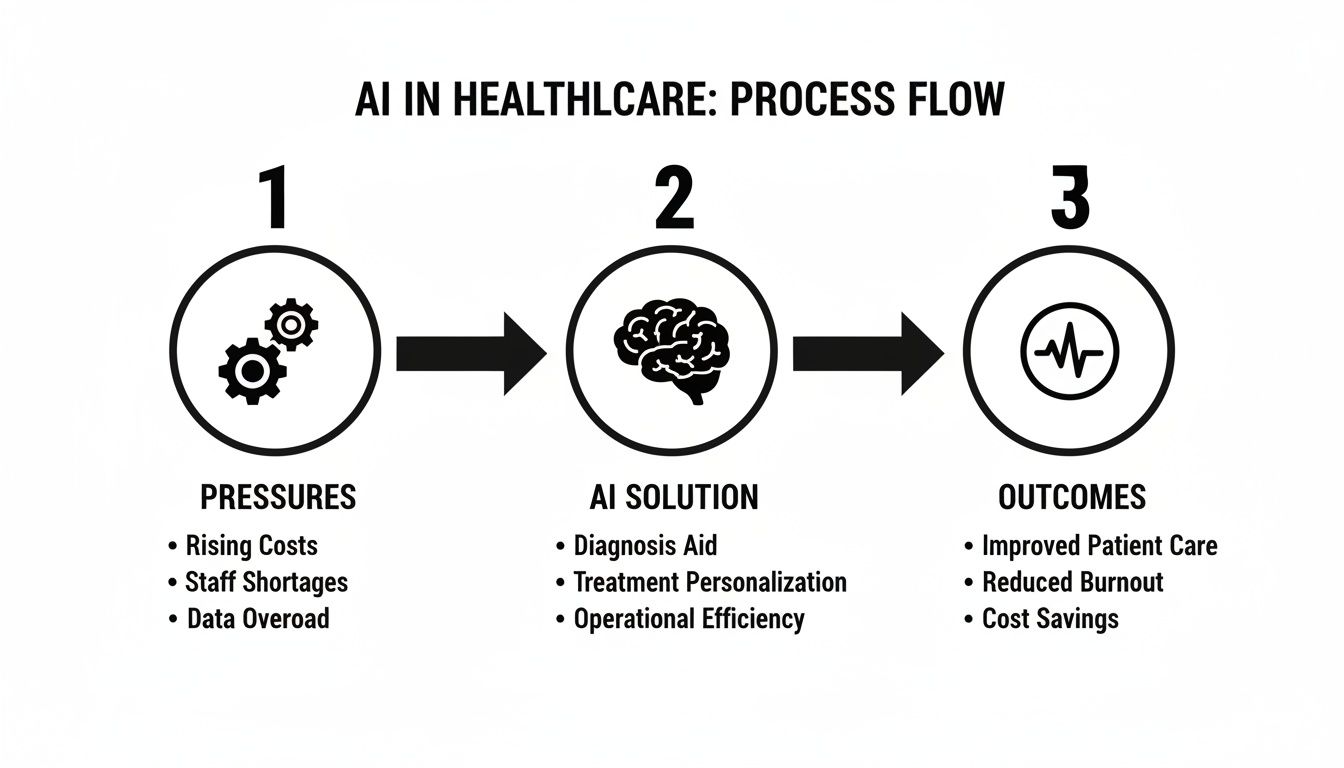
As you can see, successful AI isn't about chasing technology for its own sake. It’s a direct response to real-world operational challenges.
With your first project chosen, the next step is to get specific. You need to document the current workflow in detail—every step, every person involved. Then, define what the ideal future looks like with automation in place. What data will the AI need to work? What will its output be?
Having this clear blueprint is non-negotiable. It ensures that any solution you consider, whether you build it yourself or buy from a vendor, actually solves the problem you identified.
The good news is you're not alone. The healthcare sector is way ahead of the curve here. As of early 2025, an incredible 63% of healthcare professionals are already actively using AI. Another 31% are in the pilot or assessment phase. That brings total engagement up to 94%, a figure that absolutely dwarfs the roughly 50% adoption rate you see in most other industries.
By focusing on a single, high-impact project, you create a tangible proof of concept. This first success story becomes the foundation for building a broader, more ambitious automation strategy.
This approach takes the risk out of your investment and gives you a clear path forward. The goal is simple: start small, prove the value, and then build a culture where smart automation helps you continuously improve.
In healthcare, patient data is a double-edged sword. It's the fuel for incredible AI-driven innovation, but it's also a compliance minefield. When you bring healthcare automation using AI tools into the mix, you're not just processing information—you're handling protected health information (PHI), some of the most sensitive data on the planet. This responsibility is governed by a web of strict regulations that demand careful, proactive planning from the absolute start of any project.
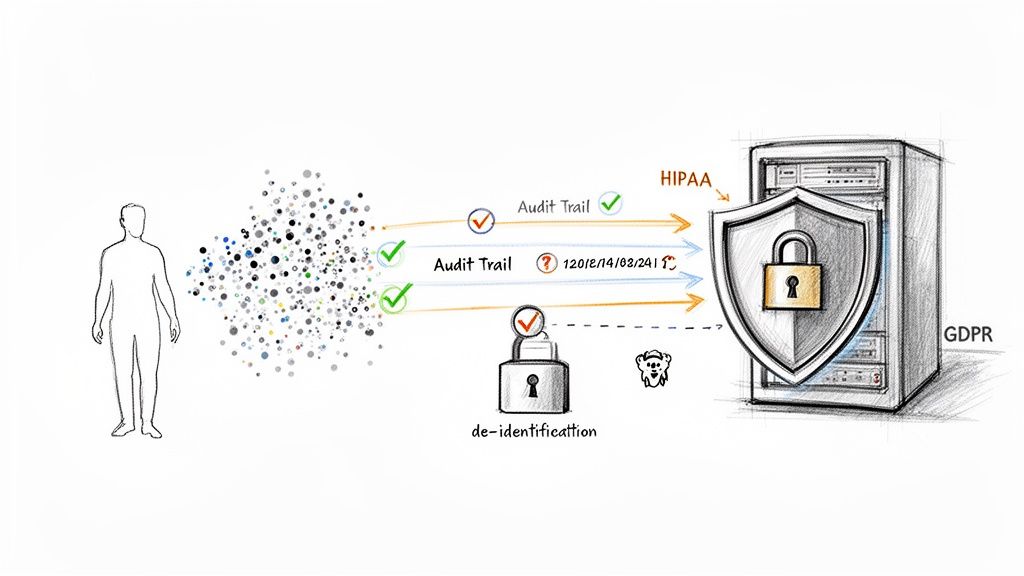
Getting this right isn't about just checking legal boxes. It's about building and maintaining trust with your patients. Every single automation project has to be built on a privacy-first foundation, which is a core tenet of effective AI strategy consulting. Security and compliance can't be bolted on at the end; they have to be woven into the very fabric of your AI systems.
Two major regulations typically set the rules of the road for healthcare data: the Health Insurance Portability and Accountability Act (HIPAA) in the United States and the General Data Protection Regulation (GDPR) in Europe. While their origins are different, their core principles overlap significantly when it comes to AI.
These rules don't just apply to your EHR system. They cover every piece of technology in your ecosystem, including the smart algorithms humming away inside your new automation tools. A proper AI requirements analysis absolutely must include a deep dive into compliance to avoid staggering fines and irreversible damage to your reputation.
Protecting patient data in an automated world requires a defense-in-depth approach. Simple encryption isn't nearly enough. You have to manage the entire data lifecycle with precision and accountability. This is where a rock-solid data governance strategy becomes non-negotiable.
One of the most powerful strategies is data de-identification, a process of stripping personal identifiers from health records. This allows AI models to learn from massive datasets without compromising individual privacy. The two main techniques you'll encounter are:
Beyond these methods, detailed audit trails are essential. You must be able to see exactly who accessed what data, when they did it, and why. This transparency is crucial for accountability and for figuring out what went wrong if there's ever a breach. Building these safeguards is a fundamental part of our AI solutions and should be for any custom healthcare software development project.
"In healthcare AI, trust is the ultimate currency. If patients don't believe their data is safe, the most advanced algorithm in the world is useless. Robust compliance isn't a barrier to innovation; it's the prerequisite for it."
Finally, compliance isn't just about security—it's also about the integrity of the data itself. An AI model is only as good as the data it’s trained on. If you feed it biased, incomplete, or just plain wrong data, you’ll get flawed algorithms that make inequitable or even dangerous clinical recommendations. It's your responsibility to ensure your data is clean, representative, and of the highest possible quality.
Just as important is getting explicit patient consent. Patients have a right to know how their data will be used in AI applications and must have a clear, easy way to opt in or out. This kind of transparency is the only way to maintain trust and stay true to both the letter and the spirit of privacy laws. Getting this framework right from the beginning, often with the help of an AI Strategy consulting tool, is the best way to set your project up for success.
The real magic of automation isn't about replacing your team; it's about giving them superpowers. Once you’ve pinpointed the high-impact projects and sorted out the compliance details, the next make-or-break step is to stitch your new AI tools into the very fabric of your daily operations. The goal here is a true partnership: technology handles the grunt work, freeing up your people for the complex decisions and patient care that matter most.
This is where the rubber meets the road—turning a promising AI concept into a practical tool that actually adds value.
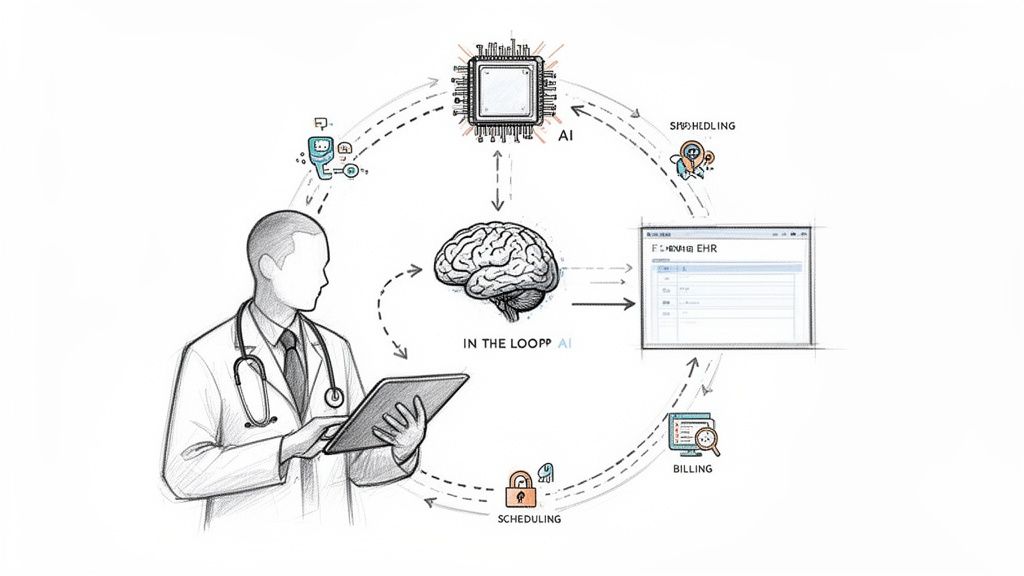
A central question you'll face is the classic "build vs. buy" debate. Honestly, the right answer is different for everyone. It comes down to your team's skills, your budget, and what you’re trying to achieve long-term.
You need to take a hard look at your internal capabilities and weigh them against what’s already available on the market. There's no one-size-fits-all solution, but thinking through these options will point you in the right direction.
Buying an Off-the-Shelf Solution: For common, well-understood problems, partnering with a vendor is almost always the faster, more cost-effective route. Think about tasks like automated medical coding, patient scheduling, or managing the revenue cycle. These are problems that specialized companies have already solved. For example, a tool like our Clinic AI Assistant can jump in and start handling administrative work almost immediately, saving you a long and expensive development cycle. You get to lean on the vendor's expertise and focus your energy on getting your team to adopt the tool, not build it from scratch.
Building a Custom Tool: This path makes sense when you're tackling a unique clinical problem or trying to create a genuine competitive advantage. If your workflow is highly specialized or proprietary, a pre-built tool probably won't cut it. Building something from the ground up requires a serious investment in time, talent, and money. But the payoff is a solution that’s perfectly tailored to your exact needs, giving you complete control.
In my experience, a hybrid approach often works best. You might buy a ready-made solution for billing and scheduling while your in-house team focuses on building a proprietary diagnostic algorithm that sets you apart.
Whether you build or buy, interoperability is non-negotiable. Your shiny new AI tool can't be an island. It absolutely must communicate seamlessly with your Electronic Health Record (EHR) system and any other software you rely on for billing, lab results, or patient messaging.
A lack of integration is the single most common reason promising AI projects fail. If a tool forces a clinician to constantly switch screens or manually copy-paste data, it's creating more work, not less.
Data has to flow smoothly and securely between systems. This means leveraging standards like HL7 and robust APIs to ensure information is shared in real-time. The AI should feel like a natural part of your core software, not some clunky, bolted-on accessory.
Getting an AI tool off the ground, whether you built it or bought it, requires a clear, structured plan. Mapping out the entire workflow ensures everyone—from IT to the C-suite to the front desk—is on the same page and helps you spot potential roadblocks before they become major problems.
A solid implementation plan usually involves these key stages:
A fantastic real-world example is an AI-powered diagnostic tool for radiologists. The AI doesn't replace the radiologist; it becomes their most valuable assistant. It scans images, flags potential issues, and bumps the most urgent cases to the top of the queue. The radiologist still makes the final call, but their workflow is faster and their attention is focused where it's needed most. This "human-in-the-loop" model is a perfect illustration of how thoughtful integration can boost both efficiency and accuracy.
Before you go all-in on a new AI tool across the entire organization, you need to prove it works on a smaller scale. This is where a pilot program comes in. It’s your chance to move from theory to practice, testing your assumptions in a real-world setting to see what sticks. A well-run pilot isn't just a test drive; it's how you build a rock-solid business case for moving forward.
The first step is picking the right sandbox to play in. You want a controlled, representative environment—maybe one specific department, a single clinical team, or even just one administrative workflow. The goal is to isolate the variables so you can get a clean "before and after" picture. If you try to pilot a tool across five different departments at once, you'll never know what actually worked and what didn't. Your data will be a mess.
Once you've chosen your testing ground, you have to get incredibly specific about what a "win" looks like. Vague goals like "making things more efficient" are useless here. You need hard numbers, or Key Performance Indicators (KPIs), that tie directly to the problem you set out to solve. And critically, you need a baseline. You can't show improvement if you don't know where you started.
Here are a few metrics I always recommend tracking:
The numbers tell you what happened, but your team's feedback tells you why. You need to be talking to the pilot group constantly. What’s frustrating them? Where are the hang-ups in the new workflow? This is gold. This is the feedback that lets you smooth out the rough edges before you try to roll this out to everyone else.
Think of it as a constant feedback loop. The insights from your pilot team will help you make small but critical adjustments that can be the difference between enthusiastic adoption and organization-wide resistance. A great pilot doesn't just produce pretty charts; it creates internal champions who will advocate for the new technology because they've seen it work firsthand.
A well-executed pilot program takes your AI project from an abstract idea to a proven solution. It replaces assumptions with hard data, turning skeptics into supporters and giving you the ammunition you need to get full buy-in.
With your data and team feedback, you're ready to tell a powerful story. Your business case should lay it all out: the initial problem, the solution you tested, the measurable results (e.g., "We cut documentation time by 70%"), and the qualitative wins like better team morale. This data-driven narrative is your best tool for getting the green light from leadership.
Moving from a successful pilot to a full-scale deployment is its own challenge. Having a clear understanding of the entire AI Product Development Workflow provides a roadmap for this transition. It ensures the valuable lessons you learned in the pilot are actually applied when you scale, helping you avoid predictable problems and setting up a much smoother organization-wide rollout.
A successful pilot is a huge win, but it’s really just the first step. The true impact of healthcare automation using AI tools comes when you move beyond a single, isolated success and start embedding it across the entire organization. This is where you begin to see compounding value and build a real, sustainable advantage.
This final phase isn't just about the technology anymore; it's about your people and your processes. The first thing you need is a phased rollout plan. Use the data, metrics, and real-world feedback you gathered during the pilot to map out where to go next. Resist the urge to do a "big bang" implementation. Instead, look for the next logical department, team, or workflow that could benefit from your proven solution.
How you manage this change will make or break your scaling efforts. Your team needs to see automation as an ally—a tool that helps reduce tedious work and burnout, freeing them up to focus on patient care and other high-value tasks. It's not a threat to their roles.
This means you have to be deliberate about hands-on training and open communication.
As we often explore in our AI adoption guides, building a culture that's open to new technology is the secret sauce for making it stick.
The goal here is to create a continuous improvement loop. The efficiencies you gain from one automated process should directly feed into identifying and launching the next wave of innovation. That’s how you drive cumulative value across the entire organization.
When you get this right, automation stops being a series of one-off projects and becomes part of your operational DNA. It’s about always looking for the next opportunity to make a workflow smarter or a patient outcome better.
As you roll out more solutions, you're effectively building a portfolio of internal tooling. Managing this portfolio requires a solid operational model to make sure you're getting a consistent return on every single initiative. That means you have to keep a close eye on performance metrics long after the initial launch.
This is where a framework like AI Automation as a Service can be a game-changer. It gives you a structured way to manage multiple automation projects at once, ensuring they all tie back to your larger business goals and continue to deliver value over time. An approach like this keeps the momentum going and stops individual projects from becoming siloed or obsolete.
Ultimately, scaling is about creating a system where intelligent automation becomes a natural part of how every department works. It takes a clear vision, committed leadership, and a genuine desire to empower your people. With the right strategy and guidance from our expert team, you can turn those initial pilot successes into a true operational transformation.
When healthcare leaders start exploring AI automation, a few key questions always come up. It's only natural. You're dealing with complex systems, sensitive data, and real human outcomes. Let's tackle some of the most frequent ones.
The hurdles are fairly consistent. The top challenge is data privacy and HIPAA compliance, which is non-negotiable. Another major issue is integration—getting new AI tools to communicate with existing legacy software like EHRs. Finally, the human element is crucial; successful adoption requires staff buy-in and effective change management, which is a core part of any good AI strategy consulting plan.
ROI should be measured with both quantitative and qualitative metrics. Quantitative ROI includes reduced operational costs, shorter patient wait times, fewer administrative errors, and increased patient throughput. Qualitative ROI involves tracking improvements in staff satisfaction, reduced burnout, and better patient outcomes. A well-designed pilot program is essential for establishing baseline metrics to accurately calculate ROI.
This is the classic "build vs. buy" debate. Buying a ready-made solution is typically faster and more cost-effective for standard tasks like patient scheduling or billing automation. Building a custom tool makes sense for unique clinical challenges or proprietary workflows where you need complete control. The custom route requires a significant investment and a deep understanding of the AI Product Development Workflow.
Examples are widespread. AI algorithms are used in diagnostic imaging to detect diseases in scans with high accuracy. In administration, AI tools for business automate medical coding, reducing errors and speeding up revenue cycles. We have compiled a library of these real-world use cases that showcase AI's impact on diagnostics, patient engagement, and operational efficiency.
Ready to turn these ideas into a concrete action plan for your organization? Ekipa AI delivers a Custom AI Strategy report in 24 hours. Let's move from questions to execution and find your highest-impact automation opportunities today.
How to build HIPAA-compliant AI: when LLM providers need a BAA, data minimization, de-identification, audit controls and a reference architecture.

Practical data migration planning guide for healthcare teams. Scope, mapping, compliance, validation, cutover and rollback decisions explained end to end.

Smart on FHIR guide for healthtech engineers. Learn the OAuth 2.0 launch model, scope syntax, backend services, and US regulatory requirements.
Connect with our team to explore how AI expertise can transform your business.