AI in Healthcare
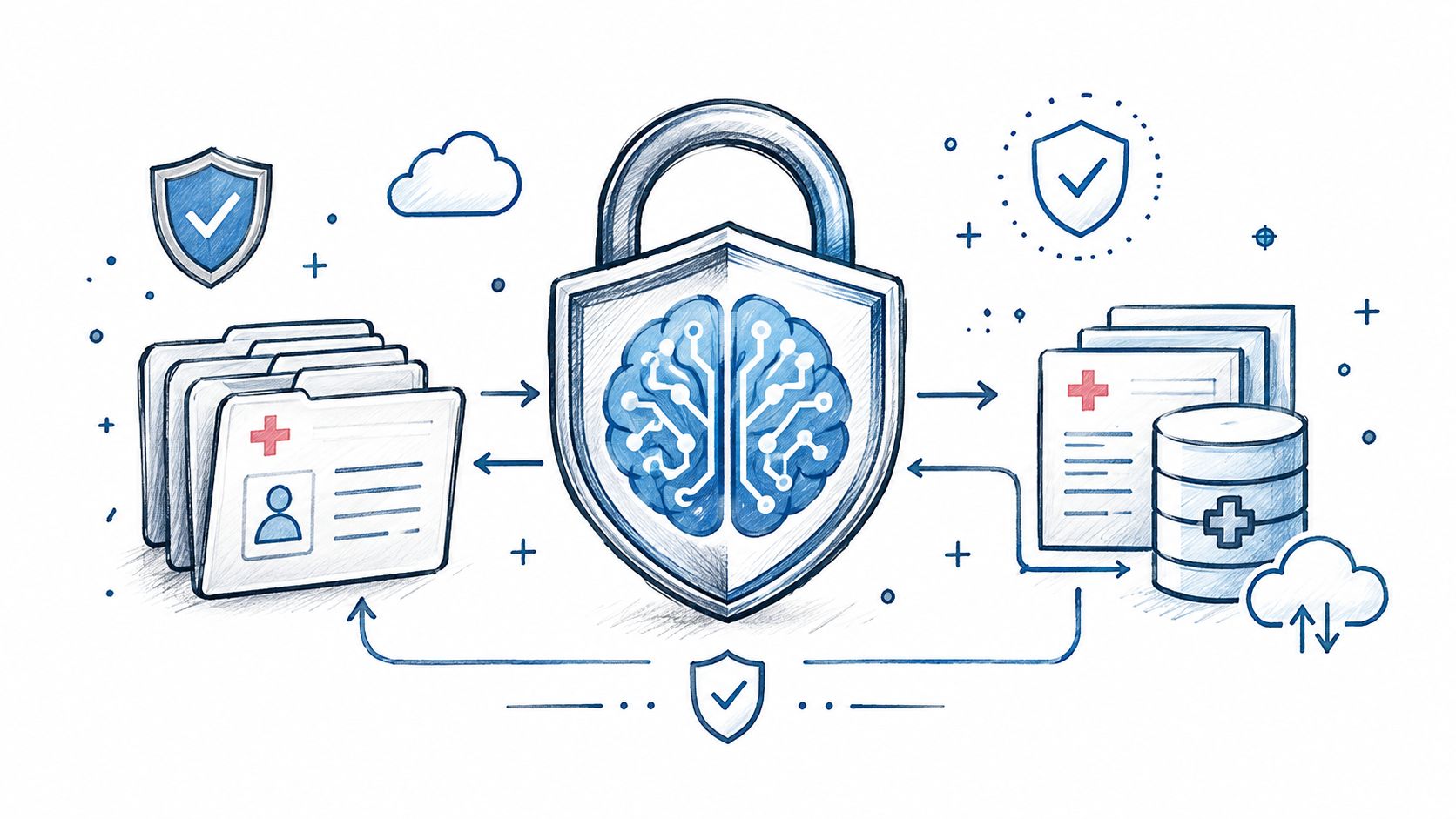
HIPAA-Compliant AI: How to Use LLMs With PHI Safely
How to build HIPAA-compliant AI: when LLM providers need a BAA, data minimization, de-identification, audit controls and a reference architecture.
October 16, 2026Read more
Discover a practical 2026 guide to implementing healthcare enterprise AI strategy, align goals, navigate regulations, and scale AI for measurable ROI.

Having an enterprise AI strategy in healthcare isn't just a good idea anymore—it's a requirement for staying relevant and competitive. This is about moving past isolated AI experiments and building a unified, scalable plan that ties directly to your organization's most important goals. Done right, every AI initiative will deliver real, measurable value.
The "wait and see" approach is over. I've seen it time and again: organizations that treat AI as a series of disconnected science projects are already falling behind. Without a formal plan, you’re basically guaranteeing wasted resources, fragmented systems, and missed opportunities to improve care and efficiency. A clear healthcare enterprise AI strategy is your blueprint for avoiding those pitfalls.
The numbers don't lie. The global AI in healthcare market is expected to explode from $39 billion in 2025 to an incredible $504 billion by 2032. This isn't just hype; it shows a massive industry-wide bet on AI's ability to solve long-standing challenges.
Yet, here’s a critical disconnect: AI is projected to eat up 19% of healthcare tech budgets in 2026, but 51% of executives admit they haven’t even measured the return on their current AI investments. Pouring that much money into an unguided effort is a high-risk gamble. A strategy ensures that investment pays off.
Most healthcare systems dip their toes in the water with a few pilot projects. Maybe one department is testing an AI tool for diagnostic imaging while another experiments with automating administrative tasks. These individual efforts can show promise, but they often die in their silos, making it impossible to scale what works across the entire organization.
The goal is to evolve from this fragmented state to a unified, high-impact program. This is the natural progression from random acts of AI to a mature, strategic asset.

As you can see, connecting these disparate initiatives into a single, well-managed program is what unlocks real, sustainable growth. We're already seeing powerful AI solutions for healthcare make a difference in clinical support and patient management, but only when they're part of a bigger picture. For more on this, check out some real-world use cases we've explored.
Let's look at the essential components of a modern AI strategy. This table summarizes the core pillars we'll be diving into, giving you a quick reference for building your own framework.
| Strategic Pillar | Description | Key Objective |
|---|---|---|
| Goals & Alignment | Tying every AI initiative to core business objectives like patient outcomes, cost reduction, or operational efficiency. | Ensure AI efforts directly support the organization's mission and financial health. |
| Data & MLOps | Assessing and improving the quality, accessibility, and infrastructure for data and machine learning operations. | Create a reliable, scalable foundation for developing, deploying, and managing AI models. |
| Use-Case Discovery | Systematically identifying and prioritizing AI applications that will deliver the most significant impact. | Focus resources on solving high-value problems rather than speculative projects. |
| Governance & Ethics | Establishing clear rules for data privacy, model fairness, transparency, and regulatory compliance (e.g., HIPAA). | Build trust with patients and clinicians while minimizing legal and reputational risk. |
| Change Management | Preparing the organization—from clinicians to administrators—for new AI-driven workflows and tools. | Drive adoption and ensure that new technologies are used effectively and consistently. |
This table gives you a bird's-eye view of what it takes. A truly strategic approach delivers clear, compounding advantages across the board.
Key Takeaway: An AI strategy is not about buying technology. It's an organizational change initiative that aligns your people, processes, and data toward a shared vision for a smarter, more efficient future.
By thinking strategically, you can:
Ultimately, building a healthcare enterprise AI strategy is about leading a transformation. For leaders ready to move from ambition to action, this guide provides the framework to build a plan that delivers tangible results and secures your place at the forefront of modern healthcare.
Before a single line of code is written, your healthcare enterprise AI strategy needs a solid foundation. It's tempting to jump straight into the technology, but the most successful AI programs I've seen start by answering a much more fundamental question: What business problem are we trying to solve?
Are you aiming to slash administrative overhead? Or maybe speed up diagnostic processes? Perhaps the goal is to deliver more personalized patient care. Each of these objectives demands a completely different AI approach. Tying every initiative back to these high-level goals is the only way to build a business case that executives will actually get behind. Without that connection, your AI projects are just expensive science experiments with no clear path to creating real value.

This alignment is also your key to securing buy-in across the board—from clinicians and IT leaders to your legal, finance, and compliance teams. Every one of these groups has a critical perspective. Getting them involved from day one isn't just a good idea; it's essential for building the consensus you'll need later.
In healthcare, trust is your most valuable asset. A strong governance framework is what protects that trust, giving you the guardrails to manage risk while still leaving room for innovation. I’ve seen organizations skip this step, and it almost always leads to regulatory headaches, eroded patient confidence, and stalled projects.
Your governance plan has to tackle a few key areas head-on:
A common mistake is treating governance as an afterthought. It must be woven into the fabric of your AI strategy from day one, not bolted on after a problem arises.
A dedicated AI governance committee is the best way to make this happen. This cross-functional team is responsible for setting policies, reviewing high-risk projects, and making sure every AI initiative lines up with your organization's values and legal duties. A great place to start is by understanding established frameworks for AI Governance and Risk Management for enterprises.
For governance to work, everyone needs to know their role. Your AI governance committee should be a mix of people who can represent every facet of a project's impact.
Key Roles for Your AI Governance Committee:
Getting these stakeholders in a room isn't just about checking a box. It's about solving problems together. Early workshops and shared documents help build a unified vision and prevent the kind of downstream conflicts that can derail a project. It’s these foundational conversations that turn your AI strategy consulting from a plan on paper into a program that is both effective and trusted.
If your organization is just getting started, a Custom AI Strategy report can provide the structured roadmap you need to build this foundation correctly from the beginning.
Let's be blunt: your grand AI strategy is useless without good data and the right operational plumbing to support it. This is doubly true in healthcare. Before you start planning for predictive models and automated clinical workflows, you have to take an honest look at your current data ecosystem and what's often called MLOps, or Machine Learning Operations.
It's not about just having data. It's about having the right data—clean, accessible, and interoperable. I've seen brilliant AI concepts die on the vine because the foundational data was a mess. This leads to inaccurate models, frustrated teams, and a lot of wasted money.
Data maturity isn’t a switch you flip; it’s a spectrum. It’s a practical measure of how well your organization can actually use its data to make better decisions. In a hospital or health system, this means breaking down the walls between your siloed EHRs, claims systems, and lab platforms to get a single, unified view of what's going on.
A truly mature data environment has a few tell-tale signs:
Figuring out where you stand on this spectrum starts with a deep, comprehensive audit of your data sources, storage, and governance. This process almost always uncovers critical gaps you need to fix before any serious AI work can start. A partner with deep experience in AI strategy consulting can be invaluable here, helping you conduct this audit without bias.
If data is your fuel, MLOps is the high-performance engine that actually makes your AI initiatives run. MLOps is really just about applying the proven principles of DevOps to the world of machine learning. It's how you build a standardized, repeatable process for developing, deploying, and—most importantly—managing your models in a live environment.
MLOps is what separates a one-off "science project" from a true enterprise capability.
An MLOps framework turns AI from a slow, manual craft into a repeatable, industrial-grade process. It’s the assembly line for your AI factory, ensuring every model you deploy is high-quality, reliable, and performing as expected.
A solid AI Product Development Workflow isn't magic. It includes practical components like automated data pipelines for training, strict version control for both your code and the models themselves, and continuous monitoring to catch performance issues or model drift before they impact care.
Building this operational muscle is no longer optional. A staggering 71% of hospitals are already deploying predictive AI tools within their EHRs. We’ve seen AI adoption among payers and providers jump from 43% to 56% in just one year. This isn't innovation for innovation's sake; it's a direct response to a looming crisis, including a projected shortfall of 11 million health workers by 2030. You can read the full healthcare AI report to dig into these numbers. Without a strong MLOps backbone, there's simply no way to deploy and maintain these systems at scale.
Ultimately, this assessment of your data and MLOps readiness is a necessary reality check. It gives you a clear, unvarnished picture of your technical foundation and spells out the essential groundwork required to support a sophisticated healthcare enterprise AI strategy. It ensures the solutions you build are not just clever, but sustainable, scalable, and worthy of trust.
Alright, you’ve laid the groundwork with your strategy and have a handle on your tech readiness. Now for the exciting part: figuring out exactly where to point your AI initiatives to get the biggest bang for your buck. This is where your healthcare enterprise AI strategy gets real, moving from high-level planning to identifying concrete problems AI can solve.
This isn’t about just tossing ideas on a whiteboard. It’s a focused discovery effort to find powerful opportunities hiding in plain sight across your clinical, operational, and financial departments. You might find gold in using predictive models to lower patient readmission risk, or maybe using Natural Language Processing (NLP) to finally tame the beast of prior authorizations.

The biggest mistake I see organizations make here is chasing after flashy "AI for AI's sake" projects. Your focus should be squarely on solving genuine, nagging problems for your clinicians, administrative staff, and, ultimately, your patients. Starting with a clear, validated roadmap is the fastest way to notch some early, impactful wins and build momentum, as we explored in our AI adoption guide.
Let’s be honest: not all AI ideas are created equal. You need a simple, repeatable way to sift through the possibilities and zero in on the projects that will actually move the needle. The best tool I've found for this is a straightforward prioritization matrix.
Think of it as a scorecard for your ideas. You’ll evaluate each potential use case across three critical dimensions:
When you map your ideas this way, the winners become obvious. You can quickly separate the high-impact, achievable projects from the high-risk, low-reward distractions. It’s a data-driven gut check that prevents you from pouring resources down the wrong drain.
Sometimes the easiest way to get started is to see what’s already working for others. The healthcare AI field is full of proven applications you can adapt to your own environment. Many forward-thinking organizations are already seeing great results from a variety of Healthcare AI Services.
Here are a few domains where we consistently see high-value AI applications:
By 2026, AI is set to fundamentally reshape how healthcare operates. With over 40 million people already asking ChatGPT about their health every day, there's a clear consumer push for better tools. This trend shows that 47% of healthcare organizations are now focused on scaling AI use cases that are already proven to work. The most popular applications are clinical decision support (42%), using NLP for documentation (40%), and medical imaging (61% for medtech). Discover more expert insights on 2026 healthcare AI trends.
This data tells a clear story: market leaders aren't gambling on unproven tech. They're doubling down on what works. Your job is to find the sweet spot where these established applications can solve your organization's most pressing and specific pain points. Starting with a well-understood problem is the single biggest factor for success.
Getting a pilot project off the ground feels like a huge win. And it is. But the truth is, a successful pilot is just the starting line. The real test is turning that small-scale victory into something that makes a real, measurable impact across your entire organization.
This is where so many promising AI initiatives stall out. I've seen it happen time and again: a project shows incredible potential in a controlled environment but never gains the traction needed for a full rollout. Why? Often, it's because the team never clearly defined what success would look like from the very beginning.
Let's be honest: to get the budget you need to scale, you have to prove your AI project is worth the investment. Skeptical stakeholders and budget holders need to see concrete results, not just cool technology. Before you even think about deployment, you must agree on the specific Key Performance Indicators (KPIs) and ROI metrics you'll be tracking.
Your metrics should paint a complete picture, covering financial, operational, and clinical outcomes.
By setting these benchmarks before your pilot even starts, you’re creating a scorecard that builds a rock-solid business case for future investment.
As you look toward scaling, you'll hit the classic "build vs. buy" crossroads. Do you pour resources into custom healthcare software development for a perfectly tailored solution, or do you go with a proven off-the-shelf product?
There's no one-size-fits-all answer. The right path depends entirely on your specific challenge, your team's capabilities, and your strategic goals.
Here's a quick way to frame the decision:
| Factor | Consider Building If... | Consider Buying If... |
|---|---|---|
| Uniqueness of Problem | Your challenge is highly specific to your workflows or patient population, and no commercial tool quite fits. | The problem is a common one (like revenue cycle management), and mature solutions are already on the market. |
| Strategic Advantage | The solution could become a core competitive differentiator for your organization. | Getting a solution in place quickly is your top priority, and a vendor can fast-track deployment. |
| Internal Resources | You have a skilled, in-house team ready to develop, deploy, and—crucially—maintain the AI model long-term. | Your internal team is lean or lacks specialized AI talent, making a vendor partnership a more practical choice. |
| Total Cost of Ownership | You're ready for the ongoing costs of updates, maintenance, and support for a custom-built system. | A predictable subscription model fits your budget better than a large, upfront capital expense. |
Often, the smartest move is a hybrid approach. You might buy a commercial AI platform for a standard operational need while focusing your internal experts on building a unique clinical model that gives you a true strategic edge.
Scalability is not an afterthought. You can’t just "add it on" later. A solution that works beautifully for 50 patients in one department will crumble when you try to apply it to 5,000 patients across ten facilities.
Key Takeaway: Thinking about scale means anticipating future roadblocks. A scalable solution isn't just built for today's data and workflows; it’s flexible enough to handle tomorrow's.
From the very beginning of your pilot design, you need to be thinking about:
Planning for these factors from the start ensures your pilot serves as a viable blueprint for organization-wide change, turning isolated successes into a lasting, strategic capability.

When healthcare leaders start mapping out an enterprise AI strategy, it’s natural for a lot of questions to pop up. This is complex territory, and from our experience, many organizations run into the same hurdles.
Let’s tackle some of the most common questions we hear. My goal is to give you direct, practical answers to help you navigate this journey with more confidence.
This is probably the most frequent question we get, and the good news is, you don't need a massive data science department to get started. The trick is to start small and smart.
Your first move should be a sharp, focused AI requirements analysis to find a high-impact, low-complexity project. Think of it as finding the perfect "first win." This initial deep dive helps you identify a use case that delivers real value without requiring a year of heavy lifting.
Working with a specialized HealthTech engineering partner is a common and effective way to fill that resource gap. They can bring the expertise to get your first pilot off the ground, prove the ROI, and help you build momentum while you grow your own team internally.
A small, successful pilot is a far more powerful catalyst for change than a large, ambitious initiative that gets stuck in committee. Starting smart always beats starting big.
This is exactly why we created services like our Custom AI Strategy report—to give organizations a clear, actionable plan they can execute on from day one, even with a lean team.
It’s not the technology. While everyone worries about data integration or model accuracy, the biggest barrier we see time and again is cultural and operational.
You can have the most brilliant algorithm in the world, but if it disrupts clinical workflows, feels clunky, or isn't trusted by clinicians, it’s dead on arrival. We see this all the time.
To get around this, you have to bring clinicians into the conversation from the very beginning. The focus should always be on "human-in-the-loop" systems that act as a helpful co-pilot, not a replacement. You're there to augment their expertise, not question it.
Small, contained pilots are your best friend here. They let you gather honest feedback and prove the tool’s value right inside a team’s existing workflow. This is how you build the trust needed for real adoption—a challenge where guidance from our expert team can be invaluable.
Measuring the return on AI in a clinical setting isn't always a straight line to dollars and cents, but it's absolutely possible. You just need to broaden your definition of "return."
For operational projects, like automating billing or optimizing schedules, the ROI is often very clear: cost savings and efficiency gains. You can put a number on that pretty easily.
For clinical tools, the ROI becomes a blend of financial and clinical outcomes. You can measure impact through a set of powerful proxy metrics:
And don't forget to measure clinician satisfaction and burnout. If an AI tool shaves hours of administrative work off their plate each week, that’s a massive win. The key is to define these KPIs before you launch a pilot and get a solid baseline to measure against. This is how you show the real-world impact of your AI tools for business.
The classic "build vs. buy" debate. The right answer really depends on the problem you're trying to solve. There's no one-size-fits-all solution here.
For common industry problems where validated commercial solutions exist—think certain types of medical imaging analysis or revenue cycle management—buying an off-the-shelf SaMD solutions is almost always faster and more cost-effective.
However, if you're tackling a challenge that's unique to your patient population or operational model, a custom-built solution can become a powerful competitive advantage. This is especially true when developing better internal tooling that’s molded perfectly to how your teams work.
Often, a hybrid approach works best. You might use a commercial AI Strategy consulting tool for your foundational needs while focusing your in-house talent on building custom models for what truly sets you apart. An AI Automation as a Service partner can be a great sounding board to help you make that call on a project-by-project basis.
What is a healthcare enterprise AI strategy? A healthcare enterprise AI strategy is a comprehensive plan that aligns an organization's AI initiatives with its core business objectives, such as improving patient outcomes, reducing costs, and increasing operational efficiency. It goes beyond isolated projects to create a scalable, governed, and unified framework for developing, deploying, and managing AI across the entire enterprise.
Why is data governance so critical in a healthcare AI strategy? Data governance is paramount because healthcare data is highly sensitive and regulated (e.g., by HIPAA). A strong governance framework ensures patient privacy and data security, promotes model fairness to prevent bias, and builds trust with both patients and clinicians. Without it, healthcare organizations face significant legal, ethical, and reputational risks.
How can a healthcare organization with limited resources get started with AI? Organizations with limited resources should start small and focus on a high-impact, low-complexity use case. The best approach is to conduct a thorough requirements analysis to identify a "quick win." Partnering with an expert AI vendor or consultant can bridge resource gaps, provide the necessary expertise for a pilot project, and help demonstrate ROI to secure future investment.
What are the key differences between building and buying an AI solution in healthcare? Buying a solution is ideal for common, well-defined problems (like revenue cycle management) where mature commercial products exist. It's faster and often more cost-effective. Building a custom solution is better for unique, specific challenges that can provide a strategic advantage. This requires significant in-house expertise for development and long-term maintenance.
How do you ensure clinicians will actually adopt new AI tools? Clinician adoption hinges on trust and seamless integration into their workflow. To ensure success, involve clinicians from the very beginning of the design process. Focus on creating "human-in-the-loop" systems that augment their expertise rather than replace it. Run small pilot programs to gather feedback, prove the tool's value, and build confidence before a large-scale rollout.
Ready to turn your AI ambitions into a concrete action plan? Ekipa AI delivers a tailored enterprise AI strategy built for your unique challenges in just 24 hours. Start building your roadmap and drive measurable impact with our team of experts.
How to build HIPAA-compliant AI: when LLM providers need a BAA, data minimization, de-identification, audit controls and a reference architecture.
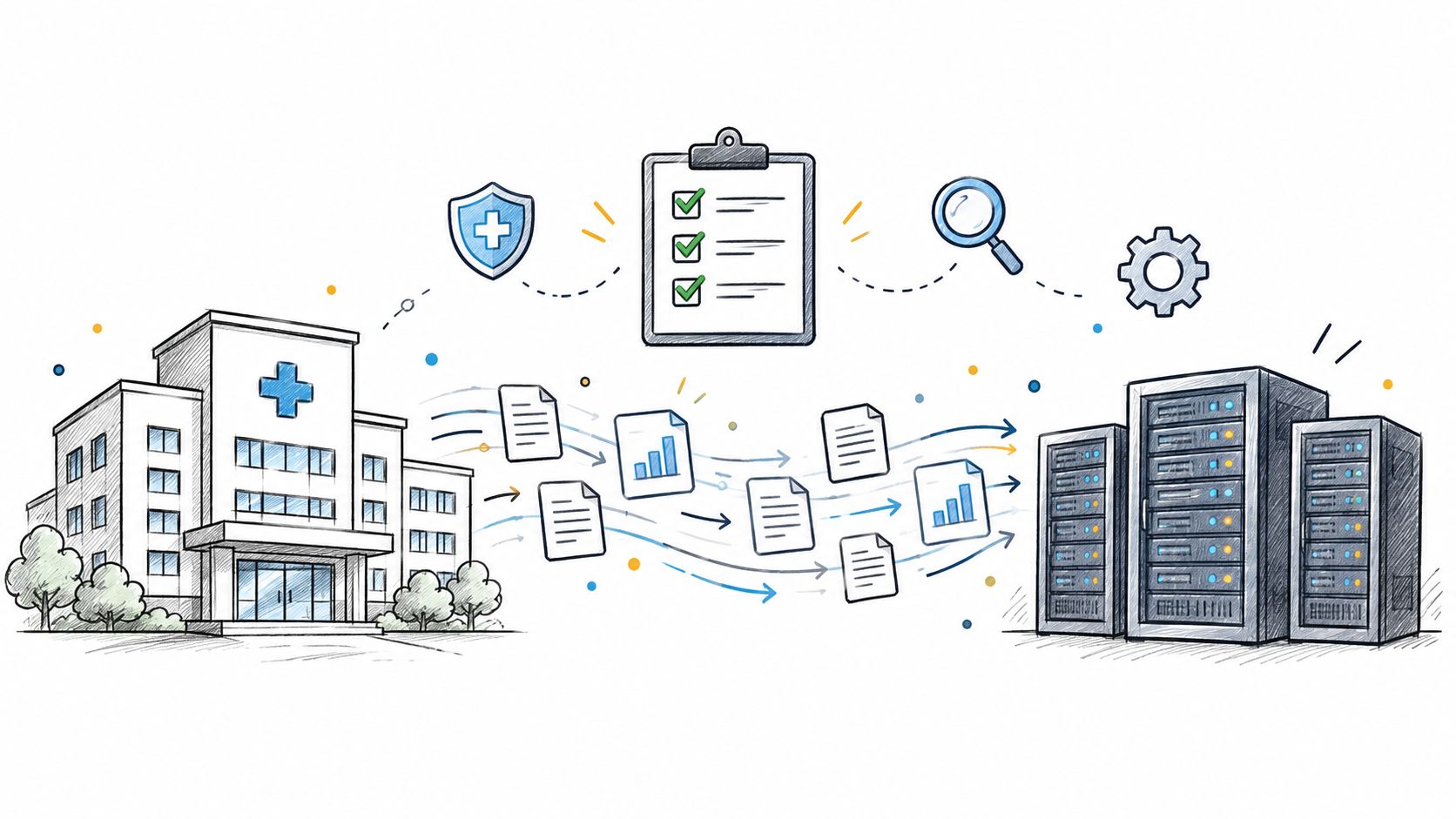
Practical data migration planning guide for healthcare teams. Scope, mapping, compliance, validation, cutover and rollback decisions explained end to end.

Smart on FHIR guide for healthtech engineers. Learn the OAuth 2.0 launch model, scope syntax, backend services, and US regulatory requirements.
Connect with our team to explore how AI expertise can transform your business.