
AI in Healthcare
HIPAA-Compliant AI: How to Use LLMs With PHI Safely
How to build HIPAA-compliant AI: when LLM providers need a BAA, data minimization, de-identification, audit controls and a reference architecture.
October 16, 2026Read more
Discover how AI is reshaping radiology through faster image interpretation, improved diagnostic precision, and smarter clinical decision support.
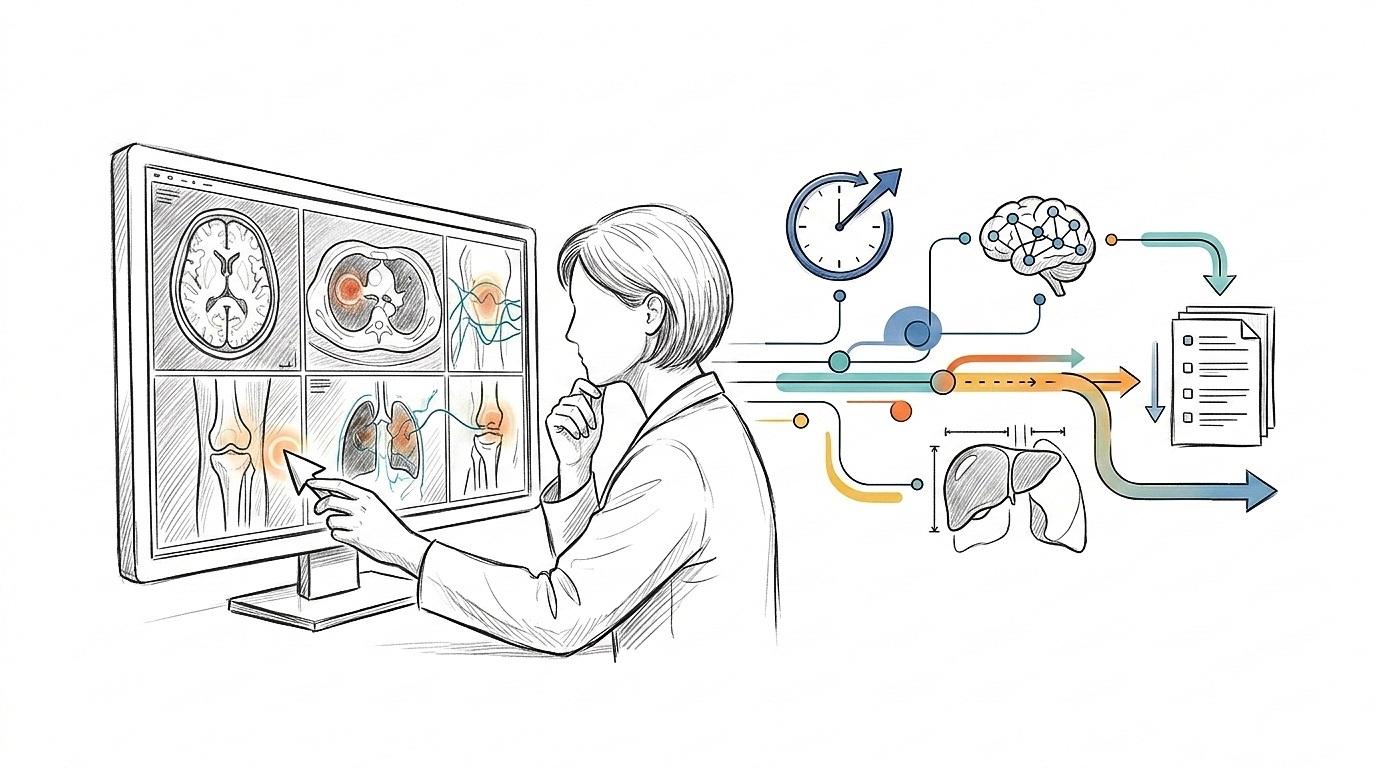
Radiology is at a major turning point as hospitals and clinics manage scans, tighter deadlines for reports, and higher clinical expectations. Imaging teams face the challenge of reading scans quickly while maintaining high diagnostic quality. Artificial intelligence has become a practical solution to meet these demands. It is transforming how scans are reviewed, organized, and interpreted in daily medical practice. AI radiology automation now serves a critical role. It increases speed, accuracy, and consistency across imaging tasks, establishing a new operational standard for radiology departments.
Radiology used to follow a steady routine. Scans arrived, radiologists reviewed them one after another, and reports were prepared within set timeframes. That process no longer meets the demands of modern clinical practice. Emergency departments send urgent cases at all hours. Screening programs generate large volumes of scans. Shortages in certain subspecialties strain the capacity to report on time.
In this setting, delays can have serious consequences. A missed brain bleed, a late cancer detection, or a slow trauma review can change how a patient’s treatment unfolds. The field now needs systems that can handle large volumes without adding extra mental strain for radiologists. Artificial intelligence has become a practical part of imaging operations, shaping how radiologists interact with studies from the moment scans are received. Many departments now rely on healthcare AI services to manage case prioritization, organize workloads, and maintain consistent reporting across growing scan volumes.
Radiology gains speed not by rushing through scans but by removing the obstacles that slow interpretation. Modern AI tools review images as soon as they enter the system, scanning for urgent findings [such as intracranial hemorrhage or pulmonary embolism]. When detected, these cases are prioritized at the top of the reading list. Many radiology teams use AI Solutions to organize this prioritization process with consistency across busy environments.
Radiologists no longer spend time scrolling through long lists to find urgent cases.
Focus shifts directly to studies that need immediate attention.
Advanced reconstruction methods in CT and MRI produce clear scans from less raw data.
Shorter acquisition times reduce patient discomfort and ease scanner congestion.
Emergency cases reach clinicians quickly, and routine studies follow without backlog.
Hospitals rely on AI strategy consulting to align technology with clinical priorities.
This approach adds predictability to the workflow, giving radiologists more time for diagnosis and clinical judgment. The entire imaging cycle accelerates while preserving diagnostic quality.

Speed alone does not add value in radiology. The real progress is when artificial intelligence adds deeper analysis to image interpretation. Deep learning models trained on millions of scans can detect subtle patterns that even experienced radiologists may miss during long reading sessions. Hospitals often rely on a custom AI strategy report to decide which analytical tools fit their imaging workflows and clinical goals.
Early-stage cancers, microfractures, and small vascular changes often appear with very few visual signs.
AI systems highlight these regions, guiding radiologists to areas that need closer review.
Radiologists keep the final judgment, but gain an analytical partner that never tires or loses focus.
Diagnostic confidence grows as false negatives decline when subtle findings are noticed earlier.
False positives reduce as AI provides probability-based context instead of simple alerts.
Over time, radiologists build trust in these signals and begin to integrate them naturally into their reading habits. This layered insight strengthens clinical decisions and adds consistency to daily practice.
Radiology involves numerous actions that require accuracy but consume valuable time. Manual segmentation, lesion measurement, organ volume calculation, and image labeling require attention away from clinical reasoning. Artificial intelligence now performs these steps with speed and consistency, reducing the burden on radiologists.
Automated segmentation outlines tumors, organs, and anatomical structures within seconds.
Measurement tools provide accurate dimensions without manual tracing.
Structured data extraction organizes imaging findings for reporting systems.
Through AI radiology automation, radiologists shift focus from mechanical steps to diagnostic synthesis.
Reading sessions become more concentrated and less fragmented, lowering cognitive strain.
Stamina improves across long shifts as repetitive tasks are reduced.
This transformation reaches across subspecialties. Oncology teams gain consistent tumor metrics across follow‑up scans, cardiac imaging benefits from standardized chamber measurements, and neurology teams receive precise lesion tracking across disease progression.
Reporting often sets the pace for delivering radiology results to clinicians. Tasks such as dictation, reviewing transcriptions, and formatting reports require time for each case. Natural language processing and generative language models are now changing this stage of radiology work. Hospitals follow an AI adoption roadmap to bring these tools into practice in a structured way, aligning technology with reporting needs and staff routines.
AI-driven systems generate draft reports based on detected findings, measurements, and patterns from radiologist dictation. Structured templates fill automatically with the right data points. Radiologists review, adjust, and finalize a draft, eliminating the need to start from a blank page.
This change eases the strain of documentation. Reports remain consistent across different practitioners and sites. Clinicians receive clear, timely summaries that match imaging results. Across large volumes of cases, the minutes saved add up to meaningful gains in capacity.
Busy environments such as emergency departments challenge diagnostic focus. Fatigue, interruptions, and rapid case turnover increase the risk of missed findings. Artificial intelligence adds an extra review step during interpretation. Probability scores, comparative image analysis, and contextual cues guide attention toward the most meaningful results. Many radiology teams study successful AI use cases to see how algorithmic insights improve decision-making in critical situations.
These tools do not replace clinical reasoning. Instead, they act as a reference layer. Radiologists compare their own assessment with algorithmic insight. When both align, confidence grows. When differences appear, it prompts a closer review.
This approach strengthens quality without changing professional authority. Clinical decisions remain led by humans, supported by a data-driven context that scales across growing workloads.
Diagnostic confidence depends on image clarity. Low-dose imaging is safer for patients, but it often adds noise that complicates interpretation. AI-powered reconstruction reduces this noise and corrects artifacts in low-dose scans.
Radiologists receive sharper images that preserve important diagnostic details. Patients benefit from reduced radiation exposure, even with repeated imaging. This balance between safety and clarity represents a meaningful shift in imaging practice, one that delivers lasting clinical value.
Radiology is connected to broader clinical information. Modern multimodal AI systems integrate imaging results with electronic health records, lab values, and genomic data. This combination places each scan within a broader clinical picture. Hospitals often apply an AI maturity model to assess readiness, strengthen integration, and direct the application of advanced data-driven insights.
Predictive models track disease progression over time.
Treatment planning gains more context than what a single scan can provide.
Radiologists contribute deeper insights during multidisciplinary discussions.
Integrated data supports decisions beyond isolated images.
These workflows mark a shift toward personalized medicine built on imaging intelligence. Interpretation shifts from visual findings to clinical foresight, improving patient care.
The success of intelligent systems in radiology depends on trust. Radiologists look for transparency, validation, and consistency when adopting new tools. AI platforms that fit smoothly into existing workflows gain acceptance more quickly than those that disrupt daily routines. Many institutions work with an AI implementation partner to guide deployment, provide training, and maintain reliability across the system.
Confidence grows when audit trails are clear, outputs are explainable, and performance remains consistent. Radiologists begin to see these systems as professional companions rather than mysterious black boxes. With time, collaboration replaces caution as teams experience real relief in workflow and greater clarity in diagnosis.
Through careful deployment, AI radiology automation becomes part of everyday practice rather than feeling experimental. Trust builds through daily reliability, creating confidence based on experience rather than theory.
Radiology is evolving, with increased scan volumes, higher clinical demands, and constant time constraints. Artificial intelligence offers a practical way forward by streamlining workflows and facilitating more informed interpretation. Radiologists keep their expertise and judgment, while technology adds speed, clarity, and consistency. AI radiology automation supports radiology in delivering effective care. Contact us to discuss how this approach can advance your imaging goals.
AI radiology automation uses AI Solutions to speed up image interpretation, automate measurements, and improve diagnostic accuracy in radiology workflows.
Healthcare AI services help prioritize urgent scans, streamline reporting, and support radiologists with efficient imaging workflows.
AI strategy consulting helps hospitals identify the right AI use cases and develop a custom AI strategy report to guide technology adoption.
An AI readiness assessment and AI maturity model help organizations evaluate infrastructure, data quality, and workflow readiness.
Working with an AI implementation partner and following a structured AI adoption roadmap helps deploy and scale AI systems effectively.
How to build HIPAA-compliant AI: when LLM providers need a BAA, data minimization, de-identification, audit controls and a reference architecture.

Practical data migration planning guide for healthcare teams. Scope, mapping, compliance, validation, cutover and rollback decisions explained end to end.

Smart on FHIR guide for healthtech engineers. Learn the OAuth 2.0 launch model, scope syntax, backend services, and US regulatory requirements.
Connect with our team to explore how AI expertise can transform your business.