AI in Healthcare
HIPAA-Compliant AI: How to Use LLMs With PHI Safely
How to build HIPAA-compliant AI: when LLM providers need a BAA, data minimization, de-identification, audit controls and a reference architecture.
October 16, 2026Read more
How can hospitals use ai for better patient care? Explore real-world examples, outcomes, and practical steps for successful AI adoption.

The conversation around how hospitals can use AI for better patient care has moved from "if" to "how." We're seeing leading healthcare institutions put AI to work in very real, tangible ways across both clinical and operational departments. They're using it to sharpen diagnostics, tailor treatments to individual patients, get a handle on administrative overload, and even predict patient risks before they escalate. It's a fundamental shift that's improving everything from patient outcomes to staff well-being.
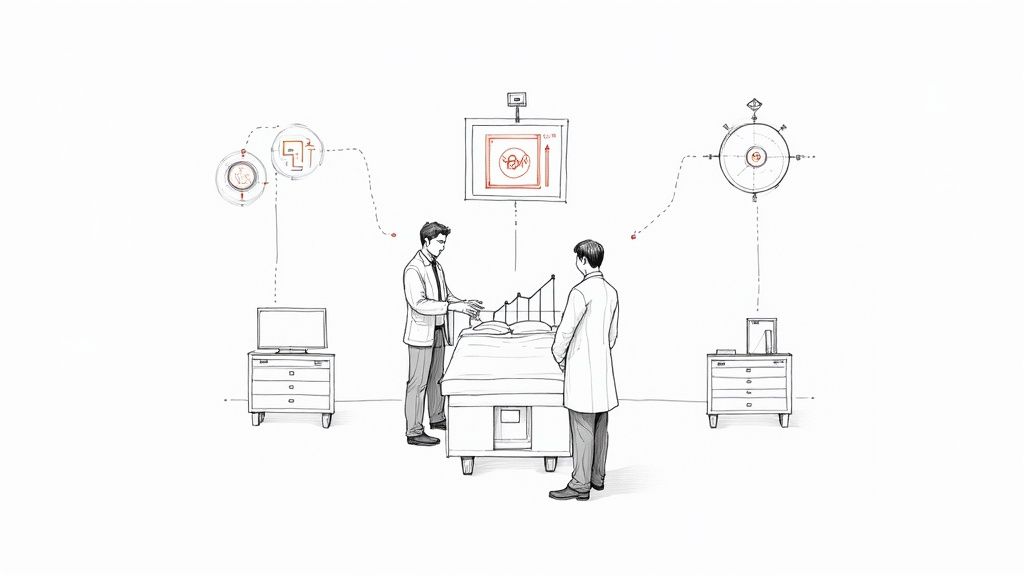
Artificial intelligence is quickly becoming a core component of modern healthcare, almost like a digital partner for both clinicians and administrators. Hospitals aren't just adopting sophisticated AI solutions for the sake of innovation; they're building a more resilient, efficient, and patient-focused system. The goal isn't to replace human expertise—it's to enhance it, giving our medical professionals the tools to deliver safer and more consistent care.
The data backs this up. A report from Deloitte projects that by 2025, about 80% of hospitals will be using AI-powered systems to get a better handle on both their clinical and operational workflows. This trend is fueled by a strong return on investment; hospitals report seeing an average of $3.20 back for every $1 spent on AI, often within just 14 months.
On top of that, with 92% of healthcare leaders convinced that automation can help solve persistent staffing shortages, AI is viewed as an essential piece of the puzzle for creating sustainable operations.
To really grasp how AI delivers value, it helps to see where it can be applied most effectively. The table below breaks down the primary domains where hospitals are seeing the biggest impact.
| AI Application Area | Primary Benefit to Patient Care | Example Use Case |
|---|---|---|
| Predictive Analytics | Proactive intervention and risk mitigation. | Identifying patients at high risk for sepsis or hospital readmission based on EHR data. |
| Administrative Automation | Reduced staff burnout and improved efficiency. | Automating medical coding, billing processes, and patient appointment scheduling. |
| Clinical Decision Support | Enhanced diagnostic accuracy and personalized treatment. | Analyzing MRI scans for early signs of tumors or suggesting drug regimens based on genetic markers. |
By focusing on these key areas, hospitals can begin to build a robust AI framework that addresses their most pressing challenges.
So, how does this look in practice? AI's application in a hospital setting generally falls into three main categories. Each one tackles a different set of challenges, from the front lines of patient care to the back-office tasks that keep everything running smoothly.
Predictive Analytics: This is all about using AI algorithms to sift through massive amounts of data to forecast what's likely to happen next. Imagine a model that can flag patients at high risk for developing sepsis or being readmitted shortly after discharge. This allows clinical teams to step in early and prevent a crisis, which can be life-saving.
Administrative Automation: Let's be honest—the administrative burden in healthcare is immense. AI tools can take on the repetitive, time-consuming work like medical coding, processing claims, and managing schedules. This frees up highly skilled staff to focus on patient-facing activities and helps reduce the burnout that plagues the industry.
Clinical Decision Support: These are systems designed to give clinicians data-driven insights right when they need them—at the point of care. An AI might analyze a CT scan with incredible accuracy, suggest a differential diagnosis based on symptoms and lab results, or recommend a personalized treatment plan based on the patient's unique genetic profile and clinical history.
Focusing on these core pillars allows a hospital to build a solid AI strategy. This targeted approach, which our AI in healthcare solutions are built to support, makes sure the technology is applied where it will make the biggest difference for both patient care and the bottom line.
When it comes to bringing AI into a hospital setting, the biggest mistake is leading with the technology. The real starting point isn't the algorithm; it's the problem you're trying to fix. The first move is to pinpoint those specific opportunities where AI can deliver genuine, measurable value for your patients and your staff.
This isn't about plugging in generic AI tools for business. It’s about a deep dive into your hospital’s unique pain points—a true AI requirements analysis. Are you constantly battling long wait times in the emergency department? Struggling with a high rate of hospital-acquired infections? The answers to these questions will show you exactly where AI solutions can make the biggest difference.
To find the most impactful starting point, you need to get the right people in the same room. This means assembling a cross-functional team of clinicians, administrators, IT specialists, and even patient advocates. Getting everyone together in structured workshops is the best way to collect different perspectives on what’s actually happening on the ground.
You’ll hear things you might not expect. A nursing manager might bring up the sheer amount of time her team loses to manual charting—a perfect opening for an ambient AI scribe. At the same time, someone from finance could flag revenue cycle bottlenecks caused by simple coding errors, a problem that AI-powered billing systems are built to solve.
It’s critical that we involve frontline staff early… It validates the problem and ensures both relevance and buy-in.
This is a common refrain from healthcare leaders who've been through this process. The most successful AI projects aren't dictated from the top down; they're built alongside the people who will live with them every day. This kind of collaborative work is the bedrock of any solid AI strategy consulting.
Once you have a list of potential projects, you need to figure out which ones to tackle first. Not all ideas are created equal. A good way to sort through them is to weigh each one against three practical factors:
Clinical Impact: Does this directly improve patient outcomes, enhance safety, or create a better patient experience? An AI model that predicts the risk of sepsis is a great example of high clinical impact.
Operational Efficiency: Will this save our people time, cut costs, or help us use our resources more effectively? Think about automating staff schedules or optimizing bed management.
Implementation Feasibility: Do we actually have what we need to pull this off? This includes clean data, the right tech infrastructure, and—just as important—staff who are on board with the change.
Looking at real-world use cases from other hospitals can be incredibly helpful here. Seeing how a similar institution successfully rolled out an AI-powered system for nurse staffing can give you a clear roadmap for your own efforts.
For example, our use case library lets you filter by function and industry to find proven examples that match your needs.
A tool like this helps leaders quickly see what's already working out in the field, whether it's using AI for diagnostic support in radiology or to smooth out patient flow in the ED. It makes the entire prioritization process much more concrete and data-driven, which is a key part of developing a Custom AI Strategy report.
Your goal here isn't to boil the ocean. It's to pick a few pilot projects with a high chance of success that will deliver clear, visible results. That's how you build momentum and show everyone in the organization what’s possible with AI.

If you really want to know how hospitals can use AI to improve patient care, the answer starts with moving from reactive to proactive intervention. That's where predictive analytics comes in. Instead of scrambling to respond to a crisis once it's already happening, AI models can dig through mountains of electronic health record (EHR) data to find the subtle clues that signal a problem on the horizon.
This completely shifts the care model upstream. It gives clinical teams a glimpse into what might be coming, letting them act before a patient's condition spirals downward. Think of it as a digital lookout that never gets tired, constantly scanning for the earliest signs of sepsis, potential organ failure, or the likelihood a patient might be readmitted shortly after they go home.
By giving these early warnings, hospitals give their clinicians the power to step in sooner and with more precision. This is a massive step forward for patient safety and outcomes, and it's where AI solutions start to fundamentally change the standard of care.
Now, building these predictive tools is no simple task. It all begins with curating enormous, high-quality datasets from EHRs—everything from lab results and vital signs to doctors' notes and patient histories. Machine learning algorithms are then trained on all that historical data to spot the complex combinations of factors that tend to show up just before an adverse event.
For example, an AI might learn that a slight, simultaneous dip in blood pressure, a small rise in heart rate, and one specific lab marker are highly predictive of sepsis within the next six to twelve hours. A busy clinician might not connect those subtle dots amid the chaos of a hospital ward, but an algorithm can flag it in an instant.
We're seeing these models adopted at a rapid pace. In fact, around 65% of hospitals are already using predictive models, either from their EHR vendor or a specialized third-party. UC Davis Health, for instance, used its BE-FAIR model to predict which patients might need immediate attention. After a 12-month evaluation, their team found they could adjust the model to reduce the underprediction of risk for minority groups—a critical step toward making care more equitable. This is a perfect example of why a thorough AI requirements analysis must address potential biases right from the start.
Just having an alert pop up on a screen isn't enough. It has to fit into the clinical workflow in a way that helps, not hinders. We've all heard about "alert fatigue," where clinicians get so many notifications that they start tuning them out.
To avoid that trap, successful systems focus on delivering the right information to the right person at the right time. This usually involves a few key elements:
Risk Scoring: Instead of a simple yes/no alert, models provide a nuanced risk score (like a 75% probability of readmission), which helps clinicians prioritize who needs their attention most.
Contextual Information: The best alerts show the why behind the warning, displaying the specific data points that triggered it so the care team can quickly assess the situation.
Workflow Integration: Notifications should appear directly inside the EHR system. This makes them a natural part of the clinician’s routine, not some separate, clunky tool they have to check.
A well-crafted Custom AI Strategy report will map out not just the data and modeling needs but also the specifics of this crucial workflow integration. The AI Strategy consulting tool is one tool that shows how AI can be embedded to support decisions without creating more noise. And while much of the public conversation is on customer retention, many of the same predictive churn modeling strategies can be adapted for patient management.
The goal is to augment human intelligence, not replace it. The AI flags the risk, but the clinical team uses their expertise to decide on the appropriate intervention.
This partnership between technology and clinical judgment is where the magic happens. We've seen it work with AI-driven sepsis alerts at places like the Cleveland Clinic, which cut false positives by a factor of ten and boosted the identification of actual sepsis cases by an incredible 46%. At the end of the day, using predictive analytics is all about giving our dedicated healthcare professionals the foresight they need to save lives.
While predictive models are grabbing headlines in clinical care, the real-world impact of AI in hospitals often starts with the unglamorous, behind-the-scenes work. We're talking about the administrative backbone—the operational tasks that, when inefficient, drain resources and are a major cause of staff burnout. By automating these routine jobs, hospitals can free up their talented people to focus on direct patient interaction.
This is where intelligent automation really proves its worth. It’s not just about doing things faster; it’s about building a more resilient, cost-effective, and responsive healthcare system from the ground up. When your clinical and admin teams aren't bogged down by repetitive work, they have more energy and focus for what truly matters: delivering exceptional care.
If you're looking for a perfect place to start, look no further than medical coding and billing. These areas are complex, full of rules, and incredibly prone to human error, which can lead to huge revenue losses and frustrating claim denials. AI-powered systems can now scan clinical documentation and suggest the right medical codes, which cuts down on mistakes and gets the entire revenue cycle moving much faster.
This does more than just get hospitals paid correctly and on time, shoring up their financial health. It also dramatically reduces the administrative ping-pong between providers and payers, which is a constant source of friction for everyone involved.
The infographic below shows how AI can connect these key administrative tasks, creating a much smoother operational workflow.
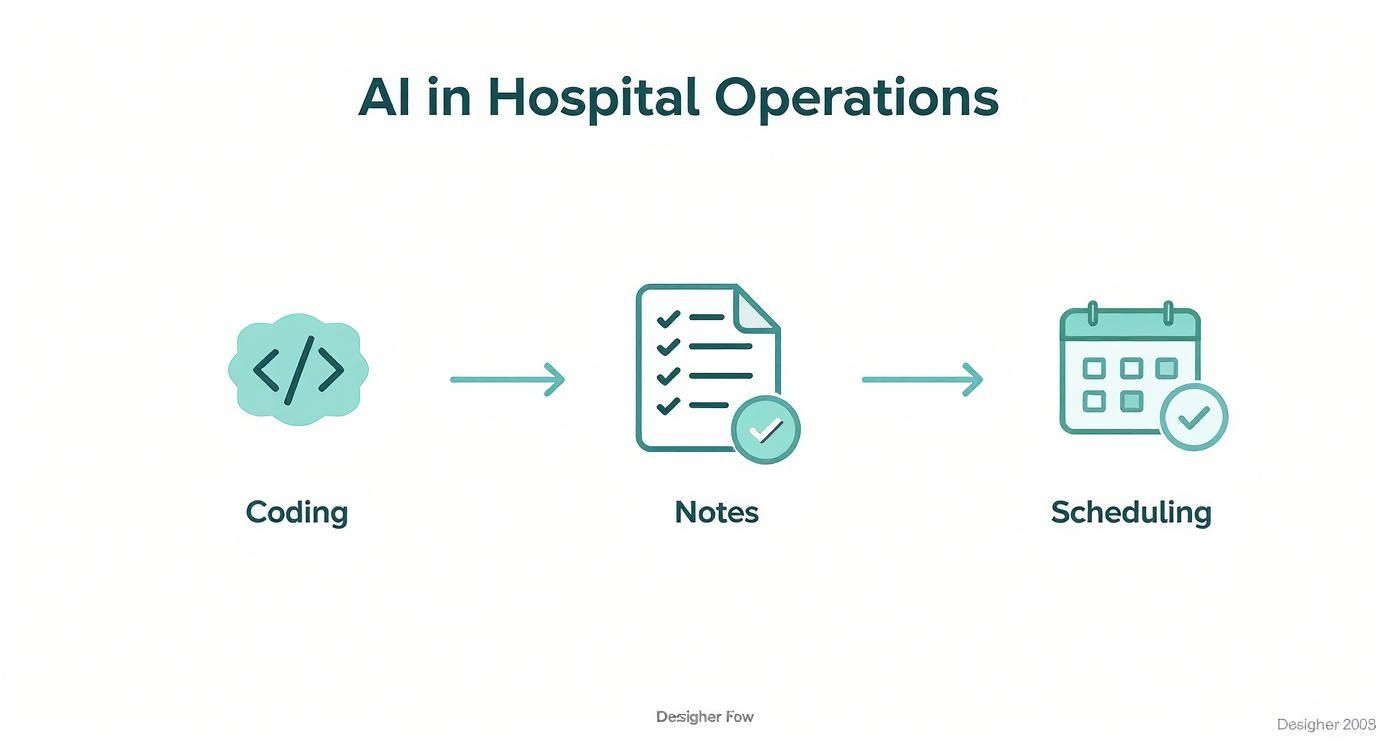
This kind of connected flow is what separates basic automation from a truly intelligent operational strategy.
One of the most exciting applications of operational AI is ambient clinical documentation. This tech is a game-changer for physicians who feel like they spend more time with their keyboard than their patients. It essentially listens to doctor-patient conversations and automatically creates structured clinical notes.
The benefits here are immediate and profound. First, it slashes the administrative burden that is a primary driver of physician burnout. Second, and just as important, it allows doctors to be fully present and engaged during consultations, leading to better conversations and better care.
By freeing a physician from hours of administrative work, ambient AI lets them focus on the person in front of them, not the computer screen. This leads to a more accurate, complete picture in the medical record, which is simply better for patients.
Adoption of these specialized tools is exploding. By 2025, it’s projected that about 22% of healthcare organizations will have implemented domain-specific AI—that’s a sevenfold jump from the previous year. These systems are already helping hospitals recover lost revenue from coding errors, and the market for ambient documentation alone is now valued at $600 million, largely because of its incredible impact on burnout and care quality.
Beyond paperwork, AI is also helping hospitals better manage their two most valuable assets: their people and their physical space. AI algorithms can create optimal nurse schedules by balancing patient acuity, staff preferences, and shift patterns. The goal is to ensure workloads are fair and coverage is always adequate.
In the same vein, AI can tackle complex bed management puzzles by predicting when patients will be discharged and coordinating housekeeping and transport services in advance. This means less waiting for patients and better flow throughout the hospital. Getting these systems right often requires a smart blend of off-the-shelf products and some level of custom development. If you're looking to dig deeper, our guide to workflow automation is a great resource.
By tackling these operational challenges head-on with a focused AI strategy, hospitals can make meaningful improvements that directly support their core mission of providing outstanding patient care.
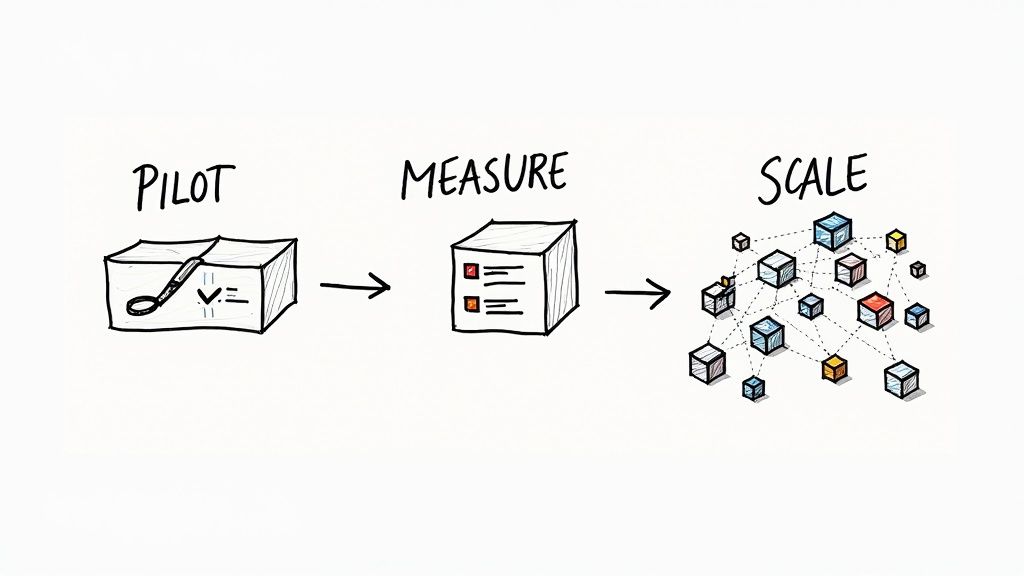
Finding a genuinely promising AI application is a huge first step, but an idea is only as good as its execution. You need a clear, deliberate roadmap to turn that concept into a fully integrated tool that actually makes a difference in patient care. This journey is all about careful piloting, precise measurement, and smart scaling to ensure the technology delivers without throwing clinical workflows into chaos.
The path from a small-scale pilot to system-wide adoption is where so many great ideas fall apart. Success hinges on a structured approach—testing the solution in a controlled environment, gathering honest feedback from the people who will use it every day, and being willing to adjust on the fly.
Think of a pilot program as your real-world test drive, but on a limited scale. The goal isn't just to see if the technology functions; it's about learning as much as possible with minimal risk and figuring out how this new tool fits into your hospital's unique ecosystem.
To set your pilot up for success, you have to be surgical with its scope. Start by picking a single clinical area or department where the problem you’re solving is most painful. This focused approach lets you gather clean, unambiguous data and feedback from a manageable group of users.
Most importantly, you need to define what success looks like before you even start. Set clear metrics for both clinical and operational outcomes.
Clinical Metrics: Are you aiming for a measurable reduction in patient falls? Lower hospital-acquired infection rates? Improved diagnostic accuracy? Be specific.
Operational Metrics: This could be anything from cutting down on administrative time for nurses to speeding up patient discharge or simply lowering costs in a specific area.
This planning is non-negotiable. Without it, you have no objective way to know if the pilot was a win and if it's worth the investment to scale. For hospitals just starting out, this practical guide on how to implement AI in business offers a great framework for building a roadmap and weaving AI into patient care.
Once you move from theory to practice, things get serious. Data governance, patient privacy, and regulatory compliance become your top priorities. Any AI tool that touches patient data must be airtight when it comes to regulations like HIPAA. This isn't just a box to check; it’s the foundation for earning trust from both your patients and your clinical staff.
A strong governance framework should oversee every AI initiative, making sure each one is evaluated not just for its clinical potential but also for ethical implications and data security. This means regular audits to sniff out algorithmic bias and to confirm patient data is always handled responsibly.
We’ve put into place a robust governance structure that goes beyond just our clinical leaders. It’s important, as we look at the use cases for AI, that we’re looking at each use case through all lenses.
This kind of multidisciplinary oversight guarantees that every AI project stays true to the hospital's core mission: providing safe, equitable, and high-quality care.
A successful pilot is a major milestone, but it's far from the finish line. The final—and often toughest—hurdle is scaling that solution across your entire hospital or health system. This is where the challenge becomes less about technology and more about people. It's a change management game.
To get widespread adoption, you have to bring your staff along for the ride. Communicate the "why" behind the change. Share the positive results from the pilot and clearly explain how this new tool will make their jobs easier and improve patient outcomes. One of the most effective strategies is to appoint clinical champions—respected peers who believe in the technology and can advocate for it.
Scaling also demands ongoing training and support. You can't just deploy the software and walk away. You need to provide the resources that help staff get comfortable and proficient with the new internal tooling. This cycle of implementation, feedback, and refinement is what separates a flash-in-the-pan pilot from a new standard of care.
Your hospital’s AI journey will rise or fall based on the partners you choose and the expertise you build. It almost always comes down to that classic dilemma: do we build it ourselves or buy it? Deciding between developing an internal tooling solution from scratch versus purchasing a specialized, off-the-shelf AI tool for business is one of the most critical decisions you'll make.
Going the custom route gives you a solution tailored perfectly to your unique workflows, but it's a heavy lift. You're looking at a serious investment in talent, time, and money. On the flip side, buying a vendor's solution gets you up and running much faster, but you have to be absolutely sure it will play nice with your existing EHRs and meet your ironclad data security standards.
The best partners get it—they understand that healthcare isn't just another industry. They have to grasp the clinical context that gives the technology meaning. When you're evaluating vendors or consultants, your checklist needs to go way beyond just technical specs.
Look for partners who can prove they have:
Deep Healthcare Expertise: They need to speak your language. If they don't understand clinical workflows, patient safety protocols, and the day-to-day realities of patient care, they aren't the right fit.
Robust Data Security and Compliance: This is a deal-breaker. Ask for concrete proof of HIPAA compliance and have them walk you through their protocols for protecting patient data.
Proven Integration Capabilities: The vendor has to demonstrate exactly how their tool will connect with your existing systems. The last thing you need is another data silo or something that throws a wrench in your clinicians' routines.
This kind of rigorous vetting is how you find a partner who can help you solve the real-world problem of how hospitals can use AI for better patient care. For example, any firm offering custom healthcare software development should be able to show you a portfolio of successful hospital integrations they've already completed.
The ideal technology partner acts as an extension of your team. They bring more than just an algorithm; they bring a genuine understanding of your mission to improve patient outcomes.
While great external partners are crucial, you also need to build up your internal expertise for the long haul. This doesn’t mean you have to go out and hire a whole team of data scientists tomorrow.
A great starting point is to upskill your current IT and clinical informatics teams. Empower them with the training to manage, validate, and oversee these new AI systems.
As your AI program matures, you can then start to selectively hire for key roles like data scientists or machine learning engineers who can work directly alongside your clinical staff. This hybrid model—blending sharp in-house knowledge with trusted external support—is what creates a sustainable engine for innovation. A structured, collaborative process like our AI Product Development Workflow is designed to bridge that exact gap between your clinical experts and our technical teams.
Ultimately, building a strong relationship with our expert team gives you the strategic sounding board you need to navigate these complex decisions, ensuring every technology choice you make directly serves your patient care goals.
As hospital leaders start exploring AI, a lot of good questions come up. It's a big step, and it's smart to be thorough. Here are some of the most common things we hear from leadership teams, along with practical, straightforward answers.
The best starting point isn't technology—it's people and problems. First, pull together a dedicated team with members from clinical, IT, and administrative departments. You need all these perspectives in the room.
Their first job is to pinpoint the most significant pain points your hospital is dealing with. Don't start with the AI solution; start with the problem you need to solve. Once you've identified a clear challenge, you can assess your readiness. Look at your data infrastructure, workflows, and your team's current skills. This groundwork is essential for setting up a pilot project that has a real chance of success, and it's often where an AI strategy consulting partner can save you a lot of time and headaches.
You can't just "feel" if an AI tool is working; you have to measure it. The best way to do this is by looking at both the hard numbers and the softer, but equally important, benefits.
The Hard Numbers (Quantitative ROI): These are the metrics you can stick on a spreadsheet. Think about things like a drop in readmission rates, a shorter average length of stay for patients, or direct cost savings from automating back-office tasks. Improvements in your revenue cycle are another big one.
The Human Impact (Qualitative ROI): This is about the experience. Are patient satisfaction scores going up? Are your clinicians feeling less burned out? Are your diagnostic tools genuinely improving accuracy?
Crucial Tip: You have to establish these benchmarks before you flip the switch on any AI project. Without a baseline, you'll have no way to prove the value of your AI solutions to the board.
Honestly, the biggest hurdles are almost always about data and people. AI is completely dependent on high-quality, accessible data. If your data is a mess, your AI models won't be reliable. It’s that simple.
Another major challenge is fitting AI into the way your clinicians already work without creating chaos. You can't just drop a new tool into a workflow and expect it to stick. Beyond that, getting clinicians to trust and adopt the technology is a huge piece of the puzzle. You'll also need to navigate complex regulations like HIPAA and be vigilant about managing potential AI bias. As we explored in our AI adoption guide, the human side of this is just as critical as the tech.
Absolutely. In fact, for smaller and rural hospitals, AI can be a game-changer that helps level the playing field.
For instance:
Expanding Access: AI-enhanced telehealth platforms can bring specialist expertise to your community, so patients don't have to travel hours for consultations.
Supporting Clinicians: AI-powered diagnostic tools can act as a second set of eyes for general practitioners, helping them spot complex conditions early.
Doing More with Less: When you have a lean team, using AI Automation as a Service for administrative tasks like billing and scheduling frees up your staff to focus on patient care.
These aren't just futuristic ideas; they are practical ways for smaller facilities to operate more efficiently and deliver better care. If you want to explore what this could look like for your specific situation, our expert team is always ready to talk.
At Ekipa AI, we help you turn complex AI opportunities into real, scalable results. Our platform is designed to help you build and execute your AI transformation strategy quickly, giving you a custom plan without the months of traditional consulting work.
How to build HIPAA-compliant AI: when LLM providers need a BAA, data minimization, de-identification, audit controls and a reference architecture.
Practical data migration planning guide for healthcare teams. Scope, mapping, compliance, validation, cutover and rollback decisions explained end to end.
Smart on FHIR guide for healthtech engineers. Learn the OAuth 2.0 launch model, scope syntax, backend services, and US regulatory requirements.
Connect with our team to explore how AI expertise can transform your business.