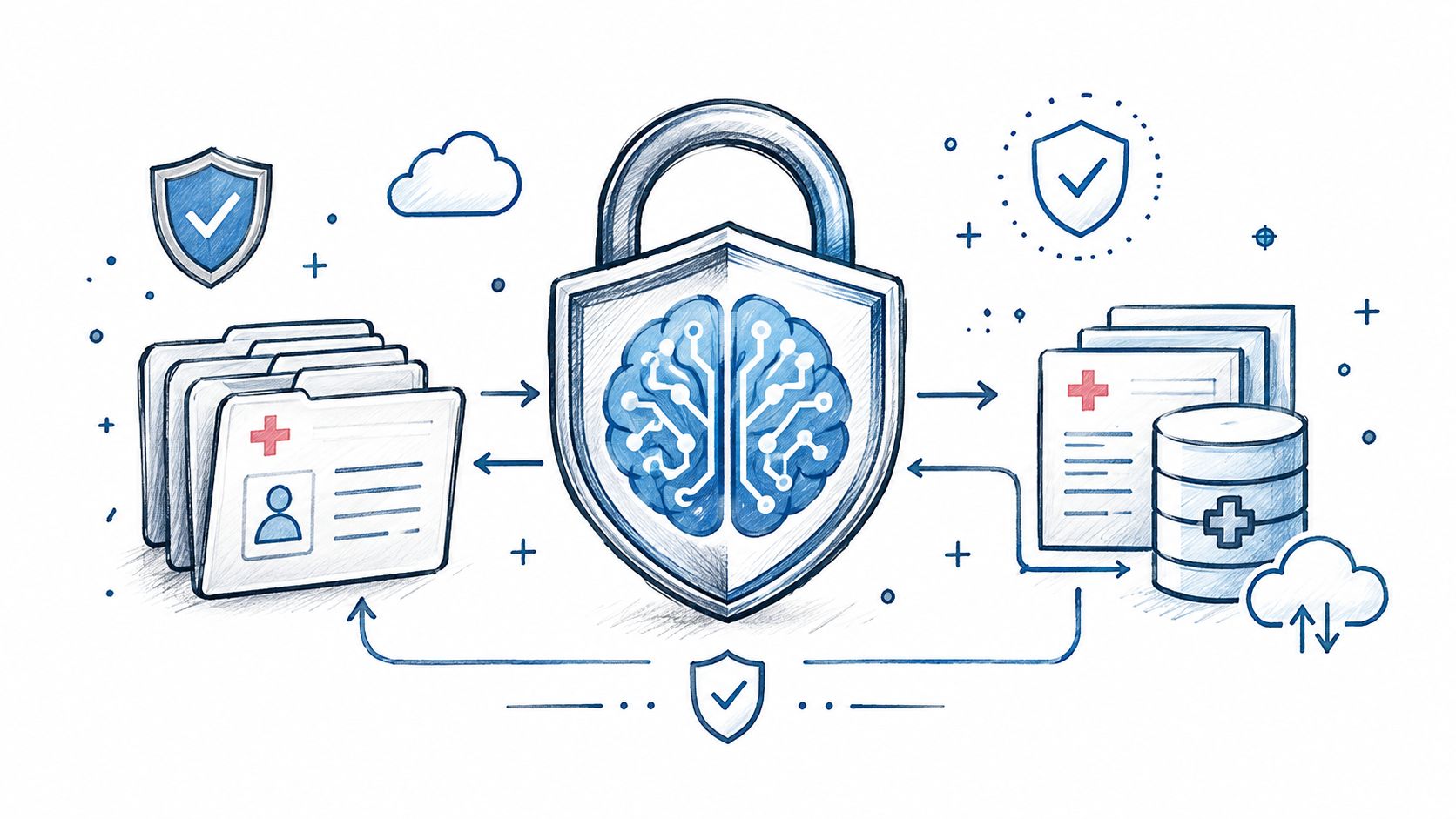
AI in Healthcare
HIPAA-Compliant AI: How to Use LLMs With PHI Safely
How to build HIPAA-compliant AI: when LLM providers need a BAA, data minimization, de-identification, audit controls and a reference architecture.
October 16, 2026Read more
Understand how hospitals evaluate AI solutions in 2026: clinical validation, ROI, data readiness, and compliance for successful adoption.

Bringing a new AI solution into a hospital isn't just a technical purchase; it's a major clinical and operational decision. To do it right, you need a methodical approach that cuts through the vendor hype and focuses on what truly matters: can this tool solve a real problem for our patients and staff, and can it do so safely and effectively within our specific environment?
It all comes down to a process built on four key pillars: clinical validation, technical feasibility, financial viability, and ethical compliance. This isn't just a checklist; it's a comprehensive framework managed by a team of people who see the challenge from every angle. This guide outlines how hospitals evaluate AI solutions to ensure they choose technologies that deliver real, measurable value.
The way mature health systems look at AI has fundamentally shifted. It's no longer about chasing the latest shiny object. Today, it’s about pragmatic, methodical evaluation. The best organizations know that how they assess a new AI tool is just as important as the technology itself. We've moved beyond celebrating an algorithm's accuracy in a sterile lab; the real test is whether it integrates seamlessly into clinical workflows, delivers measurable value, and is governed responsibly from the moment it goes live. This is why a structured approach to AI strategy consulting is critical.
Your first move should be putting together a cross-functional evaluation team. This isn't a task for the IT department alone. A successful team brings diverse expertise to the table:
This team’s job is to apply a consistent framework to every potential AI solution. The goal is to move past flashy demos and anchor the entire evaluation in solving a specific, high-impact clinical or operational challenge you've already identified. By setting clear goals and metrics upfront, you ensure every vendor is measured against the same meaningful yardstick.
This visual captures the essential pillars that must be balanced in any modern AI evaluation.

As the graphic shows, a successful AI implementation happens at the intersection of clinical value, technical soundness, financial sense, and rigorous ethical oversight. Neglecting any one of these areas can lead to failure.
| Evaluation Stage | Primary Objective | Key Stakeholders Involved |
|---|---|---|
| Needs Assessment & Scoping | Identify and define a specific, high-impact problem that AI could potentially solve. | Clinical Leadership, Department Heads, Operational Managers |
| Vendor & Solution Vetting | Screen potential AI vendors based on clinical evidence, technical specs, and company viability. | Cross-functional Evaluation Team (All Members) |
| Clinical & Technical Validation | Rigorously test the AI's performance, safety, and integration capabilities, often with a pilot. | Clinicians, IT/Data Teams, Informaticists |
| Business & Regulatory Review | Analyze ROI, TCO, and ensure full compliance with legal, privacy, and ethical standards. | Finance, Legal, Compliance, Procurement |
| Deployment & Monitoring | Implement the solution, train users, and establish ongoing governance to track performance and outcomes. | IT, Clinical Champions, Governance Committee |
This structured process ensures that by the time you're ready to deploy a tool, you've answered all the critical questions and mitigated potential risks.
With your team and framework in place, you can shift from planning to doing. Remember, the goal isn't to find the "best" AI in the abstract, but the right AI for your hospital's unique needs. This means getting granular—scrutinizing a vendor’s training data for bias, understanding exactly how a tool will appear in a busy nurse’s workflow, and planning for the human side of change management.
A structured evaluation framework transforms procurement from a simple transaction into a strategic capability. It gives your hospital a scalable, repeatable system for identifying, vetting, and deploying technologies that deliver real, measurable value.
This initial work is the foundation for everything that follows. Defining your problem and establishing clear evaluation criteria can be tough, but getting it right is critical. Expert guidance through comprehensive healthcare software solutions or a Custom AI Strategy report can bring much-needed clarity, ensuring your first steps on this journey are confident and well-informed.
Alright, the AI solution made it past the initial smell test. Now comes the hard part—where the vendor's polished demo meets the messy reality of your hospital. A slick presentation and impressive lab results are nice, but they don't mean much until you see how the tool holds up in the complex, high-stakes world of actual patient care. How you evaluate an AI at this stage is what separates a successful rollout from a costly, failed pilot.
This is all about clinical validation. It’s a deep dive into the model's accuracy, its reliability, and its safety when applied to your specific patient populations. It’s time to ask tough questions and demand transparent answers before a single patient is involved. Our Healthcare AI Services focus on precisely this phase of real-world vetting.
The first thing to do is hit the books. Your evaluation team should be digging through peer-reviewed studies that validate the AI model. Look for research published in respected medical journals that breaks down the algorithm’s performance, its methodology, and—just as important—its limitations.
But you can't just stop at published studies. You have to push the vendor for full transparency on the data they used to train and test their model. Here are the questions you need to be asking:
This initial detective work lays the foundation for designing your own small-scale, internal pilot. This is your chance to pit the AI's predictions against your own gold standard: the seasoned judgment of your senior clinicians.
A pilot program isn't just about testing the tech. It’s about testing its fit. You’re finding out how the AI handles your data, integrates into your workflows, and works alongside your experts before you commit serious resources.
A well-designed pilot is what gives you the real-world evidence you need to make a smart decision.
Take, for example, a hospital looking at a diagnostic AI for its radiology department. You wouldn't just turn it on and let it start influencing patient care on day one. A much smarter approach is to run it in a "silent mode."
In this scenario, the AI analyzes scans in the background. Its findings are then compared directly against the final diagnoses made by your senior radiologists. This head-to-head comparison lets you measure critical performance metrics without taking on any clinical risk. As you assess the clinical validity and real-world performance of AI, it's vital to apply proven tips for trustworthy AI to guard against issues like AI hallucinations, which can have serious consequences in a healthcare setting.
During a pilot, you need to track a few key things:
The insights you get from a pilot like this are priceless. They give you concrete, undeniable data on whether the AI is a genuinely helpful clinical partner or just a technically impressive algorithm that falls apart in practice.
Once an AI solution proves its clinical worth, it's time for the IT and data teams to roll up their sleeves. This is where the rubber meets the road. A brilliant algorithm is worthless if it can't talk to your existing systems.
The biggest make-or-break factor? Electronic Health Record (EHR) integration. Your hospital lives and breathes inside massive platforms like Epic and Cerner. Any new tool has to fit into that world seamlessly. If it forces clinicians to jump out of their primary workflow and log into yet another system, it's dead on arrival. This is where custom healthcare software development expertise becomes invaluable.
The industry data backs this up. In 2024, a remarkable 71% of non-federal acute-care hospitals in the U.S. were using predictive AI that was already built into their EHRs. That number is climbing fast because health systems are prioritizing tools that actually fit into how their teams already work, not disrupt them.

Before you can plug anything in, you need to take a hard, honest look at your own data house. AI runs on data. If your data is messy, incomplete, or locked away, your AI's performance will be, too. A proper AI requirements analysis always starts with assessing your own capabilities.
Ask yourself these critical questions:
It’s a well-worn saying in this field because it’s true: 80% of any AI project is just getting the data ready. Cleaning up your data isn't just about one tool; it's about future-proofing your entire organization.
Beyond the EHR, a new AI tool has to play nice with all the other technology in your stack. Your evaluation needs to confirm it can integrate with everything from the PACS in radiology to the billing software in finance. It’s all part of a connected ecosystem.
And then there's cybersecurity—a total non-negotiable. Your security team must put the vendor's protocols under a microscope. This means vetting everything from their data encryption standards to their HIPAA compliance track record. A single vulnerability can lead to a devastating breach of patient trust and privacy.
Finally, think about what happens when things go wrong. Does the vendor offer real, 24/7 technical support from people who understand healthcare? A good partner provides more than just software; they provide a clear support plan and a deep understanding of the implementation process to ensure you're successful long after the go-live date. You also need to know if the AI can make sense of messy, unstructured data. For a look at how modern tools can process raw information into valuable insights, check out Ekipa's AI-Powered Data Extraction Engine.
Let's be realistic. In any hospital environment, budgets are tight and every new initiative is competing for the same limited pool of funds. Once an AI tool has proven its clinical and technical chops, it's time for the finance team to take a hard look at the numbers. This is where the rubber meets the road. The AI has to justify its existence with a clear, compelling return on investment (ROI).
This isn't just about the sticker price. A smart financial evaluation looks at the Total Cost of Ownership (TCO), which paints a much more accurate picture of the real investment. It’s a comprehensive figure that includes everything from the initial setup to long-term upkeep.
Only by adding all this up can you begin to understand the true financial footprint of the solution.
With a realistic view of the costs, the next step is to nail down the benefits in concrete terms. This is where you build the business case, focusing on specific, measurable metrics that directly impact the hospital's bottom line. The goal is to show exactly how this investment will pay for itself and, eventually, start adding value.
For example, if you're looking at an AI for revenue cycle management, your ROI model should be built around things like a reduction in claim denial rates, faster payment cycles, and fewer administrative hours spent chasing down billing issues. These are tangible gains you can put a dollar figure on. Similarly, a diagnostic AI that helps radiologists read scans faster directly improves throughput, letting the department handle more cases without burning out the existing team.
A vague promise to "improve efficiency" won't get you very far with the C-suite. Your business case needs to be built on a solid foundation of your own operational data and realistic projections. You have to show how the AI will deliver value and by how much.
This is arguably one of the most critical hurdles in the entire process. As we explored in our AI adoption guide, a well-defined business case is non-negotiable for getting executive buy-in. An effective AI strategy consulting tool can be a huge help here, allowing you to model potential ROI by exploring various real-world use cases and tying them directly to your hospital's strategic goals.
We're seeing leading healthcare systems put this kind of numbers-backed vetting into practice at scale. Take a look at a massive system like Advocate Health. They’re a great example of how to evaluate AI solutions meticulously, having assessed over 225 potential tools in 2024 alone. After that exhaustive review, they chose just 40 high-impact use cases to actually deploy.
Their process involved rolling out tools for imaging and ambient documentation, with clear projections that these solutions would slash documentation time by over 50%. They also targeted automating prior authorizations and referrals—huge administrative burdens. By running detailed pilots, they could quantify these efficiency gains before committing to a full-scale investment. This approach is becoming the norm; in fact, 82% of organizations reported seeing moderate to high ROI from their AI investments by 2025, a trend you can read more about in the 2025 report on AI in healthcare.
While saving money is often the main event, don't stop there. A complete financial picture also includes the "soft ROI"—those less direct benefits that are incredibly valuable but harder to fit into a spreadsheet.
Ultimately, a strong financial evaluation tells a complete story. It balances the hard numbers of cost savings and revenue generation with the equally important mission-driven benefits. It shows how the AI investment not only strengthens the bottom line but also reinforces the hospital’s core purpose of delivering exceptional care. This holistic view is what gives you the confidence to make a final decision and move forward with procurement.
In healthcare, new technology can't afford to move fast and break things. When you're bringing an AI solution into your hospital, the regulatory and ethical checks aren't just a final hurdle—they're the foundation of patient safety and trust. This is where the rubber really meets the road in how hospitals evaluate AI solutions.
Any tool that touches patient data must, without question, be fully compliant with regulations like HIPAA. This is an absolute deal-breaker.

The scrutiny doesn’t stop there. For any AI-enabled medical device, you have to dig into its FDA clearance status. Overlooking this step isn't just a compliance miss; it's a massive liability waiting to happen. For many hospitals, this is where collaborating with experts in specialized healthcare technology becomes essential to ensure these guardrails are in place from the start.
Your first checkpoint is always legal compliance. Any AI tool that handles protected health information (PHI) has to be HIPAA-compliant. Don't just take a vendor's word for it. Your team needs to meticulously review their security protocols, data encryption standards, and have a signed business associate agreement (BAA) in hand.
For AI that plays a role in diagnosis or treatment planning, the evaluation gets even more intense. Your legal and clinical leadership must ask: does this tool qualify as a "Software as a Medical Device" (SaMD)? If the answer is yes, then FDA clearance or approval is mandatory.
Your due diligence should confirm:
Even a fully compliant AI can cause harm if it’s not governed properly. An algorithm might be legally sound but still perpetuate inequities across patient populations. This is why following established AI Governance Principles isn’t just good practice; it's critical for responsible deployment.
This is where an AI governance committee becomes your most valuable asset. This group, made up of people from clinical, IT, legal, and administrative departments, is responsible for setting the rules of the road and managing risks around:
Governance isn't a one-and-done project. It's an ongoing commitment. As AI models are updated and you find new ways to use them, your governance framework has to evolve right alongside to manage new risks and keep you ethically aligned.
This process is maturing quickly. Governance and pilot programs are now a major focus of AI evaluation, with 2024 data showing urban hospitals at 75% actively evaluating predictive AI, compared to 60% in rural settings. As highlighted in our look at tools like Alethic AI, having a structured framework to audit and monitor your models is what separates successful innovation from reckless implementation.
A thorough evaluation is only as good as the action it inspires. After all the hard work of assessing clinical validity, technical feasibility, financial ROI, and ethical governance, you need a clear, decisive plan. The whole point isn't just to produce a static report; it's to build a living, breathing strategic muscle within your hospital.
The journey we've mapped out—from assembling a cross-functional team to running structured pilots—isn't a one-and-done exercise. It's a repeatable framework. The most successful health systems I've worked with don't just evaluate AI once. They learn from every single evaluation, constantly refining their process for the next innovation that comes along. They're turning individual projects into a scalable system for continuous improvement.
The core takeaway is this: A rigorous, multi-faceted evaluation framework is the single most powerful tool a hospital has for turning AI's potential into tangible patient value. It demystifies the technology and anchors every decision in solving a real-world problem.
Think of this playbook as your guide, but remember that your hospital's unique context—your patients, your staff, your existing tech stack—will ultimately determine your path forward. You now have the critical questions to ask and the key milestones to watch for. This knowledge is your power; it lets you cut through vendor hype and zero in on solutions that actually deliver measurable results. By understanding the complete AI Product Development Workflow, you can better anticipate the journey from initial idea to full-scale deployment.
The message here is one of empowerment. Armed with the right approach, any hospital, regardless of size, can confidently navigate the complex AI landscape and deploy solutions that make a genuine difference. Your detailed evaluation findings are the building blocks of an executable roadmap.
It's tempting to jump straight into vendor demos, but that's a classic mistake. The best first move is always to look inward. Before you ever see a sales pitch, pull together a dedicated team—think clinicians, IT folks, administrators, and even your legal counsel.
Your first job as a group? Pinpoint a specific, high-impact problem you're trying to solve. Is it about cutting down ER wait times? Or maybe boosting the accuracy of a particular diagnostic scan? Starting with a well-defined problem gives your entire evaluation process a clear focus and a measurable goal. Our AI requirements analysis process is built specifically to guide you through this critical discovery phase.
This is a common concern, but smaller facilities have some clever options. A great starting point is to look at AI tools already embedded within your existing EHR system. This sidesteps a lot of the heavy lifting and cost associated with integration.
Also, prioritize solutions with a fast and proven ROI, especially for operational headaches like billing automation or scheduling. Another smart move is to team up with other regional hospitals to pool resources and share the costs of evaluation. You can also partner with firms offering scalable AI Automation as a Service, which gives you access to powerful capabilities without the massive upfront capital investment.
It’s non-negotiable. For any AI tool that qualifies as a medical device—meaning it's used to help diagnose, treat, or prevent a disease—FDA clearance is your assurance that it has undergone a rigorous review for safety and effectiveness.
This should be one of the very first things you check. Deploying a non-cleared tool for active clinical decision-making opens your hospital up to huge liability and, more importantly, puts patients at risk. Don't just take a vendor's word for it; always verify exactly what claims the FDA has cleared the tool for. The scope of clearance matters.
I see a few common traps all the time. The biggest is probably "shiny object syndrome"—getting excited about a cool new technology without having a clear problem for it to solve. It's a solution in search of a problem, and it rarely ends well.
Another major pitfall is underestimating the work needed for data readiness and EHR integration. You can have the best algorithm in the world, but if it can't access clean, well-structured data from your systems, it's useless.
Finally, a surprising number of hospitals neglect the human element. They either don't involve clinicians early enough or they fail to plan for training and workflow changes. You have to remember that AI is a tool used by people. Treating it as a "set it and forget it" technology without a long-term governance plan is a recipe for failure. Taking a strategic approach to exploring different AI tools for business helps you sidestep these common issues.
Ready to turn your evaluation into an executable AI strategy? With a clear framework and the right partner, you can deploy solutions that deliver real value. Talk to our expert team to translate your findings into a winning roadmap.
How to build HIPAA-compliant AI: when LLM providers need a BAA, data minimization, de-identification, audit controls and a reference architecture.

Practical data migration planning guide for healthcare teams. Scope, mapping, compliance, validation, cutover and rollback decisions explained end to end.

Smart on FHIR guide for healthtech engineers. Learn the OAuth 2.0 launch model, scope syntax, backend services, and US regulatory requirements.
Connect with our team to explore how AI expertise can transform your business.