
AI in Healthcare
HIPAA-Compliant AI: How to Use LLMs With PHI Safely
How to build HIPAA-compliant AI: when LLM providers need a BAA, data minimization, de-identification, audit controls and a reference architecture.
October 16, 2026Read more
Intelligent patient triage is transforming digital healthcare by prioritizing care, reducing wait times, automating assessments, and improving patient outcomes.
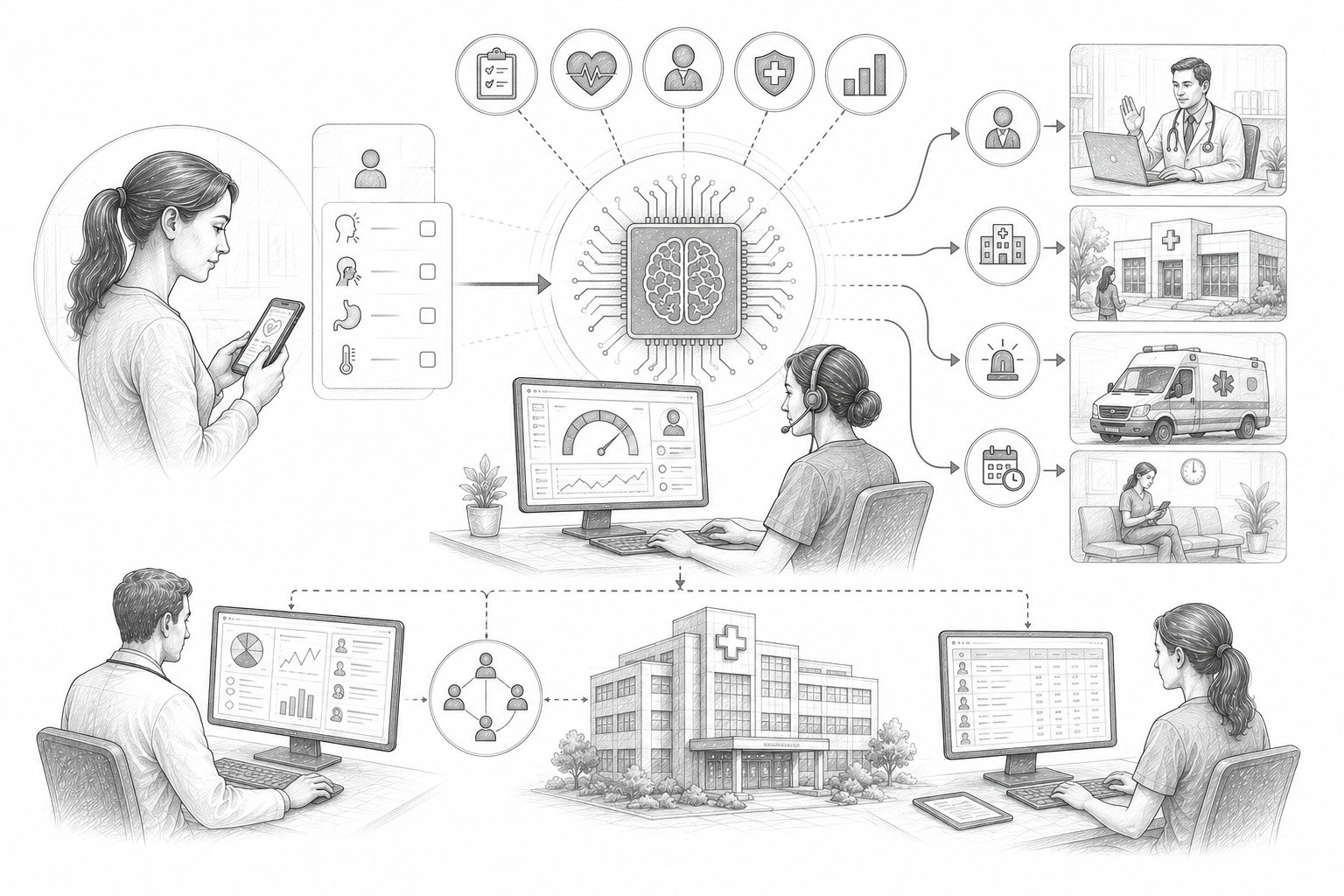
Healthcare systems are under increasing pressure to provide faster access to care while managing growing patient volumes, clinician shortages, and rising operational costs. Patients expect immediate medical guidance, shorter wait times, and personalized healthcare experiences, while providers strive to deliver high-quality care without overwhelming clinical teams.
Traditional patient triage methods often rely on manual assessments, lengthy phone calls, or in-person evaluations before patients receive appropriate care. These processes can create delays, increase administrative workloads, and make it difficult to prioritize patients based on clinical urgency.
Artificial intelligence is changing this landscape through AI patient triage. By analyzing patient symptoms, medical history, and risk factors in real time, intelligent triage platforms help healthcare organizations direct patients to the appropriate level of care more quickly and accurately.
Rather than replacing healthcare professionals, AI-powered triage serves as a clinical support tool that improves efficiency, enhances decision-making, and enables better patient experiences across digital healthcare environments.
As healthcare organizations continue expanding digital services, intelligent patient triage is becoming a foundational component of modern care delivery.
Patient triage is the process of assessing a patient's condition and determining the urgency of care required.
Traditionally, triage has been performed by nurses or physicians using clinical protocols and standardized questionnaires. While effective, manual triage can become time-consuming during periods of high patient demand.
Modern AI patient triage solutions enhance this process by using machine learning, clinical guidelines, and predictive analytics to evaluate patient information in real time.
These platforms can analyze:
Based on this information, AI recommends the most appropriate care pathway while supporting clinicians with consistent, evidence-based assessments.
The result is faster patient routing, improved prioritization, and more efficient healthcare delivery.
Healthcare demand continues to increase while clinical resources remain limited.
Many organizations experience operational challenges, such as:
Emergency departments and primary care clinics frequently experience overcrowding, making timely patient assessment increasingly difficult.
Healthcare professionals spend considerable time collecting patient information before clinical evaluation begins.
Patient prioritization may vary depending on clinician experience, workload, or available information.
Manual triage processes often delay treatment for both urgent and non-urgent cases.
Traditional triage methods are not always designed to support remote consultations or digital-first healthcare services.
These challenges highlight the need for intelligent technologies that improve both operational efficiency and patient access to care.
One of the most valuable capabilities of intelligent triage platforms is AI symptom assessment.
Instead of relying solely on fixed questionnaires, AI continuously analyzes multiple data points to generate more personalized clinical recommendations.
AI symptom assessment can:
Patients showing signs of serious conditions can be prioritized for immediate medical attention.
AI determines whether patients should visit an emergency department, schedule a primary care appointment, attend an urgent care clinic, or receive a virtual consultation.
Recognizing potential health risks earlier enables providers to begin treatment before conditions worsen.
Patients receive clearer recommendations about their next steps, reducing uncertainty and unnecessary healthcare visits.
By providing clinicians with better information before consultations begin, AI symptom assessment improves both efficiency and care quality.
 Healthcare organizations are increasingly adopting digital triage systems as part of their broader digital transformation strategies.
Unlike traditional triage workflows, digital platforms enable patients to complete assessments through mobile applications, patient portals, or web-based interfaces before interacting with healthcare providers.
Modern digital triage systems support:
These capabilities reduce administrative workloads while ensuring patients are directed to the right healthcare professional at the right time.
Digital triage also improves operational consistency by applying standardized assessment protocols across healthcare organizations.
The rapid expansion of virtual care has increased the importance of intelligent patient triage.
Telehealth appointments continue to grow, but healthcare providers must determine which patients are appropriate for remote consultations and which require in-person evaluation.
AI-powered triage platforms help healthcare organizations make these decisions more effectively by evaluating patient symptoms before appointments are scheduled.
Benefits include:
By integrating AI patient triage into virtual care workflows, healthcare organizations can deliver timely care while optimizing clinical resources.
Successfully implementing AI-powered triage requires more than deploying software.
Healthcare organizations must integrate patient data, clinical workflows, electronic health records, scheduling platforms, and communication systems into a unified digital environment.
Modern healthcare AI services help providers build scalable AI ecosystems that support intelligent triage while ensuring security, interoperability, and regulatory compliance.
These services include:
Evaluating digital maturity and identifying opportunities for AI implementation.
Connecting clinical systems, patient records, and digital health platforms.
Embedding AI into patient intake and clinical workflows.
Ensuring transparency, compliance, and continuous model improvement.
When implemented strategically, healthcare AI services enable organizations to modernize patient access while improving operational performance.
As artificial intelligence becomes more deeply embedded in healthcare delivery, many intelligent triage applications are being developed as SaMD solutions (Software as a Medical Device). These software applications perform medical functions independently of hardware devices and are increasingly supporting patient assessment, clinical prioritization, and care delivery.
Examples include:
When integrated into AI patient triage workflows, these technologies help clinicians identify high-risk patients earlier, prioritize urgent cases, and recommend appropriate care pathways with greater confidence.
Because these solutions often influence clinical decision-making, they must comply with regulatory requirements while maintaining transparency, accuracy, and patient safety. As healthcare organizations continue expanding digital healthcare services, compliant SaMD solutions will play an increasingly important role in intelligent triage ecosystems.
Building scalable AI patient triage platforms requires expertise in healthcare technology, artificial intelligence, interoperability, cybersecurity, and regulatory compliance.
A specialized healthtech engineering partner helps healthcare organizations design intelligent triage solutions that integrate seamlessly with electronic health records, scheduling systems, communication platforms, and clinical workflows.
Before implementing AI-driven patient triage, many healthcare organizations benefit from developing a custom AI strategy report that evaluates current digital capabilities, identifies operational challenges, assesses AI readiness, and prioritizes automation opportunities that improve both patient care and organizational efficiency.
Experienced engineering teams help organizations with:
Instead of deploying isolated digital tools, healthcare organizations can build connected ecosystems where AI supports patients and clinicians throughout every stage of the care journey.
This strategic approach enables providers to improve patient access while creating scalable healthcare infrastructures for future growth.
Healthcare organizations that successfully implement AI-powered triage typically follow several best practices.
AI recommendations should always support healthcare professionals rather than replace clinical judgment.
Healthcare providers remain responsible for final patient care decisions.
Successful AI implementation requires seamless integration with electronic health records, appointment scheduling platforms, laboratory systems, and patient communication tools.
Accurate patient information improves AI performance and supports more reliable symptom assessment.
Organizations should establish strong data governance practices before implementing intelligent triage platforms.
AI should simplify healthcare access through intuitive digital interfaces, personalized recommendations, and faster care navigation.
Healthcare organizations should regularly evaluate AI accuracy, patient outcomes, workflow efficiency, and user satisfaction to ensure continuous improvement.
Patient triage will continue evolving as artificial intelligence becomes more sophisticated.
Emerging technologies such as generative AI, conversational healthcare assistants, wearable health devices, predictive analytics, and real-time patient monitoring will further improve digital triage capabilities.
Future AI patient triage platforms are expected to provide:
As healthcare organizations continue investing in digital transformation, AI patient triage will become an essential component of connected healthcare delivery.
Organizations that adopt intelligent triage today will be better positioned to improve patient outcomes, optimize healthcare operations, and deliver more accessible care.
Healthcare organizations are increasingly recognizing that faster access to care begins with better patient assessment.
AI patient triage helps providers improve clinical prioritization, reduce administrative burden, enhance patient experiences, and support more efficient healthcare delivery.
By combining AI symptom assessment, digital triage systems, virtual care, and intelligent healthcare technologies, organizations can build connected patient journeys that improve both operational efficiency and clinical outcomes.
Healthcare providers planning their digital transformation journey can begin with a custom AI strategy report to identify opportunities for automation, optimize patient access, and develop a roadmap for scalable AI implementation.
Explore how Ekipa's healthcare AI services help healthcare organizations design intelligent patient triage solutions that improve care delivery, streamline operations, and support long-term digital healthcare innovation.
AI patient triage uses artificial intelligence to assess patient symptoms, evaluate clinical urgency, and recommend the most appropriate care pathway based on real-time healthcare data.
AI symptom assessment analyzes patient information to identify potential health risks, prioritize urgent cases, and guide patients toward the appropriate level of care more quickly and accurately.
Digital triage systems are technology platforms that automate patient assessment, symptom collection, and clinical prioritization through mobile applications, patient portals, or web-based healthcare services.
AI improves virtual care by helping providers assess patients before consultations, prioritize appointments, automate patient intake, and deliver more personalized healthcare experiences.
A healthtech engineering partner helps organizations integrate AI technologies, ensure interoperability and regulatory compliance, optimize digital workflows, and build scalable healthcare platforms that support long-term innovation.
How to build HIPAA-compliant AI: when LLM providers need a BAA, data minimization, de-identification, audit controls and a reference architecture.

Practical data migration planning guide for healthcare teams. Scope, mapping, compliance, validation, cutover and rollback decisions explained end to end.

Smart on FHIR guide for healthtech engineers. Learn the OAuth 2.0 launch model, scope syntax, backend services, and US regulatory requirements.
Connect with our team to explore how AI expertise can transform your business.