
AI in Healthcare
HIPAA-Compliant AI: How to Use LLMs With PHI Safely
How to build HIPAA-compliant AI: when LLM providers need a BAA, data minimization, de-identification, audit controls and a reference architecture.
October 16, 2026Read more
Predictive analytics is transforming patient transition management by identifying risks, improving care coordination, and enabling timely interventions. It helps healthcare providers reduce readmissions and deliver smoother patient care transitions.
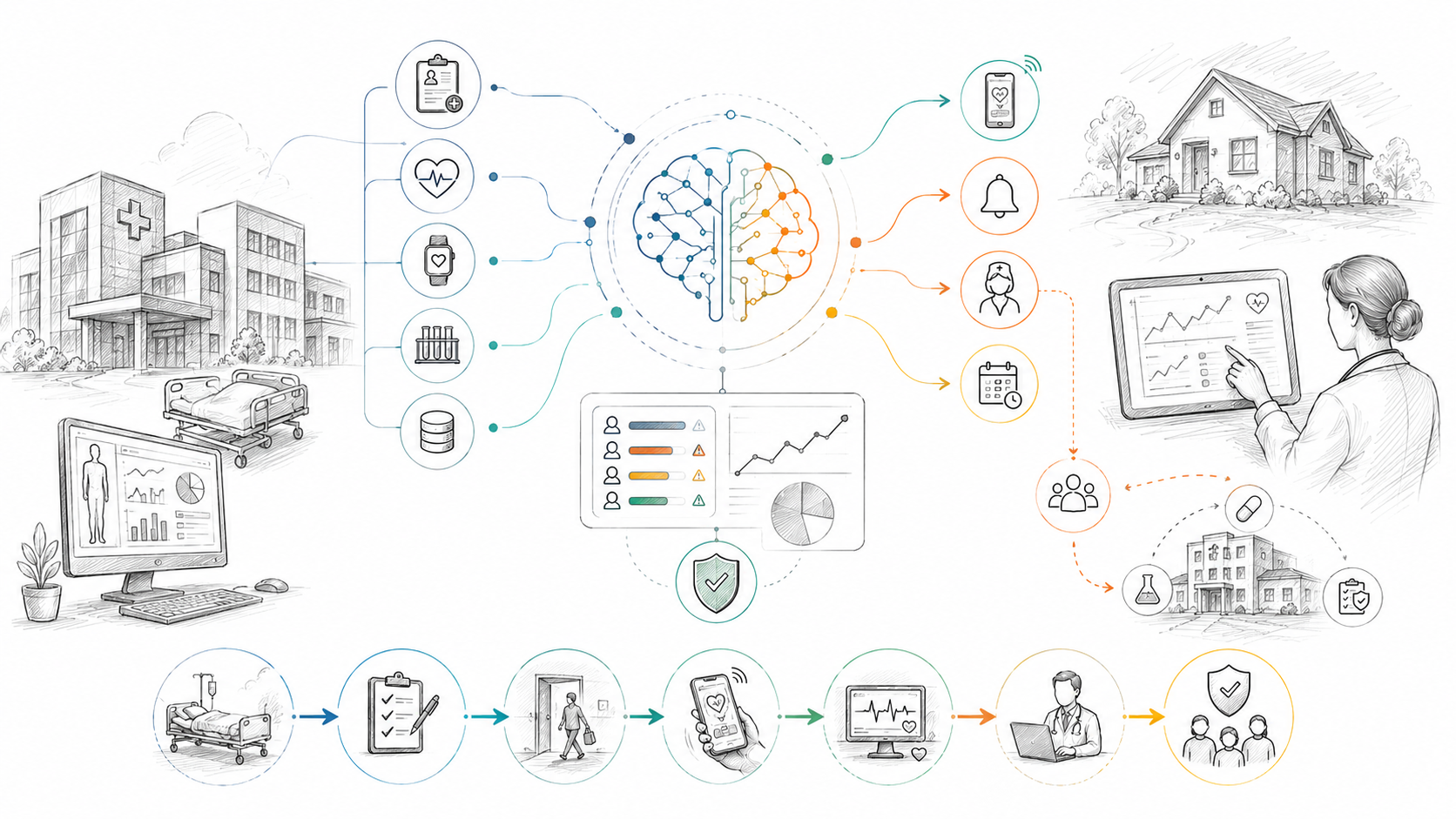
Patient transition management covers every stage of care transfer after a patient leaves one setting and enters another. A patient may move from a hospital room to home care, a rehabilitation unit, or a specialty clinic. During these shifts, gaps in care can lead to readmissions, delayed treatment, communication breakdowns, and rising medical costs. Many clinical teams struggle with limited visibility after discharge, slow response times, and patient records spread across different systems. Predictive analytics in healthcare gives care providers a practical way to review risks early, take timely action, and keep patient care connected.
Modern healthcare systems generate vast amounts of patient information every day. Hospitals, clinics, laboratories, pharmacies, and remote monitoring platforms collect data during diagnosis, treatment, recovery, and follow‑up care. Predictive technologies use this information to identify patterns, assess patient risks, and guide clinical teams toward faster decisions. Working with a healthtech engineering partner gives healthcare providers the ability to manage this data more effectively and apply predictive insights in real clinical settings. This approach offers a clearer view of patient conditions before complications become serious.
Predictive analytics in healthcare uses AI, machine learning, and patient history to forecast medical outcomes. Hospitals and clinics rely on these systems to identify patients at high risk, predict readmissions, track recovery progress, and improve treatment plans.
Instead of waiting for a condition to worsen, predictive systems review patient behavior, medical records, and clinical trends to detect warning signs early. Physicians and care coordinators can then act quickly, creating safer and more organized care transitions.
AI systems process large volumes of healthcare data from different clinical sources. Machine learning models study patient patterns, compare current conditions with records, and highlight unusual changes that may need attention.
For example, if a patient shows irregular heart rate patterns after discharge, AI systems can flag the risk immediately and alert care teams for review. This gives physicians faster visibility during critical moments and strengthens communication across departments.
Healthcare AI services also reduce the need for manual data review. Clinical teams receive organized insights, risk scores, and automated alerts that improve efficiency across patient transitions.
Healthcare organizations gather different kinds of patient information for predictive analysis. Each source gives physicians a wider view of patient health and recovery progress.
Electronic Health Records include diagnoses, medications, allergies, treatment history, physician notes, and discharge summaries. These records give clinical teams a complete picture of a patient’s medical journey.
Patient history covers past illnesses, surgeries, chronic conditions, lifestyle patterns, and family medical background. This information helps physicians identify long‑term health risks and recurring medical concerns.
Remote monitoring devices track health information in real time, such as heart rate, blood pressure, oxygen levels, glucose readings, and sleep activity. These updates keep care teams informed after discharge.
Laboratory reports include blood test results, imaging findings, pathology reports, and diagnostic evaluations. Predictive systems use this data to detect changes in patient condition and recovery progress.
Real-time patient data comes from connected healthcare systems, wearable devices, remote consultation platforms, and live monitoring tools. Continuous data flow gives care teams faster visibility during recovery and emergencies.

Healthcare systems today manage a growing number of patients with chronic conditions across different care environments. Home care programs, virtual consultations, and remote monitoring services now reach wider patient groups. A single patient journey may involve physicians, nurses, specialists, pharmacies, laboratories, and rehabilitation teams.
Patient transition management now requires ongoing coordination at every stage of care. Missing records during handoffs can lead to medication errors, delayed recovery, and avoidable hospital readmissions. Care teams also face challenges in identifying high‑risk patients across large populations.
Care continuity has become a major concern for hospitals with increasing discharge volumes. Patients often leave clinical facilities with limited awareness of follow‑up care, incomplete understanding of medications, or delayed specialist appointments. Fragmented communication between departments adds further pressure on medical teams. A custom AI strategy report can guide healthcare organizations in addressing these challenges by identifying data gaps and improving coordination across care transitions.
Hospitals use predictive analytics in healthcare to review the risk of readmission early. AI models study past admission records, medication history, chronic disease patterns, and current clinical conditions. Risk scores guide care coordinators toward patients who may need quick follow‑up after discharge.
For example, a patient with heart disease may leave the hospital after a short‑term recovery. Later, real‑time monitoring data might show unusual blood pressure patterns or irregular medication use. Care teams can reach out early and arrange a medical review before the condition becomes severe.
Discharge planning depends on accurate patient assessment before release. Predictive systems review recovery history, current symptoms, medication response, and patient age to guide planning. Physicians can prepare recovery plans with scheduled follow‑up visits, rehabilitation checks, and home monitoring recommendations.
Clinical staff also gain a clearer view of patients who may face mobility challenges, medication confusion, or delayed recovery after discharge. Early planning reduces gaps across care delivery.
Hospitals now use automated alerts for patients with rising medical risk after discharge. AI systems track patient status continuously and notify care teams when unusual activity appears.
For instance, a patient recovering from surgery may record fever symptoms through a remote monitoring device. Alerts guide physicians toward rapid review before complications become serious. Timely follow‑up care reduces emergency admissions and improves recovery experiences.
Connected monitoring devices collect patient information after discharge in home settings. Physicians receive updates on heart rate, glucose levels, oxygen saturation, sleep patterns, and medication activity.
Predictive analytics in healthcare gives hospitals a way to observe patients continuously across large populations. Remote review also reduces unnecessary hospital visits for stable patients and improves resource use across busy healthcare systems.
Care coordination depends on accurate information sharing across hospitals, specialty clinics, laboratories, pharmacies, and home care providers. Unified data systems reduce confusion during patient transfers.
When physicians gain quick access to patient history and treatment records, decisions become faster and safer. Coordinated workflows also reduce repeated testing, medication conflicts, and treatment delays.
Predictive technologies give healthcare organizations a clearer view of patient risks, operational gaps, and care priorities. Clinical teams can act faster, reduce delays, and improve coordination during patient transitions. SaMD solutions also play a role by integrating predictive insights directly into clinical workflows, making patient transitions more organized and efficient.
Reduced Hospital Readmissions: Early risk detection gives physicians time to arrange follow‑up care before conditions become severe.
Faster Clinical Decision Making: Real‑time patient insights guide physicians toward quicker treatment planning and medical review.
Improved Resource Allocation: Hospitals can assign staff, beds, equipment, and clinical attention based on patient risk levels.
Lower Operational Costs: Fewer emergency visits, reduced duplicate testing, and smoother workflows lower healthcare expenses.
Improved Patient Outcomes: Continuous monitoring and early intervention strengthen recovery progress and patient safety.
Reduced Administrative Burden: Automated alerts, digital records, and AI‑based analysis cut down on manual review tasks for healthcare teams.
Real-time data plays a central role during modern care transitions. Monitoring devices, EHR systems, laboratory updates, and remote consultation platforms generate continuous streams of patient information. AI systems review this data quickly and highlight unusual clinical patterns. Early alerts guide physicians toward rapid medical response when a patient’s condition begins to decline. Automated workflows also reduce the need for manual review by clinical teams.
Integrated healthcare systems create a clearer path for patient review across multiple departments. Faster access to information strengthens communication and coordination across large healthcare networks.
Healthcare organizations still face several barriers when adopting predictive systems. Data privacy remains a major concern, especially in clinical environments that manage large patient records. Many hospitals also work with disconnected software platforms that have limited interoperability. Inconsistent data across systems can reduce the accuracy of analysis during patient review. Training clinical staff is another challenge. Physicians and nurses need practical guidance to use AI‑based workflows in daily care activities. Large patient datasets also create storage and management pressure for healthcare organizations.
Future healthcare systems may use advanced AI models to create highly personalized recovery plans for patients. Predictive platforms could guide physicians toward earlier disease intervention and more accurate discharge timing. Remote patient observation is likely to expand across larger populations through wearable devices and connected monitoring tools. Population health programs may also gain deeper insight into community‑level disease patterns and recovery outcomes.
Healthcare organizations continue to build connected care ecosystems with unified patient records, real‑time communication, and data‑driven clinical planning.
Modern healthcare systems need faster coordination, clearer communication, and early patient risk review across every stage of recovery. Predictive analytics in healthcare gives providers practical insight for proactive planning, timely intervention, fewer care gaps, and reduced avoidable readmissions. Connected clinical systems also strengthen patient experience during discharge and recovery. Contact us to discuss modern patient care transformation and connected healthcare systems.
Predictive analytics in healthcare helps hospitals identify high-risk patients early, reduce readmissions, and improve patient transition management through faster clinical decisions and proactive follow-up care.
A healthtech engineering partner helps healthcare organizations connect systems, manage patient data, and build smarter workflows that strengthen care continuity across healthcare environments.
Healthcare AI services support risk analysis, automated alerts, remote monitoring, and patient transition management by giving clinical teams real-time patient insights.
A custom AI strategy report helps organizations identify workflow gaps, improve data coordination, and strengthen care continuity through connected predictive healthcare systems.
SaMD solutions support remote patient monitoring, predictive alerts, and digital care coordination, helping healthcare teams manage patient transition management more efficiently.
How to build HIPAA-compliant AI: when LLM providers need a BAA, data minimization, de-identification, audit controls and a reference architecture.

Practical data migration planning guide for healthcare teams. Scope, mapping, compliance, validation, cutover and rollback decisions explained end to end.

Smart on FHIR guide for healthtech engineers. Learn the OAuth 2.0 launch model, scope syntax, backend services, and US regulatory requirements.
Connect with our team to explore how AI expertise can transform your business.