AI in Healthcare
HIPAA-Compliant AI: How to Use LLMs With PHI Safely
How to build HIPAA-compliant AI: when LLM providers need a BAA, data minimization, de-identification, audit controls and a reference architecture.
October 16, 2026Read more
How to choose an AI implementation partner in healthcare: Evaluate expertise, compliance, data security, scalability, and ROI.

Before you even think about looking for an AI partner, you have to get your own house in order. It all starts with a crystal-clear internal vision. You need to nail down concrete objectives for your AI project—things like cutting patient no-show rates by 15% or taking hours off diagnostic imaging analysis. This groundwork is non-negotiable; it's what separates a project that delivers real value from one that just burns cash.

Jumping into vendor meetings without a solid strategy is a recipe for disaster. It’s like starting a road trip with no map and no destination. You'll definitely go somewhere, but it probably won't be where you needed to be. The most critical first step is to look inward, figuring out exactly what your organization needs and what you hope to achieve.
This goes way beyond vague goals like "improving efficiency." We're talking about a deep, honest assessment of the real pain points in your clinical workflows, patient management, or back-office operations. Is your billing department buried under a mountain of manual claims? Are your clinicians bogged down by data entry when they should be with patients? These are the specific, tangible problems that a well-chosen AI solution can actually solve.
To get the full picture, you have to bring the right people into the room from the very beginning. A strong AI vision isn't dreamed up in an IT silo. It's built through collaboration. Your team needs a mix of stakeholders who can share what's really happening on the ground.
Make sure you include people from:
Clinical Staff: The nurses, doctors, and specialists who live the day-to-day workflows and can spot real opportunities for things like clinical decision support.
IT and Data Specialists: Your tech experts who understand the current infrastructure, EHR systems, and crucial data governance policies.
Administrative Leaders: The department heads and managers who know the reality of billing logjams, scheduling nightmares, and resource constraints.
Compliance and Legal Officers: These are the folks who will make sure any potential solution is buttoned up from a HIPAA and regulatory standpoint right from the start.
Getting everyone involved early creates buy-in and makes sure the final plan actually works in the real world. This simple step helps you dodge the common mistake of picking a technology that sounds impressive but just doesn't fit how your people work.
With your team in place, it’s time to dig deep into a proper needs assessment. This isn’t just a feature wish list; it’s about dissecting the problems you're trying to solve. Start by mapping your current processes and flagging the specific bottlenecks or areas crying out for improvement.
For example, instead of a fuzzy goal like "use AI for scheduling," a targeted objective is much more powerful: "implement an AI-powered system that predicts high-risk no-show appointments and automates personalized reminders to cut our no-show rate."
This level of clarity is priceless. It shifts your search from a generic tech hunt to a focused mission to find a partner who can deliver measurable results. Getting this right is a cornerstone of a solid AI strategy, and it’s how we've seen organizations find successful AI solutions for the healthcare industry.
Once you have a clear vision, the real work begins: finding a partner who can actually build it. A slick sales pitch and a flashy demo mean nothing if the team behind the curtain lacks two critical, non-negotiable qualities: deep technical chops and genuine healthcare fluency. Lots of firms can talk a good game about AI, but only a handful truly get the complex, high-stakes world of patient care.
Choosing the right partner is far more than a technical decision; it's a strategic one. Before you dive into the specifics of AI, it’s worth reviewing the fundamentals. Broader advice on how to pick the best software development company offers some universal truths for assessing technical skill and reliability that absolutely apply here.
The first, most important filter is to look right past their theoretical capabilities and demand proof of deployed solutions. Don’t settle for “we can do this.” Ask for “we have done this.” A serious partner’s portfolio will be full of proven, deployed real-world use cases—specifically in healthcare. These aren't just pretty case studies on a website; they are tangible examples of their work driving actual results in a clinical or operational setting.
Get ready to dig deep into their past projects. You need to ask pointed questions that cut through the marketing fluff and reveal their true experience:
"Walk us through a project where you had to integrate with a legacy EHR system. What were the biggest hurdles you hit, and how did you solve them?"
"Describe your model validation process for a clinical decision support tool. How did you prove its accuracy and safety to the satisfaction of clinicians?"
"How do you handle sensitive patient data during the development and testing phases? Give me the specifics."
Their answers will quickly separate the seasoned pros from the newcomers. A true partner will speak with confidence about navigating data silos, cleaning up messy, real-world data, and understanding the nuances of clinical workflows—because they’ve lived it. This is a critical piece of our own AI Product Development Workflow.
Technical skill in a vacuum is useless in this industry. The best AI models are built by teams who intimately understand the context behind the data. Your partner's data scientists, engineers, and project managers have to speak the language of healthcare. They need to know the difference between a CPT code and an ICD-10 code, truly grasp the gravity of HIPAA, and understand the day-to-day pressures your clinicians are under.
This is where you have to look at the résumés and backgrounds of the people on their team.
Do they have clinicians or healthcare informaticists on staff?
Can their data scientists hold a real conversation about patient pathways or revenue cycle management without you having to explain the basics?
A partner without this deep domain knowledge will require constant hand-holding. That slows down the project, inflates costs, and dramatically increases the risk of building a tool that, while technically sound, is practically useless to your staff. You need a team that can act as a true extension of your own.
This is exactly why it’s so important to evaluate the people, not just the technology. You can see the kind of blended expertise I'm talking about by getting to know our expert team.
Finally, a powerful AI tool that can’t connect to your existing systems is just an expensive, isolated piece of software. Seamless integration with your Electronic Medical Record (EMR) or Electronic Health Record (EHR) systems and other internal tooling is non-negotiable. A potential partner must show you a proven track record of successfully connecting their solutions to the major EHR platforms like Epic, Cerner, or Allscripts.
Don't underestimate how tough this can be. A recent KPMG report found that while 65% of US healthcare organizations see the major impact of AI, only 33% work with more than three specialist AI partners. This gap exists because finding the right collaborators is incredibly hard, partly because 47% of organizations cite a lack of AI talent as a massive obstacle. Learn more about these healthcare AI adoption findings. This scarcity makes vetting a partner's real-world integration experience more critical than ever.
In healthcare, patient data isn't just data—it’s a person's life story, and protecting it is non-negotiable. One wrong move doesn’t just risk a fine; it shatters patient trust. When you bring an AI partner on board, you’re handing them the keys to your most sensitive asset. Their commitment to data governance and regulatory compliance can't just be a line item in a contract; it has to be part of their DNA.
This goes way beyond a simple HIPAA compliance checkbox. You need a partner who genuinely understands the weight of applying AI to patient care. A reactive "we'll fix it if it breaks" attitude is a deal-breaker. Look for a team that builds their AI solutions with security and privacy as the bedrock, not as an afterthought.
You need to put their security infrastructure under a microscope. Don't settle for vague promises. Dig into the specifics of how they safeguard Protected Health Information (PHI) from end to end.
Get straight to the point with these fundamental questions:
Encryption Standards: How is data protected both in transit and at rest? Make them specify the protocols. Vague answers aren't good enough.
Access Controls: Who on their team gets to see patient data? They should be able to clearly explain their "principle of least privilege," ensuring access is granted only when absolutely necessary.
Audit Trails: Can they show you a detailed, unchangeable log of who accessed PHI, when they did it, and why? This is crucial for accountability.
If a potential partner gets defensive or fuzzy when you ask these questions, consider it a major red flag. A true expert in healthcare AI will welcome this scrutiny and present their security measures as a core strength.
This level of due diligence is standard for any custom healthcare software development, but it becomes even more critical with AI, given the sheer volume of sensitive data the models require.
A strong security setup is just the start. The right partner will also have a sophisticated data governance framework—a rulebook for how data is managed, used, and protected from the moment they receive it. This is where you see if they truly get the nuances of healthcare data.
Given how fast privacy laws are changing, they must be experts in navigating the regulatory maze. For more context on this, you can explore resources on data privacy and GDPR evolution with AI & Big Data.
Ask them to walk you through their processes for data de-identification and anonymization. This is a critical skill. Can they prove they can strip patient identifiers from datasets for model training without losing the clinical value of the information? A clear, documented process here is a huge sign of maturity.
Their governance should also tackle the ethical side of AI head-on. How do they work to prevent bias in their algorithms? A partner who is serious about ethical AI will have clinicians and ethicists involved in reviewing models to catch unintended consequences. As we guide clients in our AI strategy consulting practice, we stress that this commitment is the foundation for building trust and ensuring the technology actually helps, rather than harms.
This is where the rubber meets the road. Moving from talk to tangible results is the only way to truly vet a potential AI partner. A well-designed Proof of Concept (PoC) or pilot program is your best friend here, giving you a low-risk, real-world glimpse into how a vendor's technology—and just as importantly, their team—operates within your four walls.
Think of it less as a tech demo and more as a trial run of the entire relationship. Before you sign a massive contract, you need to see how they handle pressure, feedback, and the inevitable hiccups.
The biggest mistake I see organizations make is trying to solve every problem at once, a pitfall we explored in our AI adoption guide. Avoid scope creep like the plague. For a pilot, you must narrow your focus to a single, high-impact use case where you can score a quick, measurable win.
For instance, if your hospital is constantly dealing with last-minute appointment cancellations, a perfect pilot would be to test an AI tool that predicts no-shows and automates smart reminders. It's a contained problem with a clear ROI, making it an ideal test case.
Before anyone writes a single line of code, you and the vendor must sit down and agree, in writing, on what a "win" looks like. Setting clear, objective success metrics from day one is non-negotiable. These shouldn't be vague goals; they need to tie directly back to the problem you're trying to solve.
Your success criteria should be a mix of hard numbers and practical outcomes. For example:
Clinical Impact: Can the tool lead to a 10% reduction in diagnostic errors for a specific imaging test?
Operational Lift: Does it cut down the average time for prior authorization approvals by 48 hours?
Financial Return: Can we see a 15% reduction in administrative overhead in the billing department?
User Adoption: Do we see an 80% adoption rate among the pilot group of clinicians within the first 60 days?
Getting these Key Performance Indicators (KPIs) locked down eliminates any guesswork later on. It’s a vital part of the overall AI Product Development Workflow and ensures both sides are aiming for the same target.
With your use case and metrics in place, the final step is building the framework to judge the pilot's success. A good pilot validates much more than just the algorithm; it stress-tests the partnership itself.
Pull together the same cross-functional team you used for your initial needs assessment—get clinicians, IT security, and administrators back in the room. You need their diverse perspectives to get a complete picture.
The goal of a pilot isn’t just to see if the AI works. It’s to see if you can work with the people who built it. A technically brilliant solution is useless if the partner is impossible to collaborate with, misses deadlines, or doesn’t understand your feedback.
This entire process is layered with complex data and regulatory hurdles. Any AI initiative in healthcare must be built on a foundation of compliance, covering everything from HIPAA to patient data security.
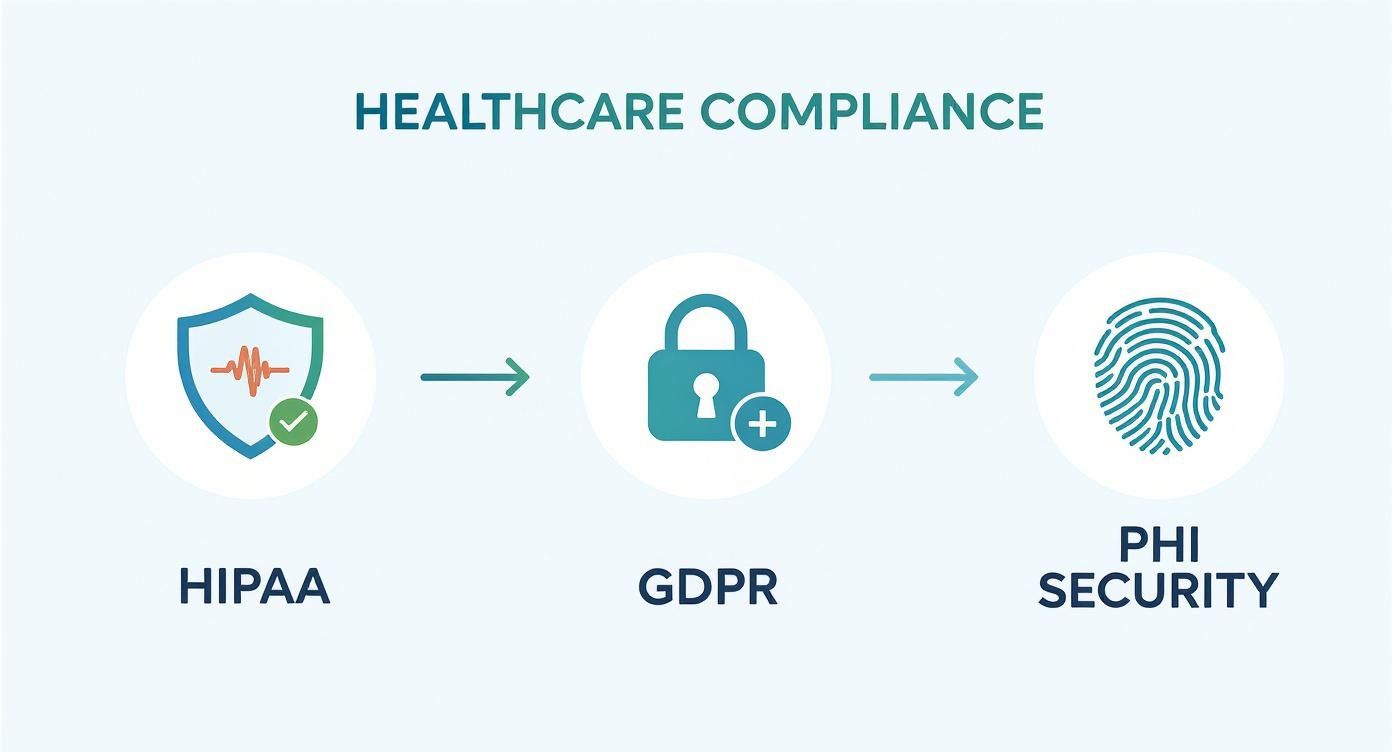
How a potential partner navigates these requirements during a small-scale pilot is a massive tell. If they are fluent in the language of PHI security and data governance now, it's a strong signal they're ready for a long-term engagement.
To keep your evaluation objective and data-driven, use a scoring matrix. This simple tool helps you compare vendors side-by-side, moving beyond gut feelings to a structured assessment. It ensures all stakeholders are evaluating candidates against the same consistent criteria.
| Evaluation Criteria | Vendor A Score (1-5) | Vendor B Score (1-5) | Notes & Key Differentiators |
|---|---|---|---|
| Technical Performance | 4 | 5 | Vendor B's model showed higher accuracy (92% vs. 88%). |
| Clinical Workflow Integration | 5 | 3 | Vendor A's UI was far more intuitive for our nurses. Seamless EHR integration. |
| Data Security & HIPAA Compliance | 5 | 5 | Both vendors demonstrated excellent security protocols during the pilot. |
| Team Collaboration & Support | 4 | 2 | Vendor A was proactive; Vendor B's support was slow to respond to issues. |
| Scalability & Future Roadmap | 3 | 4 | Vendor B has a clearer roadmap for future features we need. |
| Cost & ROI Projections | 4 | 3 | Vendor A is more expensive upfront but shows a faster path to positive ROI. |
| Total Score | 25 | 22 |
After the pilot wraps up, use this matrix in a formal debriefing session. Collect all the feedback, analyze the performance against your KPIs, and use this evidence to make your final, confident decision.
Choosing an AI implementation partner in healthcare is less like buying a tool and more like entering into a long-term relationship. Your first project is just the beginning. The real payoff comes from a partner who can grow with you, scaling solutions across departments and adapting to challenges you haven't even encountered yet.
Think far beyond the initial pilot. You need to be sure their technology is built for the future. Can their systems handle a 10x increase in data when you roll out a diagnostic tool hospital-wide? Will their platform stay responsive when thousands of clinicians are hitting it at the same time? A vendor who gets cagey about these questions or lacks a clear technical roadmap is a serious red flag.
A great partner doesn't just sell you what they have today; they show you where they're headed. It's time to dig into the product roadmap for their AI tools for business. Are they actively pouring resources into R&D, or are they just playing catch-up with the competition?
You're looking for a genuine commitment to innovation. Their roadmap should tell a story about where healthcare is going, not just list a few generic feature updates. This foresight is what keeps the platform you invest in today from becoming a legacy system in three years.
A partner’s vision for the future is a direct reflection of their potential value to your organization. If their roadmap doesn't excite you or align with your long-term strategic goals, they are likely not the right fit for a lasting partnership.
This kind of forward-looking evaluation is a core part of effective AI strategy consulting. It’s about making sure your partner can support the entire journey, from a single use case to an enterprise-wide AI program.
Technical scalability is only half the battle. The other half is human—their ability to support your organization as you become more reliant on their solutions. A true partner should feel like an extension of your own team, not just a helpdesk you call when something breaks.
You need to look closely at their entire support and training framework:
Onboarding and Training: Do they offer hands-on training that gets your staff comfortable and confident? How do they cater to people with different technical skills?
Ongoing Support: What happens after go-live? Will you have a dedicated account manager who knows your goals, or will you be just another ticket in a queue? The pilot phase is a great time to test their responsiveness.
Strategic Guidance: Do they offer proactive advice? A partner that helps you spot new opportunities for AI and refine your strategy becomes an invaluable advisor over time.
This level of support is critical for successful AI adoption, which often depends on an organization's resources. We see a significant gap in healthcare: large hospitals (over 400 beds) have adoption rates between 90% and 96%, while smaller hospitals (fewer than 100 beds) lag far behind at 53% to 59%. Similarly, urban hospitals are at 77-81% integration, compared to just 48-56% for rural ones. You can discover more about these AI adoption trends in U.S. hospitals.
A partner who understands these realities and can offer a support model that scales with you is built for the long haul. Their expertise is what ensures your AI initiatives deliver real, sustained value. The best partner is one who is genuinely invested in your success because they know your growth is their growth. Building that relationship means knowing who you're working with, which is why it's so important to meet and evaluate the people behind the product. Take a moment to get to know our expert team and see what a true partnership looks like.
A good partnership is about more than just a handshake and a shared vision. It’s grounded in a rock-solid contract and a detailed Service Level Agreement (SLA) that protects everyone involved and keeps the project on track. This is where you translate all your planning and vendor discussions into a binding, success-focused framework.
Think of this agreement as the constitution for your partnership. It needs to be far more specific than a standard vendor contract, especially when dealing with the intricacies of healthcare AI. You have to be crystal clear on who owns what—from the underlying AI models to the new data your system will generate. Getting this wrong can lead to major headaches down the road.
Vague goals are the fastest way to a failed project. Your SLA needs to be packed with specific, measurable Key Performance Indicators (KPIs) that connect directly to the clinical and operational goals you set out from the very beginning. We're not just talking about technical specs; we're talking about real-world impact.
Your SLA should get granular on metrics like:
System Uptime: For a critical clinical decision support tool, anything less than a 99.9% availability guarantee should be a non-starter.
Model Accuracy: What's the minimum acceptable accuracy for a diagnostic model? And what’s the protocol for immediate retraining if its performance drops below that threshold?
Support Response Times: You need explicitly defined response times for technical support, with faster turnarounds for issues that could directly impact patient care.
These KPIs aren't just for show. They are the tools you'll use to hold your partner accountable and objectively measure the value their AI solutions are delivering. It ensures everyone is marching toward the same finish line.
AI pricing isn't one-size-fits-all. It can range from simple subscription fees to complex agreements where the vendor gets paid based on the results they deliver. The right model for you depends entirely on your project, your appetite for risk, and what you’re trying to achieve.
You should be ready to explore different structures:
Subscription-Based: This gives you predictable costs, which is great for ongoing services like AI Automation as a Service.
Per-Use or Transactional: Here, costs are tied to volume. This model is a great fit for high-volume, repeatable tasks like processing insurance claims.
Value-Based: This is the most aligned model. The partner's payment is directly linked to hitting specific, pre-defined outcomes. Their success becomes your success.
Hammering out these details is a crucial part of your AI strategy consulting, as it’s fundamental to seeing a real return on your investment.
Expert Tip: Be wary of any potential partner who only offers a rigid, upfront payment model. It could be a sign they aren't confident in their solution's ability to deliver long-term value. The best partners are willing to share in both the risks and the rewards.
Finally, every good contract needs a clear exit strategy. This isn't about planning for failure; it's about professional foresight. A well-defined exit clause outlines exactly how you'll transition data, models, and institutional knowledge back to your team or over to a new partner if things don't work out.
This simple step ensures that a vendor change doesn't cause a massive disruption to your operations or, more importantly, to patient care. When you have a thoughtfully crafted agreement, supported by a partner and their expert team who value transparency, you’re setting the stage for a productive relationship right from the start.
A major warning sign is a vendor who can’t show you concrete, specific real-world use cases from other healthcare organizations. If their success stories are vague or from totally different industries, that’s a problem. Another huge red flag is any hesitation or ambiguity when you bring up HIPAA compliance and data security. They should have precise, confident answers. Also, be wary of anyone pushing a generic, one-size-fits-all solution without first digging into your specific operational challenges through a thorough AI requirements analysis. If they’re not asking you tough questions, they're probably not the right partner.
Calculating the return on an AI investment isn't just about the technology's price tag; it's a comprehensive business case. You have to look at it from multiple angles. On the quantitative side, you can measure direct cost savings from reduced manual labor, efficiency gains in clinical workflows (like faster diagnostic analysis), and a drop in costly medical errors. But don't stop there. The qualitative benefits are just as crucial—improved patient outcomes, higher satisfaction scores, and a reduction in clinician burnout. A genuinely good partner won't just sell you an AI Strategy consulting tool; they'll help you build this business case from the ground up, a process detailed in a comprehensive Custom AI Strategy report.
This is a classic "it depends" situation, but the decision hinges on your specific needs and risk tolerance. Large, established tech companies bring stability, massive resources, and experience with enterprise-level deployments. The trade-off? They can sometimes be less agile, and their solutions might not have the deep clinical nuance you need. On the other hand, a specialized AI startup often lives and breathes healthcare. They usually bring deep domain expertise and a more flexible, collaborative approach. The potential downside is they might have a shorter track record or less experience scaling their solution across a large health system. Ultimately, the company's size is less important than its healthcare fluency. The right partner is the one that truly understands your world. To see what that kind of dedicated partnership feels like, we invite you to get to know our expert team.
How to build HIPAA-compliant AI: when LLM providers need a BAA, data minimization, de-identification, audit controls and a reference architecture.

Practical data migration planning guide for healthcare teams. Scope, mapping, compliance, validation, cutover and rollback decisions explained end to end.

Smart on FHIR guide for healthtech engineers. Learn the OAuth 2.0 launch model, scope syntax, backend services, and US regulatory requirements.
Connect with our team to explore how AI expertise can transform your business.