AI in Healthcare
HIPAA-Compliant AI: How to Use LLMs With PHI Safely
How to build HIPAA-compliant AI: when LLM providers need a BAA, data minimization, de-identification, audit controls and a reference architecture.
October 16, 2026Read more
Learn how to implement AI in healthcare organizations with a practical guide covering strategy, data compliance, pilot projects, and scaling for success.

Diving into AI in a healthcare setting is exciting, but jumping straight to the technology is a recipe for failure. Before you ever think about a single algorithm, you need to build a solid foundation. This is all about aligning AI goals with hospital objectives, getting a painfully honest look at your readiness, and putting together the right team to see it through. Get this phase right, and your AI initiatives will have purpose, support, and a real chance to succeed.
Think of this as the strategic blueprint for your entire AI journey. The goal here isn't just to implement tech; it's to solve real problems. That could mean anything from improving patient outcomes and slashing readmission rates to finally taming the beast of administrative overhead.
The first move is a serious readiness assessment. You need a clear-eyed view of where you stand right now. This means digging into your data infrastructure, evaluating your current tech stack, and, just as importantly, gauging the digital skills of your people. Knowing your weaknesses is just as valuable as knowing your strengths—it helps you build a realistic roadmap.
This initial spadework is what allows you to build a business case that actually gets buy-in. When you can connect an AI project to tangible value, everyone from the C-suite to the clinicians on the floor will understand why it matters.
This is not an IT project. Let me say that again: this is not an IT project. Success depends on bringing together a cross-functional team with a seat at the table from the very beginning.
Your steering committee needs to be a blend of expertise from across the hospital to ensure every angle is covered. Without this, you risk building a tool that looks great on paper but falls flat in practice.
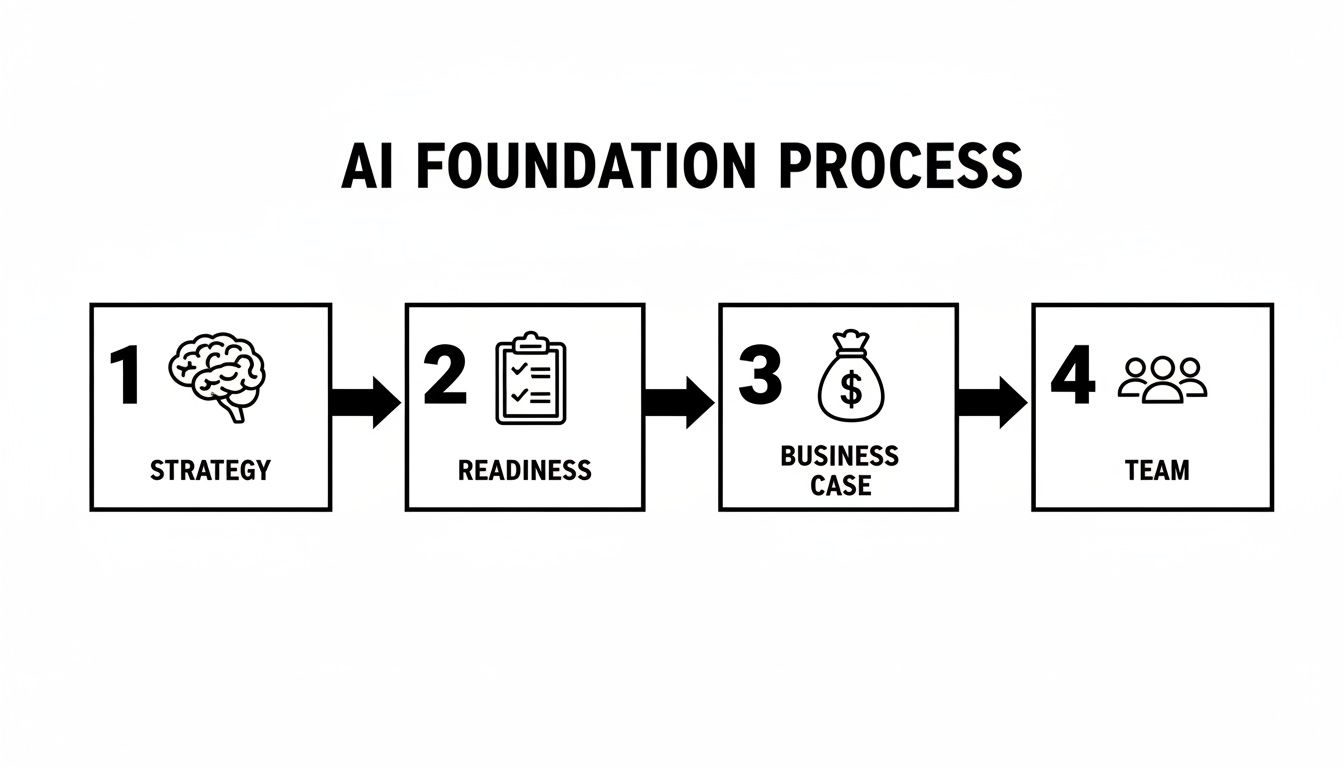
This simple flow shows how strategy, a readiness check, a solid business case, and a strong team are the four pillars holding up a successful AI implementation.
To get the right mix of perspectives, you need to pull together a dedicated group. Below is a breakdown of the core roles you’ll want to fill.
| Role | Primary Responsibilities |
|---|---|
| Clinical Champion | A respected physician or nurse leader who ensures the AI solution addresses real clinical needs, improves workflows, and is safe for patient care. They bridge the gap between the technical team and frontline staff. |
| IT/Data Lead | The technical expert responsible for data infrastructure, system integration, algorithm validation, and ensuring the tech actually works within your existing environment. |
| Compliance Officer | The gatekeeper for all things legal and ethical. This person navigates the complex web of HIPAA, GDPR, and other privacy regulations to keep the project and the organization protected. |
| Operations Manager | Focuses on the practical side of implementation. They ensure the project aligns with broader operational goals, manages the budget, and measures ROI. |
| Project Manager | The conductor of the orchestra. They keep the project on track, manage timelines, facilitate communication between all stakeholders, and clear roadblocks. |
Having these roles filled with passionate, knowledgeable people is non-negotiable. This team will be your guide, your reality check, and your biggest advocate.
It’s helpful to know where you fit in the broader picture. AI adoption in healthcare is definitely on the rise, but it's not happening evenly. There's a big gap between large hospitals (over 400 beds), which have a 96% adoption rate, and small hospitals (fewer than 100 beds), where only 59% are using AI.
It’s a similar story when you compare hospital systems to independent facilities. Those in multi-hospital systems have a much higher adoption rate (81–86%) than standalone hospitals (31–37%). This usually boils down to having more resources and a more robust technical infrastructure.
What does this mean for you? If you're just starting out, don't be intimidated. Success isn't about having the deepest pockets; it’s about being smart and strategic. A clear plan that aligns with your specific goals and capabilities will always outperform a bigger budget with no direction.
As you lay this groundwork, remember that protecting sensitive patient data is paramount. It’s worth looking into the role of Artificial Intelligence in enhancing cybersecurity for businesses from the start. For a deeper dive into this area, we’ve put together more specific insights on AI in the healthcare industry.
Now that you have your foundation, the real work begins: deciding where to point your AI efforts. The possibilities are endless in healthcare, which can be paralyzing. The secret is to pick the right battles—the ones you can actually win and that will make a tangible difference.
This isn't about chasing the latest tech trend. It's about getting into the trenches and understanding the real, day-to-day headaches your teams are dealing with, as we explored in our AI adoption guide.
The best ideas won't come from a vendor's sales pitch. They’ll come from your own people. Talk to your physicians, nurses, schedulers, and billing staff. Where are the bottlenecks? What tasks are eating up their time and leading to burnout? Is it the endless documentation? The struggle to predict which patients are at high risk? A formal AI requirements analysis is the only way to turn these frontline frustrations into well-defined projects with clear goals.
This ground-up approach helps you build a portfolio of potential AI solutions rooted in genuine need, not just flashy technology.
You’ll likely end up with a long list of great ideas. The next step is to figure out which ones to tackle first. A project that seems technically fascinating might have a negligible impact on patient care, whereas a simple AI tool for administrative tasks could save thousands of hours per year.
You need a practical way to score each idea. I've always found a straightforward prioritization matrix works best. It forces you to look at each potential project through four essential lenses:
By forcing every idea through this filter, you stop chasing shiny objects. You start focusing on projects that deliver real, measurable value, which is crucial for building momentum and getting buy-in for future AI initiatives.
There's no need to reinvent the wheel. Looking at what has—and hasn't—worked for other health systems can save you a world of pain. Recent data shows a really interesting split in how different AI applications are faring in the real world.
For example, ambient clinical documentation tools have been a massive hit. They've seen 100% adoption activity across health systems that tried them, with 53% of those organizations calling them highly successful. On the other hand, AI for imaging and radiology, while being the most common application (90% partial deployment), has been a mixed bag. Only 19% of organizations reported high success with these diagnostic tools.
This is a powerful lesson. The most hyped-up technology isn't always the one that delivers the most immediate value. It hammers home the point that you need to solve your organization's specific problems first. Maybe an AI-powered tool that automates clinic notes, like the Clinic AI Assistant, is a much smarter first move than a complex diagnostic algorithm that requires a mountain of perfect data.
By sourcing ideas directly from your teams and prioritizing them with a disciplined framework, you create a roadmap that makes sense. It ensures every AI project you launch is targeted, measurable, and ultimately helps you deliver better care.
Once you’ve pinpointed some high-impact opportunities for AI, the real work begins. You have to get into the weeds of the technical and regulatory details. This is the stage where you prep your data, lock down compliance, and make the big technology decisions that will define the success of your entire project.
Great AI requires great data—it's as simple as that. Before a single algorithm is trained, you need a firm grasp on your data landscape. This means conducting a serious data readiness assessment. We're not just talking about whether you have data; it's about whether you have the right data.
Is it clean? Is it complete? Critically, is it accessible to the tools you want to use? You need to establish clear governance protocols right now, defining who can touch what data and why. Without this foundation, you're building on sand.
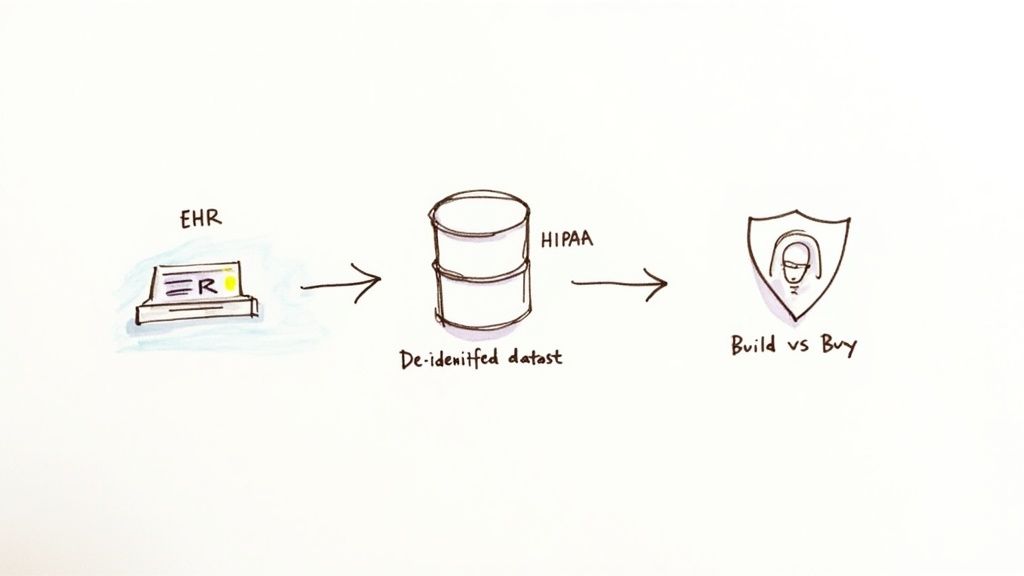
In healthcare, data governance and regulatory compliance are two sides of the same coin. Adhering to laws like HIPAA isn't just a best practice; it's an absolute requirement. A single misstep can result in massive fines and, worse, a complete erosion of patient trust that you may never get back.
The cornerstone of compliance in AI is effective data de-identification. This process is all about systematically stripping out personally identifiable information (PII) so that datasets can be used for model training without putting patient privacy at risk.
The real challenge here is a delicate balancing act. You have to remove the identifiers without stripping out the rich clinical context that makes the data valuable in the first place. This requires sophisticated anonymization techniques to create a dataset that’s both safe and powerful.
With a data strategy starting to form, you'll hit a major fork in the road: do you build a custom AI solution from scratch or buy a ready-made one? There's no single right answer—it all depends on your organization's resources, timeline, and specific needs. A structured process like our AI Product Development Workflow can bring much-needed clarity to this decision.
Let's break down the trade-offs:
| Factor | Buy (Off-the-Shelf AI Tools) | Build (Custom Software Development) |
|---|---|---|
| Speed to Deployment | Faster. Pre-built solutions can get you up and running in weeks, not months or years. | Slower. A full development cycle takes time and careful planning. |
| Initial Cost | Lower. You're typically looking at predictable subscription or licensing fees. | Higher. Requires a substantial upfront investment in talent and infrastructure. |
| Customization | Limited. You have to work within the vendor's existing features and roadmap. | Total. The solution is designed from the ground up to fit your exact workflows. |
| Maintenance | Handled by Vendor. They take care of updates, security, and support. | In-House Responsibility. Your team is on the hook for all ongoing maintenance. |
Opting for off-the-shelf AI tools for business is often a smart move for getting started quickly and testing the waters. On the other hand, investing in custom healthcare software development can create a powerful, proprietary asset that gives you a unique edge, especially when tackling a problem no one else has solved.
This 'build vs. buy' choice isn't always so black and white. A hybrid approach has become an increasingly popular and practical strategy. Services like AI Automation as a Service offer a compelling middle path.
This model gives you access to top-tier AI talent and pre-built components without the heavy cost of an in-house data science team or the constraints of a rigid off-the-shelf product. It’s a fantastic way to get moving faster.
When you're evaluating specific technologies, it’s worth looking at powerful models like OpenAI's Whisper AI for speech recognition, which can be a game-changer for clinical documentation. Just remember, integrating any new system with your existing EHR and IT infrastructure is often the biggest technical hurdle. Make interoperability a top priority in any decision.
Alright, you’ve laid out your strategy and wrestled with the data and tech stacks. Now it’s time to get your hands dirty and move from theory to practice. A well-designed pilot project is your sandbox—a controlled space where you can test your AI solution, learn from what breaks, and prove its value before going all-in on a full-scale rollout. This is where the real learning happens.
The point isn't just to see if the technology works; it's to see if it works here, in your unique clinical environment. This means planning your pilot with near-surgical precision, from defining what a "win" looks like to rigorously validating the results. This is a non-negotiable step in a structured AI Product Development Workflow, and it's what gives you the hard evidence needed to get everyone on board for the next phase.

One of the biggest traps I see organizations fall into is focusing only on technical accuracy. Sure, a model's predictive power is important, but that's just one piece of a much larger puzzle. Real success in a healthcare setting is measured by how seamlessly the tool fits into the daily lives of your clinicians and staff.
To get the full picture, your success metrics need to cover a few key areas:
Setting these key performance indicators (KPIs) before you start gives you a clear, multi-faceted scorecard to judge the pilot’s true impact.
Before any AI tool gets near a real patient workflow, it has to be put through its paces with rigorous clinical validation. There are no shortcuts here. This is how you ensure the solution is safe, effective, and free from the kind of biases that could cause real patient harm.
The process involves benchmarking the AI model’s performance against established clinical standards and expert human review. For an AI diagnostic tool, this might mean a head-to-head comparison of its findings against those of a panel of senior radiologists. If it's a predictive model, you’d test its forecasts against what actually happened with historical patient data.
This validation step is your most important safety check. It’s where you uncover the hidden flaws—like a model that performs brilliantly for one patient group but fails miserably for another—and fix them before they can do any damage in the real world.
Throughout the entire pilot, you absolutely must have an open, constant channel for feedback from the clinicians and staff on the front lines. Technology built in a vacuum is destined to fail. Your end-users are the ultimate authority on whether a solution helps or hinders their work.
Set up regular check-ins, send out simple surveys, and just have informal chats to get their honest opinions. This qualitative feedback is every bit as valuable as your quantitative KPIs. It will tell you things a spreadsheet can't—uncovering crucial insights about workflow snags, user interface frustrations, and unmet needs that you can use to make the tool genuinely better.
The healthcare industry is already leading the way with this iterative approach. In fact, 63% of healthcare organizations are actively using AI, with another 31% running pilots. This staggering 94% combined engagement rate shows a clear commitment to testing, learning, and finding what truly works in the real world.
Getting a pilot project across the finish line feels like a major victory, but in reality, it's just the starting line. The real work—and the biggest rewards—come from scaling that success across the entire organization. This isn't just a technical upgrade; it's a fundamental shift that requires a deliberate strategy for your technology, your processes, and most importantly, your people.
You're moving from a controlled experiment to a new standard of care. This is where a long-term vision, supported by a solid Custom AI Strategy report, becomes absolutely critical. Scaling isn’t about deploying more software; it’s about rewiring how your organization thinks and operates.
Flipping a switch and hoping for the best is a surefire way to fail. A phased rollout is almost always the smarter, safer play. This approach lets you manage the technical load, gather feedback in manageable doses, and build momentum with a series of early wins.
Start by looking for the teams or clinical areas that are already leaning in—the ones who are genuinely excited about the change. These "early adopters" will become your most powerful internal champions, smoothing the path and showing everyone else what's possible. As you expand, remember that your IT infrastructure will be under pressure. Your plan must account for scaling up data storage, processing power, and support right alongside the user rollout.
For many health systems, this is the point where building your own proprietary internal tooling becomes a massive advantage. Custom-built tools can integrate far more deeply with your existing EMR and workflows than any off-the-shelf solution ever could.
Let's be honest: the biggest hurdle you'll face isn't the technology. It's the people. Your clinicians and staff are already stretched thin, and they're often skeptical of any new tool that promises to "help." They're worried about their jobs, the learning curve, and whether a machine can truly be trusted with patient care.
You have to tackle these concerns head-on. Your communication needs to be transparent, consistent, and focused on the why. Forget the jargon about efficiency metrics. Instead, show a nurse how this tool gives her 20% more time for direct patient interaction. Explain how it helps a radiologist spot anomalies they might have missed at the end of a 12-hour shift.
Training is the other half of this puzzle. It has to be hands-on, specific to each person's role, and continuous. The goal isn't just to teach people how to click buttons; it's to build genuine confidence and competence. You want to turn skeptics into advocates who see the AI as an indispensable partner in their work.
As AI becomes more deeply embedded in your daily operations, strong governance moves from a "nice-to-have" to a non-negotiable. This is about more than just a one-time validation. It's about creating a system for continuous oversight to ensure your AI models remain safe, fair, and effective for the long haul.
Your AI governance framework should be built on a few key pillars:
This governance structure provides the guardrails that empower your teams to innovate safely and responsibly.
One of the most common mistakes is treating AI governance like a one-time checklist. It has to be a living, breathing process that adapts as the technology and regulations evolve. Get it right, and you'll build something invaluable: trust. Trust from your clinicians, your patients, and the regulators.
Even the most well-thought-out plans can run into trouble. Scaling AI is a complex journey, but being aware of the common pitfalls ahead of time can help you steer clear of them. Here are a few of the most frequent challenges we see and how to get ahead of them.
| Common Pitfall | Description | Mitigation Strategy |
|---|---|---|
| Lack of Clinical Buy-In | Clinicians see the AI as a top-down mandate that messes with their workflow without offering clear, tangible benefits to them or their patients. | Involve clinical champions from the very beginning. Frame all communications around how the AI solves their specific daily frustrations and improves patient outcomes. |
| Data Silos and Poor Quality | The data needed to power the AI is fragmented across dozens of disconnected systems, is riddled with inconsistencies, or is just plain incomplete. | Invest in a unified data governance strategy early on. Implement automated data quality checks and cleansing processes before you attempt to scale. |
| Ignoring the User Experience (UX) | The AI tool is technically brilliant but is a nightmare to use—clunky, unintuitive, and poorly integrated into daily tasks, leading to abysmal adoption rates. | Make user-centered design a top priority. Embed designers with clinical teams, gather constant feedback from frontline staff, and iterate on the interface until it feels seamless. |
Successfully navigating this final phase is what separates organizations that merely use AI from those that are truly AI-driven. This cultural shift, guided by a clear strategy from an AI Strategy consulting tool, is the ultimate prize. The road will have its challenges, but the destination is a more efficient, effective, and resilient healthcare organization.
Getting your first AI pilot off the ground is a huge milestone, but it's not the finish line. Far from it. The real value in healthcare AI comes from treating it as an ongoing journey, not a one-and-done project. Your organization, patient needs, and the technology itself are always changing, and your AI initiatives have to keep pace.
Think of it this way: you wouldn’t just install a new piece of surgical equipment and never service or upgrade it. The same logic applies here. A successful AI program is built on a foundation of constant monitoring, listening to your team, and always looking at what’s next.
Once an AI solution is live, you need to know exactly how it’s performing out in the wild. This isn’t just about the technical stuff like model accuracy. The real test is whether it’s moving the needle on the key performance indicators (KPIs) you identified way back in the planning phase.
Your metrics should be tied to real-world results:
But numbers only tell half the story. You absolutely need a clear, simple way for your clinicians and staff to give feedback. They are the ones using these tools every day. Their insights are gold.
Set up straightforward channels for them to report bugs, share what’s working, and suggest new ideas. This feedback is critical for planning your next update and can often spark inspiration for completely new real-world use cases. This iterative cycle is the bedrock of good AI strategy consulting.
Your frontline staff aren't just users; they're your most valuable consultants. The practical insights you'll get from a nurse who uses an AI tool daily are worth more than any technical spec sheet when it comes to making meaningful improvements.
The world of AI moves incredibly fast, and so do healthcare regulations. A strategy that looks brilliant today could be obsolete in six months. To avoid being left behind, you have to be proactive. This means keeping an eye on emerging technologies and anticipating regulatory shifts before they happen.
One of the smartest things you can do is invest in flexible internal tooling. Having your own adaptable platforms gives you the agility to pivot quickly when a new opportunity or requirement comes along.
Building a forward-thinking AI program means you're always learning and planning. It ensures your current projects are successful while also setting you up to catch the next wave of innovation. That’s how you build lasting success.
Navigating this field can be complex. For ongoing strategic guidance, working with our expert team can give you the specialized foresight needed to stay on the front foot in healthcare AI.
When you're on the ground, getting an AI initiative off the launch pad, the same questions pop up time and again. Let's cut through the noise and get straight to the practical answers I've seen work in the real world.
Everyone wants to jump straight to the cool tech, but that's a mistake. The very first thing you need to do is get your key people in a room and hammer out a real strategy that actually connects to your organization's mission.
Don't start with the AI; start with the problem. Are you trying to slash readmission rates? Or maybe free up nurses from endless charting? Pinpoint that specific, high-impact issue first. From there, you can build a small, dedicated team and take a hard look at your data and IT infrastructure to see if you're even ready. A solid AI requirements analysis isn't just a nice-to-have; it's the foundation for everything that follows.
This is the big one, and it keeps a lot of leaders up at night. The key is a defense-in-depth approach.
First, your default should be using de-identified or fully anonymized data for training AI models whenever you can. Beyond that, it's about building a fortress around the data you do use. That means:
Your legal and compliance folks can't be an afterthought—they need to be involved from the very first meeting. And when you're looking at outside vendors, put their HIPAA compliance under a microscope before you even think about signing a contract.
From my experience, the biggest challenges aren't usually the technology itself. They're almost always about data, systems, and people.
You'll run into messy, incomplete, or siloed data that makes it impossible to train a reliable model. You'll struggle to get a new AI tool to talk to your ancient EHR system. And, most importantly, you'll face resistance from clinicians who see it as just another piece of tech getting in the way of patient care.
The way through this is to obsess over data quality from day one, pick AI tools for business built for interoperability, and—critically—invest time in training your staff. Show them exactly how this new tool saves them 30 minutes a day or helps them spot something they might have missed. Make it a win for them.
Measuring the return on investment for AI in a clinical setting is about more than just dollars and cents. You need a broader definition of value.
Think about a balanced scorecard of metrics. You'll want to track:
The trick is to define these key performance indicators before you launch your pilot. That way, you have a clear baseline to measure against and can definitively prove the value of your chosen AI solutions.
Ready to turn these answers into action? Ekipa AI provides the strategic framework and expert support to help your healthcare organization implement AI successfully, from initial strategy to full-scale deployment. Explore how our expert team can guide your transformation.
How to build HIPAA-compliant AI: when LLM providers need a BAA, data minimization, de-identification, audit controls and a reference architecture.
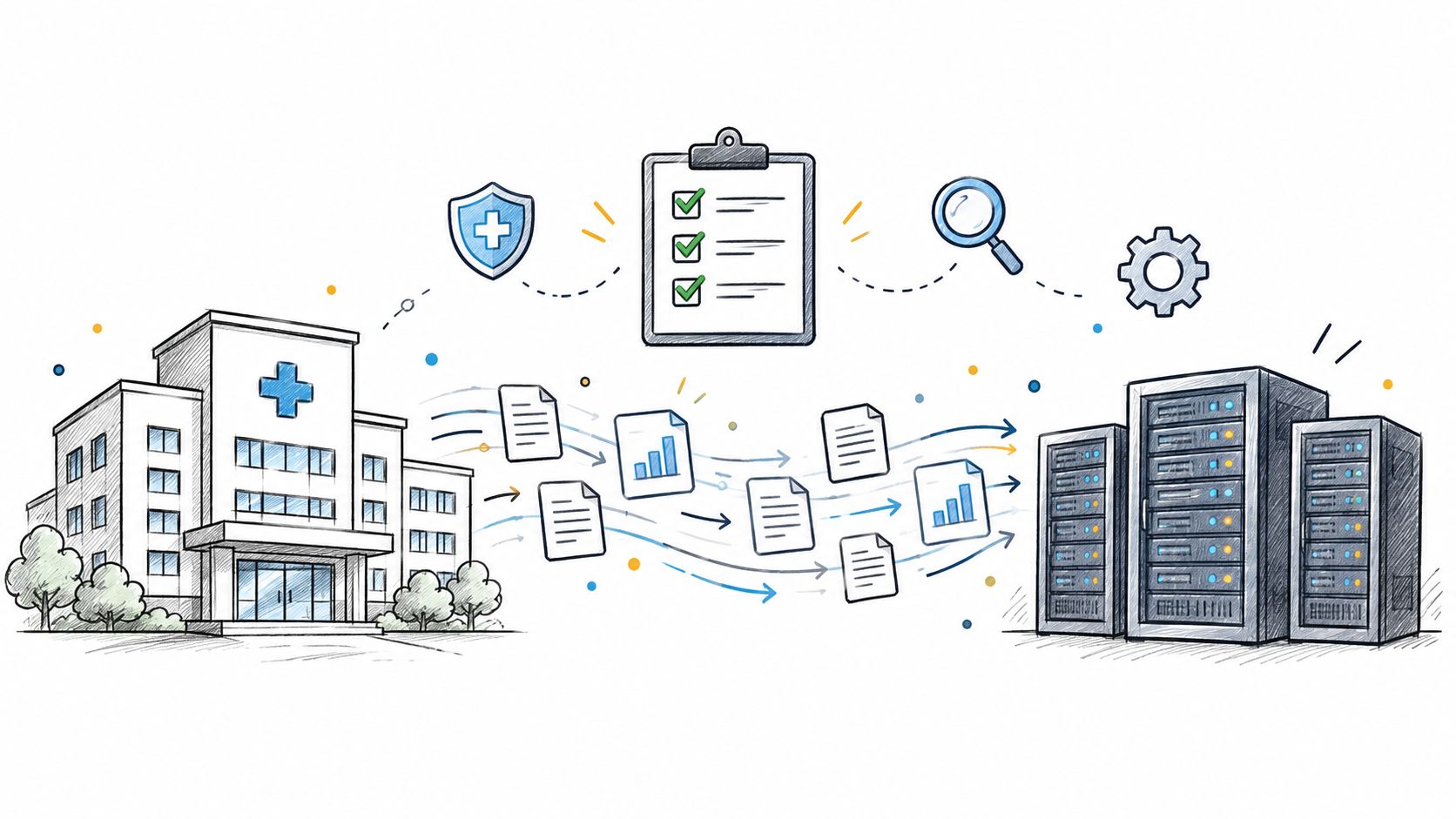
Practical data migration planning guide for healthcare teams. Scope, mapping, compliance, validation, cutover and rollback decisions explained end to end.
Smart on FHIR guide for healthtech engineers. Learn the OAuth 2.0 launch model, scope syntax, backend services, and US regulatory requirements.
Connect with our team to explore how AI expertise can transform your business.