AI in Healthcare
AI Transformation Healthcare Industry Explained
Learn what AI transformation healthcare industry means, from EHR integration to governance, ROI, and adoption roadmap for healthtech leaders.
September 23, 2026Read more
Hybrid intelligence blends human intuition with AI precision to drive smarter decisions and innovation. Explore how this collaboration transforms businesses and real-world outcomes.
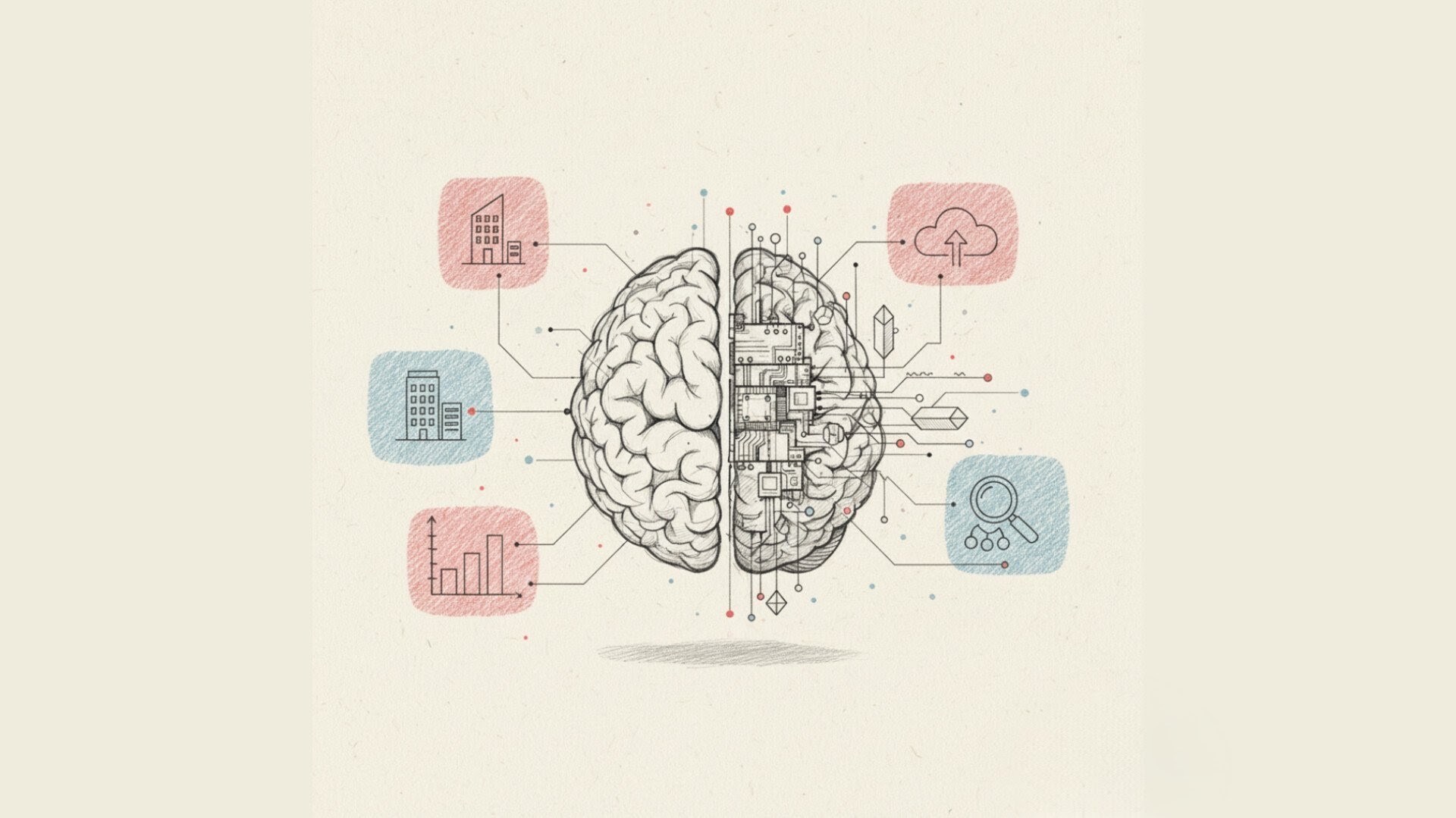
In today’s fast-moving world, companies are searching for ways not just to adopt AI but to make it meaningful and sustainable. The hype around AI is real, but many organizations struggle to get true value. That’s where hybrid intelligence comes in: a model that unites human insight and artificial intelligence to unlock better outcomes.
In this blog, we’ll explore what hybrid intelligence means, why it matters, how to implement it, and how a strong AI implementation partner contributes to hybridising your enterprise through concrete AI use cases.
Whether you’re developing an AI strategy or eyeing an AI roadmap services provider, this post is for you.
Hybrid intelligence refers to the integration of human intelligence and AI in a collaborative, complementary fashion. Unlike pure automation, hybrid intelligence leverages human judgment, creativity, and context awareness alongside AI’s computational strength and speed. It is sometimes referred to as a human-AI partnership model, where both sides contribute to improved decision-making.
This concept is central to approaches such as McKinsey’s QuantumBlack, which blends domain experts and multidisciplinary teams with algorithmic capabilities to deliver hybrid intelligence as a competitive advantage. Researchers have also studied hybrid human-AI performance across tasks, showing that combining the two often outperforms either in isolation.
In a hybrid intelligence setup, humans and AI perform different but complementary tasks: AI handles rapid pattern detection, prediction, and scale; humans ensure relevance, ethics, nuance, and trust. The result is more reliable outcomes and more sustainable adoption.
Many firms invest in AI but struggle to capture value. Only a few of these companies are deriving measurable value from AI efforts. Meanwhile, organizations now use AI in at least one business function. The discrepancy suggests challenges in scaling and integrating AI meaningfully. Hybrid intelligence offers a path to close this gap.
Pure AI systems often operate as “black boxes,” raising concerns about bias, errors, and opacity. With hybrid intelligence, human oversight can add interpretability, flag anomalies, and intervene when needed. Adding human participation to AI-powered workflows improves robustness and accountability.
AI systems excel in scale and speed but may misinterpret nuance or select suboptimal paths. Humans can correct courses, guide AI models, and adjust for context. This balance helps companies scale with automation and augmentation together, achieving higher throughput while reducing risk.
Hybrid intelligence encourages reskilling and role evolution. Rather than replacing human workers, it reshapes roles toward supervising, designing, and collaborating with AI. In organizations redesigning with AI, employees express anxiety about job security; thus the need for upskilling and transparent collaboration is critical.
To build hybrid intelligence robustly, organizations should focus on:
Begin with an AI strategy consulting approach. Define where AI brings real value, which processes to augment, and the boundaries of human vs AI roles. Having a clear roadmap helps avoid scattered pilots that never scale.
Choose AI use cases that fit a hybrid model: for example, predictive analytics, recommendation engines, decision support systems, anomaly detection, or content suggestions. The more interaction or oversight required, the more hybrid is suited.
Many organizations cite poor data quality as a top AI challenge. Inconsistent or biased data limits accurate insights. Businesses need solid data pipelines, cleaning, and governance to ensure accuracy, security, and compliance. Strong data foundations enhance both AI reliability and human trust.
Human-in-the-loop systems combine human judgment with AI efficiency. They ensure oversight at critical decision points, especially in sensitive or complex cases. This collaboration boosts transparency and ethical use. Making HITL a design priority keeps AI both effective and trustworthy.
Hybrid intelligence thrives on collaboration between data scientists, engineers, and business leaders. Domain experts provide context, while technical teams ensure precision and alignment. AI consultants help bridge communication gaps. Diverse expertise drives innovation and reduces bias.
Gradual AI adoption yields better results than sudden change. Small pilots reveal data and integration gaps early. Regular feedback and iteration ensure adaptability as markets evolve. Continuous learning strengthens human-AI synergy and long-term system performance.
Look for an AI implementation partner with experience in hybrid systems, domain knowledge, and an emphasis on operationalization rather than just models. Ensure that a partner shows capability in AI roadmap services, AI automation services, and end-to-end support.
Here are a few examples of how hybrid intelligence is already driving results:
These use cases show hybrid intelligence’s strength: autonomy in routine decisions, human judgment when interpretation matters.
Hybrid intelligence is powerful, but not trivial to deploy. Key challenges include:
Addressing these requires investment in training, selecting the right AI automation services tools, choosing capable partners, and incrementally scaling.
With this approach, your hybrid intelligence journey will be guided and sustainable.
In a world where AI hype is everywhere, hybrid intelligence cuts through the noise by emphasizing synergy of humans and AI working together rather than competing. When implemented thoughtfully, it bridges the gap between AI ambition and operational value. It reduces risk, fosters trust, enables scalable automation, and keeps the human element front and center. Whether your team is planning an AI roadmap, seeking AI automation services, or evaluating an AI implementation partner, hybrid intelligence should be a core lens.
If you’d like to explore building a hybrid intelligence system, strategize your human AI partnership, or collaborate on an AI strategy consulting project, we’re here to help - let’s get connected.
1. What is the difference between hybrid intelligence and standard AI?
Hybrid intelligence emphasizes the collaborative model of humans and AI, not just autonomous systems. Whereas standard AI aims to automate tasks entirely, hybrid intelligence combines human judgment, oversight, and creativity with AI’s computational capabilities, balancing strengths and mitigating risks.
2. Why is hybrid intelligence more sustainable for business than pure automation?
Pure automation often struggles with edge cases, bias, and lack of context. Hybrid intelligence introduces human oversight, making systems more robust, explainable, and trustworthy. This helps maintain adoption and safety over time, avoiding costly errors or pushback.
3. How do I choose the right AI implementation partner for hybrid systems?
Look for a partner with domain expertise, experience in human-in-the-loop systems, the ability to deliver AI roadmap services, and capabilities in AI automation services. They should help bridge AI models to workflows, not just build models in isolation. Evaluate references, case studies, and alignment to your goals.
4. What kinds of AI use cases are best suited for hybrid intelligence?
Use cases that require judgment, ambiguity, context, or interpretability suit hybrid setups. Examples include fraud detection, medical review, creative content suggestion, decision support systems, and personalized recommendation systems. Wherever human nuance matters, hybrid models excel.
5. How long does it take to move from pilot to full hybrid intelligence deployment?
It depends on complexity, data maturity, team skills, and domain. A pilot might take 3–6 months; scaling to full production across multiple workflows could take 12–24 months. The key is incremental rollout, feedback loops, and continuous refinement rather than aiming for a “big bang” in one go.
Learn what AI transformation healthcare industry means, from EHR integration to governance, ROI, and adoption roadmap for healthtech leaders.

Explore skilled nursing facility software in 2026. Covers core modules, compliance, KPIs, vendor evaluation, & AI integration for executives.

Unlock scalable impact with a practical healthcare AI transformation framework. This guide covers strategy, governance, ROI, and a phased roadmap for leaders.
Connect with our team to explore how AI expertise can transform your business.