AI in Healthcare
HIPAA-Compliant AI: How to Use LLMs With PHI Safely
How to build HIPAA-compliant AI: when LLM providers need a BAA, data minimization, de-identification, audit controls and a reference architecture.
October 16, 2026Read more
Explore intelligent care delivery models with a practical guide on architecture, governance, workflows, KPIs, and implementation roadmap for healthtech leaders.

Your AI pilot looks successful in the sandbox. The retrospective validation is strong, the dashboard is persuasive, and the product team is ready to expand. Then production exposes the core challenge. A sepsis model generates alerts, but no care pathway tells the team what to do, no clinician owns the response, and reimbursement rules make the extra documentation burdensome.
That failure isn't primarily a model failure. It's an operating model failure. Intelligent care delivery models succeed when AI capability, clinical workflow redesign, reimbursement design, and governance are built together, not delivered as separate workstreams.
This guide takes that position directly. You'll find a practical framework for redesigning care around AI, the integration mechanics that matter inside an EHR, the governance decisions that change regulatory exposure, and a reimbursement-aware roadmap for moving from pilot to measurable operations. If your team needs help turning that roadmap into production software, implementation support should begin with workflow and accountability design, not a model shopping exercise.
The pilot usually stalls at the handoff between prediction and action. A model can identify a patient who may deteriorate, but that signal has no operational value unless somebody receives it, understands it, decides what happens next, and records the intervention in the system of record.
Start by asking four questions before approving a scale-up:
The four-layer model described in Nature's 2026 framework is useful because it treats AI-enabled care transformation as the interaction of Knowledge, Intelligence, Application, and Workflow. Knowledge defines the clinical and operational context. Intelligence produces a risk estimate or recommendation. Application places that capability into a usable product. Workflow determines who acts, how they act, and what the organization learns afterward.
Practical rule: If the workflow layer isn't designed before deployment, the organization is buying an alert generator, not an intelligent care delivery model.
The business case also needs historical context. Value-based care shifted attention away from activity alone and toward outcomes, coordination, and incentive alignment. AI now changes how teams execute that model. The winning sequence is not “buy AI, then find a use case.” It's “choose an accountable care problem, redesign the pathway, integrate the decision support, and measure whether the operating model performs.”
Healthcare delivery has already moved beyond a simple clinic-visit model. The transition from fee-for-service toward value-based arrangements included patient-centered medical homes and accountable care organizations, models developed to improve outcomes and align incentives. The peer-reviewed overview of care delivery models also notes that the Affordable Care Act accelerated adoption of these approaches in the United States.
That history matters because intelligent care delivery models aren't synonymous with telehealth or clinical AI. Telehealth changes the access channel. Population health organizes patients and interventions across a defined group. A generic clinical AI tool may support one decision. An intelligent care delivery model combines risk-bearing economics, redesigned workflows, embedded intelligence, and continuous measurement into one operating system for care.
A board-level definition can be stated plainly:
An intelligent care delivery model is a coordinated system of people, processes, culture, technologies, and incentives that uses AI to improve how care is accessed, prioritized, delivered, and measured.
The four-layer framework gives product leaders a practical planning structure:

Product teams usually plan around four categories:
The payment model should influence the category you choose. A workflow that improves access may fit a capacity objective. A transitional-care workflow must connect to readmissions, follow-up completion, or episode economics. AI is the capability. The care model is the business and clinical system that makes the capability valuable.
The architecture should make every AI action bounded, traceable, and usable inside existing clinical work. Start with the data contract. U.S. interoperability guidance recommends defining which HL7 and FHIR resources and data elements an AI component can access, including limits by resource type, profile, or time window. It also recommends specifying coding systems such as LOINC, SNOMED CT, and RxNorm when they're in scope for processing, as described in the health IT interoperability guidance for AI.
The integration pattern depends on the care model:
EHR-native functionality works well when the decision is tightly coupled to a chart action and the vendor supports the required extension points. An external platform can be more appropriate when the organization needs cross-system orchestration, specialized model operations, or a patient-facing experience that must work across different EHR environments. External point-of-care software may be classified as software as a medical device, or SaMD, depending on its function and deployment, while point-of-care tools commonly integrate directly into the EHR. The NCBI clinical deployment handbook provides that distinction and explains the relevance of interoperability protections under the 21st Century Cures Act.
A production model needs more than a trained algorithm. It needs:
| Component | Function | Integration Pattern |
|---|---|---|
| Clinical feature store | Maintains governed clinical and operational inputs | FHIR resources, normalized terminology, approved data pipelines |
| Model-serving layer | Produces risk scores or recommendations | Versioned API with monitoring and access controls |
| Inference trigger engine | Determines when evaluation occurs | CDS Hooks, event feeds, scheduled population jobs |
| Outcomes writer | Records action and result | EHR documentation, FHIR write-back, auditable workflow record |
The predictable failure modes are dual-charting, alert fatigue, inconsistent latency, and incomplete feedback. A technically accurate model still fails if staff must reconcile two charts or if the system generates recommendations faster than the workflow can absorb them. Teams evaluating an AI delivery framework should ask where the action is documented, how overrides are analyzed, and what happens when an integration endpoint is unavailable.
Governance begins with accountability. Create a clinical oversight committee with named accountable officers, then give it authority over intended use, deployment scope, monitoring, incident response, and retirement. A model lifecycle policy should define validation requirements, retraining triggers, drift monitoring, access reviews, and the evidence required before a version changes.
The intended-use statement must describe what the system does in production. If a tool is marketed as administrative scheduling support but begins ranking patients for clinical priority, the risk profile has changed. The same applies when a recommendation moves from clinician review to automated patient messaging or autonomous action.
The European Commission states that the EU AI Act entered into force on 1 August 2024. High-risk AI systems used for medical purposes must meet obligations including risk mitigation, high-quality datasets, clear user information, and human oversight, as explained on the European Commission's AI in healthcare page.

Treat these decisions as governance gates:
Good governance also includes usability. Patients and staff need interfaces that expose uncertainty, support alternative input methods, and make escalation clear. A practical resource on accessible UX design for healthtech can help teams connect accessibility decisions to safe use rather than treating accessibility as a late design review.
Before legal review, confirm that you can answer five questions: What is the intended use? Which users can act on the output? Which data can the system access? Where is every action logged? Who can pause or override the system? Teams evaluating SaMD solutions should answer those questions before comparing model accuracy or interface features.
The right workflow depends on the population, the trigger event, and the team available to respond. Comparing archetypes using the same lens prevents executives from choosing a fashionable capability that their organization can't operationalize.
| Dimension | AI-Augmented Transitional Care | Integrated Virtual Care | Predictive Inpatient Triage |
|---|---|---|---|
| Trigger event | Discharge or post-acute transition | Patient message, intake, or monitoring signal | New clinical data or inpatient risk event |
| Data inputs | Encounter history, discharge information, utilization patterns, care-plan data | Symptoms, messages, chart context, remote-monitoring data | Vitals, laboratory results, orders, location, and patient history |
| Human decision point | Nurse validates risk and selects outreach pathway | Clinician reviews summary and decides escalation | Unit team confirms priority and initiates response |
| Common failure mode | Risk is identified but outreach isn't completed | Asynchronous volume overwhelms reviewers | Alerts arrive without staffing or bed-management integration |
| Staffing model | Nurse-led navigation with escalation support | Distributed virtual team with clinician review | Inpatient team linked to triage and capacity operations |
Transitional care has the clearest evidence for a closed-loop design. In a 12-hospital cohort of 6,371 encounters, AI flagged 29.3% as medium-high risk for 30-day rehospitalization, and care teams completed 40.2% of resulting recommendations. The workflow was associated with a 21.0% lower adjusted incidence of 30-day rehospitalization versus matched controls, equal to 69 fewer rehospitalizations per 1,000 encounters, with a 95% confidence interval of 0.65 to 0.95, according to the transitional-care cohort study.
The lesson isn't that every risk model will produce the same result. The lesson is that risk stratification must route into a staffed navigation workflow. Integrated virtual care needs the same discipline, combining asynchronous triage, chart summarization, and clinician escalation rather than adding another inbox. Predictive inpatient triage should feed unit operations, bed management, and escalation protocols, not a standalone alert dashboard.
Choose transitional care when post-discharge ownership is clear and avoidable utilization matters. Choose virtual care when access and continuity are the primary constraints. Choose inpatient triage only when the organization can staff rapid response and integrate the signal into existing unit decisions.
The CFO will challenge a productivity claim that can't be traced to a clinical or financial outcome. Build the business case as a chain:
Model output → workflow action → operational change → clinical or financial result.
For transitional care, a risk tier should connect to outreach completion, follow-up timing, and rehospitalization. For virtual care, message classification should connect to clinician handling time, escalation appropriateness, and access capacity. For inpatient triage, a risk signal should connect to time-to-treatment, escalation reliability, and resource utilization.
The four KPI families should remain separate:
Large-scale adoption is already visible. The ONC-linked hospital trends brief reports that predictive AI use in U.S. hospitals rose from 66% in 2023 to 71% in 2024, with use for predicting inpatient health trajectories or risks at 93% and scheduling facilitation at 67%. Philips' Future Health Index 2026 reports that 65% of clinicians increased their use of workplace AI tools, 46% saved at least 132 hours per year, and 50% said they could see more patients, averaging eight additional patients per week. It also reports savings equivalent to over 16 working days per year.
Those numbers support a measurement hypothesis, not a guaranteed return. Set a baseline, define the causal pathway, and run sensitivity tests for adoption, response completion, clinical effect, implementation cost, and reimbursement. A model with strong accuracy but weak usage may have less value than a simpler tool that clinicians consistently act on.

One caution matters for planning. Don't promise a fixed ramp or payback date without organization-specific evidence. The digital health review identifies reimbursement, implementation cost, EHR integration, auditability, governance, and ongoing monitoring as interdependent conditions for scale. Those conditions belong in the ROI model from the beginning.
A pilot can look successful while the operating model is already failing. Clinicians may open alerts, managers may report strong model performance, and the organization may still lack clear ownership, EHR integration, audit evidence, or a payment pathway. Use a gated roadmap. Release the next investment only after the current phase resolves its known failure mode.
During months 1 to 3, run a controlled pilot in one clinic or unit. Test model performance alongside alert routing, ownership, response time, documentation, and override behavior. The gate is operational. Clinicians must act without leaving their workflow, and leaders must see whether the pathway improves the selected KPI.
The immediate risk is silent alert fatigue. Measure time to action and completed interventions from the first day. A model with strong accuracy becomes background noise if no one responds to its output.
During months 4 to 6, connect the model to the EHR through scoped data access and a documented write-back pattern. Confirm that the system handles terminology, patient context, permissions, downtime, and audit logging. U.S. interoperability guidance recommends OAuth2 or OpenID-based identity, TLS encryption, and audit logs that connect requests to users, agents, and organizations.
This phase addresses integration debt. Reject any workflow that depends on dual-charting or manual data exports as its permanent design. Ask vendors which FHIR resources the platform reads and writes, whether it supports SMART on FHIR or CDS Hooks where appropriate, how current its sandbox is, and whether it supports the organization's actual EHR version and terminology.
During months 7 to 9, establish the oversight committee, lifecycle policy, intended-use statement, monitoring dashboard, incident process, and change-control procedure. Include subgroup performance and drift review. The gate is evidence, not paperwork. The organization must explain what changed, who approved it, and how a clinician can override or suspend the capability.
This phase closes accountability gaps. Governance belongs in the product through visible logs, assigned owners, defined escalation routes, and release criteria. Require answers on SaMD classification, intended use, human oversight, drift monitoring, audit trails, data retention, and incident response. A vendor that cannot explain system behavior after a model update is not ready for clinical deployment.
During months 10 to 12, map outputs to payer arrangements, care-management activities, clinician review, and documented outcomes. The digital health evidence indicates that payers have explored reimbursement when AI output is stored in an auditable format, a qualified clinician reviews and documents its use, and the AI contribution can be attributed for audit.
This phase addresses reimbursement misalignment. A feature that creates work without a payment or outcome pathway should lose priority to one that strengthens an existing accountable-care objective.

Set a defensible build-versus-buy threshold. Buy commodity capabilities such as identity, terminology, hosting, and standard interface infrastructure. Build where the differentiator is the care pathway, escalation logic, patient population, or contract-specific workflow.
Sell a clinical copilot, not autonomous labor replacement. Human review improves accountability and creates an auditable connection between the AI contribution and the care decision. Design the product to summarize, prioritize, and recommend while preserving clinician control.
Prioritize reimbursement-aware features. Assess whether proposed capabilities support documented care-management work, including workflows associated with CPT codes 99490 and 99457. Validate coding and payer interpretation with qualified billing and compliance professionals before committing funds.
Make the quarterly OKR causal. Pair throughput objectives with clinical and margin outcomes. Track completed outreach and clinician time per encounter alongside readmission performance and per-encounter margin. Alert volume is not a value metric.
Demand integration evidence from vendors. Require demonstrations using the organization's actual EHR version, terminology, permissions, downtime procedures, and audit requirements. A polished interface does not compensate for weak write-back or incomplete patient context.
Treat governance as a release requirement. Do not approve production deployment until intended use, human oversight, monitoring, retention, incident response, and post-update behavior are documented and tested.
Assess the delivery partner, not only the model vendor. A healthtech engineering partner should connect use-case definition, EHR integration, workflow software, and deployment planning. For broader Healthcare AI Services, compare experience across clinical operations, compliance engineering, and production support.
Use a requirements analysis process for AI projects before selecting a platform. Then compare AI tools tailored for business operations, internal tooling, and custom healthcare software development against the workflow you need. Involve a regulatory compliance partner specializing in healthtech before the intended-use statement and architecture are locked.
Review a Custom AI Strategy report when the assessment needs to become a sequenced investment plan. Examine real-world use cases for implementation patterns, and use the AI Product Development Workflow to connect discovery, integration, validation, governance, and rollout. Meet our expert team before committing to a platform or implementation partner.
The evidence across integrated and virtual care models supports disciplined execution. An umbrella review covering 66 systematic reviews and 1,272 primary studies found that evaluated models commonly improved or matched usual care across clinical indicators, mortality, utilization, self-management, patient knowledge, quality of life, and cost-effectiveness. Effects varied by condition, workflow, and measure, as summarized by the American Hospital Association's AI care-delivery overview. The opportunity is real, but the unit of innovation is the care system that makes the algorithm actionable.
Ekipa AI helps digital health teams define, integrate, govern, and scale AI-enabled care workflows across EHRs and clinical operations. Visit Ekipa AI to discuss a care-delivery use case, architecture, and next production milestone with the team.
How to build HIPAA-compliant AI: when LLM providers need a BAA, data minimization, de-identification, audit controls and a reference architecture.
Practical data migration planning guide for healthcare teams. Scope, mapping, compliance, validation, cutover and rollback decisions explained end to end.
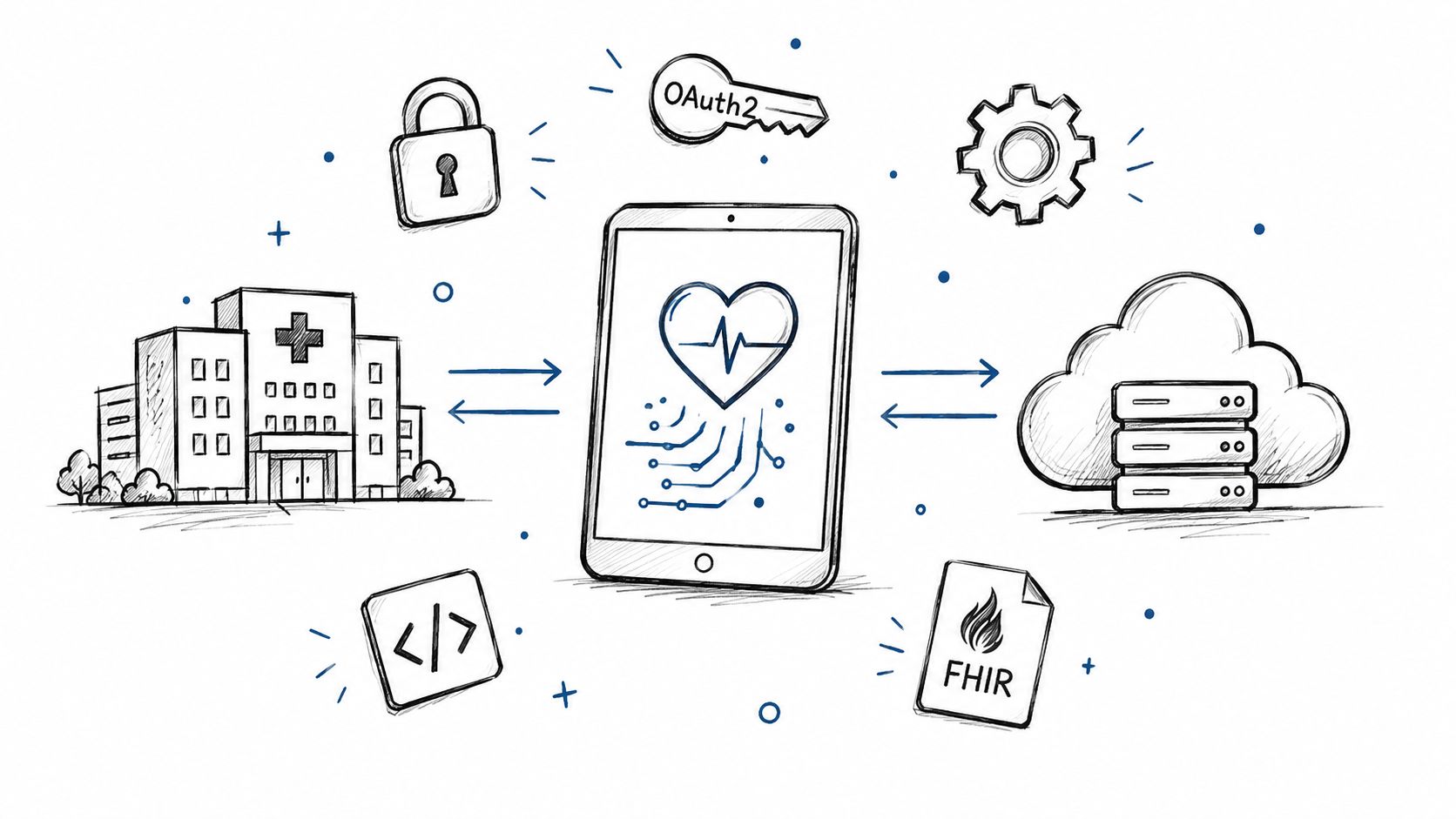
Smart on FHIR guide for healthtech engineers. Learn the OAuth 2.0 launch model, scope syntax, backend services, and US regulatory requirements.
Connect with our team to explore how AI expertise can transform your business.