AI in Healthcare
HIPAA-Compliant AI: How to Use LLMs With PHI Safely
How to build HIPAA-compliant AI: when LLM providers need a BAA, data minimization, de-identification, audit controls and a reference architecture.
October 16, 2026Read more
Discover how intelligent healthcare operations streamline workflows, reduce costs, and improve patient outcomes in 2026.

You're probably living this already. A prior authorization sits in one portal, a lab result never lands cleanly in the EHR, a scheduler books around the wrong dependency, and the patient moves through the system like every department owns a different version of the truth. By the time leaders spot the delay, the damage is operational, financial, and reputational.
Intelligent healthcare operations is the answer, but not in the fluffy AI sense. It means running clinical and administrative work as one governed system, with interoperable data, accountable automation, and clear ownership for every handoff. By the time the CMS prior authorization and interoperability rules bite, this is no longer a strategy debate, it's an operating requirement.
A fragmented health system doesn't fail in one dramatic moment. It fails when a denied prior authorization stalls a procedure, an unlinked lab result forces a manual chase, and a scheduling conflict pushes a case back another day. The delay looks small on paper, but the chain reaction can wipe out capacity, frustrate clinicians, and turn a clean operational margin into a mess.
That's why I define intelligent healthcare operations as the disciplined integration of clinical data, interoperable workflows, and accountable automation. It's not digital health, which is broad. It's not smart hospitals, which often gets reduced to devices and dashboards. It's not population health, which is about a different operating lens entirely. This is a management discipline, not a branding exercise.
The shift is simple. Leaders used to ask where AI could be added. Now they need to ask which workflows are stable enough to automate, which data flows are clean enough to trust, and which approvals need to be governed before anything goes live. That's the difference between a pilot and an operating model.
The CMS interoperability and prior authorization final rule makes that distinction unavoidable, because payers and covered entities are being pushed toward HL7 FHIR APIs for electronic exchange and prior authorization workflows, with operational provisions generally beginning January 1, 2026 CMS final rule. If your organization still treats interoperability as an IT side project, you're already late.
If you want a practical home base for this thinking, the Healthcare AI Services page is a useful starting point for mapping AI work to actual healthcare operations.
Practical rule: if a workflow cannot be explained, audited, and handed off by operations, it is not ready to be called intelligent.
Think of the operations stack like air traffic control. Data is radar, interoperability is the shared language between towers, AI is the co-pilot, EHR integrations are the runways, and workflow redesign is the flight protocol. If any one of those pieces is weak, you don't get intelligence, you get confusion at scale.

Start with the data layer. If your clinical, financial, and operational data live in separate systems with inconsistent identifiers, every automation inherits the mess. The failure mode here is obvious, garbage in, confident garbage out, but executives still underestimate how much work it takes to make data machine-readable across legacy environments.
Interoperability is the next constraint. ONC's 2026 interoperability standards, adopted in the CMS IPPS final rule, focus on FHIR APIs for administrative and clinical exchange, including prior authorization support, payer formularies, and provider directories ONC standards adoption. That means data sharing is no longer just a technical preference, it's an operational expectation.
AI should sit on top of that foundation, not replace it. In practice, that means using automation for work that is repetitive, measurable, and tied to existing workflow state, while keeping humans in the loop where judgment, exceptions, and liability matter. The most common mistake is buying a model and assuming the integration will take care of itself. It won't.
EHR integration is where ambition usually collides with reality. If the workflow doesn't live where clinicians and staff already work, adoption drops fast. The system may look elegant in a demo and still fail in production because nobody wants another swivel-chair process.
Workflow redesign is the part leaders skip because it feels unglamorous. It's also where the value is. If you don't remove duplicate approvals, clean up exception routing, and set escalation rules, AI just accelerates bad process design.
The pillars only create value when they're governed together. Buy isolated tools, and you create more islands. Build the operating model, and the technology starts compounding.
Bottom line: the stack works only when the workflow, data, and governance layers are designed as one system.
The market still loves model demos, but healthcare operations leaders care about what survives contact with the EHR, the payer portal, the fax queue, and compliance review. By 2024, 71% of non-federal acute-care hospitals in the United States reported using predictive AI integrated into their EHRs, up from 66% in 2023 industry tracking. That tells you AI has moved into mainstream workflows, but it doesn't tell you those workflows are controlled.
The harder truth is governance. Recent survey data shows only 59% of organizations have a formal, documented process requiring approval before AI implementation governance survey. That gap matters more than model quality because an uncontrolled model is a maintenance liability, not an asset.
The operational story is similar on the integration side. In a 2026 interoperability survey, 76% of healthcare leaders said interoperability is a top strategic priority, nearly one in four organizations spend more than 20 hours per week troubleshooting integration issues, and 58% cited staffing or vendor limitations as their biggest barrier interoperability survey. Those are not model problems. They're workflow and systems problems.
| Dimension | Where Budgets Go | Where Failures Happen |
|---|---|---|
| Model selection | Demos, feature lists, benchmark claims | Production fit, drift, weak handoffs |
| Workflow design | “AI will handle it” assumptions | Unmapped exceptions and ownership gaps |
| Governance | Policy decks and committees | Approval, monitoring, override, auditability |
| Integration | API promises | Legacy EHRs, payer portals, fax, data quality |
| Value tracking | Vanity metrics | Finance-level proof and operational ownership |
Boards are asking different questions now. They want to know who can override the system, how drift gets caught, how exceptions are logged, and who owns liability when an autonomous step goes wrong. If you want a practical governance reference, govern your AI agents effectively is a strong complementary read because it aligns with the control questions healthcare leaders keep missing.
The takeaway is blunt. Any health system can buy a model. Very few can operationalize it safely across Epic, Cerner, payers, and clinical teams without breaking trust.
A payer denies prior authorization because the chart note never reached the right workflow, while the hospital still tracks the request in a separate queue. That kind of friction is exactly what the federal rules are meant to force out of the system. Compliance is becoming the excuse leadership needs to fix architecture that should have been in place long ago.
CMS finalized a rule requiring impacted payers to implement and maintain HL7 FHIR APIs for electronic data exchange and prior authorization. The operational provisions generally begin January 1, 2026 CMS prior authorization rule. The same rule requires a Prior Authorization API that publishes covered items and services, identifies documentation requirements, and supports request and response workflows, with initial metrics due by March 31, 2026 CMS prior authorization rule.
ONC's interoperability standards adopted in the CMS IPPS final rule extend that direction into administrative and clinical exchange, including electronic prior authorization, payer drug formularies, and provider directories. The standards include HL7 FHIR Da Vinci Prior Authorization Support (PAS) Implementation Guide version 2.2.1 ONC standards adoption.
This is not an IT checklist. It forces the organization to know where prior authorization data lives, how documentation requirements are exposed, who consumes the API, and how turnaround time gets measured. Identity, consent, and data quality can no longer sit inside disconnected teams.
CMS's 2026 proposed interoperability and prior authorization drug rule would extend its FHIR standards to all HIPAA covered entities that electronically exchange prior authorization requests and decisions for items and services, with compliance timing of 24 months from a final rule effective date for HIPAA covered entities and 36 months for small health plans CMS proposed rule. That gives executives a clear window, but not much room to drift.
The operating implication is blunt. Compliance is now the forcing function for cleaner data architecture, tighter workflow ownership, and measurable exception handling. If you need a budget justification to fix integration friction, this is it. The same pressure is why leaders should govern your AI agents effectively, before autonomy outruns control.
Start where the payoff is easiest to prove and the risk is easiest to control. That means revenue cycle and administrative operations first, clinical decision support later. The order matters because the first category is measurable, repeatable, and tied to structured exchange, while the second category carries a much higher burden of proof.

Administrative workflows are where AI earns trust. Prior authorization automation, eligibility verification, coding assistance, denial management, and ambient clinical documentation all sit close to structured data and recurring patterns. They're easier to monitor, easier to measure, and less likely to create direct patient-safety risk.
That doesn't make them trivial. It makes them the right first bets. Independent tracking found that revenue-cycle automation reached about 50% adoption and AI-based clinical documentation improvement reached 43%, which reinforces the same point, the earliest wins are workflow-heavy, not mystical industry tracking.
Clinical decision support, imaging, and triage tools deserve a higher evidence bar. They can be valuable, but they demand stricter validation, stronger oversight, and tighter liability management. Most organizations don't earn the right to those bets until they've proved they can govern administrative automation without drifting into chaos.
| Use case type | Confidence of payoff | Cycle time to value | Patient-safety risk |
|---|---|---|---|
| Administrative automation | High | Shorter | Low |
| Clinical decision support | Medium | Longer | Higher |
| Imaging AI | Medium | Longer | Higher |
| Triage AI | Medium | Longer | Higher |
If you're mapping use cases for your leadership team, real-world use cases is a useful way to separate practical workflow automation from slideware. And if you need tooling beyond healthcare, AI tools for business can help frame the broader automation stack around clear operational outcomes.
Practical rule: prove governance on admin work before you let AI anywhere near higher-risk clinical decisions.
A pilot that looks promising in a demo can still fail in hospital operations if no one owns maintenance, drift, exception handling, and rollback. That is why a maturity roadmap has to start with governance and integration, not with model enthusiasm.

Experiment starts with a documented problem hypothesis, a narrow workflow, and one named business owner. If the team cannot state the problem in one sentence, the work is not ready.
Validate is where baseline performance and lift get measured. Leaders should ask one question here, whether the pilot improves cycle time, accuracy, or workload enough to justify more investment.
Production needs a model card, bias review, a maintenance plan, and active monitoring. Many programs skip this discipline, then wonder why the workflow breaks outside the pilot environment.
Scale only works once integration architecture, exception handling, and support ownership are in place. If the workflow cannot run repeatedly across departments, it belongs back in controlled use.
Optimize ties value tracking to finance and operational reviews, not just the data science team. That keeps the system accountable after launch and limits drift from business goals.
The AI Product Development Workflow gives teams a practical delivery path, not a loose set of intentions. The same logic applies to AI Automation as a Service when a hospital needs managed execution instead of another internal proof of concept. For teams that want a clearer operating model, our AI delivery framework shows how governance, integration, and support fit together.
Most programs break at the Validate-to-Production handoff because leadership underinvests in governance and workflow redesign. The board should require proof of ownership, monitoring, and rollback before any AI workload is allowed to scale.
A rollout that works is not a Gantt chart with hopeful labels. It is a sequence of gates that proves the organization can govern, integrate, and scale without adding risk. If the roadmap does not include go or no-go decisions, it is just presentation material.
Months 1 to 3, establish governance. Build the AI oversight charter, assign risk tiers, assess data quality, and map undocumented approval workflows that block automation. Decide early what is out of bounds, because that boundary shapes every later decision.
Months 4 to 6, stabilize the technical foundation. Confirm HL7 FHIR R4 readiness, map EHR touchpoints, and verify that the selected workflows can consume structured data. Hold the line until the integration path is clear.
Months 7 to 9, pilot under controlled KPIs. Run one administrative workflow and one clinical workflow only after governance and integration are in place. Keep the scope narrow, the ownership explicit, and the measurement discipline tight. our AI delivery framework is useful here because it ties the pilot to operating controls, not just model output.
Months 10 to 12, scale what clears the bar. Expand only what meets clinical, financial, and compliance thresholds. Anything else stays in controlled use, not enterprise rollout.
Your partner needs more than AI branding. Look for HL7 FHIR R4 expertise, EHR vendor relationships, prior authorization API support, and enough managed-service depth to handle monitoring and maintenance after launch. If they cannot explain workflow state, exception handling, and operational ownership, keep looking.
For organizations that need help turning this into execution, AI implementation support should focus on integration, governance, and change control, not vague transformation language.
Use clinician advisory boards to catch workflow friction early. Run downtime simulations before scaling. Require bias audits before production use. Those steps sound basic until a rollout fails because nobody tested the ugly edge cases.
For teams comparing build and implementation support options, Custom AI Strategy report can help force the right scoping decisions before anyone writes code. If you want implementation guidance from a healthtech engineering partner, the key test is whether they reduce operational ambiguity, not just ship features.
Decision rule: if ownership is fuzzy, the project is not ready for scale.
Here's the short list I'd put in front of any CEO or CTO this quarter.
Executive checklist
Why do pilots stall so often around the 18-month mark?
Because the organization runs out of governance patience before it runs out of AI enthusiasm. The pilot proved something useful, but nobody built the approval, monitoring, or maintenance process needed to turn it into a stable operating capability.
When should we build versus buy?
Buy when the workflow is standard and the integration burden is manageable. Build when the workflow is tightly tied to your operating model, your EHR footprint, or your compliance logic, and off-the-shelf tools won't fit cleanly.
How do we measure ROI before fee-for-value shifts hit?
Measure reduction in manual work, fewer denials, cleaner turnaround, and better exception handling. Don't wait for a reimbursement model change to justify discipline. Operational gains should show up first.
How do we avoid the agentic AI control gap?
By treating autonomous actions as controlled exceptions, not defaults. Every system needs documented policy boundaries, monitoring, auditability, and a human override path.
What should we ratify in the next 90 days?
Approve the governance charter, assign data owners, identify the first administrative workflow to automate, and decide which compliance obligations will drive the timeline. That keeps the work grounded in execution instead of demo culture.
If you want help turning this into a real operating model, Ekipa AI works across healthcare AI services, workflow automation, and integration planning, so the strategy doesn't stop at slides. Visit Ekipa AI to review the team, compare delivery options, and start turning governance and interoperability into a working healthcare operations roadmap.
How to build HIPAA-compliant AI: when LLM providers need a BAA, data minimization, de-identification, audit controls and a reference architecture.

Practical data migration planning guide for healthcare teams. Scope, mapping, compliance, validation, cutover and rollback decisions explained end to end.
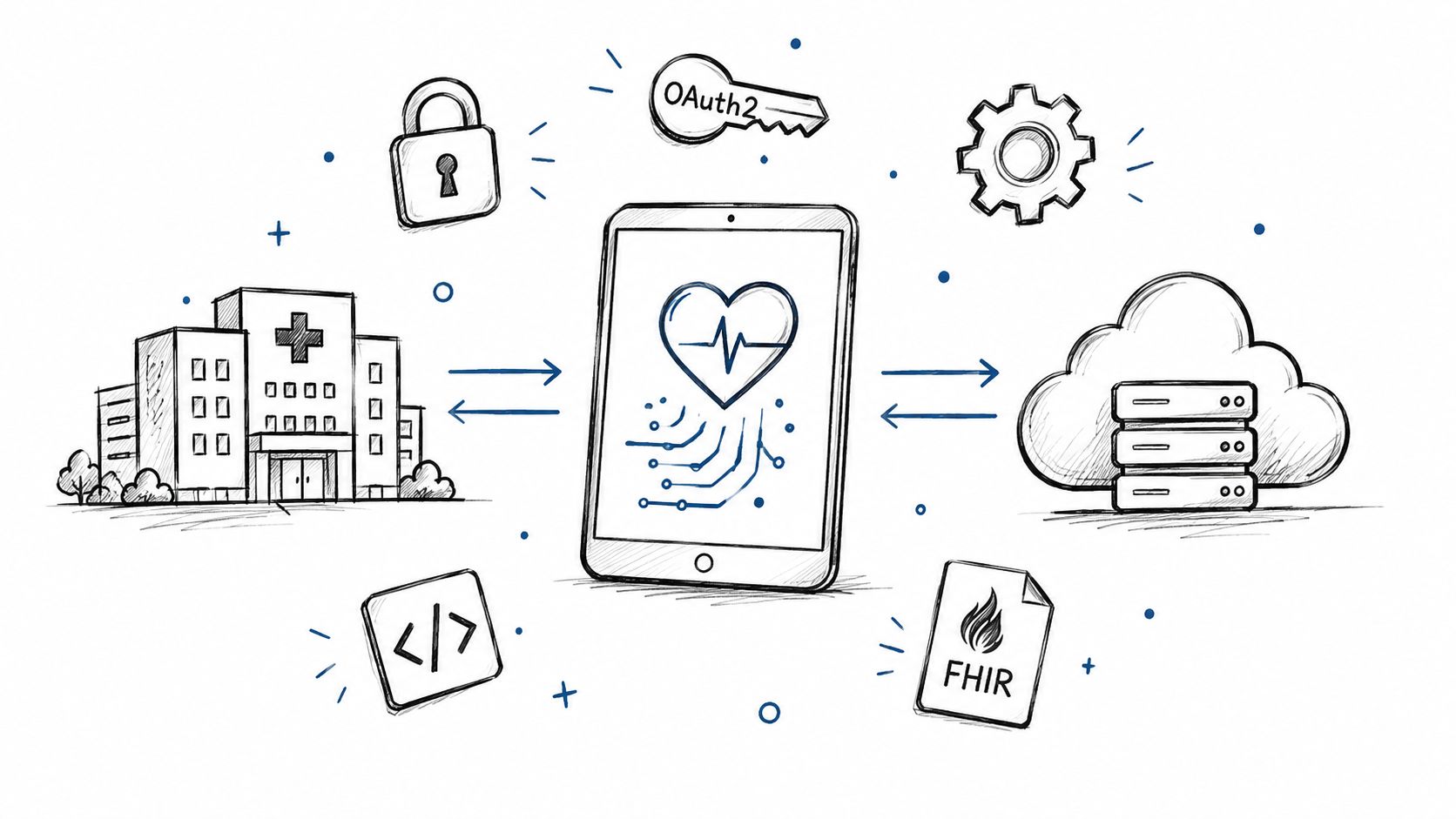
Smart on FHIR guide for healthtech engineers. Learn the OAuth 2.0 launch model, scope syntax, backend services, and US regulatory requirements.
Connect with our team to explore how AI expertise can transform your business.