AI in Healthcare
HIPAA-Compliant AI: How to Use LLMs With PHI Safely
How to build HIPAA-compliant AI: when LLM providers need a BAA, data minimization, de-identification, audit controls and a reference architecture.
October 16, 2026Read more
Explore Med-PaLM, Google's revolutionary medical AI. This guide explains its capabilities, business applications, and integration for healthcare leaders.

Imagine a medical expert who has instantly read, understood, and synthesized every textbook, clinical trial, and research paper ever published. That's the essence of Med-PaLM, Google's large language model built specifically for the medical field. It’s designed to deliver high-quality, safe, and context-aware medical insights that come remarkably close to human accuracy.
In the fast-moving world of healthcare, advanced AI solutions aren't just a "nice to have" anymore—they're becoming essential. Med-PaLM is a major leap forward, moving past general-purpose AI to offer a tool that truly understands the nuances of medicine. For business and technology leaders, it's best to think of it less as a complex algorithm and more as a strategic asset that can deliver real-world results.
At its core, Med-PaLM is built to digest and make sense of massive amounts of medical information to support clinicians, researchers, and administrators. This core function is what creates powerful business advantages.

Med-PaLM is designed to strengthen critical operations all across the healthcare system. By bringing this technology into the fold, organizations can find new efficiencies and elevate the quality of care they provide.
Just think about its impact on these key areas:
To really get a handle on its potential, it helps to look at the wider world of large language model applications to see how they're creating value in different fields. Med-PaLM is a perfect example of how purpose-built Healthcare AI Services are becoming non-negotiable for staying ahead.
So, what makes a specialized model like Med-PaLM different from the general AI tools most of us have used? The table below breaks down the key distinctions, showing why its focus on medicine is so important for any healthcare organization.
| Attribute | General-Purpose LLM (e.g., ChatGPT) | Med-PaLM (Specialized Medical LLM) |
|---|---|---|
| Training Data | Broad internet text, books, and articles | Curated medical textbooks, clinical data, and research papers |
| Primary Function | General knowledge, content creation, and conversation | Clinical question answering, diagnostic support, and medical data synthesis |
| Safety & Accuracy | Variable; can produce plausible but incorrect medical information | Optimized for clinical safety and factual accuracy through rigorous evaluation |
| Ideal Use Case | Marketing copy, general queries, brainstorming | Assisting clinicians, automating medical documentation, and research |
Ultimately, the difference comes down to purpose. While a general LLM knows a little about everything, Med-PaLM is trained to know a lot about one incredibly complex and high-stakes field: medicine. That specialization is its greatest strength.
You can't just take a general-purpose AI, give it a few medical articles, and expect it to perform like a doctor. Med-PaLM is different. It starts with the powerful foundation of Google's PaLM architecture, but its real expertise comes from what feels like an intensive medical residency. This is how a capable generalist becomes a true specialist.
Think of it this way: a standard AI learns from the vast, chaotic library of the public internet—a mix of facts, falsehoods, and everything in between. Med-PaLM, on the other hand, was put through a highly focused curriculum. It was trained on curated medical data, including textbooks, clinical research, and specialized datasets like MultiMedQA, which is a benchmark that pulls together several medical question-answering sources.
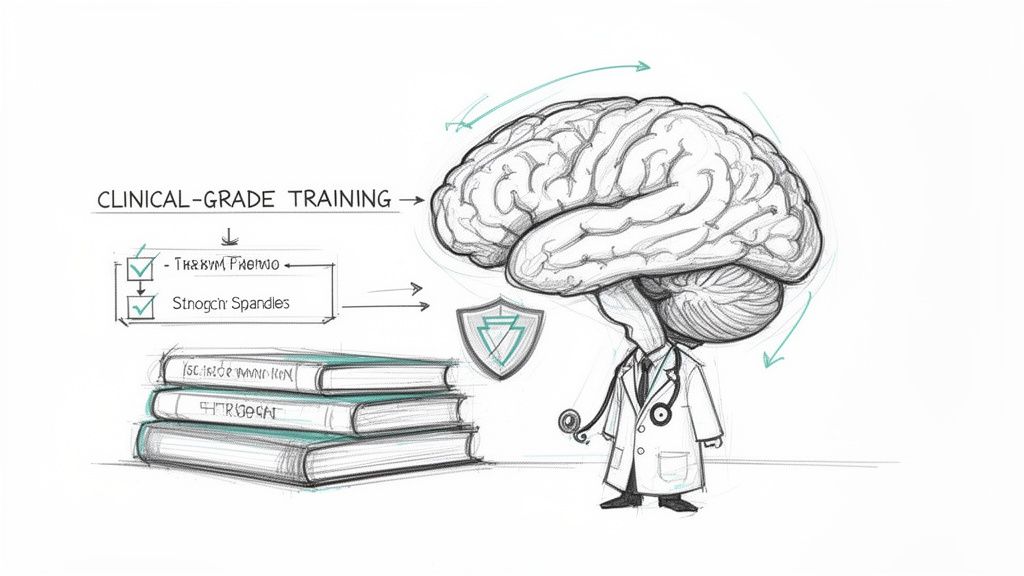
This specialized education is what allows Med-PaLM to move past simply retrieving information and start developing a skill absolutely critical in healthcare: clinical reasoning.
Clinical reasoning is that complex thought process physicians use every day to connect symptoms, weigh evidence, and ultimately diagnose and treat a patient. Med-PaLM was specifically engineered to mimic this process, which is why it's a huge leap forward compared to other generic AI tools for business.
The model’s training isn't just about finding the right answer; it’s about "thinking through" the problem. This means generating a list of possible diagnoses and explaining the logic behind its conclusions—a crucial step for earning a clinician's trust.
This focused approach delivers tangible results. The very first version of Med-PaLM was able to pass US Medical Licensing Exam (USMLE) style questions with remarkable accuracy. That milestone proved it could understand and apply complex medical concepts on par with human experts. As we explored in our AI adoption guide, choosing tools that are proven on industry-specific benchmarks is one of the biggest keys to success.
The AI field doesn't stand still, and neither did Med-PaLM. Its successor, Med-PaLM 2, was a major step forward in both performance and safety. In fact, it was the first AI model to hit an "expert" level on the MedQA benchmark, scoring an impressive 86.5%.
So, what changed? A few key things:
This evolution is a perfect example of why a dynamic AI strategy consulting approach is so important. As new models like Med-PaLM 2 emerge, organizations need to be ready to adapt and integrate these more capable tools.
This constant push for refinement is what elevates a model from a generalist tool to something truly ready for the high-stakes world of healthcare. By prioritizing safety and accuracy, Med-PaLM provides a solid foundation for developing advanced custom healthcare software development and innovative clinical tools. To find out how to navigate these advancements, feel free to connect with our expert team.
To make smart decisions about integrating Med-PaLM, we need to move past the hype and get real about its capabilities. This is a powerful tool, no doubt, but like any tool, it has both incredible strengths and very real limitations. A balanced view is the only way to build a strategy that unlocks its potential while managing the inherent risks.
A great place to start is its performance on medical licensing exams. Med-PaLM 2 made waves as the first AI to hit an "expert" level on the MedQA benchmark, scoring an impressive 86.5%. That's not just a number; it shows a near-human ability to understand and apply complex medical knowledge, placing it in a different league than general-purpose AIs.
This high-level performance isn't just academic. It translates into specific, valuable skills that can make a real difference in a healthcare setting. Med-PaLM is at its best when it's asked to do the heavy lifting of medical comprehension and synthesis.
Here’s where it excels:
These strengths are the building blocks for creating smarter internal tooling and more efficient clinical workflows, which our own AI Product Development Workflow is built to deliver.
For all its power, Med-PaLM isn't perfect. Acknowledging its limitations isn't about dismissing the technology; it's about being smart and safe with its implementation. These are manageable risks, but they demand a solid plan, something a Custom AI Strategy report can help you map out.
The most important challenges to keep in mind are:
This is also where we see the growing importance of adjacent technologies. For example, the healthcare biometrics market is expected to hit USD 42.00 billion by 2030, largely because of the urgent need to secure digital health platforms and prevent issues like medical identity theft. You can read the full research about healthcare biometrics trends to see how this fits into the broader security picture.
Ultimately, how you frame these limitations is everything. They aren’t deal-breakers; they're guideposts for a thoughtful rollout. By facing them head-on, we can build the necessary guardrails—like rigorous validation, bias audits, and mandatory clinical oversight—to deploy Med-PaLM responsibly. This practical, clear-eyed approach is central to our AI Automation as a Service philosophy, making sure powerful AI solutions deliver real value, safely and effectively.
Knowing what Med-PaLM can do is interesting, but the real question is how it can deliver tangible value to your organization. This is where we move from theory to practice. The true power of this medical AI isn't in its technical specs; it’s in the specific, concrete ways it can be deployed to solve the persistent challenges that healthcare providers face every single day. These aren’t pie-in-the-sky ideas but real-world use cases that deliver a clear return on investment by boosting efficiency, sharpening accuracy, and improving patient outcomes.
The key is to move Med-PaLM out of the research lab and into your daily workflows. By targeting high-impact areas where its specialized knowledge can make the biggest difference, organizations can unlock significant operational and clinical advantages.
One of the most immediate and powerful applications for Med-PaLM is to act as an intelligent co-pilot for clinicians. The model isn't there to make decisions—it’s there to sift through mountains of information at a speed no human ever could, offering crucial support without ever replacing the final judgment of a medical professional.
Think about a doctor treating a patient with a complicated, multi-year medical history. Instead of spending precious minutes trying to piece together fragmented records, they could use a Med-PaLM-powered tool to get an instant, accurate summary.
It can also suggest differential diagnoses based on reported symptoms and lab results, helping broaden a clinician’s perspective. This is a huge step in reducing the risk of a missed or delayed diagnosis, which directly impacts the quality of care and patient safety.
Physician burnout is a full-blown crisis, and a huge part of the problem is the crushing administrative workload. This is where Med-PaLM offers an immediate and measurable ROI. Automating documentation is a cornerstone of our AI Automation as a Service offering, because it’s designed specifically to give clinicians back their time.
By handling the repetitive, soul-crushing documentation tasks, Med-PaLM allows clinicians to redirect their focus from keyboards back to their patients. This shift doesn’t just improve job satisfaction; it increases patient throughput and the quality of face-to-face interactions.
The model can be integrated into existing EMRs and other systems to automate the creation of:
This kind of targeted automation tackles operational bottlenecks head-on. The result? Lower administrative costs and a more efficient, resilient healthcare workforce. Our structured AI Product Development Workflow ensures these tools are built securely and effectively from the ground up.
Beyond day-to-day clinical work, Med-PaLM is also a remarkably sophisticated training tool for the next generation of healthcare professionals. It can create realistic, interactive patient case simulations, giving medical students and residents a safe, controlled environment to hone their diagnostic and clinical reasoning skills.
These simulations can be fine-tuned to present everything from common illnesses to incredibly rare conditions, providing a breadth of experience that’s nearly impossible to get through traditional methods alone. It’s a practical way to build a more prepared and knowledgeable clinical workforce.
Finally, Med-PaLM can be the engine behind intelligent, patient-facing tools like chatbots and virtual assistants. But unlike a generic AI, it can provide medically sound, easy-to-understand answers to common patient questions about their conditions, treatments, or medication schedules.
This gives patients a reliable source of information anytime they need it, which can reduce their anxiety and free up nurses and other staff from answering the same routine queries over and over. Each of these applications shows how investing in specialized Healthcare AI Services turns a powerful technology into a strategic asset that strengthens the entire organization.
Getting a powerful tool like Med-PaLM into your operations is about more than just plugging in an API. For CTOs and operations leaders, the real work lies in creating a practical roadmap that moves from theory to reality. It's a careful process of upgrading existing systems, navigating a maze of regulations, and building a secure architecture that can actually scale.
The idea is to weave Med-PaLM into your organization’s technical fabric in a way that makes sense for you. This could mean enhancing your current Electronic Health Record (EHR) system with AI-powered summarization. It might involve improving the internal tooling your administrative teams already use. Or, you could go bigger and design entirely new applications built around AI to tackle specific clinical problems from the start.
In healthcare, you can't talk about technology without talking about regulations. Every single part of a Med-PaLM integration must be built with an intense focus on compliance, especially with the Health Insurance Portability and Accountability Act (HIPAA). This isn't just a recommendation; it's the absolute foundation of your entire plan.
A HIPAA-compliant architecture isn't one single thing but a combination of several critical safeguards working together:
These aren't just technical boxes to check. They're what build the trust needed for both your clinical staff and your patients to feel safe using the system.
For all its impressive abilities, Med-PaLM is a tool to assist experts, not replace them. That’s why a "human-in-the-loop" system isn't just a good idea—it's a must-have for patient safety and clinical accountability. This principle is simple: a qualified medical professional must always be there to review, validate, and sign off on any AI-generated output before it's used to make a clinical decision.
This approach acts as a crucial safety net, catching potential model inaccuracies or "hallucinations" and ensuring the final call always rests with a human expert. It shifts the AI from being an autonomous decision-maker to a highly capable co-pilot.
This is a great way to think about how Med-PaLM can support clinicians, automate routine work, and help educate staff—all while keeping a human firmly in control.
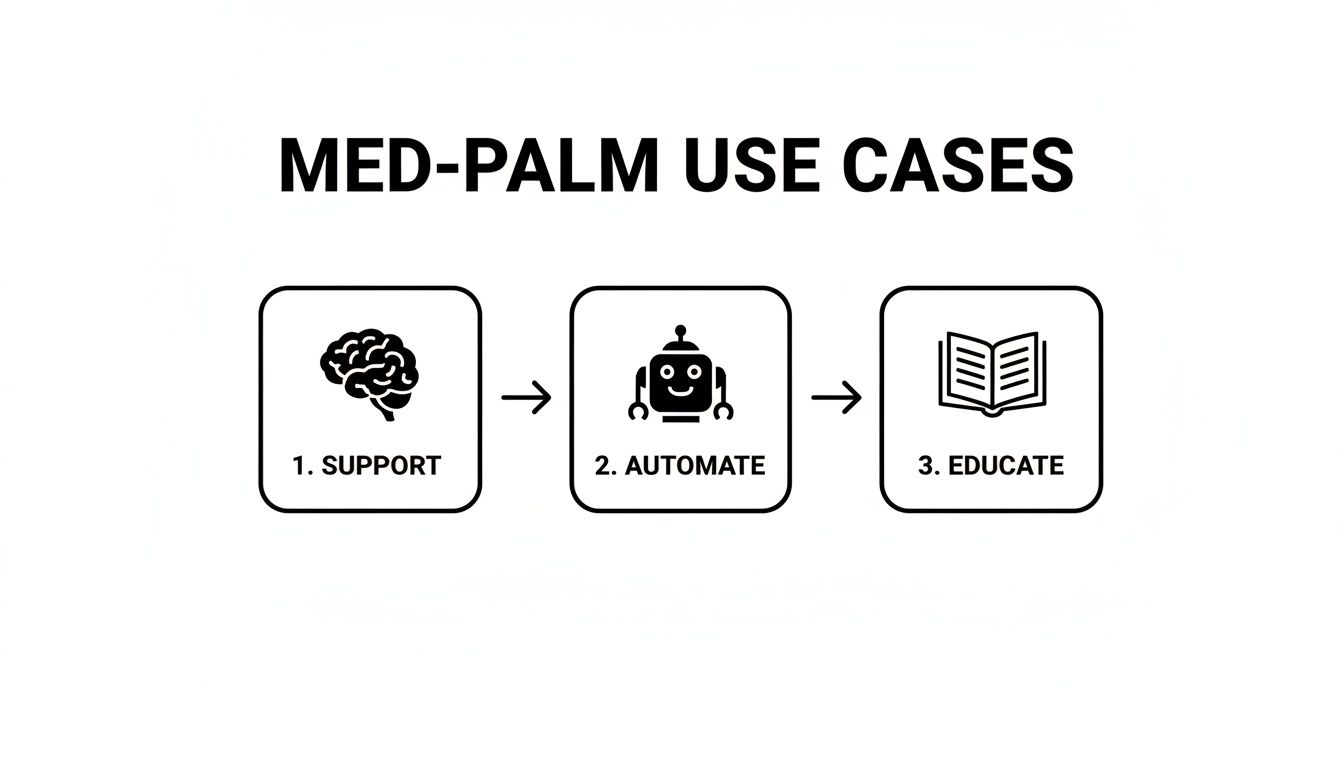
As you can see, whether Med-PaLM is helping with a diagnosis or automating paperwork, it’s always designed to enhance human workflows, not operate in a vacuum.
Getting past the compliance hurdles is only half the battle. A successful integration also means tackling some real technical challenges. You’ll need to manage API calls efficiently, build resilient data pipelines, and keep a close eye on the model’s performance over time. A "figure it out as we go" approach just won't cut it; it’s a recipe for spotty performance, security holes, and, ultimately, a failed project.
This is exactly why having a structured implementation plan is so critical. A methodical process ensures every step—from figuring out what you need in the first place to deploying the final product and keeping it running—is handled with precision. It breaks a massive technical undertaking down into a manageable, step-by-step rollout, letting you bring sophisticated AI to life safely and effectively to deliver real value to clinicians and patients alike.
Med-PaLM isn't the final chapter in medical AI—it's more like the opening paragraph. The real story is heading toward multimodal models. Imagine systems that don't just read a patient's chart but can simultaneously analyze their X-ray, process lab results, and even factor in genomic data. This fusion of information is what will unlock hyper-personalized patient care on a scale we've never seen before.
This isn't some far-off science fiction scenario. It's being built right now, and it’s going to fundamentally change how healthcare works. For leaders, the time to get ready is now. Waiting for these tools to become common off-the-shelf products means you'll be playing catch-up to competitors who are already building the infrastructure and skills they need to win.
So, how do you make this future a reality for your organization? It starts with an honest look at where you are today. Before you dive in, you need to understand your own capabilities.
Here’s a practical checklist to get you started:
This guide gives you a solid foundation, but the real advantage comes from decisive action. It’s time to shift from just learning about tools like Med-PaLM to actually leading with them. That means building a focused strategy that turns powerful AI into a real, lasting advantage for your hospital or health system.
The most successful AI integrations aren't about adopting technology for its own sake. They're about strategically applying it to solve your most pressing clinical and operational challenges.
To start this journey, we encourage you to connect with our expert team. We can help you run a thorough AI requirements analysis and build a tailored plan that turns these powerful technologies into tangible value.
This section tackles the most common questions we hear from business leaders about Med-PaLM. The answers are straightforward and designed to address the key concerns you might have.
Absolutely not. Med-PaLM is a clinical decision support tool. Think of it as an expert co-pilot, not the pilot. Its job is to augment medical professionals by speeding up research, summarizing complex information, and offering potential avenues for exploration. The final medical judgment and responsibility for patient care always, always stay with the human expert.
Any application built on Med-PaLM that touches patient data must run inside a HIPAA-compliant environment. This is a non-negotiable technical requirement, involving strict access controls, end-to-end encryption, and detailed audit trails. The model itself doesn't store personal health information from queries. Your organization is ultimately responsible for ensuring its applications and data pipelines meet all privacy regulations—a cornerstone of any well-designed AI strategy.
The two biggest differences are specialization and safety. Med-PaLM was fine-tuned specifically on curated medical data and tested against clinical safety benchmarks. General-purpose models like ChatGPT are trained on the wild west of the internet and can produce dangerously wrong medical advice. Med-PaLM is engineered to grasp medical nuance, cite its sources, and minimize errors, making it a much more suitable tool for high-stakes healthcare environments.
You can get access to Med-PaLM through Google Cloud's Vertex AI platform. But the best first step isn't technical; it's strategic. Identify a specific, high-value problem in your organization, like automating clinical note-taking to reduce physician burnout. Partnering with an expert in AI strategy consulting can help you design a smart pilot project, navigate the setup, and build a strong business case for a successful rollout with measurable ROI.
At Ekipa AI, our expert team can help you create a tailored strategy to integrate Med-PaLM and other powerful AI solutions.
How to build HIPAA-compliant AI: when LLM providers need a BAA, data minimization, de-identification, audit controls and a reference architecture.
Practical data migration planning guide for healthcare teams. Scope, mapping, compliance, validation, cutover and rollback decisions explained end to end.
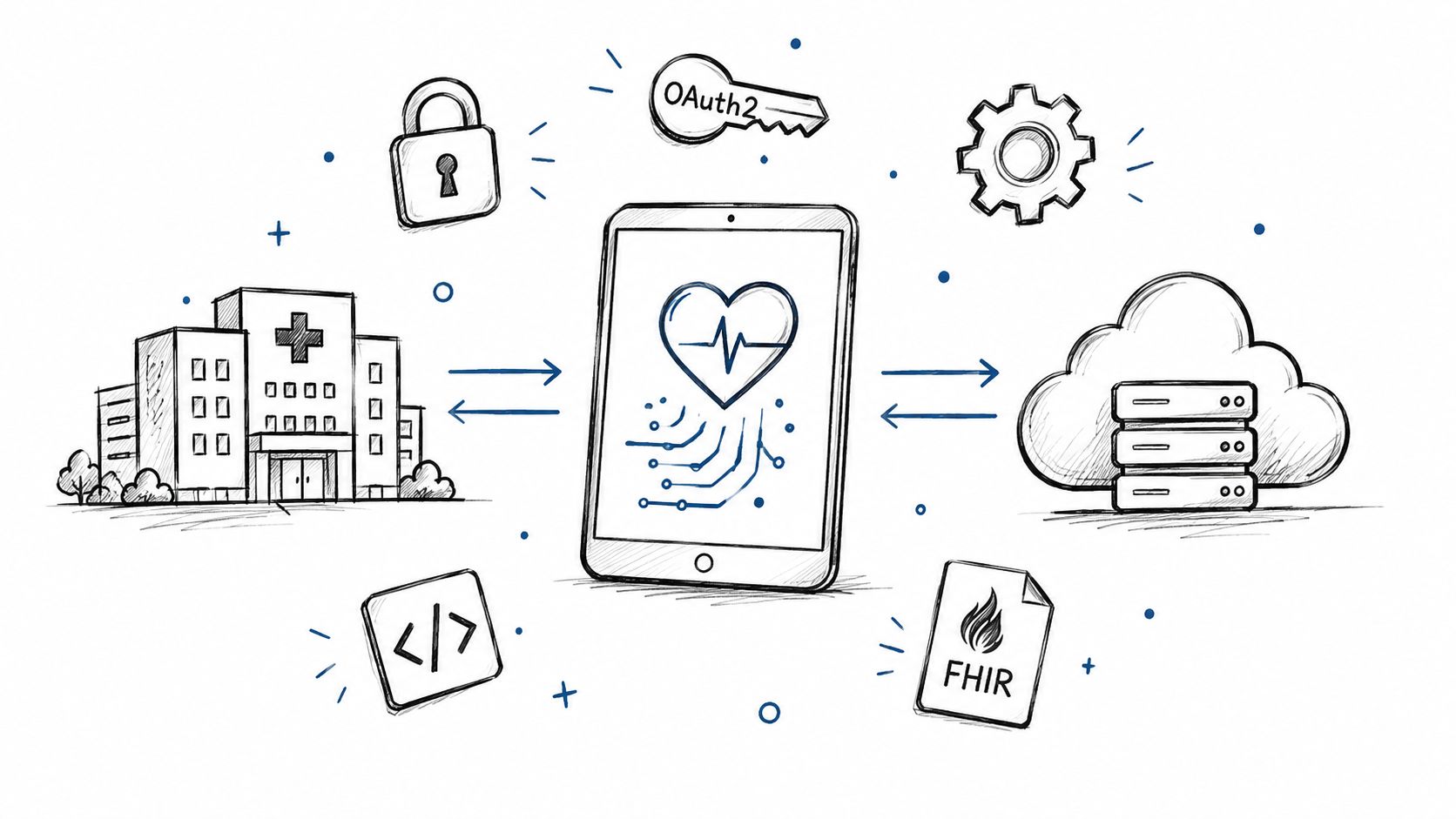
Smart on FHIR guide for healthtech engineers. Learn the OAuth 2.0 launch model, scope syntax, backend services, and US regulatory requirements.
Connect with our team to explore how AI expertise can transform your business.