
AI in Healthcare
HIPAA-Compliant AI: How to Use LLMs With PHI Safely
How to build HIPAA-compliant AI: when LLM providers need a BAA, data minimization, de-identification, audit controls and a reference architecture.
October 16, 2026Read more
Discover how medical scribe AI is revolutionizing clinical documentation, freeing up physicians, and improving patient care. Your essential guide.
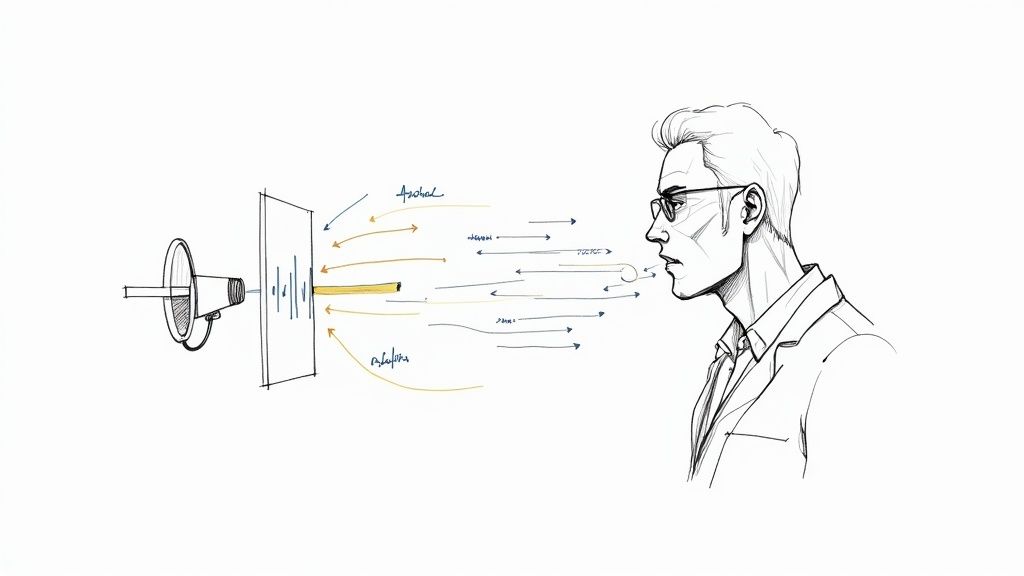
At its core, a medical scribe AI is a smart system that listens to a conversation between a doctor and a patient and turns it into a structured clinical note, all in real time. Think of it as a virtual assistant whose only job is to handle the paperwork, letting the doctor be a doctor.
Picture a world where doctors can actually look their patients in the eye instead of being glued to a computer screen. For too long, the shift to Electronic Health Records (EHRs) brought an unintended consequence: a crushing amount of administrative work. Many clinicians find themselves spending hours after work finishing charts—a phenomenon often called "pajama time."
This documentation burden isn't just an annoyance; it's a leading cause of physician burnout and gets in the way of building real patient relationships.
This is exactly the problem that medical scribe AI is built to solve. It’s not just another software tool. It's an intelligent partner designed to eliminate the very friction that drains clinicians. The AI listens ambiently during an appointment, instantly capturing, understanding, and organizing the dialogue into a precise, compliant clinical note.
The difference between the old way and the new way is night and day. When a doctor has to manually type notes during a visit, their attention is split. Appointments feel rushed, and the documentation itself can end up being incomplete. This creates an administrative debt that piles up, eating into the personal time that clinicians desperately need.
Medical Scribe AI is designed to make the whole process smoother, often replacing the slow, manual work of traditional medical transcription by building documentation right into the patient visit. The impact is felt immediately.
Here's a quick look at what these systems do.
This table breaks down the core functions that define a medical scribe AI, showing its immediate impact on daily clinical tasks.
| Capability | What It Does | Impact on Clinical Workflow |
|---|---|---|
| Ambient Listening | Captures natural doctor-patient dialogue without interruption. | Eliminates the need for the clinician to pause and type, allowing for a natural conversation flow. |
| Intelligent Transcription | Converts spoken words into accurate, readable text. | Creates a complete, verbatim record of the encounter for reference and note generation. |
| Clinical Note Generation | Structures the transcript into a formal SOAP note or other required format. | Drastically reduces the time and effort spent on manual note writing and organization. |
| EHR Integration | Pushes the finalized note directly into the patient's record in the EHR. | Removes manual data entry steps, minimizes clicks, and ensures the record is updated instantly. |
As you can see, each capability is designed to remove a specific point of friction from the clinician's day.
This technology is hitting its stride just when the healthcare industry needs it most. It’s one of the most practical and high-impact AI solutions available today, offering a direct answer to the heavy operational and human costs of administrative work. As we explored in our AI adoption guide, adopting these systems is a smart move for any forward-thinking healthcare organization.
It can feel a little like magic the first time you see it. A natural, free-flowing conversation between a doctor and patient is somehow turned into a perfect, structured clinical note. But behind the curtain, it’s a sophisticated and carefully orchestrated process built on some seriously powerful technology.
Let's pull back that curtain. The entire workflow really boils down to three key steps: Capture, Interpretation, and Generation. This is the engine that drives any ambient clinical intelligence tool, turning casual conversation into data that’s ready for the EMR.
This simple visual shows the real-world impact—shifting the doctor's focus from a computer screen back to the human being in front of them.
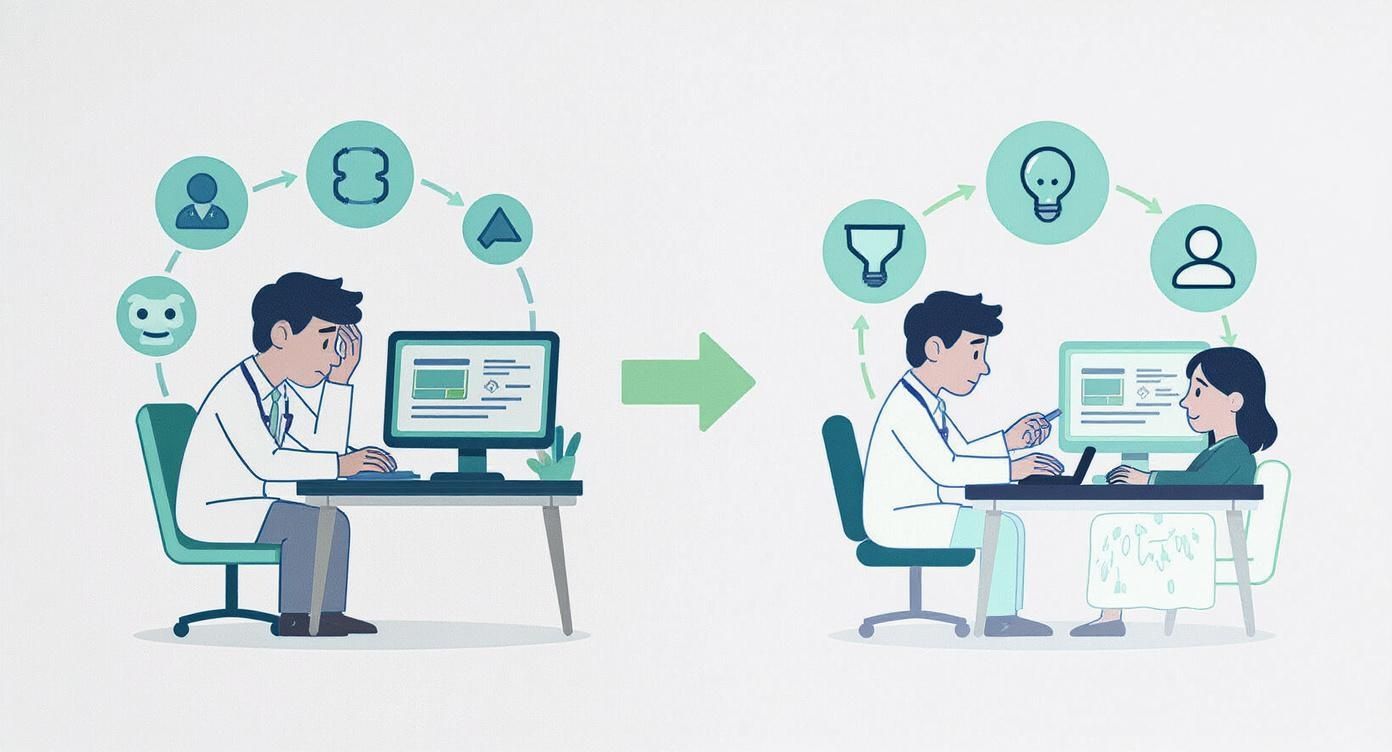
It’s a clear picture of the goal: moving away from the burnout of manual data entry and toward a more collaborative, patient-focused environment.
Everything starts the moment the physician activates the AI in the exam room. The system uses what’s called ambient listening technology to passively and securely record the entire encounter. This isn't your phone's voice recorder; it's a high-fidelity system designed to capture clear dialogue, even with the typical background noise of a clinic.
This first step is the foundation for everything that follows. The cleaner the audio, the more accurate the final note. Today’s best systems are also great at distinguishing who is speaking—the doctor, the patient, a family member—and tagging the transcript so the context is never lost.
With the conversation captured, the system moves on to the really heavy lifting: interpretation. This is where the AI essentially becomes a medical translator, fluent in both everyday language and clinical shorthand. The core technology at play here is Natural Language Processing (NLP).
Think of NLP as the AI's cognitive engine. It does a few critical things:
This interpretation engine is always getting smarter. Each encounter helps the models get better at understanding a specialist’s unique vocabulary or a specific doctor’s way of phrasing things. It’s a lot like how our own internal tooling is built to adapt to the people who use it.
Once the AI has made sense of the dialogue, the final step is to put it all together into a structured clinical note. The system takes all the medical information it extracted and neatly organizes it into the right sections of an Electronic Health Record (EHR), often using a standard format like SOAP (Subjective, Objective, Assessment, and Plan).
The AI drafts a complete, coherent note that’s ready for the physician to quickly review, edit if needed, and sign. This “human-in-the-loop” approach ensures 100% clinical accuracy and oversight while getting rid of almost all the manual typing. This powerful sequence of capturing, interpreting, and generating is at the heart of how our AI Automation as a Service makes complex business processes run smoothly.
So, what does all this technology actually mean for your clinic day-to-day? Moving past the technical details, the real value of a medical scribe AI snaps into focus when you see its effect on your organization. This isn't just about faster typing; it's a fundamental change that improves financial health, makes operations run smoother, and elevates the quality of care itself.
The business case for AI scribes is built on four powerful pillars that tackle the biggest headaches in modern medicine.
And the market is certainly taking notice. The AI medical scribe software market, currently valued around USD 1.12 billion, is expected to grow at a healthy clip of 20.4% each year, potentially hitting USD 7.85 billion by 2033. This boom is driven by a serious push to reduce physician burnout and the widespread use of EHRs. You can dig into the numbers in the full market analysis on dataintelo.com.
The most immediate and profound impact is on your clinical staff's well-being. Physician burnout is a full-blown crisis, largely fueled by the crushing weight of administrative tasks. It's not uncommon for clinicians to spend two hours on documentation for every one hour they spend with patients.
A medical scribe AI gives that time back. By automating the note-taking process, it dramatically cuts down the hours spent staring at an EHR. This all but eliminates the dreaded "pajama time"—those extra hours physicians spend catching up on charts at home after an already long day. With that time back, they can decompress, focus on more complex patient cases, or simply go home on time. The result is better job satisfaction and less staff turnover.
The benefits don't stop with your clinicians; they ripple through the entire practice, from the front desk to the billing office. When clinical notes are completed instantly, the whole workflow speeds up.
To see these kinds of results, you need a plan. Developing a Custom AI Strategy report is the first step toward creating a clear roadmap for a successful rollout.
Think of an AI scribe as more than a transcriptionist—it's a meticulous record-keeper. It captures the subtle details of a patient encounter, like faint symptoms, a complex family history, or a multi-step care plan, which are easy to miss when you're typing and talking at the same time.
The result is a clinical note that is not only more complete but also more structured and consistent. This kind of high-quality documentation is invaluable for lowering compliance risks, supporting medico-legal defense, and ensuring every provider is on the same page.
This focus on detail and structure is a core principle in effective AI strategy consulting, where solid data is the bedrock of intelligent automation.
Ultimately, the person who benefits most is the patient. When a doctor isn't glued to a computer screen, they can offer their full attention. They can make eye contact, listen without distraction, and build a more human connection.
This improved interaction builds trust and strengthens the physician-patient relationship. Patients feel truly heard and leave with a better understanding of their treatment plan, which often leads to better follow-through and improved health outcomes. By removing the screen that acts as a barrier, a medical scribe AI helps bring the human element back to the exam room.
Before we dive deeper, let's look at a side-by-side comparison to see just how stark the difference is between the old way and the new.
The table below provides a clear breakdown of the operational and financial improvements clinics can achieve by adopting AI scribe technology.
| Metric | Manual EHR Entry | With Medical Scribe AI | Key Performance Driver |
|---|---|---|---|
| Documentation Time | 10-15 minutes per patient | 1-2 minutes for review & sign-off | Ambient listening & real-time note generation |
| "Pajama Time" | 1-2 hours per day post-clinic | Eliminated or reduced by 90% | Point-of-care documentation completion |
| Patient Throughput | Baseline | Potential increase of 10-20% | Reclaimed clinical time reinvested in patient care |
| Claim Denial Rate | Industry average: 5-10% | Reduced by up to 50% | Higher specificity & accuracy in clinical notes |
| Time to Reimbursement | 21-35 days average | Shortened by 5-7 days | Faster coding & billing cycle |
| Physician Burnout | ~50% of physicians report burnout symptoms | Significant reduction in administrative burden | Improved work-life balance & job satisfaction |
| Patient Face-to-Face Time | Often split between patient & screen | Increased, with 100% focus on the patient | Doctor is free from typing and clicking |
As you can see, the impact goes far beyond simple convenience. Adopting a medical scribe AI drives measurable improvements across nearly every critical metric for a modern healthcare practice.
The real magic of a medical scribe AI isn't just what it does, but how it adapts. While the core technology is consistent, its day-to-day application looks completely different depending on the clinical setting. Let's step into four distinct specialties to see how this tool actually works on the ground, helping specialists get back to the work that matters most. These aren't theoretical examples; they reflect the kind of practical wins we've documented in our library of real-world use cases.
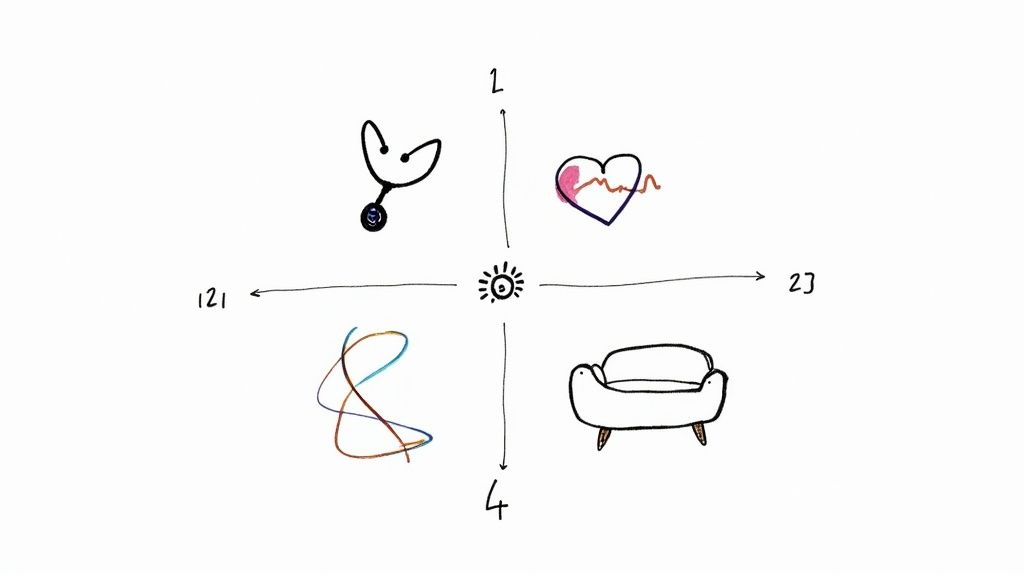
Think about the fast-paced environment of a primary care clinic, where appointments are often scheduled back-to-back. A doctor is conducting an annual physical, covering everything from diet and exercise to refilling prescriptions and discussing a patient's new, nagging cough. The AI scribe is listening to the entire conversation, intelligently separating the patient's subjective complaints from the doctor's objective findings during the exam.
Before the patient even leaves the room, a comprehensive SOAP note is drafted and waiting in the EHR. The patient’s history, review of systems, and assessment are already populated. The physician just needs to give it a quick review and sign off, saving a solid 10-15 minutes per patient. That time adds up, creating room for another appointment or just a much-needed moment to catch a breath.
Now, let's move to a cardiology consultation for a patient with complex atrial fibrillation. The cardiologist is dictating highly technical findings from an EKG and laying out a multi-step treatment plan that includes anticoagulants and a potential ablation procedure. The AI scribe has to nail the transcription of specific terms like "paroxysmal supraventricular tachycardia" and precise medication dosages.
This is where the system shines. It captures the subtle details of the cardiac exam and the intricate plan of care, ensuring every critical data point is documented with absolute precision. This isn't just about good notes; it's essential for accurate billing and maintaining continuity of care with other specialists.
In an orthopedic clinic, the physical exam is everything. An orthopedist is evaluating a knee injury, moving the joint through various ranges of motion while noting degrees of flexion, ligament stability, and specific points of tenderness. As they work, they're speaking their findings aloud, completely hands-free.
The medical scribe AI captures these spoken observations in real time, building a detailed objective assessment as the exam happens.
This allows the doctor to stay focused on the patient and maintain physical contact, without ever breaking the flow to type on a keyboard. Our own Clinic AI Assistant was built for this exact kind of seamless, hands-free workflow, making sure the technology supports the clinical encounter instead of interrupting it.
Finally, let's consider a therapy session. A psychiatrist is navigating a sensitive conversation with a patient about their anxiety and depression. The dialogue is full of nuance, where tone and context are just as meaningful as the words spoken. Maintaining eye contact and an empathetic presence is crucial.
The AI scribe works silently in the background, discreetly and accurately documenting the session. It’s programmed to handle highly sensitive information with bank-level security, creating a factual record of symptoms, patient responses, and the therapeutic plan moving forward.
This frees the therapist from the distraction of taking notes, which helps build a stronger, more trusting therapeutic relationship. It’s a powerful example of how technology, when applied thoughtfully, can actually enhance the most human aspects of medicine.
Bringing any new technology into a clinical setting can feel like a massive undertaking. But with the right roadmap, what seems complex becomes a series of manageable steps. Successfully integrating a medical scribe AI isn't about just turning on a new piece of software; it's a careful process of connecting it with your current systems, ensuring every bit of data is secure, and getting your team excited to use it.
The demand for this kind of help is exploding. The market for AI in medical writing, which is the broader category for these scribe tools, was pegged at around USD 878.08 million and is on track to hit over USD 2.78 billion by 2035. That kind of growth tells you the industry sees real value here. If you want to dig deeper into the numbers, a detailed market report from Research Nester breaks it all down.
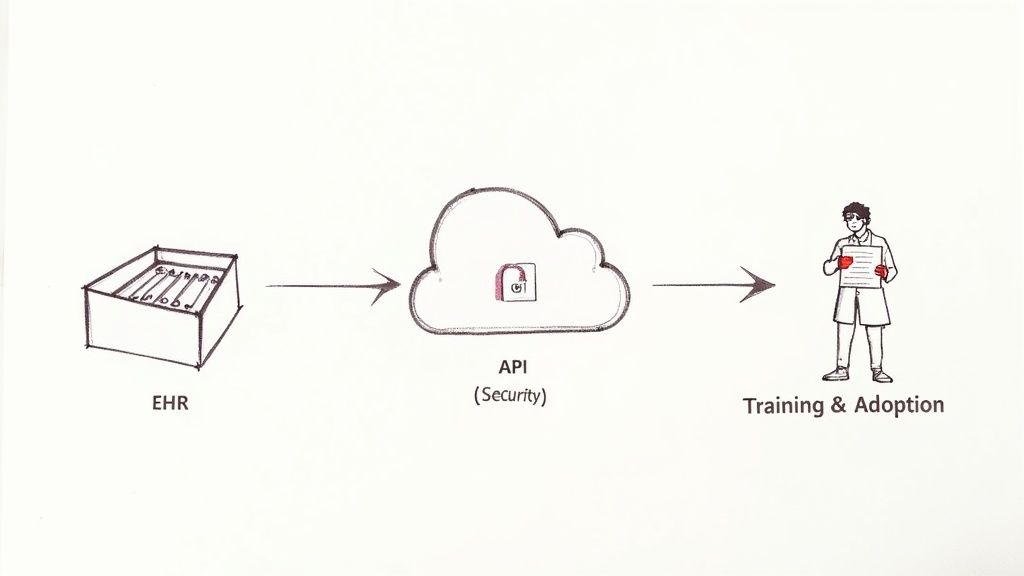
First things first: your AI scribe has to play nice with your Electronic Health Record (EHR) system. This is the absolute foundation. Modern AI scribe platforms are designed for this, using Application Programming Interfaces (APIs) to build a secure bridge for data to travel back and forth.
Think of an API as a skilled interpreter, letting the AI scribe and your EHR speak the same language fluently. The dream is a "zero-click" workflow where the AI’s note just appears in the right patient chart, ready for the physician to review and sign off. This deep integration is what prevents the tool from becoming just another disconnected app that adds more work instead of taking it away.
When you're handling Protected Health Information (PHI), security isn't just a feature—it's everything. Any medical scribe AI you even consider must be built from the ground up with bulletproof security and ironclad HIPAA compliance. This is a hard-and-fast rule with no exceptions.
Here are the security table stakes you should insist on:
A great tool is useless if nobody wants to use it. The human side of implementation is every bit as critical as the technical setup. A smooth rollout is all about good training, ongoing support, and building genuine confidence in the technology among your clinical staff.
A pilot program is often the best way to start. Hand-pick a small group of tech-savvy or just plain curious physicians to try it out first. Let them provide feedback, work out the kinks, and become your internal champions. Their authentic enthusiasm will do more to convince their peers than any top-down mandate ever could.
We guide organizations through this exact process with our structured AI Product Development Workflow, which provides a playbook for moving from a small pilot to a full-scale deployment without the usual headaches. This often involves collaborating on custom healthcare software development to make sure the solution fits your clinic's unique needs like a glove.
Choosing the right technology is only half the battle. Your medical scribe AI initiative will succeed or fail based on the implementation partner you choose. Think of it less like a software purchase and more like a strategic partnership—one that will reshape your clinical workflows, touch every aspect of patient care, and ultimately determine your return on investment. You need a partner who gets both the intricate tech and the realities of a busy healthcare setting.
The market for these tools is exploding. Ambient scribes have quickly become a dominant clinical AI application, pulling in around $600 million in revenue and showing a staggering 2.4-fold increase year-over-year. This growth, driven by major players, proves the technology is ready for prime time. You can get a great overview of the current landscape from this insightful analysis on menlovc.com.
When you start talking to vendors, you have to dig deeper than the sales pitch. Your evaluation needs to be a serious look into their actual capabilities, security practices, and whether they're truly committed to your success long-term.
Here are the non-negotiable questions you should be asking:
The best results always come from a genuine partnership, not a simple transactional relationship. Your ideal partner should feel like an extension of your own team, offering guidance that stretches far beyond the initial setup. This is precisely where expertise in AI strategy consulting proves its worth. A good partner walks with you from the very first AI requirements analysis all the way through deployment and ongoing optimization.
A critical piece of this is a solid commitment to robust Third-Party Risk Management (TPRM). This is your assurance that every single layer of their technology meets the strictest security and compliance standards, protecting both your organization's data and your patients' privacy.
The goal is to find a team that doesn't just sell you a product but co-creates a solution with you. They should be just as invested in your clinical and operational goals as you are, helping you measure what matters and adapt the tool as your needs change.
This kind of collaborative spirit is what makes the difference between an AI tool that’s merely installed and one that’s fully adopted, optimized, and delivering real value. It turns a piece of software into a cornerstone of your clinical efficiency strategy.
Finding your way through the vendor landscape and implementing medical scribe AI is no small feat. It demands a partner with deep technical chops and a genuine, nuanced understanding of healthcare environments. The path from an idea to a fully scaled solution is complex, but it doesn't have to be a nightmare.
The best outcomes are born from working with a team that has been there and done that—a team with a proven history of turning ambitious AI goals into real-world clinical improvements. By pairing the right technology with a clear strategy, you can unlock incredible gains in efficiency, clinician well-being, and patient care. To see how you can build a successful AI scribe program, get in touch with our expert team.
Bringing any new technology into a clinical setting naturally comes with questions. When it comes to AI scribes, we find that a few key concerns pop up for both clinicians and administrators who are thinking about making the switch.
Let's walk through some of the most common questions we hear.
This is usually the first question on everyone's mind, and for good reason. Top-tier platforms consistently hit accuracy rates above 95% for the core job of transcribing the conversation.
Of course, real-world factors like poor audio quality, heavy accents, or highly specific medical jargon can affect performance. That’s why the clinician always stays in the loop—they give the final review and sign-off before anything hits the patient's chart, ensuring 100% accuracy.
Absolutely. Patient privacy is non-negotiable. Any reputable AI scribe vendor builds their entire system around security from the ground up.
This means you should expect features like end-to-end encryption, secure cloud infrastructure (like AWS or Azure), and strict user access controls. A signed Business Associate Agreement (BAA) is a must-have, as it's the legal guarantee that the vendor is committed to protecting patient data to HIPAA standards.
Getting started is often quicker than people think. A focused pilot program with a small group of physicians can be up and running in just two to four weeks.
A full-scale rollout across an entire department or organization is a bigger project, typically taking three to six months. This timeline allows for proper EHR integration, tailoring the software to your specific workflows, and getting everyone trained up. We’ve found that a phased approach works best—it minimizes disruption and helps build momentum.
The key steps usually look something like this:
"A phased approach reduces risk and builds internal champions for lasting success."
Yes, and this is where the technology truly shines. The best AI scribes are not one-size-fits-all; they are trained on vast datasets covering a wide range of medical fields. This allows them to understand the unique vocabulary and documentation styles of different specialties right out of the box.
This built-in adaptability makes it much easier for different departments to get on board and see the benefits quickly.
Our team has helped countless organizations navigate these questions and achieve successful implementations. We invite you to connect with our expert team to see how we can help you do the same.
Ready to transform clinical documentation? Contact Ekipa AI https://www.ekipa.ai
How to build HIPAA-compliant AI: when LLM providers need a BAA, data minimization, de-identification, audit controls and a reference architecture.

Practical data migration planning guide for healthcare teams. Scope, mapping, compliance, validation, cutover and rollback decisions explained end to end.

Smart on FHIR guide for healthtech engineers. Learn the OAuth 2.0 launch model, scope syntax, backend services, and US regulatory requirements.
Connect with our team to explore how AI expertise can transform your business.