
AI in Healthcare
HIPAA-Compliant AI: How to Use LLMs With PHI Safely
How to build HIPAA-compliant AI: when LLM providers need a BAA, data minimization, de-identification, audit controls and a reference architecture.
October 16, 2026Read more
A practical framework for leaders on planning & deploying personalized treatment recommendations using AI. Navigate complexities to drive real-world outcomes.

Sixty-three percent of U.S. adults say AI-generated health information is reliable enough to take seriously, while nearly half still worry about accuracy, as noted earlier. That is the operating reality for personalized treatment recommendations using AI. Demand is here, but trust is conditional.
For leadership teams, the hard part is rarely the model itself. The failure point is implementation inside real care delivery. Recommendation quality means little if the system cannot use fragmented EHR data, fit clinician decision-making, meet compliance requirements, and produce outputs a physician can explain to a patient in the moment.
I have seen the same pattern across health systems and digital health companies. Pilot teams spend months improving model performance, then lose value at deployment because workflow integration, interoperability, and governance were treated as downstream tasks. That is why so many healthcare AI pilots stall. The barrier is operational, not theoretical.
This is the standard C-suite teams should use when evaluating healthcare AI implementation and delivery strategy. Do not ask only whether the model can predict. Ask whether the organization can validate, deploy, monitor, and defend personalized recommendations under clinical conditions, at scale, with a clear path to ROI.
The organizations that get this right treat AI as a clinical product and an operating model change at the same time.
Most healthcare AI pilots never reach durable clinical use. In practice, the failure point is usually workflow integration, interoperability, and governance, not model accuracy. This represents the key opportunity in personalized treatment recommendations using AI. The market does not need another impressive pilot. It needs systems that hold up inside care delivery.
The opportunity is clear. Personalized recommendations can improve treatment selection in chronic disease management, oncology, and point-of-care decision support by using patient-specific signals that standard protocols often miss. As noted earlier, patient interest in AI-assisted health information is real, but so is scrutiny. That combination creates demand for tools that are useful under clinical pressure, not just persuasive in a product demo.
The obstacle is operational trust.
If a recommendation engine cannot reconcile fragmented EHR inputs, fit consent and privacy requirements, and give clinicians a rationale they can explain in the room, it does not create enterprise value. It adds implementation cost, slows adoption, and increases compliance exposure. Leaders evaluating Healthcare AI implementation and delivery strategy should assess the full operating model, not only model performance.
Leaders in health systems and digital health often express fatigue with abstract precision medicine narratives. Budget owners want proof that an AI system improves a treatment decision, fits the visit, and does not create more clicks, more exceptions, or more review burden for already stretched teams.
A credible business case usually rests on three linked outcomes:
I use a simple test with executive teams. If the recommendation cannot be surfaced at the moment a clinician makes a decision, and defended later in a utilization review, quality audit, or patient inquiry, the projected ROI is overstated. The same operational discipline that supports clinical AI also matters in adjacent workflows that streamline legal medical document review, because business value depends on usable outputs inside existing processes.
The strongest programs start with a narrow treatment decision that already causes measurable cost, delay, or variation. They map where that decision breaks down, what data is available at that point in care, and what level of explanation the clinician needs to act with confidence.
That is where many programs stall. Teams invest in model development before they resolve interoperability constraints, ownership of clinical overrides, or post-deployment monitoring. The result is familiar. A pilot shows promise, deployment hits the realities of care delivery, and the organization concludes that the AI was immature when the underlying issue was operating design.
The organizations that make progress treat personalized treatment recommendations using AI as a product, a clinical intervention, and a change program at the same time. That is how they reduce risk, protect trust, and turn technical potential into measurable financial and clinical return.
Healthcare AI programs rarely fail because the model is impossible to build. They fail because the organization starts with whatever data is easy to access, then tries to force a clinical use case onto it. In practice, that sequence drives expensive pilots with weak adoption.
For personalized treatment recommendations, the order should be fixed. Start with the treatment decision. Then define the workflow moment. Then determine what data is reliable enough to support that decision.
That discipline matters because workflow and interoperability problems kill more programs than algorithm design.
A sound program begins with AI requirements analysis. Specify the treatment choice you want to influence, where it appears in care delivery, who can override the recommendation, and what evidence the clinician will need to defend the decision later. Teams that skip this step usually discover too late that the model needs data that is unavailable, delayed, or unusable at the point of care. For organizations formalizing this work, a targeted product and workflow assessment, such as clinical AI decision support planning in Diagnoo, helps tie model scope to operational constraints before engineering spend accelerates.
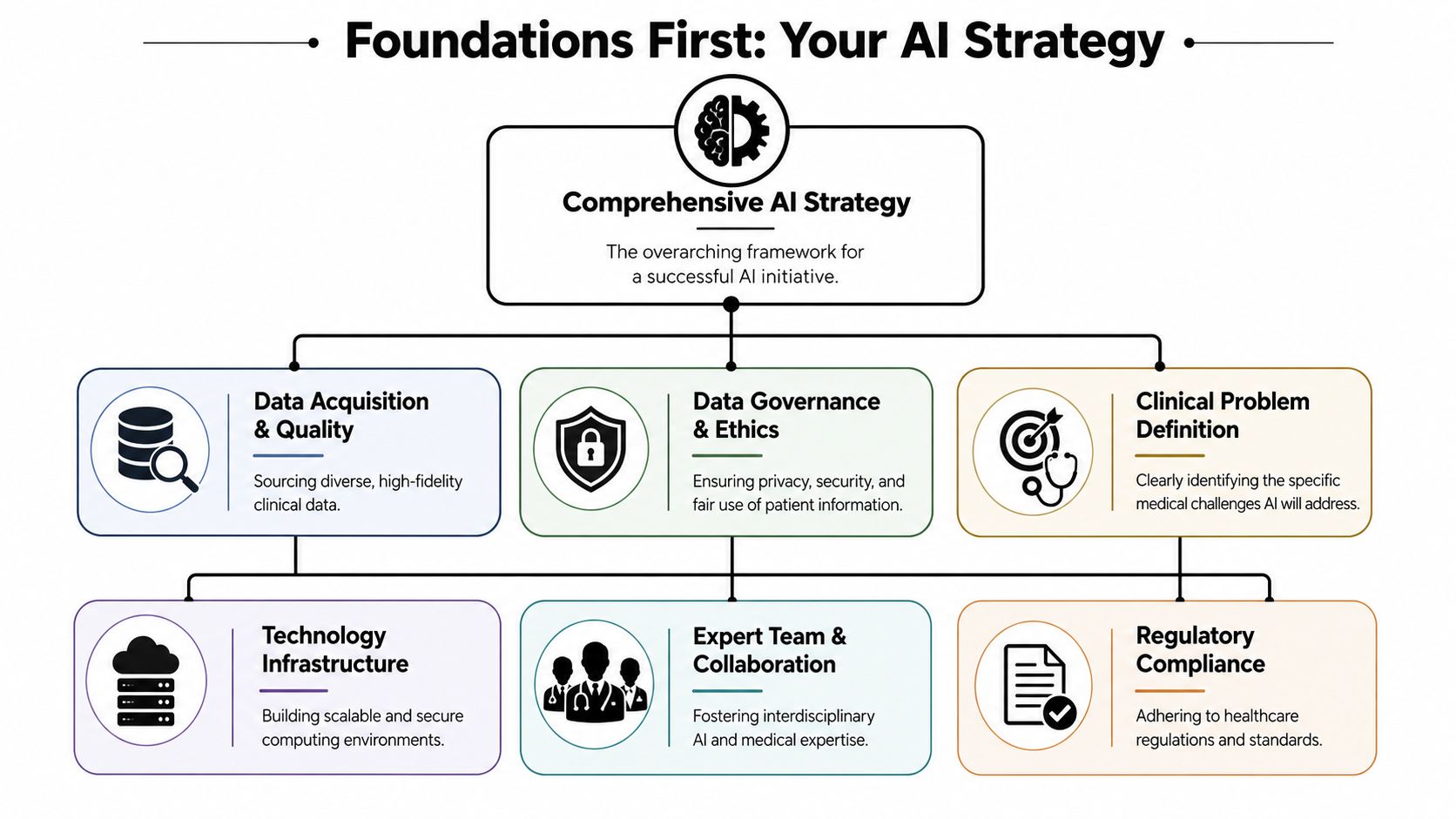
A standard methodology for AI treatment systems includes data standardization, algorithm auditing, and real-time outcome monitoring, with typical implementation costs ranging from $150,000 to $300,000 depending on infrastructure complexity, as outlined in Meegle's overview of AI-powered personalized treatment plans.
Personalization depends on joining systems that were never designed to work together cleanly. EHR records, imaging, lab results, genomics, and patient-reported data arrive in different formats, with uneven completeness and different governance rules. If the integration layer is weak, the recommendation layer inherits that weakness.
The failure mode is usually subtle. Scores drift because a lab feed changes format. Recommendations become less consistent because diagnosis codes are mapped differently across sites. Clinicians stop trusting the output because two similar patients receive different guidance and no one can explain why.
A workable foundation usually includes:
Clinical problem definition
Define the decision in operational terms. “Improve oncology outcomes” is too broad to fund or govern well. “Rank likely treatment response for a defined cohort during therapy selection” gives the data, product, and clinical teams a shared target.
Data mapping and normalization Resolve source quality, field consistency, coding standards, missingness, and update frequency before training begins. At this stage, many ROI assumptions need correction.
Governance and privacy controls
Set rules early for data use, consent, retention, access, and auditability. If those decisions are deferred, legal review will slow deployment at the worst possible time.
Bias review should start at cohort design, not at model sign-off. The patients included, the labels used, and the care settings represented all shape whether a recommendation engine performs safely across the population you plan to serve.
A California Health Care Foundation analysis on AI and underserved communities notes that 73% of AI healthcare datasets are drawn from North American and European populations. For leaders, that is not just an ethics concern. It is a deployment risk. If performance drops in underrepresented groups, the organization absorbs the clinical risk, the reputational risk, and the financial drag from rework.
Practical rule: Audit representation before you audit performance. A model can post strong aggregate metrics and still produce poor treatment guidance for the patients who need the most precise support.
Legal and operational review should also start at the foundation stage. Teams building recommendation systems often benefit from adjacent tooling that can streamline legal medical document review, especially when clinical evidence, consent language, and policy interpretation need to move in parallel with product decisions.
A clinical model shouldn't win by being mathematically elegant. It should win by helping a clinician make a better decision with the data available at the point of care.
That changes how you think about architecture. Some treatment questions need ranking. Others need subgroup discovery. Others need a prediction of likely response under alternative treatment paths. Those are different jobs, and they don't belong in one generic model just because a platform team wants architectural purity.

In oncology, AI has shifted treatment from generalized protocols to individualized therapies by combining EHR data, imaging, and genomics, using deep generative approaches to predict subgroup treatment effects and simulate counterfactual outcomes. That's the important shift. The model is no longer matching a patient to a broad category. It's trying to estimate what fits that patient's clinical fingerprint.
For executives evaluating product direction, this simple comparison helps:
| Clinical need | Model tendency | Executive trade-off |
|---|---|---|
| Response prediction for a defined therapy | Classifier or risk model | Easier to operationalize, narrower value scope |
| Treatment ranking across options | Decision support model | More useful clinically, harder to validate |
| Sparse-data scenarios or rare cohorts | Generative or synthetic data support | Broader inference power, higher governance burden |
A team building personalized treatment recommendations using AI should ask four questions before selecting an approach:
Deep generative models and synthetic patient data can be powerful in low-data environments. They can also become a distraction if the deployment team can't explain when synthetic augmentation is used, where it improves inference, and where it might distort confidence.
One practical pattern is to keep the recommendation layer narrower than the research layer. Use richer modeling behind the scenes, but expose only the decision support a clinician can act on responsibly. Some teams test recommendation delivery inside targeted workflows such as Diagnoo, where symptom interpretation and decision support are already structured around point-of-care usability rather than standalone model output.
If the model can't survive incomplete records, delayed labs, and workflow interruptions, it isn't designed for care delivery. It's designed for a slide deck.
For more grounded examples, reviewing real-world use cases is often more useful than reading another generic precision medicine explainer.
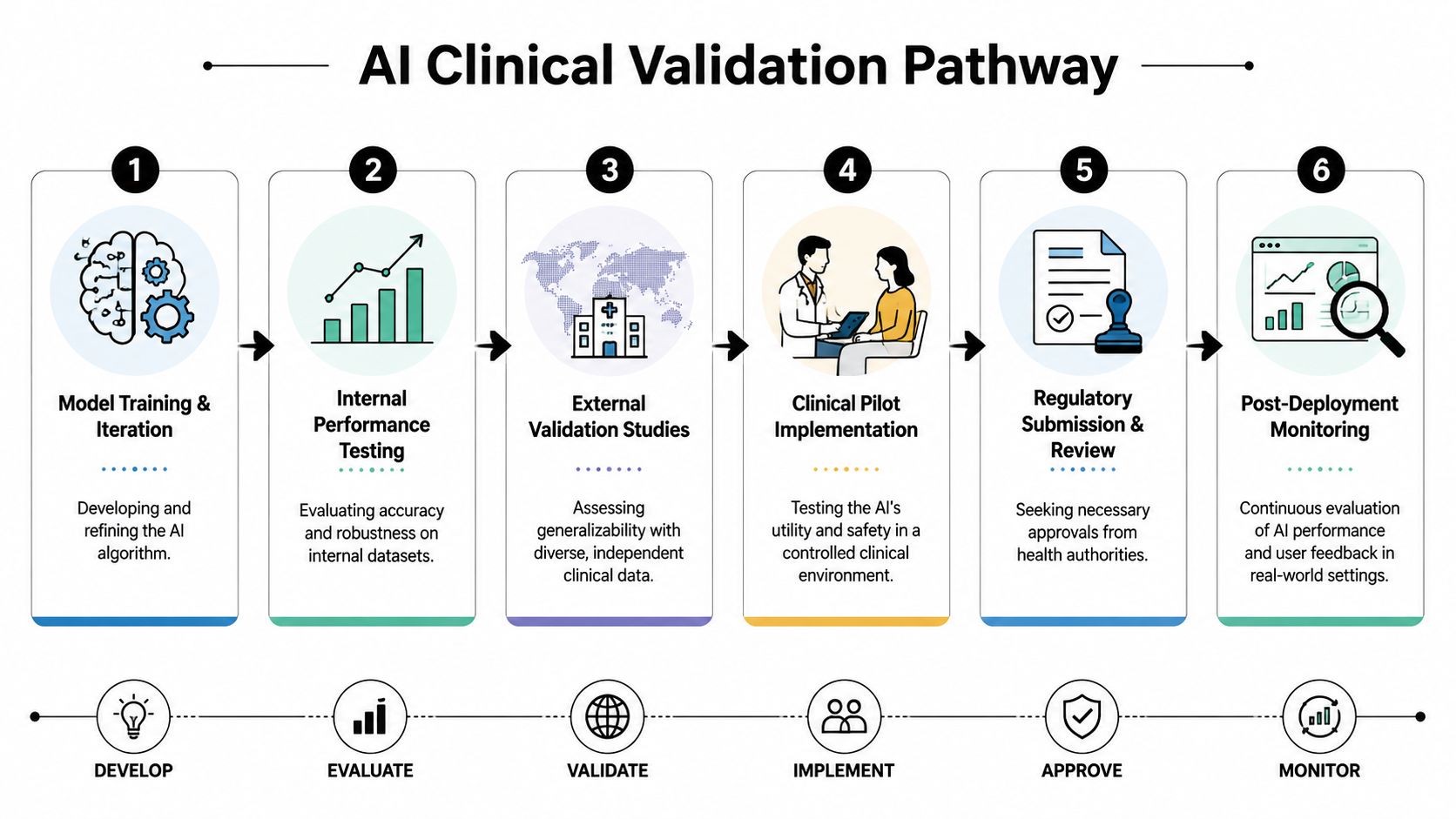
Clinical AI programs fail in production far more often because validation stopped at model performance than because the core algorithm lacked promise. In personalized treatment recommendations, safety and trust are operational requirements. They have to be designed, tested, and documented before the product reaches a clinician.
Validation starts before regulatory submission. It starts when leadership decides which errors are acceptable, which are not, which patient groups need tighter safeguards, and where human review remains required.
That distinction matters. A treatment recommendation engine is not a generic personalization layer. In some deployments, it may operate as part of a regulated clinical decision support product or full SaMD solutions. If the output can influence care pathways, medication selection, or dose logic, the validation plan needs clinical governance, auditability, and risk controls from day one.
A useful benchmark comes from oncology. Specific machine-learning models have achieved 80% accuracy in predicting chemotherapy response from gene expression data. Encouraging performance is only the first gate. The same review points to key deployment risks: weak data protection, poor fairness controls, and inconsistent translation into clinical use.
Strong validation programs test four things at once:
The third layer is where many healthcare AI programs break. Teams validate the model in isolation and miss the clinical system around it. A recommendation with solid retrospective metrics can still fail if the confidence signal is unclear, the rationale is thin, or the suggested action does not match how care teams make decisions.
I have seen technically strong models lose credibility in one pilot cycle because they surfaced the right recommendation with the wrong framing. Clinicians do not make treatment decisions from AUROC tables. They make them from patient context, ranked options, contraindications, and documentation they can defend later.
That is why interface validation matters as much as score validation. A well-designed clinical AI assistant for care teams should show the recommendation, the supporting patient factors, the confidence boundaries, and the path for clinician override. If any one of those is missing, adoption and trust drop fast.
The most reliable operating model is clear. The system recommends. The clinician remains accountable for the decision.
Operating principle: Present the recommendation with rationale, relevant patient factors, and enough traceability for case review, quality audits, and incident analysis.
Synthetic data and digital twin style simulation can help teams test edge cases, rare presentations, and treatment-path alternatives before production release. They do not replace prospective validation, external review, or ongoing monitoring in live care settings.
For leadership reviews, the checklist should stay practical:
Population coverage
Are the intended patient groups represented well enough in testing to support safe deployment?
Fairness controls
Has the team examined subgroup performance before release and defined thresholds for escalation?
Privacy and legal controls
Can the organization show how data use, retention, consent, and access controls align with applicable requirements?
Clinical override tracking
Can you see when recommendations are rejected, by whom, and for what reason?
Post-deployment monitoring
Are recommendation quality, complications, recovery trends, and model drift reviewed on a recurring schedule?
Trust in healthcare AI is earned through repeatable evidence, clear limitations, and disciplined supervision. As discussed in our AI adoption guide, the implementation barrier is usually not model intelligence. It is whether the organization can prove the system is safe, governable, and reliable under real clinical conditions.
Most failed AI products in healthcare don't fail because the data science team chose the wrong algorithm. They fail because nobody did the hard work of fitting the product into care delivery.
That point is no longer anecdotal. The widely cited implementation view shared here estimates that 80% of AI healthcare pilots fail because of interoperability issues, weak privacy integration, and poor analysis of clinical workflows before deployment. That's the implementation barrier competitors often ignore.
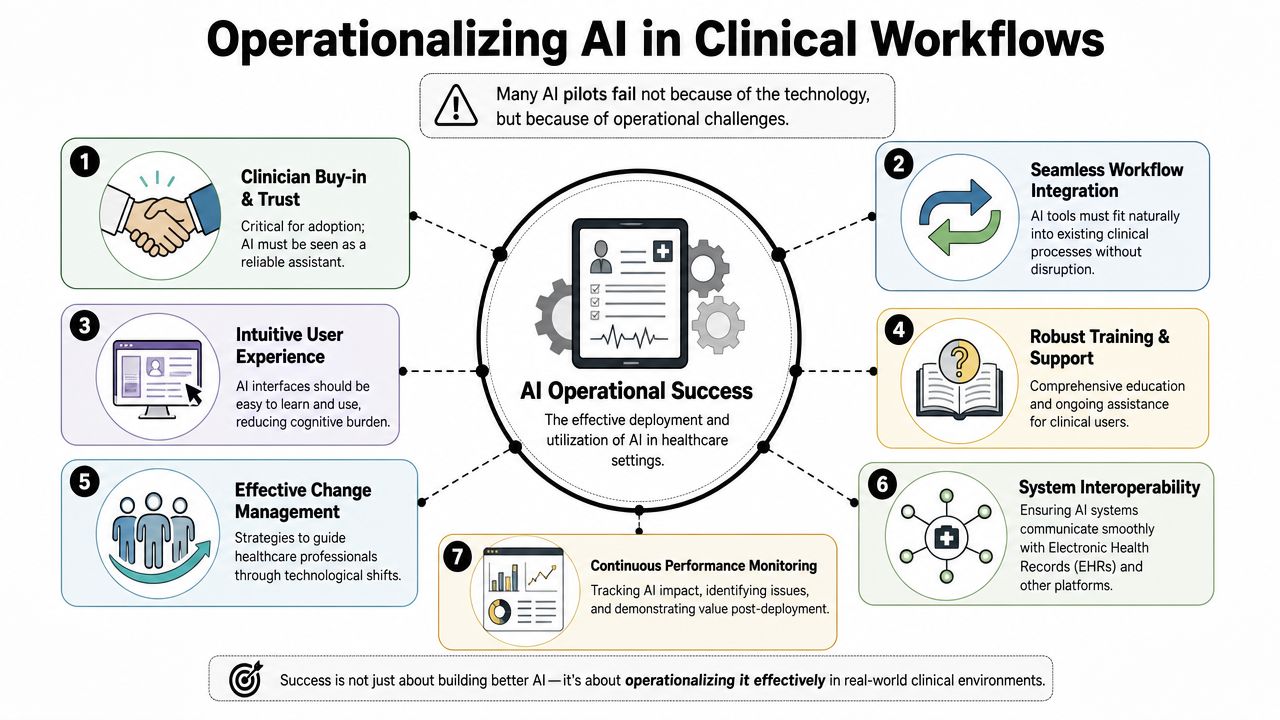
A recommendation system has to live somewhere. Inside the EHR. Inside a telehealth flow. Inside a home-care escalation workflow. If it sits outside the clinician's normal operating environment, adoption drops fast.
The first design review shouldn't ask “How accurate is the model?” It should ask:
If those questions are unanswered, the pilot is too early.
Operational success depends on work that isn't glamorous:
| Often skipped step | Why it matters |
|---|---|
| Workflow shadowing | Reveals where treatment decisions actually happen |
| Interoperability mapping | Identifies how recommendations will enter existing systems |
| Privacy design upfront | Prevents late-stage legal rework and blocked deployment |
| User testing with clinicians | Catches friction before rollout |
| Change management planning | Reduces resistance and misuse |
An AI Product Development Workflow earns its keep. Structured implementation support forces teams to answer delivery questions before they spend months tuning models no one will use.
A practical example is recommendation support embedded into tools like a Clinic AI Assistant, where the product can surface patient-specific guidance inside a clinician-facing workflow instead of requiring a separate dashboard. For deeper integration work, especially when legacy systems and clinical middleware are involved, experienced partners in custom healthcare software development can close the gap between pilot logic and production reality.
The best clinical AI deployments feel boring to the end user. The recommendation appears at the right time, inside the right screen, with a next step that makes sense.
Health systems do not scale personalized treatment recommendations using AI on model quality alone. They scale when the economics hold up under real clinical conditions. In practice, that means measuring whether the system improves care, fits existing delivery models, and keeps producing value as it moves across sites, specialties, and IT environments.
Executives need a scorecard that reflects how healthcare organizations buy, govern, and expand technology. A recommendation engine that looks strong in a pilot can still fail at rollout if adoption drops, local workflow changes increase support costs, or each new site requires custom integration work. That is why many healthcare AI pilots stall. The barrier is rarely the model by itself. The barrier is the cost and friction of operationalizing it across fragmented systems.
A useful scorecard covers four areas:
I advise leadership teams to watch one metric closely during scale-up: marginal deployment cost. If every new department or hospital needs a fresh integration project, custom mapping, and manual rule adjustment, the unit economics break fast. A pilot can hide that problem because early teams tolerate workarounds that enterprise operations will not.
Scaling also changes the risk profile. One site may have clean data and a strong clinical champion. Ten sites bring different EHR configurations, referral patterns, formulary rules, staffing mixes, and local review processes. The model may still perform. The operating model may not.
That is why mature programs invest in repeatable delivery capabilities, not just better algorithms. Teams need shared data contracts, monitoring for drift and usage, clear ownership for model changes, and role-based delivery logic that can adapt to local practice without creating a separate product for every service line. In adjacent domains, the pattern is similar. These AI semen analysis resources show how narrow clinical AI use cases gain traction when teams define scope tightly and build the workflow around the decision, not around the model.
The programs that scale cleanly treat expansion as an operating discipline. They set deployment standards early, price integration effort accurately, and measure whether each rollout gets faster, safer, and cheaper than the last one. That is the difference between an impressive pilot and a durable clinical product.
Clinical teams do not need more pilots. They need treatment recommendation programs that fit care delivery, clear governance, and a path to measurable return. That is the context behind the questions executives ask most often.
Start with one treatment decision that is frequent, high-cost, and already slowed down by data review across multiple systems. A defined cohort with a clear decision point usually outperforms a broad recommendation vision because teams can validate faster, integrate with less disruption, and prove value with fewer variables in play.
I usually advise against starting with the hardest specialty case. Start where variation is meaningful, data quality is acceptable, and the recommendation can be reviewed inside the clinician's existing workflow.
Yes. Personalized treatment recommendations affect safety, liability, and patient trust. Clinicians should review recommendations, understand the basis for the output, and retain authority to accept, modify, or reject it.
That choice is not only about ethics. It is also how health systems catch edge cases, avoid unsafe automation, and build adoption.
More than many teams budget for. The failure point is often not the model. It is unclear data ownership, inconsistent terminology, missing workflow decisions, and no agreement on what the model is supposed to influence.
Before serious model work begins, define the decision, the source systems, the review process, and the operational owner. That reduces rework later.
The common cause is implementation friction. A model can look strong in a controlled environment and still fail once it hits real EHR workflows, consent requirements, pharmacy rules, and local care protocols.
This is the primary barrier that stalls many programs. The issue is usually interoperability and workflow fit, not algorithm design.
Use a scorecard that ties model performance to business performance. Review impact on treatment timeliness, resource use, clinician adoption, override rates, and downstream financial results.
If the recommendation is accurate but rarely used, or used but operationally expensive to maintain, the business case is weak. ROI in healthcare AI comes from adoption plus outcomes, not model metrics alone.
Choose a partner that can handle product strategy, clinical workflow design, integration constraints, compliance-aware engineering, and implementation support. Pure model development is rarely enough.
Ekipa AI works with digital health teams on use case definition, implementation planning, and clinical software delivery. The practical test is simple. Can the team help your organization move from pilot logic to an operating model that works across real clinical settings?
How to build HIPAA-compliant AI: when LLM providers need a BAA, data minimization, de-identification, audit controls and a reference architecture.

Practical data migration planning guide for healthcare teams. Scope, mapping, compliance, validation, cutover and rollback decisions explained end to end.

Smart on FHIR guide for healthtech engineers. Learn the OAuth 2.0 launch model, scope syntax, backend services, and US regulatory requirements.
Connect with our team to explore how AI expertise can transform your business.