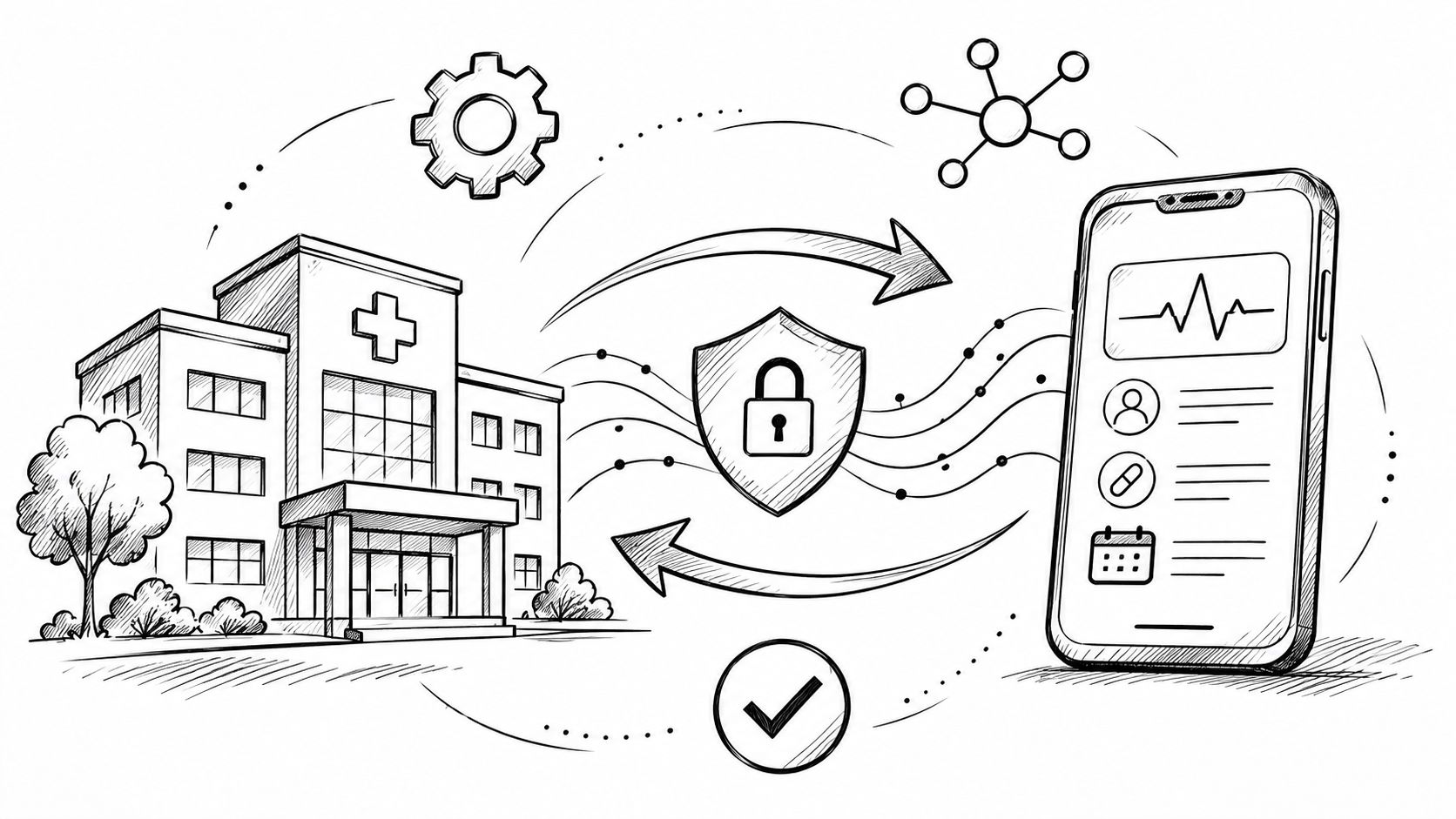
CMS-0057-F turns prior authorization into a timed, API-driven workflow with explicit deadlines, specific denial reasons, and machine-readable status changes. For payer and provider tech teams, that means the problem isn't just moving a form online, it's making payer rules computable, auditable, and resilient when the clock is running. It also means teams still living on fax, portal uploads, or phone trees need a transition plan.
What CMS-0057-F changes for prior authorization automation
CMS-0057-F turns prior authorization into a federal systems requirement. It defines how payer rules, request status, and denial reasons need to be represented, exchanged, and audited, so automation has to account for policy versioning and accountability as much as message flow.
That shift matters because prior authorization breaks in production at the seams. Payer logic changes, documentation rules vary by plan, response clocks are fixed, and the workflow spans clinical judgment, operations, and compliance. If a system only automates submission, it still leaves the hardest parts unsolved: requirement discovery, status tracking, denial handling, and traceable handoffs.
The architecture has to carry provenance, timestamps, payer-specific documentation logic, and an exception path that humans can intervene in without losing the record. A practical fax guide for clinics can still help during transition periods where legacy intake remains in the mix, but the long-term design has to make every request governable and auditable.
The rule changes the object of automation. The unit of work is no longer the form, it's the governed request.
Who the rule applies to and the deadlines that anchor the roadmap
The scope matters because each covered entity carries a different implementation burden. Medicare Advantage organizations, Medicaid and CHIP plans, and QHP issuers on the federal exchanges all have to align policy, operations, and systems to the same timeline, even if their internal workflows do not look alike.
The first hard date is operational. From January 1, 2026, impacted payers must send expedited prior-authorization decisions within 72 hours and standard decisions within 7 calendar days, and denials must include a specific reason. That turns timestamp capture, urgency classification, and deadline monitoring into core product requirements.
The next date is reporting. The first public prior-authorization metrics report is due March 31, 2026, so teams need data collection and quality checks in place well before then.
The platform date is scheduled to begin January 1, 2027, per the rule's compliance timeline. By then, the Prior Authorization API, Provider Access API, Payer-to-Payer API, and prior-authorization data in the Patient Access API need to be available, with drugs excluded from that prior-auth data path. For teams building across payer and provider systems, the deadline also forces a choice: automate the governed request path first, or keep rework downstream in manual queues. For a broader view of how these requirements sit inside health system and payer operations, this healthcare overview is a useful reference point.
| Milestone |
Effective date, generally |
What it means for tech teams |
| Expedited decisions within 72 hours |
January 1, 2026 |
Build urgency routing, deadline timers, and escalation logic |
| Standard decisions within 7 calendar days |
January 1, 2026 |
Track request age and surface aging work items |
| Public prior-auth metrics reporting |
March 31, 2026 |
Instrument data quality, reporting lineage, and approval tracking |
| Prior Authorization, Provider Access, Payer-to-Payer APIs, and prior-auth data in Patient Access API |
January 1, 2027 |
Ship interoperable API support, response mapping, and patient-visible status handling |
The roadmap question is not whether to automate. It is which deadline should drive which workstream first.
The FHIR APIs and Da Vinci guides that define the contract
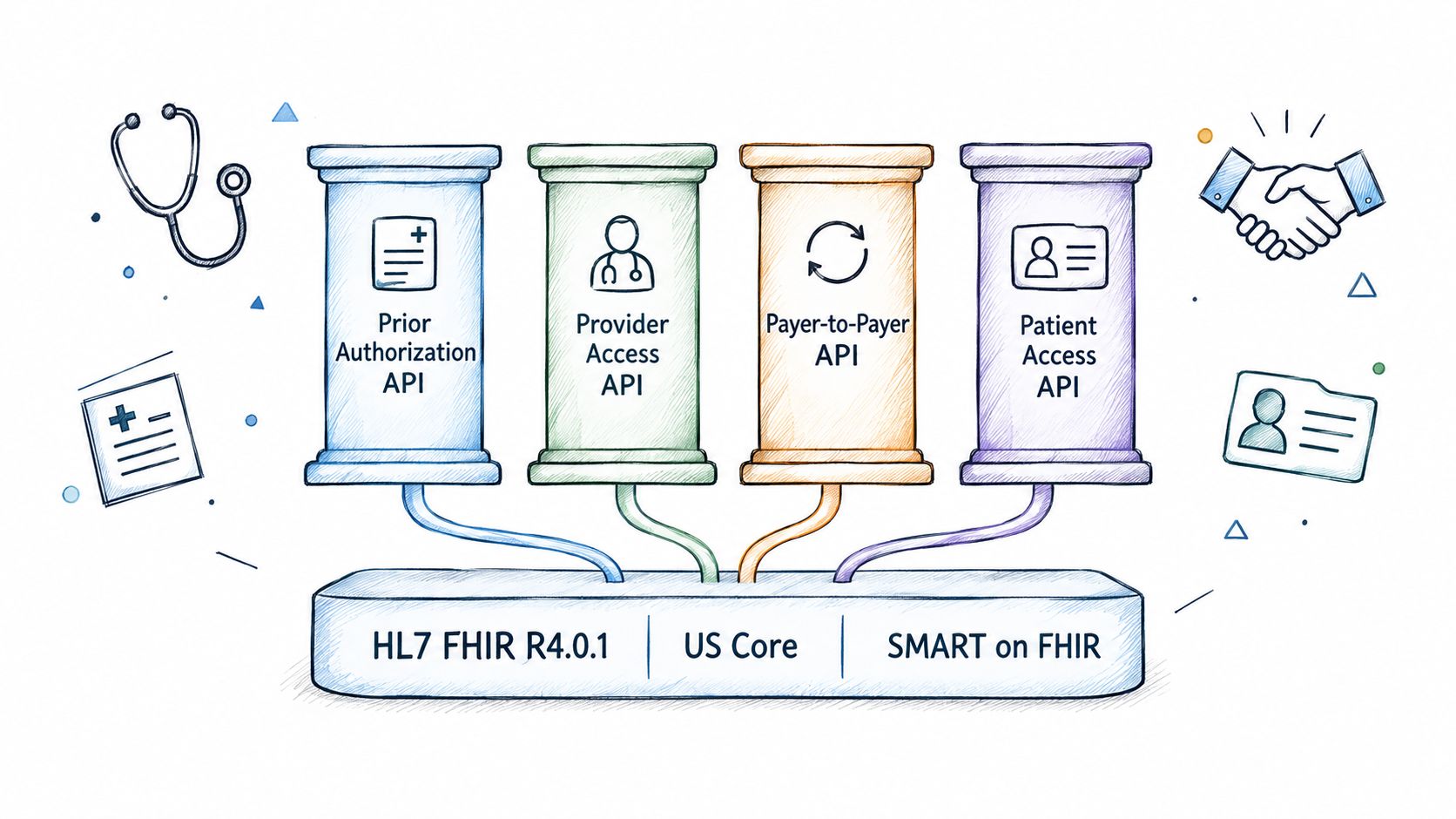
CMS did not just ask for an API. It defined a machine-readable contract built on HL7 FHIR R4.0.1, US Core, and SMART App Launch. For prior authorization automation, that means the EHR or practice system has to know whether authorization is required, what data is needed, how to submit it, and how to read back the decision.
The four API surfaces divide the workflow across participants. The Prior Authorization API handles the request and decision exchange. The Provider Access API exposes payer data to providers. The Payer-to-Payer API supports plan-to-plan exchange. The Patient Access API carries prior-auth data for the patient, with the drug exception noted in the final rule text Federal Register final rule.
CMS also recommends the Da Vinci CRD, DTR, and PAS implementation guides as the standards pattern for this work HL7 Da Vinci CRD. CRD is where requirement discovery happens. DTR is where structured data capture happens inside the EHR. PAS is where the authorization request is transmitted and the response comes back.
That separation is where many programs go wrong. Teams connect to an endpoint and assume they have automated the workflow, but connectivity alone does not tell the clinician what documentation is missing or whether a payer requires a specific attestation.
SMART App Launch controls how the app gets into clinical context, while FHIR resource provenance preserves which data came from the chart, which came from payer rules, and which was added by staff. HHS enforcement discretion on the X12 278 standard for all-FHIR prior-auth APIs gives teams room to center their architecture on the FHIR path rather than building dual stacks.
What ONC HTI-4 changes for providers and EHRs
ONC's HTI-4 final rule brings the provider side into the same modernization track. Effective October 1, 2025, it added electronic prior-authorization certification criteria for certified health IT, and a Medicare e-prior-auth reporting measure starts in 2027 HTI-4 rule.
That matters because payer APIs alone do not create provider readiness. EHRs, care-management apps, and embedded workflows have to consume payer prior-auth services, surface requirement discovery inside the clinical flow, and write the decision back into the chart in a way clinicians can trust and auditors can trace.
The certification angle changes vendor conversations too. Providers can no longer treat prior auth as a manual back-office add-on if their health IT stack needs to support it as certified functionality. Product teams have to ask whether the system can launch in context, retrieve the payer's documentation requirements, and preserve the response as structured data instead of a screen capture or free-text note.
If the EHR cannot surface the requirement before the order is finalized, the workflow will still break after the API goes live.
CMS defines the payer API obligation, ONC raises the floor for provider-side health IT, and the integration path between them becomes a product surface in its own right. If you're aligning that work with broader interoperability planning, the healthcare data interoperability discussion is worth reading alongside the rule text.
A reference architecture for prior authorization automation
The cleanest production design is a stateful workflow, not a one-shot submission service. Think in states: draft, submitted, pended information, approved, denied, expired. Each transition should carry a timestamp, the actor or system that caused it, and the evidence bundle attached to that transition.
How the workflow should actually move
The request starts in the EHR when a clinician orders a service. The system checks whether authorization is required, then gathers structured data from the chart, then submits the request, then watches for the payer's response. That sequence maps cleanly to CRD, DTR, and PAS, but only if the implementation keeps the stages separate and traceable.
A practical stack usually includes:
Eligibility and requirement discovery, so the team knows what the payer expects before submission.
Structured data retrieval, so the system can pull US Core-aligned chart data instead of asking staff to retype it.
Submission and status tracking, so the request can move asynchronously without losing the thread.
Exception handling and appeal routing, so denials and incomplete requests are never dead ends.
One place teams fail in production is the handoff between automation and judgment. Deterministic automation should handle document retrieval, status polling, aging alerts, and routing. Clinical attestations should still require a human sign-off when the submission depends on medical necessity or ambiguous chart content.
Hypothetical worked example
A clinician orders an MRI. The EHR calls CRD and learns that authorization is required and that a recent clinical note and imaging rationale are needed. DTR pulls the structured fields already present in the chart, while staff fills one missing field in the workflow UI. PAS submits the request, and the payer returns a pended-information response because one supporting document is missing. The exception queue routes the task to staff, the missing record is attached, the request is resubmitted, and if the payer later denies it with a specific reason, that reason lands back in the chart with an appeal task.
That kind of flow is where operational value appears. The 2022 CAQH Index found that only 28% of prior authorizations were fully electronic, even though existing automation already saves U.S. healthcare about $187 billion a year CAQH Index. The remaining gain comes from making the workflow reliable across the messy parts, not just from adding more integration points.
If you're shaping the implementation backlog, workflow automation is the right lens. The core design choice is whether the system can explain every state change and retry, because that's what keeps the workflow supportable after go-live.
Where AI helps and where it should stop
AI fits best where the work is repetitive, text-heavy, and rule-driven. It can help normalize payer policy language, summarize documents, draft request narratives, and route cases to the right queue. It should not make the coverage or medical-necessity decision on its own.
That boundary matters because the operational risk changes when AI becomes the decision-maker. In an AMA survey released in 2025, 61% of physicians said they were concerned that health plans' use of AI is increasing prior-authorization denials, which shows that trust and policy design matter more than model sophistication AMA press release.
A safe architecture keeps the machine in the workflow lane and the clinician in the judgment lane. That means:
Keep deterministic steps deterministic, including eligibility checks, document retrieval, deadline monitoring, and status updates.
Preserve model and prompt versions for every AI-assisted submission so the evidence trail is reproducible.
Require clinician approval for material attestations or any recommendation that affects clinical judgment.
Track operational metrics, especially turnaround time, avoidable denials, false escalations, and patient-impacting delays.
The point of AI here is to reduce manual effort without weakening review quality.
A useful governance model is to treat AI as an evidence-preparation layer, not an approval layer. That keeps a named person accountable for every decision, which matters when the workflow has to survive audits and appeals.
If your team wants to use a system like Ekipa AI for document ingestion, payer-rule logic, and workflow orchestration, keep the same principle in place. The tool can prepare, route, and trace, but the final medical judgment still belongs to a qualified reviewer. That separation is what keeps automation credible when denials are challenged or rules change.
Implementation roadmap and governance
A rollout should follow the rule dates, not an abstract transformation plan. Start by mapping prior-auth volume by payer and service line so the team can see where operational pressure is concentrated. Build CRD discovery and status tracking first for the highest-volume payers. Then turn on Provider Access and Payer-to-Payer flows, and expand appeal automation only where denial handling is already mature.
Ownership has to be explicit. Engineering owns integrations, observability, retries, and state transitions. Compliance owns rule provenance, audit trails, and reporting controls. Clinical owns sign-off criteria, exception review, and appeal standards. Those lines matter because payer rules change, exceptions pile up, and no one can maintain a reliable rule model if accountability is fuzzy.
The denial side deserves special attention because it sits inside the core workflow. HHS OIG estimated that 13% of sampled Medicare Advantage prior-authorization denials in June 2019 met Medicare coverage rules and would have been covered on appeal OIG report. The system needs to retain the submitted evidence, payer rationale, timestamps, and appeal status. It also needs a clear record of why a case was denied, so later review can separate a policy issue from a processing miss.
A practical program also needs governance that survives audits. Version payer rules the same way you version code, keep a readable history of rule changes, and tie every automated action back to the rule set that drove it. Ekipa's implementation support is structured around that kind of dated rollout, where the work is sequenced around deadlines, exception paths, and evidence capture instead of a generic modernization project.
Conclusion
Prior authorization automation works when the team treats it as a governed workflow with deadlines, state, and accountability. CMS-0057-F and ONC HTI-4 make the technical path clearer, and they also raise the bar for provenance, exception handling, and clinician oversight. The architecture that holds up in production can explain every request from discovery to appeal.
If your team is planning the build, book a consultation with Ekipa's HealthTech engineers.
This article is general information, not legal or regulatory advice.
Frequently asked questions
How should a team sequence prior authorization automation work?
Start with payer volume and the highest-friction services. Build requirement discovery and status tracking first, because those functions reduce rework before full submission automation is live. Then add structured document capture, exception handling, and appeals.
Do EHRs need to support this for certification?
Yes. Provider-side health IT is being pulled in through ONC HTI-4, which added electronic prior-authorization certification criteria and the Medicare e-prior-auth measure starts in 2027.
What should happen when a denial comes back with a specific reason?
The system should store the denial reason as structured data, attach it to the original request, and route the case into an appeal or correction queue. That matters because the rule requires specific denial reasons and denial handling sits inside the core workflow.
Where should AI sit in the workflow?
AI should assist with summarization, classification, and draft assembly, but it should not decide medical necessity or coverage by itself. Keep the decision boundary human-reviewed and preserve the model version and prompt context for every submission.
What kind of engineering team do we actually need?
You need integration engineers, a product owner who can work with payer policies, and someone accountable for compliance evidence and auditability. If the org is provider-side, include EHR workflow specialists as well, because UI placement and chart context determine whether staff will use the automation.
What's the most common implementation mistake?
Treating FHIR connectivity as the finish line. A system can connect cleanly and still fail if it does not version payer rules, classify urgency correctly, or preserve a clean audit trail from request to decision.