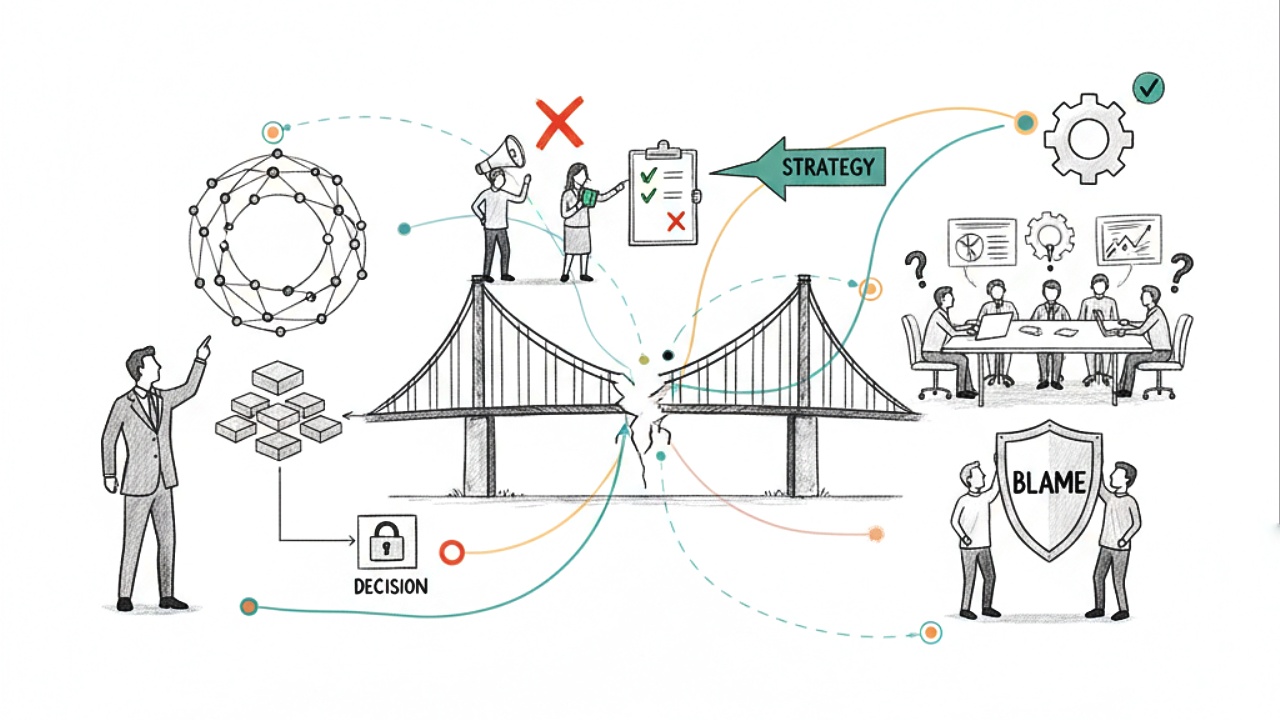
Leaders of large companies often put significant money and hope into artificial intelligence. They expect quick, precise results. Yet actual decisions rarely improve in a real way. More dashboards appear, models become more intricate, and data systems get larger. Clarity, however, does not arrive. The problem is not found in the software or servers. A deeper issue exists in the design of these decision tools, the trust people place in them, and how they are managed company-wide. Seeing this gap clarifies why AI decision-making challenges persist, despite significant investment and clear intentions.
The confusion between data insight and decision ownership
Within large organizations, we often confuse data-driven understanding with the permission to act. AI models uncover patterns, predict outcomes, and identify risks. But the final decision gets stuck in old systems of approval. Teams do not move on what the model suggests because no one knows who is accountable. When a choice fails, people accept the blame, not the machine. This gap breeds doubt and delays progress. Over time, AI becomes only another report, not a partner in the process. This reinforces the AI decision-making challenges at the leadership level.
Why Direction Matters More Than Deployment
Many organizations launch artificial intelligence projects before they identify which decisions require support. They start using the technology before they have a clear direction. Without a connection between business priorities and AI Solutions, teams focus on building tools that do not change real results. Models produce insights, but the way decisions are made stays the same. This gap reduces trust and limits long-term value.
Why Data Without Context Weakens Trust
Large collections of data can create an impression of readiness that fails in reality. When data quality changes and business details are missing, hesitation surfaces during meetings where choices are made. People in charge question the basics rather than act on clear conclusions. Even well-planned AI use cases face difficulty when the insights have no connection to daily operations. This doubt sends leaders back to the old ways they trust.
How Structure Builds Trust
Confidence in artificial intelligence grows when expectations are clear. When suggestions come without clear reasons, doubt increases. Many companies launch systems before they establish rules for their management. Clear supervision, paths for review, and responsibility systems are left uncertain. In this situation, leaders pause before acting on automated guidance. The lack of structure intensifies AI decision-making challenges and slows acceptance across teams.
Human Judgment Stays Central

Good decisions seldom come from automation by itself. Artificial intelligence can perform analysis, but understanding still needs experience and context. Companies that dismiss human insight face pushback from within. People step back when decisions seem forced rather than supported. Balanced decision systems keep human judgment at the core, guiding how understanding turns into action.
Readiness, When Overlooked
Many organizations start expanding their use of artificial intelligence without a clear picture of their own preparedness. A structured AI readiness assessment can reveal gaps in data practices, team skills, and management rules. Skipping this step builds false confidence. Systems go live before people trust them, which leads to hesitation when big decisions are needed.
Maturity Grows Unevenly
Artificial intelligence skills rarely advance at the same speed in all teams. One group might use sophisticated analytics while another still depends on manual reports. Without a common AI maturity model, the standards for decisions differ greatly. This is where AI strategy consulting can provide critical guidance. Leaders struggle to compare findings from different departments. This slows agreement and weakens trust in organization-wide conclusions.
Execution influences credibility
The success of a technology project depends heavily on the quality of its execution. Choosing an AI implementation partner decides how well the system connects and how reliably it operates over time. Poor execution results in fragile systems that struggle when real decisions must be made. Strong execution focuses on improving the flow of choices, not just on technical complexity.
Mapping the Path to Progress
Long-term decision improvement depends on structured planning. An AI adoption roadmap illustrates how early tests can become trusted support for decisions. This path connects management rules, data work, and team training in a sensible order. Without this structure, early wins disappear and progress stalls.
The Importance of Oversight
Research on automated choices highlights the dangers of using algorithms without review. Studies show that relying on automatic systems can lead to surprising results. Regular review and feedback hold artificial intelligence to practical and ethical standards.
The Need for a Realistic Strategy
Standard plans often fall short in complex situations. A custom AI strategy report defines priorities. It addresses risk, the speed of decisions, and who is accountable. This clarity aligns with what leaders expect and reduces the need for random tests. A strategy based on real conditions creates lasting value.
Conclusion
Large companies face difficulty with artificial intelligence, not because the technology is lacking, but because the systems for making choices are not aligned. Unclear responsibility, poor structures for trust, and absent management rules slow acceptance when it matters most. Solving AI decision-making challenges requires discipline, clear communication, and respect for human judgment at every phase. Organizations that integrate artificial intelligence into their choice framework achieve more consistent results. Contact us to build an AI centered on better decisions.
FAQ
1. Why do enterprises face AI decision-making challenges despite heavy investment?
AI decision-making challenges arise when tools lack ownership, structure, and alignment with real business priorities.
2. How do AI Solutions improve enterprise decision processes?
Effective AI Solutions support clearly defined AI use cases and align insights with accountable decision-makers.
3. What role does AI strategy consulting play in better decisions?
AI strategy consulting brings clarity through a custom AI strategy report and aligns initiatives with a practical AI maturity model.
4. Why is an AI readiness assessment important before scaling AI?
An AI readiness assessment identifies data, skill, and governance gaps, reducing risk before following an AI adoption roadmap.
5. How does an AI implementation partner strengthen execution?
A strong AI implementation partner ensures reliable deployment, system integration, and long-term trust in AI-driven decisions.