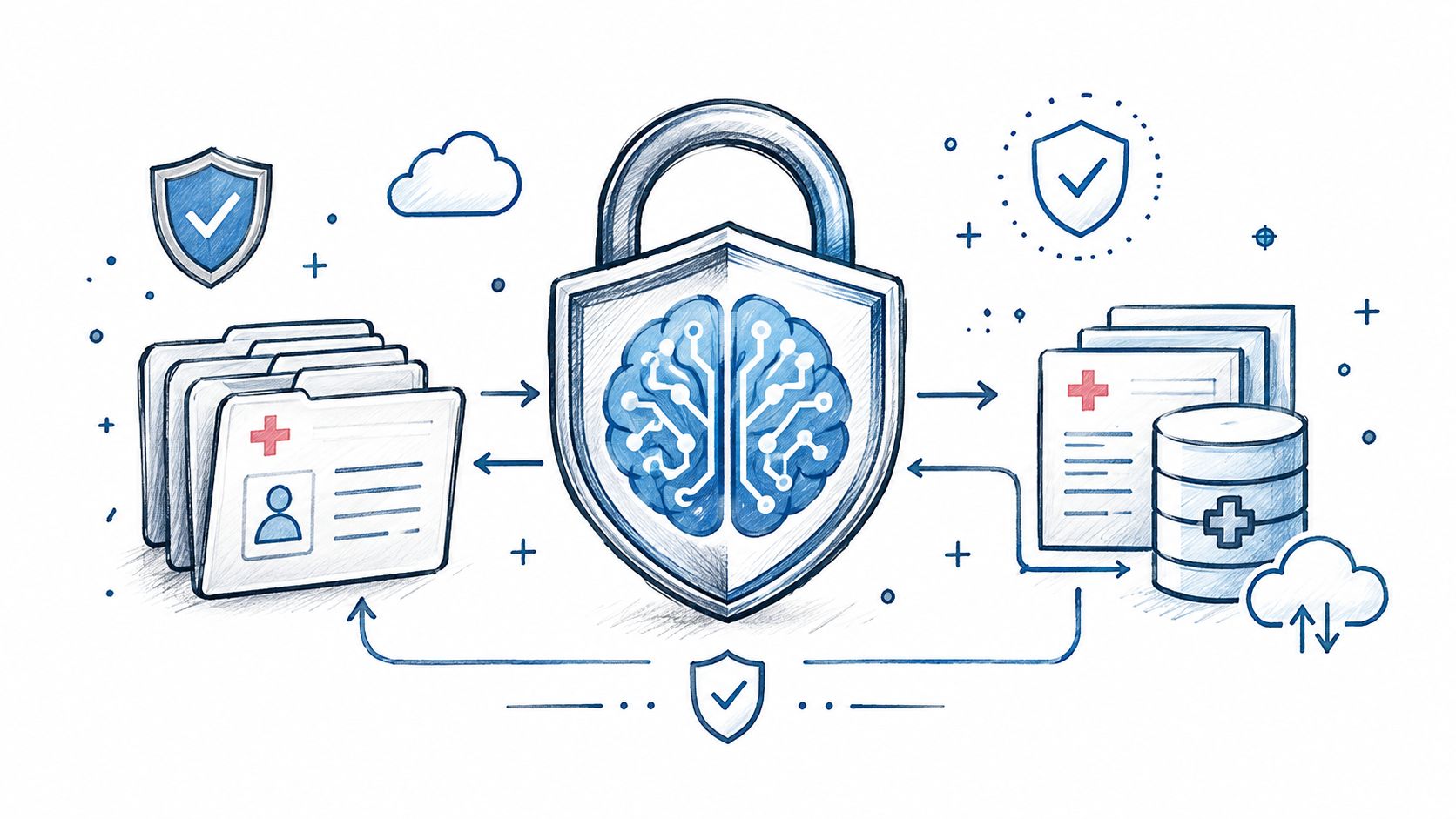
AI in Healthcare
HIPAA-Compliant AI: How to Use LLMs With PHI Safely
How to build HIPAA-compliant AI: when LLM providers need a BAA, data minimization, de-identification, audit controls and a reference architecture.
October 16, 2026Read more
Unlock efficiency with operational AI for healthcare enterprises. This 2026 guide covers key benefits, use cases, roadmaps, and ROI for leaders.

Most healthcare AI conversations still focus on diagnosis, decision support, or generative copilots for clinicians. That’s not where most enterprises should start.
The sharper opportunity is operational. Healthcare organizations reached 22% implementation of domain-specific AI tools in 2025, a 7x increase from 2024, with deployment happening 2.2x faster than in the broader economy according to Menlo Ventures’ 2025 healthcare AI analysis. That shift matters because operations is where healthcare leaders can usually get cleaner ROI, lower implementation risk, and faster internal trust.
For CEOs, CTOs, and operations leaders, the question isn’t whether operational AI for healthcare enterprises is real. It is. The question is how to move from isolated experiments to scaled systems that improve throughput, reduce administrative drag, and hold up under compliance scrutiny.
Operational AI applies AI to the workflows that keep a healthcare enterprise running: documentation, revenue cycle, scheduling, prior authorization, patient communication, staffing coordination, and shared services.

The practical distinction is simple. Clinical AI supports medical judgment. Operational AI supports execution.
That difference shapes how leaders should approach adoption. Operational workflows usually have clearer process owners, cleaner baseline metrics, and a shorter path to measured value. They still require governance, integration discipline, and human oversight, but they are often better suited to a phased rollout than high-stakes diagnostic systems.
In healthcare enterprises, operational AI usually appears in workflows such as:
A strong Healthcare AI Services partner helps leadership teams decide which of these workflows are ready for AI, which need process cleanup first, and which should stay human-led.
Operational AI is not just rules-based automation with a new label. Traditional automation works best when inputs are structured and decisions are fixed. AI becomes useful when the work includes unstructured documents, language, prioritization, prediction, or exception handling.
For example, a standard workflow engine can route a prior authorization request. An AI-enabled workflow can read supporting documentation, classify the request, surface missing information, and push the case to the right queue with a confidence threshold and human review.
That is the execution playbook leaders need to understand. Start with a constrained workflow. Define the decision points. Set escalation rules. Measure whether the system improves speed, accuracy, or labor efficiency without creating downstream risk. That is how organizations move from pilot activity to scaled operations, which is where many proofs of concept fail.
Practical rule: If an AI initiative does not map to a named workflow owner, a baseline operating metric, and a specific handoff or bottleneck, it is still experimentation.
Healthcare leaders can also learn from adjacent enterprise patterns. This piece on AI Business Process Automation is a useful reference for deciding when AI should recommend an action, when it should execute one, and where human review should remain in the loop.
The business case becomes clearer when you stop talking about “AI transformation” in the abstract and start talking about labor hours, documentation drag, claim friction, and throughput constraints.
By 2025, ambient speech technology had become the most widely adopted operational AI application in healthcare, used by 79% of organizations to improve clinical documentation efficiency, while 24% used AI for claims adjudication and coding automation according to Privaplan’s 2025 healthcare AI report. That distribution tells you where leaders are seeing practical value first.
Operational AI tends to create business impact in four places.
The strongest deployments don’t try to “AI-enable the enterprise” all at once. They remove friction from one costly workflow at a time.
| Use Case | Primary Business Impact | Implementation Complexity | Typical ROI Timeline |
|---|---|---|---|
| Ambient clinical documentation | Reduces documentation burden and improves note completion workflows | Medium | Often faster than higher-risk clinical AI because workflow fit is clearer |
| Claims adjudication support | Improves review speed and consistency in revenue workflows | Medium to High | Depends on integration depth and exception handling design |
| Coding automation | Supports coding accuracy and revenue capture | Medium | Often attractive when paired with existing RCM modernization |
| Denials management support | Prioritizes follow-up work and surfaces likely root causes | Medium | Strong when teams already track denial patterns well |
| Patient messaging automation | Improves outreach consistency and reduces manual coordination | Low to Medium | Faster when communication rules are already standardized |
| Prior authorization workflow support | Shortens administrative cycle time in document-heavy workflows | High | Longer if payer-specific logic is fragmented across teams |
What works is rarely glamorous. Leaders get better outcomes when they choose use cases with a few characteristics:
What usually fails is also predictable.
Leaders should rank use cases on two axes: business pain and implementation drag.
Start with high-pain, lower-complexity workflows. Ambient documentation often lands there. Coding support can also qualify when data quality is acceptable and the compliance review path is clear. Prior authorization may offer strong upside, but integration and policy variability usually make it harder.
For teams that don’t want to build every component from scratch, AI Automation as a Service can be a practical delivery model. So can curated libraries of real-world use cases that help leadership teams compare workflow candidates before committing engineering capacity.
Healthcare enterprises rarely fail on AI because a model underperforms in a demo. They fail because the organization never builds the operating model required to move from pilot to scale. That execution gap is why so many proofs of concept stall after early enthusiasm.
A workable roadmap has four parts: people, process, technology, and governance. The sequence matters. Teams that skip ahead to tooling usually create local wins that never become enterprise capability.

Operational AI changes roles, decision rights, and escalation paths before it changes software. Leadership should treat implementation as an operating change, not a technical install.
The core team needs enough authority to make workflow decisions quickly. In practice, that means operations leadership, IT, security, compliance, a named workflow owner, and frontline staff from the business unit using the system. Without frontline participation, teams design for the documented process and miss the actual one. In healthcare, those are often very different.
A useful team structure includes:
One warning from experience. If staff believe AI is a headcount program disguised as an efficiency program, adoption drops fast. Leaders need to state where human review stays, which tasks change first, and how performance will be evaluated after rollout.
A pilot becomes scalable only when the workflow is specified at the level of real operational decisions. That requires more than a requirements document. It requires a clear map of how work enters the queue, what information is available at each step, where exceptions occur, and who has authority to override the system.
The design questions are usually straightforward:
That level of detail exposes whether AI should draft, classify, route, summarize, or stay out of the workflow entirely.
A strong pattern is to separate the workflow into three layers:
This structure holds up well in documentation support, intake operations, and revenue cycle workflows because it protects accountability while still reducing manual work.
Technology choices should follow workflow design, not the other way around. Most healthcare enterprises end up with a hybrid stack. They use vendor products for mature, repeatable functions and add custom components where local policy, data structure, or approval logic creates variation.
The constraint is usually not model quality. It is enterprise infrastructure. Older EHR environments, brittle interfaces, and disconnected departmental systems create hidden costs in deployment and support. Leadership teams should assess those constraints early, because they determine how fast a pilot can expand beyond a single team.
A practical sequence looks like this:
For organizations formalizing delivery across discovery, prototyping, deployment, and post-launch support, a defined AI implementation support model helps standardize how teams move from a promising pilot to a managed operational service.
Governance should be built into the release process, not added as a final approval step. In healthcare, governance decisions shape what data can be used, which actions need human review, what must be logged, and who can approve changes after launch.
At minimum, leadership should define:
Strong governance is operational. It sets release criteria, monitoring routines, and escalation paths that teams use. That is what turns AI from a pilot program into an enterprise capability.
Healthcare AI programs usually stall for one reason. Leadership cannot see a clean line from pilot activity to financial impact. If the business case rests on broad productivity claims, budget owners will treat it as experimentation, not an operating priority.

ROI starts with current-state economics. Document the workflow as it runs today: who touches it, how long each step takes, where work sits in queue, what errors trigger rework, and which downstream metrics absorb the cost. In healthcare operations, that often means tracing labor hours, denial patterns, backlog aging, write-offs, and turnaround times back to one process, not averaging them across a department.
Then define the smallest improvement that changes the economics of that workflow. Good targets are specific and measurable: fewer manual touches per claim, faster note finalization, lower authorization backlog, better message routing, or shorter time to resolve patient requests.
Use two KPI groups.
A pilot matters financially only when the organization can show which line item changed, what operational change caused it, and whether the result will hold at production volume.
Executives do not need a longer dashboard. They need a model that supports a funding decision.
Use three views:
Direct impact
Which costs, delays, or revenue leaks can this workflow reduce in the next budget cycle?
Implementation cost What will integration, validation, staff training, support, and change management cost?
Scale potential
If this use case works, which adjacent workflows share the same pattern and can reuse the same delivery approach?
That last point is where many teams miss out on the full return. A single pilot rarely justifies an enterprise program on its own. The stronger case comes from repeatability. If the organization can move one workflow from pilot to production with a clear operating model, it can apply the same execution pattern to related areas and lower the cost of each subsequent deployment.
For leadership teams that want tighter visibility into operational performance, a tool such as the Financial Insights Dashboard for healthcare operations can connect workflow activity to business outcomes. The dashboard matters less than metric discipline. Finance, operations, and IT need the same definitions for cost, quality, exception handling, and realized value, or the ROI discussion breaks down in steering committee reviews.
A lot of healthcare AI writing treats risk as a legal appendix. In practice, risk determines whether the program scales at all.

The biggest technical problem is often interoperability with legacy systems. Many hospitals and health systems still operate across layered EHR customizations, aging departmental applications, and undocumented manual workarounds. AI pilots can look strong in isolation and still fail the minute they need reliable production integration.
That’s why workflow fit matters more than demo quality. A model can generate excellent output and still create operational risk if staff have to copy data manually, switch between systems, or resolve edge cases outside the audit trail.
A mature risk review should ask:
Healthcare enterprises need governance that covers privacy, access control, auditability, vendor management, retention, and release discipline. That often requires a dedicated regulatory compliance partner alongside internal legal, security, and privacy teams.
Governance should also include model behavior reviews. In operational contexts, the biggest issue is often not dramatic model failure. It’s quiet inconsistency. An AI system may perform well most of the time while creating subtle variation in routing, prioritization, or summary quality that staff only notice weeks later.
A practical control set includes:
There’s also a contrarian issue that leadership teams shouldn’t avoid. Operational AI can reduce administrative burden, but it can also create workforce inequity if the enterprise treats automation as labor subtraction instead of job redesign.
When organizations automate intake, documentation support, or routing work, they often shift remaining tasks toward exception handling, escalation, and tool supervision. That raises the cognitive load for some staff while reducing learning opportunities for others. If leadership doesn’t invest in role redesign and training, teams can end up with more stress, less clarity, and weaker internal mobility.
The workforce question isn’t “Will AI replace staff?” It’s “Which parts of the job become more complex, and who gets trained for that shift?”
Strong governance includes workforce policy. That means defining what decisions remain human, what new skills staff need, and how performance will be evaluated in AI-assisted workflows.
Leaders that handle this well usually do three things:
For healthcare enterprises, governance isn’t what slows operational AI. Weak governance is what keeps it stuck in pilot mode.
Healthcare AI programs rarely fail because the model is weak. They fail because the enterprise never builds the operating system around the model. If leadership wants results beyond a pilot, the work has to follow a clear sequence.
Start with one workflow that has three traits. It is operationally painful, measurable, and owned by a leader who can change the process. Good examples usually sit in revenue cycle, access, contact center operations, or documentation support. Define the current baseline, the handoffs, the exception volume, and the exact point where a human remains accountable.
Then run a pilot with production discipline. That means integrating into the workflow, not testing in isolation. Measure output quality, turnaround time, rework, adoption, and override patterns. A pilot that improves a model metric but adds manager review time or creates new queue bottlenecks is not ready to scale.
Here, many healthcare enterprises stall.
They approve the pilot, see early promise, and then discover that nobody owns support, release management, workflow redesign, or KPI review after go-live. The path to scale is less about model tuning and more about operating decisions. Who signs off on changes. Which exceptions route to staff. How issues are logged. What gets retrained, retired, or rolled back.
For teams that want a useful comparison outside healthcare operations, AI for Customer Success: Your 2026 Strategic Guide shows the same core principle. AI succeeds when leaders treat it as a workflow, accountability, and service design problem.
Scale only after the enterprise can repeat the pattern. Standardize logging, approvals, testing thresholds, training, and incident response so each new use case does not restart the same debate. This is also the point where a partner such as Ekipa AI can be useful in a factual, limited sense: helping leadership prioritize use cases, define scope, and move selected workflows from experimentation into deployment.
Keep the internal AI function small at first, but give it authority. It should review use cases, enforce architecture and governance standards, and decide whether a pilot has earned broader rollout. That is how healthcare organizations move from isolated proofs of concept to an execution model that can scale.
Start with a workflow that is frequent, painful, and measurable. Documentation support, coding support, patient communications, and queue triage are often better starting points than higher-risk clinical decision workflows.
Usually both. Buy where the workflow is mature and the vendor product fits your operating model. Build custom layers when your systems, approval paths, or process logic are too specific for an off-the-shelf tool.
Assign a single workflow owner, define success metrics before launch, and design for production integration early. Most pilots stall because nobody owns scaling, support, and change management after the initial test.
More than initially anticipated. You need access controls, logging, review thresholds, and a process for handling failure before the first live deployment. Governance should shape the workflow design, not just approve it.
The combination of legacy systems, privacy constraints, audit expectations, and workflow complexity. Healthcare operations often depend on many small exceptions. If the AI design ignores those exceptions, staff won’t trust it.
Look for a team that can connect workflow design, technical integration, compliance awareness, and operating model design. Strategy alone won’t get you to scale. Engineering alone won’t get you adoption.
Ekipa AI helps healthcare leaders move from AI exploration to execution with use-case discovery, implementation planning, and delivery support. If you’re evaluating operational AI for healthcare enterprises and want a clearer path from pilot to scale, explore Ekipa AI, review the team behind the work on the team page, or use the homepage as an AI Strategy consulting tool to start shaping priorities.
How to build HIPAA-compliant AI: when LLM providers need a BAA, data minimization, de-identification, audit controls and a reference architecture.
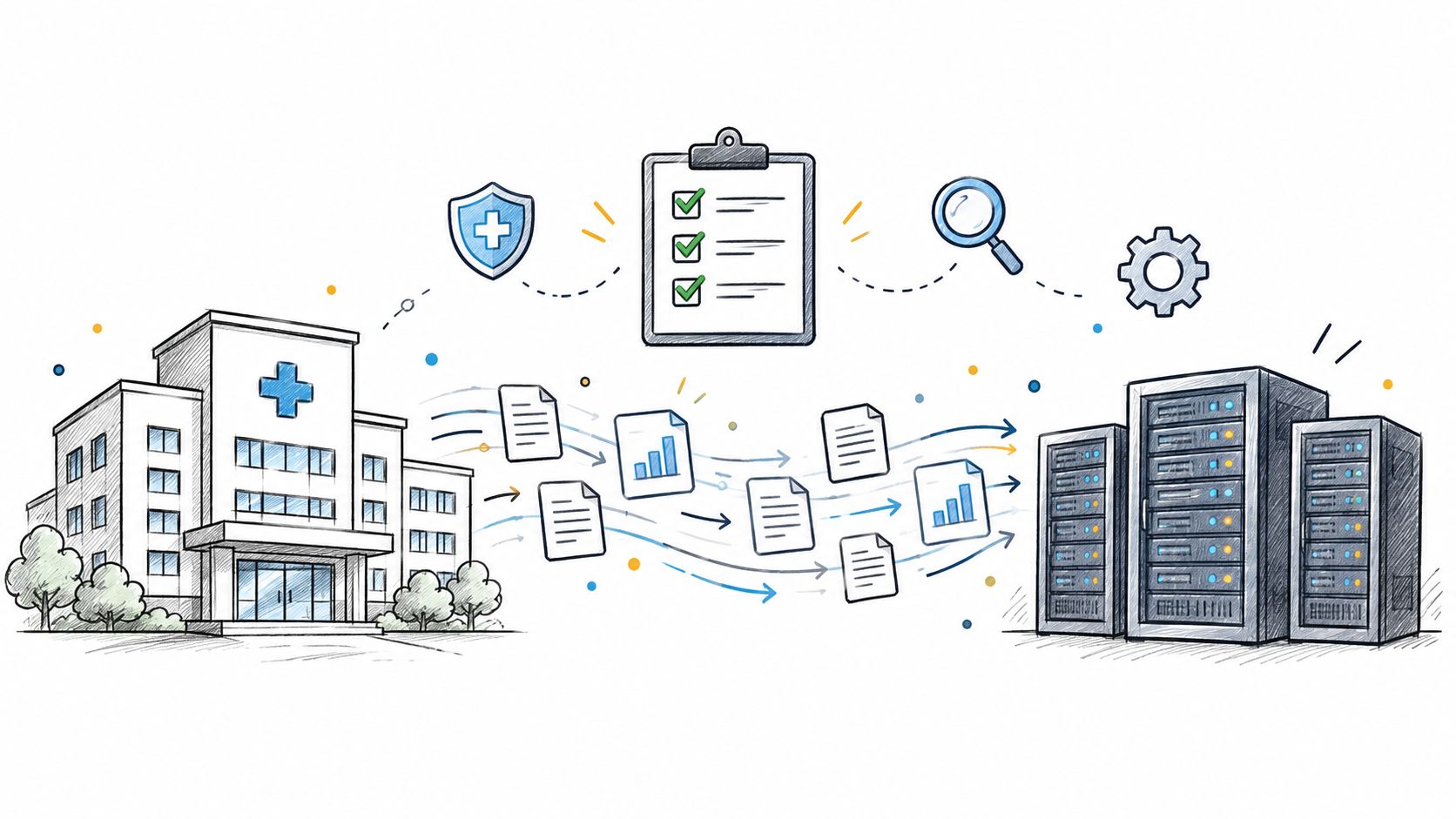
Practical data migration planning guide for healthcare teams. Scope, mapping, compliance, validation, cutover and rollback decisions explained end to end.

Smart on FHIR guide for healthtech engineers. Learn the OAuth 2.0 launch model, scope syntax, backend services, and US regulatory requirements.
Connect with our team to explore how AI expertise can transform your business.