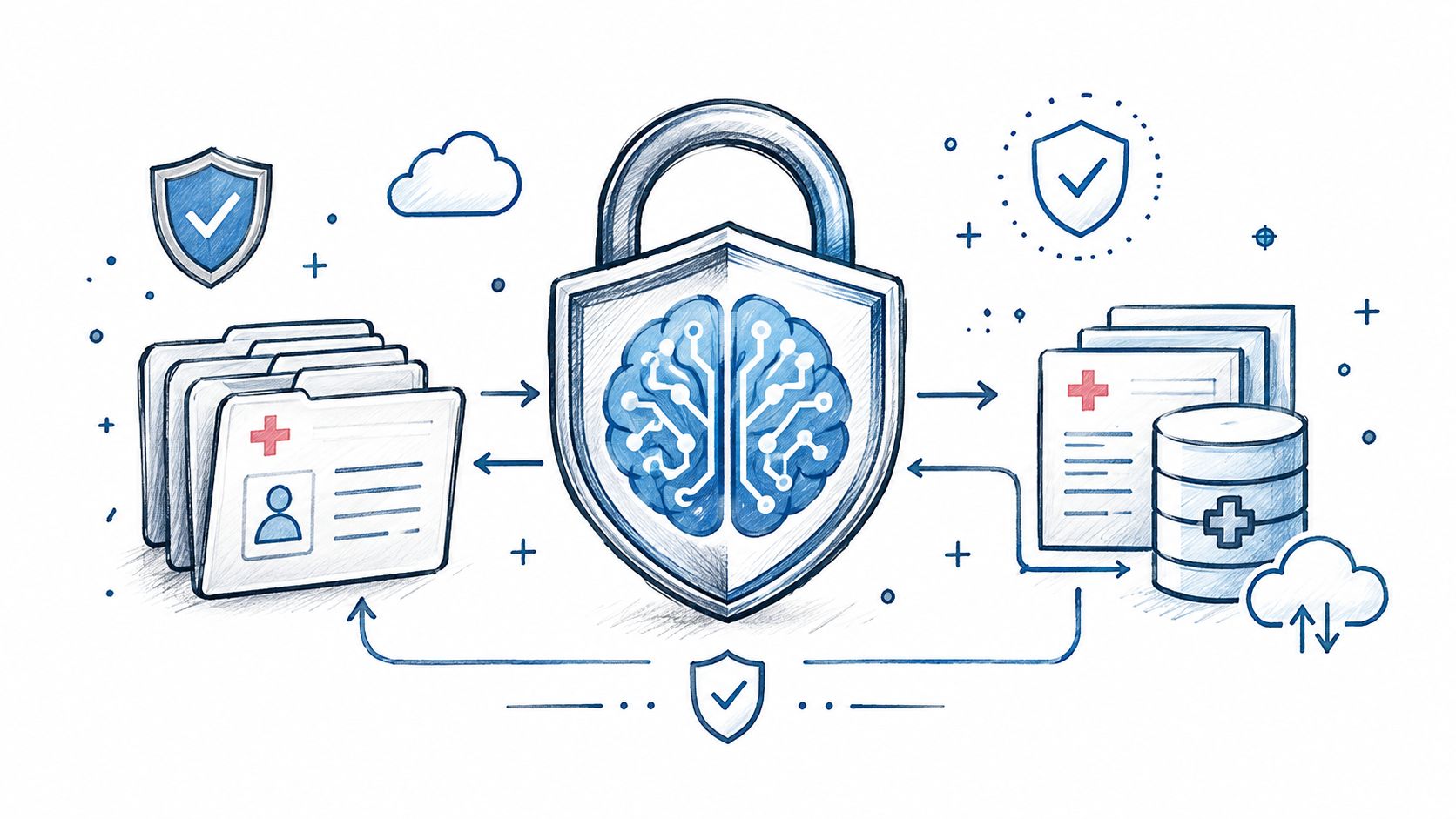
AI in Healthcare
HIPAA-Compliant AI: How to Use LLMs With PHI Safely
How to build HIPAA-compliant AI: when LLM providers need a BAA, data minimization, de-identification, audit controls and a reference architecture.
October 16, 2026Read more
AI maturity assessment for healthcare organizations - Conduct an AI maturity assessment for healthcare organizations to evaluate current capabilities. Chart a

An AI maturity assessment is more than just a buzzword; it's a deep, formal look at how ready your healthcare organization is to use artificial intelligence safely and effectively. This isn't about listing the AI tools you have. It’s a comprehensive measurement of your capabilities—from data infrastructure and governance to your team's skills and how well you can integrate AI into actual clinical workflows. It's the foundation for a real strategy.
The excitement around AI in healthcare is palpable, but there’s a massive gap between running a few pilot projects and being truly ready to deploy AI at scale. I’ve seen countless organizations jump headfirst into a new AI tool only to face misaligned investments, regulatory nightmares, and results that fall flat. A formal AI maturity assessment is how you sidestep those common, and costly, mistakes.
This isn't just a tech audit. Think of it as evolving from scattered, one-off projects to a unified, organization-wide strategy. It’s about getting your technology, people, and processes all pulling in the same direction to build a capable and accountable organization that can actually get value from AI.
The numbers tell a sobering story. While about 85% of healthcare organizations are exploring or have adopted AI in some form, a mere 18% are genuinely prepared to integrate it into patient care. This disconnect is the single biggest hurdle I see leaders face when they want to drive real change with AI.
Without a clear, structured assessment, organizations inevitably fall into predictable traps:
One of the most promising areas for AI is in advanced clinical decision support tools, which have the potential to dramatically improve outcomes. But even these powerful systems depend entirely on a mature infrastructure to work correctly and safely.

An AI maturity assessment gives you a map of your current position. You can’t plot the most efficient route to your destination if you don’t know where you’re starting from. This is why established frameworks, like the HIMSS Analytics AI Maturity (AMAM) Model or the DiMe Health AI Maturity Model, are so valuable—they give you a proven structure for the evaluation.
An honest assessment turns subjective opinions into objective data. It builds a shared, fact-based understanding across your clinical, IT, and operational teams, pinpointing both your strengths and your most critical vulnerabilities.
This evaluation isn’t a one-and-done checkbox. It’s the kickoff for a cycle of continuous improvement. Once you understand your maturity level, you can finally make informed decisions, prioritize investments where they'll have the most impact, and build a roadmap that is both ambitious and achievable.
This is precisely where a dedicated HealthTech engineering partner can turn an assessment into your most powerful strategic tool. By guiding you through the process, your organization can ensure its Healthcare AI Services initiatives are built for long-term, sustainable success—transforming your efforts from a series of disconnected experiments into a unified engine for growth and better patient care.
So, how do you actually measure your organization's AI readiness? You can't just guess. For a clear, unbiased look in the mirror, you need a solid framework. We've found one of the most practical tools for this is the Health AI Maturity Model from the Digital Medicine Society (DiMe). It’s less of an academic exercise and more of a real-world map for your journey.
This model gives you a common language to talk about AI across your entire organization—from the C-suite to the IT department and the clinicians on the floor. It assesses your capabilities across seven key domains and plots you on a five-stage maturity scale. Knowing where you stand is the first, most critical step to figuring out where you need to go.
The DiMe model maps out a clear progression. Think of it as moving from tinkering with AI in a back room to having it fully integrated into your strategic and clinical operations. Pinpointing your current stage is essential for setting realistic goals.
Stage 1: Initial: At this point, any AI work is happening in isolated pockets. A few curious people might be experimenting with off-the-shelf AI tools for business, but there's no official strategy, budget, or executive backing. This is the "tire-kicking" phase.
Stage 2: Developing: The first real projects start to emerge. They are usually small, department-specific pilots—think a single radiology algorithm or a new billing automation tool. Funding is scarce and tied to that one project. Governance is an afterthought.
Stage 3: Defined: This is where things get serious. Your organization starts creating formal processes for AI. A governance committee might get formed, and you begin documenting standards for data, ethics, and model validation. You're shifting from one-off experiments to building a repeatable, scalable program.
This is often the moment of truth when health systems realize they need help connecting the dots. Many bring in specialized AI strategy consulting to build a formal roadmap. It’s the shift from asking "what if" to defining "how to."
Pushing into the upper tiers of maturity means AI is no longer a side project—it’s becoming woven into the way you operate. This is where you start to see a tangible impact on everything from patient outcomes to your bottom line.
Key Takeaway: An organization in the 'Managed' stage doesn't just use AI; it measures its impact. Success is defined by clear metrics tied directly to strategic business and clinical goals.
Once you're at the Managed stage, your AI projects are no longer random. They’re part of a coordinated portfolio that’s directly aligned with your organization's broader strategy. Crucially, you’re measuring outcomes against predefined KPIs. For instance, a hospital might implement an AI tool to predict patient flow and then track its success by measuring the reduction in ED wait times or improved discharge efficiency.
The final destination is the Optimized stage. Here, AI isn’t just a tool; it’s a catalyst for continuous innovation, driven by visionary leadership. Organizations at this level are industry leaders, transparently reporting on their AI outcomes and even helping to develop novel SaMD solutions. They aren't just adopting AI—they are helping to shape its future in healthcare.
Alright, let's move from just talking about AI to actually doing something. Kicking off an internal AI maturity assessment for healthcare organizations feels like a massive undertaking, and in many ways, it is. But it’s also the only way to get an honest snapshot of where you really are so you can map out a realistic path forward.
First things first: this isn't just an IT project. If you try to run this out of a single department, you’re setting yourself up for failure. I’ve seen it happen. You need a coalition of the willing, a cross-functional team that brings different perspectives to the table.
Your team should include:
This infographic paints a great picture of the journey most organizations go through as they build out their AI capabilities.

Think of these stages as a roadmap. They help you pinpoint where you are right now and see what it takes to get to the next level, moving from scattered experiments to true strategic leadership in AI.
With your team assembled, it's time to start digging. This part of the assessment is a mix of hard data and human intelligence. You're not just auditing technology; you're looking at your people, your established processes, and your organizational culture.
Start by conducting structured interviews with stakeholders from all the departments you’ve brought together. The goal here is to get past the surface-level talk and uncover real pain points, what they see as genuine opportunities, and how much AI-related skepticism or excitement already exists. These conversations are pure gold for understanding your cultural readiness. For some solid guidance on running these sessions, as we explored in our AI adoption guide, you need to ask targeted questions to uncover true readiness.
Next, you have to get your hands dirty with system and data audits. This means documenting your current tech stack, mapping out where all your data lives, and making an honest call on its quality and accessibility. This is a key step in your AI requirements analysis.
Finally, pull out all your existing policies on data governance, patient privacy, and how you buy new technology. You'll probably find, as many organizations do, that these documents were written long before AI was a serious consideration. This exercise immediately highlights the policy gaps you'll need to fill. If you're looking for frameworks to help, there are some great AI Transformation Readiness Tools that can guide your evaluation.
I can't stress this enough: a common pitfall is focusing only on the tech. You have to give equal weight to your people and processes. The most brilliant algorithm is worthless if clinicians refuse to use it or if your governance policies can't support it.
To bring some structure to your interviews and audits, your team needs to develop a checklist of specific questions for each key area of AI maturity.
Here are a few examples to get your team's discussion started:
| Domain | Sample Question for Your Assessment |
|---|---|
| Data & Infrastructure | Can we actually get data out of our EMR, billing, and lab systems to use for analysis? Is it clean? Is it integrated? |
| Governance & Ethics | If we deploy an AI model, who is on the hook for monitoring it? What’s the approval process look like? |
| People & Skills | What real training have our clinical and IT staff had on AI principles and risks? Do they know what to look for? |
| Strategy & Leadership | Is there a real, dedicated budget for AI beyond a few small pilot projects? Do we have an executive champion? |
The point of all this isn't just to create a report that sits on a shelf. It's to build a comprehensive, documented baseline that everyone agrees on. This process replaces assumptions with facts and gets your entire organization aligned on a single, shared starting point for your AI journey.
An assessment is worth nothing if it just sits in a folder. You've audited your capabilities and know where you stand on the maturity scale—now it's time to put that knowledge to work. This is where you translate those findings into a prioritized, actionable AI roadmap, connecting the dots between the gaps you found and your organization's biggest goals, like improving patient outcomes or taming operational costs.
The biggest mistake I see is trying to boil the ocean. A realistic roadmap has to be sequenced based on where you are today. For instance, if your organization is still in the early stages, don't even think about jumping into complex predictive modeling. The much smarter play is to lock in some foundational wins first—think data cleansing projects or automating a single, universally hated administrative task.

Getting these early, tangible victories is how you build momentum. It’s what gets skeptical stakeholders on board for the more ambitious projects you have planned down the line.
To build a roadmap that actually works, every potential AI initiative needs to be plotted against two simple but critical criteria: impact and feasibility. This forces you to look past the shiny new technology and focus on what will deliver real, measurable value to the organization.
Impact: Ask yourself: How much will this project really move the needle? Will it make a dent in clinician burnout? Can it measurably lower readmission rates or speed up revenue cycle collections? High-impact projects are the ones that solve a major headache or directly support a core strategic goal.
Feasibility: Now, get real about what it would take to get this done. This means looking hard at your budget, the current state of your data, your team's skills, and the sheer complexity of plugging a new tool into existing clinical workflows. A project might have massive potential impact but be completely out of reach with your current resources.
This exercise lets you map everything onto a classic four-quadrant matrix, which makes prioritization much more straightforward.
Your first move should always be to target the "high-impact, high-feasibility" quadrant. These are your quick wins. They’re projects that can be rolled out with relative ease and deliver a noticeable, positive result fast.
A perfect example is deploying a simple AI tool to automate prior authorization submissions. It frees up administrative staff from soul-crushing paperwork and directly reduces delays in patient care. It’s a win-win that everyone can see.
Success with these quick wins creates buzz and proves AI's value to both leadership and your frontline teams. That political capital is absolutely essential for getting the green light for the next, tougher stage of your roadmap: foundational projects.
Foundational projects usually fall into the "high-impact, lower-feasibility" box. These are the bigger, messier, but absolutely necessary initiatives for any long-term success.
Examples include:
These projects don't offer a flashy, immediate payoff. But they are the bedrock for every advanced AI application you'll want to build later. They directly address the core weaknesses you uncovered in your AI maturity assessment for healthcare organizations.
The goal of a roadmap isn't just to list projects; it's to tell a story. It should clearly show how a series of small, achievable steps will build upon each other to create significant, long-term transformation for your organization.
This kind of strategic sequencing is what separates a roadmap that gets funded from one that gathers dust. It proves you have a clear-eyed view of both the opportunities and the challenges, and that you're building a sustainable capability, not just chasing trends.
For organizations that need to accelerate this whole process, a Custom AI Strategy report can be a real game-changer. By drawing from a library of real-world use cases, it can help you build a ready-to-execute plan and streamline your AI Product Development Workflow, getting you from assessment to action in a fraction of the time.
Even with the best-laid plans, the journey to AI maturity in healthcare is never a perfectly straight line. Let's be realistic: you're going to hit obstacles. The trick isn't avoiding them entirely, but knowing what they are ahead of time so you can navigate them effectively.
Anticipating these common pitfalls—from messy data to the very human fear of change—is what truly defines a successful AI maturity assessment for healthcare organizations. As we've discussed in our AI adoption guide, it’s the proactive strategies for these hurdles that separate lasting success from another failed pilot project.
One of the first and most universal headaches is the state of healthcare data itself. It's almost always locked away in disparate systems that refuse to talk to one another—the EMR, the billing platform, lab software, you name it. And even when you get your hands on it, the data is often a mess of incomplete or inconsistent entries, making it totally unreliable for training AI models.
This is why you have to get your data governance in order before you can do anything else.
A brilliant AI tool that clinicians refuse to use is just expensive shelfware. We see it all the time. Resistance isn't just stubbornness; it comes from very real concerns. Clinicians worry about added work, losing their autonomy, or that tech is trying to replace their hard-earned judgment.
If you ignore these feelings, your initiative is doomed from the start.
The only way this works is by making clinicians partners in the process, not just subjects of it. We’ve found that creating clinical champion programs is one of the most powerful ways to build buy-in. These champions—respected peers—can help test new tools, give honest, real-world feedback, and become your most credible advocates.
Key Takeaway: AI adoption is a change management problem first and a technology problem second. If you don't win the hearts and minds of your clinical staff, you've already lost the battle.
Global AI maturity in healthcare is picking up speed. Research shows 70% of payers and providers are expected to pursue generative AI by early 2026. But that same report highlights deep-seated fears, like the potential loss of human interaction (61%) and overreliance on AI for diagnostics (58%). To dig deeper into these trends and the governance gaps, you can read the full research about the state of AI in healthcare.
There’s a growing, often hidden risk that many leaders miss: shadow AI. This is what happens when your staff, trying to be more efficient, starts using unauthorized consumer AI tools for work. Think of a nurse using a public chatbot to summarize patient notes—it’s a massive security and privacy nightmare waiting to happen.
This kind of behavior is a clear signal of an unmet need. When the official tools are clunky, slow, or nonexistent, your most resourceful employees will find their own workarounds.
The answer isn't a blanket ban, which just drives the behavior further underground. Instead, you need to provide sanctioned, secure alternatives that actually work. Investing in effective internal tooling or using a standardized service like AI Automation as a Service gives your teams the capabilities they’re looking for within a secure, governed environment. This way, you get the productivity gains your staff wants without compromising safety and compliance.
Completing an AI maturity assessment for healthcare organizations is a huge step, but the real work begins once you have the report in hand. Too often, these detailed assessments end up as just another document, while the organization struggles to translate the findings into action. The path from a color-coded roadmap to deploying real, impactful solutions is where most initiatives stall.
We’ve seen it happen time and again. The problem isn’t a lack of ambition; it’s the inertia that can set in. Traditional consulting projects can drag on for months, mired in theory and meetings, while the urgency to innovate fades. Our philosophy is different. We focus on getting you from insight to execution quickly, turning your assessment into a living, breathing plan without the usual delays.
Your assessment gives you a map, but you still need to build the vehicle. The next step looks different for every health system. For one hospital, it might mean building new AI tools for business to finally get a handle on patient no-show rates. For another, it could involve a deep-dive into custom healthcare software development to create a diagnostic tool that works with their unique EHR setup.
This is about connecting the dots. We look at the specific gaps your assessment uncovered and bring the right expertise to the table. Whether that means refining your plan for building compliant SaMD solutions or simply needing an experienced team to guide you, we function as a natural extension of your own people. The goal is to build a practical AI Product Development Workflow so that every project you launch adds to your capabilities.
Your AI journey is unique, and your strategy should be too. A partnership focused on rapid execution and tailored support ensures you’re not just adopting AI, but mastering it for a real competitive advantage.
Ultimately, this is about making sure your AI efforts pay off. By combining a rapid, strategy-first approach with the technical chops for end-to-end implementation, we help you turn that initial assessment into tangible results that actually improve patient outcomes and make your operations run smoother.
Ready to put your plan into motion? Connect with our expert team to talk about your goals and see how we can help you accelerate your path to AI maturity.
Have questions about starting your own healthcare AI maturity assessment? You're not alone. Here are some of the most common questions I hear from leaders in the field, along with some straight-to-the-point answers.
Before you even think about technology, your very first move is to get the right people in a room. This means forming a multidisciplinary committee with a strong champion from the executive suite.
You absolutely need leaders from your clinical teams, IT, data analytics, compliance, and operations at the table from day one. Why? Because this isn't just an IT project. Getting this group to define the scope and agree on a framework together is crucial for ensuring you get the buy-in and honest information needed to make the assessment worthwhile.
Honestly, it depends. If you're running the process internally from scratch, be prepared for it to take anywhere from several weeks to a few months, especially in a large, complex organization. You have to schedule interviews, gather documentation, and align everyone's findings.
There are ways to move much faster, though. A specialized AI Strategy consulting tool can really shorten that timeline. We designed our platform specifically to generate a comprehensive Custom AI Strategy report and benchmark your maturity, often condensing months of work into a much shorter timeframe.
Absolutely. In fact, you should. Many people think AI maturity is all about buying expensive new systems, but the early stages are far more about strategy and governance than a spending spree.
You can achieve significant wins with minimal investment. Focus on foundational work first:
These low-cost steps are what build the essential groundwork for smart investments down the road.
The single biggest mistake I see is treating the assessment as a purely technical exercise owned solely by the IT department. When that happens, the resulting "roadmap" is almost always dead on arrival.
True AI maturity is an organizational capability. It's woven into your people, your processes, and your clinical workflows. If you exclude clinicians and operational leaders from the assessment, you get a skewed picture of reality. Worse, you get a plan that nobody on the front lines will adopt, and your initiative will fail before it even begins.
At Ekipa AI, we're experts at transforming assessment findings into a plan that actually works. Ready to move from insight to impact? The best way to start is to connect with our expert team and let us help accelerate your journey.
How to build HIPAA-compliant AI: when LLM providers need a BAA, data minimization, de-identification, audit controls and a reference architecture.
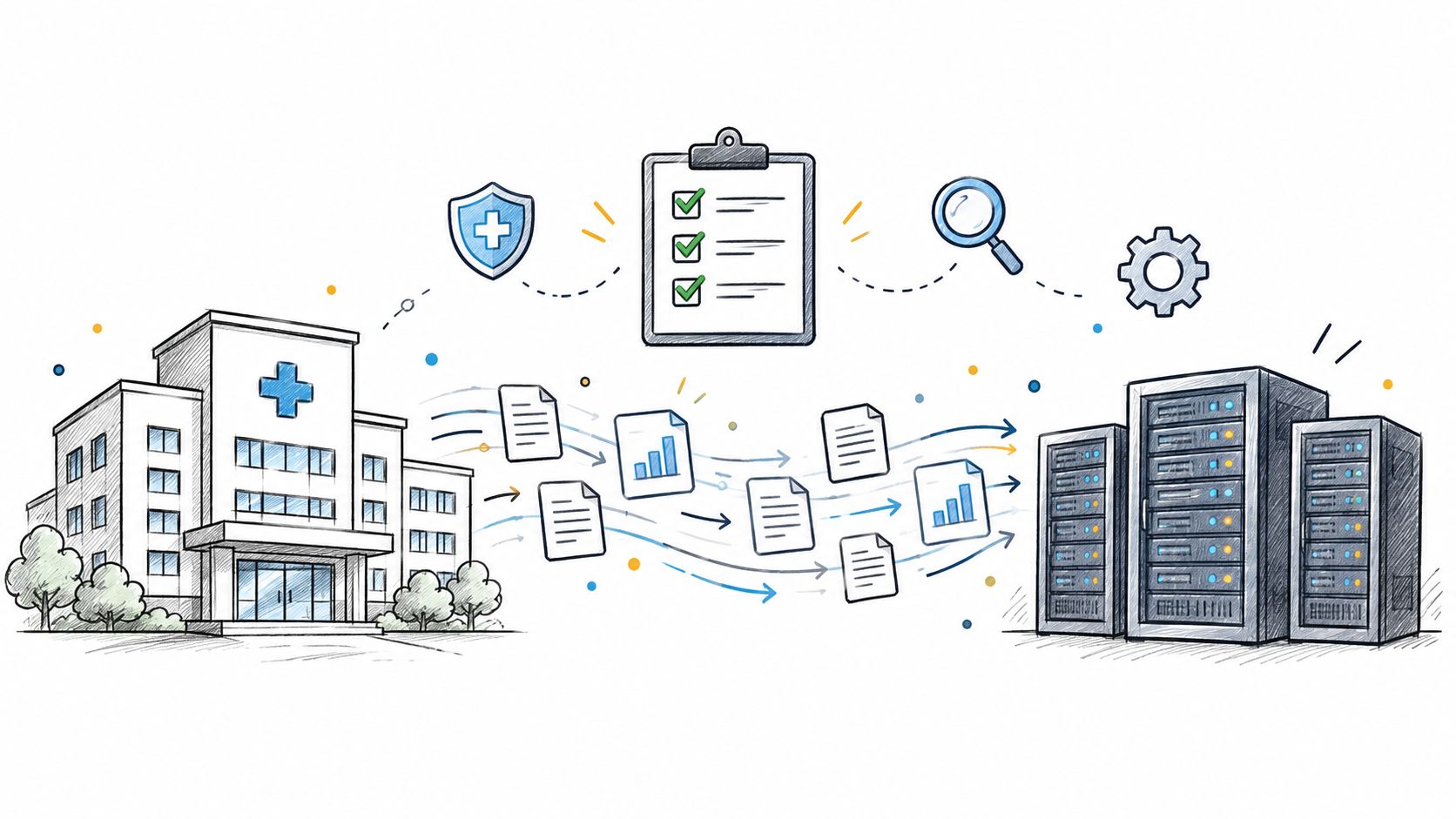
Practical data migration planning guide for healthcare teams. Scope, mapping, compliance, validation, cutover and rollback decisions explained end to end.
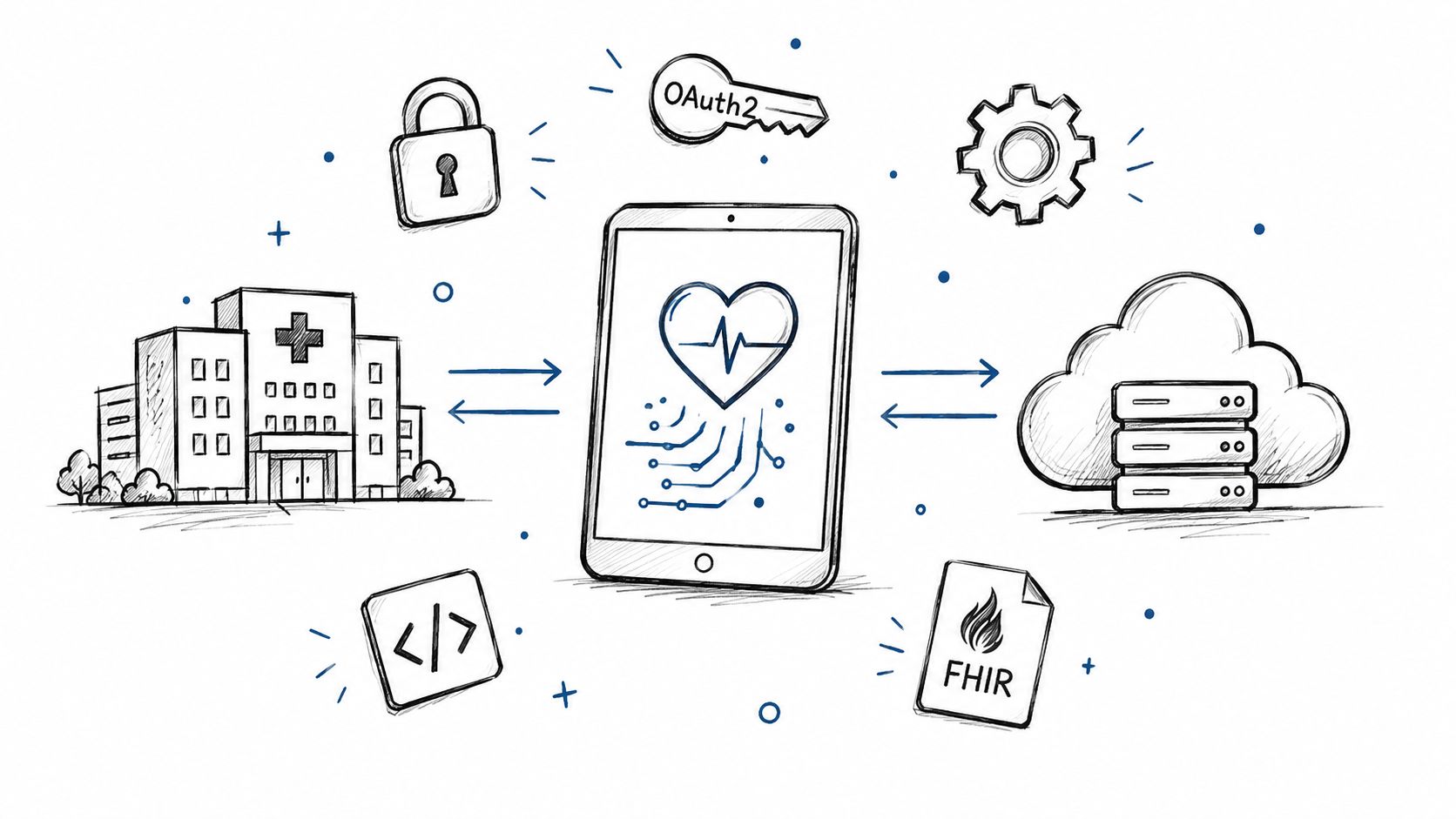
Smart on FHIR guide for healthtech engineers. Learn the OAuth 2.0 launch model, scope syntax, backend services, and US regulatory requirements.
Connect with our team to explore how AI expertise can transform your business.