AI in Healthcare
EHR Integration Software: A 2026 Buyer's Guide
Compare 10 EHR integration software options, from FHIR platforms to integration engines, with use cases, trade-offs, and selection guidance for healthtech
September 25, 2026Read more
Explore key healthcare AI governance models. Our guide helps CTOs compare centralized, federated, and hybrid options for safe, compliant AI deployment.

Hospitals don’t have a healthcare AI problem. They have a governance timing problem.
In 2024, 71% of U.S. hospitals reported using predictive AI, but only 18% of health systems had mature AI governance structures, according to the Office of the National Coordinator data brief. That gap is where most deployment risk lives. Models move into care pathways, scheduling, billing, triage, and operational workflows faster than committees, policies, and monitoring routines can keep up.
For a hospital CTO, the issue isn’t whether to govern AI. It’s how to build a governance system that clinicians will follow, compliance will trust, and operations can sustain. Good healthcare AI governance models don’t slow useful AI down. They decide which tools deserve fast approval, which ones need tighter controls, and which ones shouldn’t go live at all.
The practical challenge is that one model won’t fit every environment. An academic medical center, a regional health system, a rural hospital, and a safety-net clinic don’t have the same staffing, data maturity, vendor negotiation power, or risk tolerance. That’s why the operational design matters more than abstract ethics statements. Governance has to work on a Tuesday afternoon when a vendor pushes a model update, a clinician questions a recommendation, or an audit request lands without warning.
Hospitals with weak AI oversight do not usually fail at strategy. They fail in operations. A model gets approved without a named owner. A vendor pushes an update and nobody revalidates performance. A clinical team starts relying on an output that was never cleared for that workflow. The risk shows up later, during an incident review, audit, or patient complaint.
That pattern is common because AI enters healthcare through very different doors. Some tools arrive through IT. Others come through a department pilot, a research group, revenue cycle, or a vendor bundled into an existing platform. In smaller hospitals and resource-constrained settings, the problem is sharper. The same person may be covering security review, contract review, and analytics support. Without a defined governance path, teams either approve too much informally or stall every request because no one knows the threshold for approval.
Ad hoc governance breaks down when hospitals use one review style for every use case. A documentation assistant, a bed-capacity forecasting model, and a clinical decision support tool do not carry the same operational or patient risk. Treating them as identical creates friction in the wrong places and blind spots in the dangerous ones.
A workable model sorts requests by a few practical factors:
That structure matters more than a polished policy deck. It gives a rural hospital with a lean team a way to triage reviews in an hour, not a month. It also gives a large health system a repeatable intake process across departments.
Practical rule: If a model can influence who gets evaluated, prioritized, treated, escalated, or billed, governance starts before procurement.
Strong governance is not an ethics statement. It is a set of operating controls that hold up under time pressure.
For a CTO, the true test is mundane. Can the team answer four questions quickly and with evidence?
If those answers live in email, slide decks, or one person's memory, the hospital does not have governance. It has good intentions.
This is also where healthcare AI programs can borrow from broader board-level discipline. A sound corporate governance framework clarifies decision rights, escalation paths, and reporting expectations. Healthcare AI needs the same structure, adapted for clinical risk, privacy obligations, and model lifecycle control.
The right design depends on staffing, vendor mix, regulatory exposure, and how decisions are made across the organization. An academic medical center can support a formal review board with specialty representation. A community hospital may need a lighter intake form, a monthly review cadence, and a short list of mandatory checks. A safety-net clinic may rely on shared services, external partners, or a small cross-functional committee that reviews only higher-risk use cases.
That is why theory alone is not enough. Teams need operating templates. Start with a use-case intake form, a risk-tiering checklist, a named business owner, a validation sign-off, and a post-launch monitoring log. For organizations building broader healthcare AI services, governance should be designed alongside workflow change, vendor review, and model operations, not added after deployment.
Hospitals that do this well are not slower. They are clearer about what can move fast, what needs controls, and what should not enter production at all.
Most healthcare AI governance models are variations of five operating patterns. The right choice depends less on what seems impressive and more on how your hospital genuinely makes decisions.
Some organizations need tight central control because they carry high regulatory exposure and have many departments procuring tools. Others need local flexibility because workflows differ sharply across sites or specialties. In practice, many hospitals land on a blend rather than a pure model.

| Model | Structure | Pros | Cons | Best For |
|---|---|---|---|---|
| Centralized | Enterprise committee controls approval, standards, monitoring, and vendor intake | Strong consistency, clear accountability, easier audit readiness | Can slow local innovation, may miss specialty workflow nuance | Large health systems with many vendors and shared infrastructure |
| Federated | Enterprise sets guardrails, departments govern local implementation | Better clinical fit, faster specialty adoption, stronger frontline ownership | Inconsistent decisions across units, harder to maintain common evidence standards | Multi-hospital systems with diverse service lines |
| Hybrid | Central policy and risk review with local workflow ownership | Balances control and adoption speed, practical for most hospitals | Requires disciplined role definition, can create duplicate review if poorly designed | Regional systems, integrated delivery networks, growing AI portfolios |
| Risk-based | Oversight intensity changes by use case risk and impact | Efficient resource use, avoids over-governing low-risk tools, aligns to real harm potential | Needs a clear scoring method and confidence in classification | Hospitals deploying mixed clinical and operational AI |
| Clinical-embedded | Governance is built into existing clinical quality, safety, and service line processes | Strong clinician trust, grounded in care delivery realities | May underweight enterprise security, procurement, or technical oversight | Organizations with mature quality governance and strong clinical leadership |
A useful parallel is the way boards design a broader corporate governance framework around roles, risk, and reporting. AI governance works the same way. The model matters less than whether decision rights, escalation paths, and reporting lines are unambiguous.
Centralized control works when your biggest risk is inconsistency. If several departments can buy AI-enabled software, a central review body prevents contradictory standards for privacy, validation, and monitoring. It fails when every decision has to climb too high for routine approvals.
Federated governance respects the fact that emergency medicine, radiology, revenue cycle, and ambulatory operations don’t run the same way. It works when local teams are mature enough to document use, challenge model output, and own change management. It fails when enterprise standards are too vague.
Hybrid governance is the default recommendation for most CTOs because it matches how hospitals operate. Security, privacy, validation standards, and vendor review stay centralized. Workflow integration, clinician training, and exception handling stay local. This model only breaks when people don’t know who has final authority.
Risk-based models deserve special attention because they solve a common operational problem. Not every AI system deserves the same review burden.
The CHAI framework, developed with The Joint Commission, uses risk-based management, multidisciplinary governance teams, pre-implementation validation, and explicit go or no-go thresholds with continuous monitoring. In a cited hospital chest X-ray AI case, retraining on more diverse data under this framework led to a 22% reduction in diagnostic errors, reported in this CHAI governance framework paper.
That result matters because it shows what good governance does. It doesn’t just generate meeting minutes. It catches performance degradation, forces root-cause analysis, and gives leaders a reasoned basis to pause or redeploy.
Don’t choose the model that looks most rigorous on paper. Choose the one your organization will actually execute every month.
Use these questions before you lock in a structure:
If your answer set is mixed, your governance model should be mixed too. That usually means hybrid with risk-based triage layered on top.
Governance fails when everyone is invited and nobody is accountable.
A regulated AI environment needs named owners for decision quality, data handling, deployment safety, and audit evidence. The committee matters, but the operating roles matter more. If a model drifts, exposes patient data, or changes clinician behavior in an unsafe way, the hospital needs to know exactly who assesses it, who can pause it, and who signs off on remediation.
A workable structure usually includes these roles:
For legal review, teams often benefit from structured intake and issue triage tools. A practical overview of emerging options appears in this guide to best AI legal assistants, especially for organizations trying to organize policy review without overloading counsel.
The governance technology market itself tells you where buyers feel pressure. The clinical AI model governance market reached USD 1.77 billion in 2025, with solutions holding 67.48% market share in 2026, and on-premises deployments holding 51.4% share due to patient data sovereignty requirements, according to this clinical AI governance market analysis. That’s not just a market signal. It reflects a basic operational truth: architecture decisions often become compliance decisions.
If a vendor can’t explain where data is processed, how versions are controlled, and how audit evidence is retained, the problem isn’t just technical ambiguity. It’s governance weakness.
The most effective committees are small enough to decide and broad enough to challenge. They usually have two layers:
Steering group
Working group
Board-level insight: In healthcare AI, the cleanest org chart still fails if clinicians see governance as an IT mandate rather than a patient-safety function.
For software that may cross into regulated clinical functionality, governance and product strategy have to align early. That’s especially true for SaMD solutions where intended use, validation evidence, and post-market monitoring need tighter control than general workflow automation.
Hospitals rarely need a grand redesign first. They need a controlled starting point, clear decision rights, and a path from pilot discipline to enterprise routine.
The roadmap below works across large systems and smaller operators because it focuses on operating habits, not just policy language.

Start with a steering committee charter, not a tool purchase. The charter should define scope, authority, escalation, approval thresholds, and what counts as AI inside your organization. If you skip this step, teams spend months arguing about whether a predictive score, ambient documentation feature, or vendor recommendation engine falls under governance.
Write the first version in plain language. A good charter answers five questions fast:
Next, conduct an AI Product Development Workflow exercise focused on requirements, not enthusiasm. Most failed deployments don’t collapse because the model is mathematically poor. They fail because nobody pinned down workflow fit, override conditions, training expectations, or post-launch ownership.
Use a structured intake for every proposed use case. Capture intended user, intended decision, affected population, data source, known exclusions, and what happens when the model is wrong. Then classify each use case into low, moderate, or high governance burden based on patient impact, autonomy level, and data sensitivity.
Many strategy decks become useless when a hospital copies a governance framework from a large academic center and discovers it assumes staff, budget, and specialist support that don’t exist locally.
A 2024 study noted that current AI governance collaborations largely exclude safety-net organizations, even though U.S. safety-net organizations serve 30 million low-income patients annually, as discussed in this PMC analysis on safety-net inclusion. That should change how you design rollout. Safety-net settings need leaner governance mechanics, stronger patient-community input, and realistic evidence standards that don’t depend on large in-house AI teams.
A practical adaptation looks like this:
If your governance model assumes unlimited informatics support, it isn’t a governance model. It’s an aspiration.
Choose one or two use cases that create visible value without placing the organization in its highest-risk zone. Administrative summarization, scheduling support, coding assistance, or narrow workflow prioritization often make better first candidates than complex clinical decision support.
The pilot should produce operational evidence, not just launch activity. Review these items before expansion:
Hospitals that scale well treat the pilot as a rehearsal for governance behavior. They test escalation, documentation quality, retraining triggers, and leadership attention before the portfolio grows.
A governance model becomes real only when it shows up in forms, logs, approvals, alerts, and incident playbooks. Through these manifestations, most hospitals discover whether their healthcare AI governance models are operational or merely presentable.
The minimum viable system isn’t glamorous. It’s a set of practical controls that force consistency across procurement, validation, deployment, and change management.

You don’t need a fifty-document manual to start. You do need a coherent operating packet. At minimum, create policies for:
A short acquisition checklist helps. Ask every vendor for intended use, validation scope, known limitations, training data provenance at a meaningful level, update practices, explainability approach, and audit log availability. If answers are vague, the review should slow down.
Integrated governance with human-in-the-loop review and model registries can reduce non-compliance incidents by 35%, and a multi-hospital study found ungoverned models had an 18% higher risk of PHI breaches than governed ones, according to this healthcare AI governance review. Those figures align with what operational teams see in practice. Version control, access control, and human review aren’t red tape. They reduce avoidable failure.
What helps on the tooling side:
| Tooling component | Why it matters | What to look for |
|---|---|---|
| Model registry | Tracks versions, approvals, owners, and deployment status | Clear version history, approval fields, rollback visibility |
| Monitoring dashboard | Flags drift, failure patterns, and usage anomalies | Threshold alerts, user-level logs, exportable evidence |
| HITL workflow system | Routes high-risk or uncertain outputs to human review | Queue management, reason codes, escalation rules |
| Vendor inventory | Prevents shadow AI and duplicate tools | Renewal dates, contracts, risk tier, hosting notes |
| Policy knowledge base | Keeps staff aligned on approved use | Searchable guidance, linked forms, update history |
One example in this category is VerifAI, which is positioned around AI validation and governance workflows. The broader point is the feature set, not the brand. Hospitals need traceability, review gates, and evidence capture in one operating rhythm.
When a model causes concern, teams need a playbook they can execute without improvising. Keep the first response protocol simple:
Small teams should prefer fewer policies with stronger enforcement over elaborate manuals nobody reads.
If governance can’t be measured, it won’t stay funded.
The mistake many hospitals make is tracking only model performance. Governance needs a wider scorecard. A model can remain accurate and still be unsafe because of bad workflow placement, poor override design, missing audit logs, or uncontrolled vendor changes.

Track governance health across four domains:
Approval discipline
Operational safety
Model integrity
Compliance readiness
Not every metric needs to be automated. In fact, some of the most useful governance signals are qualitative. Clinician trust, frontline workarounds, and confusion about intended use often surface before dashboard thresholds do.
Hospitals need both.
Continuous monitoring catches change in near real time. It should focus on operational signals that can trigger review quickly, such as unusual override volume, missing logs, sudden output shifts, or unexplained usage spikes.
Periodic audits test whether the whole control system still works. They ask harder questions. Are approvals documented properly? Are retired models still accessible? Are users following the approved workflow? Did the hospital investigate prior incidents thoroughly?
A good audit doesn’t just inspect the model. It inspects the institution’s behavior around the model.
Audit the workflow around the prediction, not just the prediction itself.
For teams expanding governed automation into broader AI Automation as a Service, this distinction matters. Monitoring protects day-to-day operations. Audits protect long-term credibility.
A governance model only works if clinical, technical, and operational teams can follow it under normal pressure.
Healthcare AI governance models succeed when they fit the environment they are meant to control. A large academic health system can support formal review committees, dedicated model monitoring, and deeper vendor management. A community hospital or rural provider usually needs a leaner setup with named decision-makers, a short intake form, basic validation standards, and a clear escalation path when a tool creates risk. The goal is the same in both settings. Make AI use visible, accountable, and safe enough to operate at scale.
For a CTO or digital health leader, the next step is execution, not another principles document. Start with a 90-day plan that your teams can finish:
That sequence works because it matches hospital reality. Teams rarely fail on policy language alone. They fail when ownership is unclear, reviews are too slow, local workarounds appear, or nobody knows which AI tools are already affecting care or operations.
External support can help if internal teams are stretched across EHR work, cybersecurity, data engineering, and daily service delivery. The useful test is practical. Can a partner help define approval criteria, map current AI use, set up review workflows, and prepare audit evidence without adding unnecessary process? If not, the hospital will inherit more complexity, not more control.
The strongest conclusion is simple. Start smaller than you want, document more than feels necessary, and design governance for the hospitals you run, not the ideal future-state org chart.
Hospitals rarely struggle because they lack principles. They struggle because governance has to work across clinical care, operations, IT, compliance, and vendor management at the same time. These are the questions I hear most often from CTOs and digital health leaders trying to make that work in real settings.
For most mid-sized hospitals, a hybrid model with risk-based review is the practical choice.
It keeps privacy, security, legal, and vendor controls consistent at the enterprise level while allowing service lines and operational teams to own workflow decisions, training, and day-to-day use. A fully centralized model often slows adoption and pushes departments into workarounds. A fully decentralized model creates uneven review standards and weak audit trails. The hybrid structure handles both problems better.
Use one governance system, but set different evidence requirements.
Internally built models need review of training data, validation methods, drift monitoring, rollback plans, and change control. Vendor AI needs contract language, documented intended use, release notification requirements, local validation, and clarity on who is accountable when outputs affect care or operations. In practice, vendor tools are often treated as lower effort because the model is external. That is a mistake. The hospital still owns implementation risk.
They start with committees and policy documents before they establish basic visibility.
If the organization cannot answer which AI tools are already in use, who approved them, what data they touch, and whether they influence patient care or operational decisions, governance will stay reactive. I advise teams to ask one hard question first: where is AI already changing work today, even informally? That usually exposes more risk than the formal pilot list.
Yes. They need a smaller operating model, not a weaker one.
A critical access hospital or community provider does not need multiple layers of review for every use case. It does need a named owner, a short intake form, minimum privacy and security checks, a record of approved tools, and a clear stop-use path if the tool causes harm or workflow disruption. In lean environments, simple controls matter more because there are fewer staff available to catch failures later.
A good test is this. Could a department manager explain, in two minutes, how a new AI tool gets reviewed and who can shut it off if something goes wrong? If not, the process is still too vague.
Patient-facing AI should be reviewed separately from internal clinical or administrative tools.
The risk profile is different. These apps can create misleading advice, weak escalation paths, poor disclosure of limitations, and fragmented follow-up when patients act on bad outputs outside the care team’s view. Review should cover patient disclosure language, triage rules, handoff to clinicians, complaint intake, and monitoring for harmful or confusing responses. For organizations with limited capacity, a simple checklist works better than a lengthy ethics review. What does the app say, what data does it collect, when does it escalate, and who reviews incidents?
For background on disclosure and feedback models in consumer health AI, see this consumer health AI governance overview.
The best support stack is usually simple at the start. An intake workflow, review routing, evidence repository, policy library, and versioned record of approved tools will cover far more than an elaborate dashboard with weak process underneath.
If resources are tight, start with tools your teams already use, as long as approvals, decisions, and evidence are searchable and retained. As volume grows, add model registries, monitoring dashboards, and automated alerts where they reduce manual effort. The key design question is operational: can your team reconstruct who approved a tool, what evidence was reviewed, what changed after approval, and what happened when an issue was raised? If the answer is no, the stack is not supporting governance yet.
If your team is defining healthcare AI governance models now, Ekipa AI can support practical work such as use-case prioritization, governance design, and operating model review for your care setting and risk profile.
Compare 10 EHR integration software options, from FHIR platforms to integration engines, with use cases, trade-offs, and selection guidance for healthtech
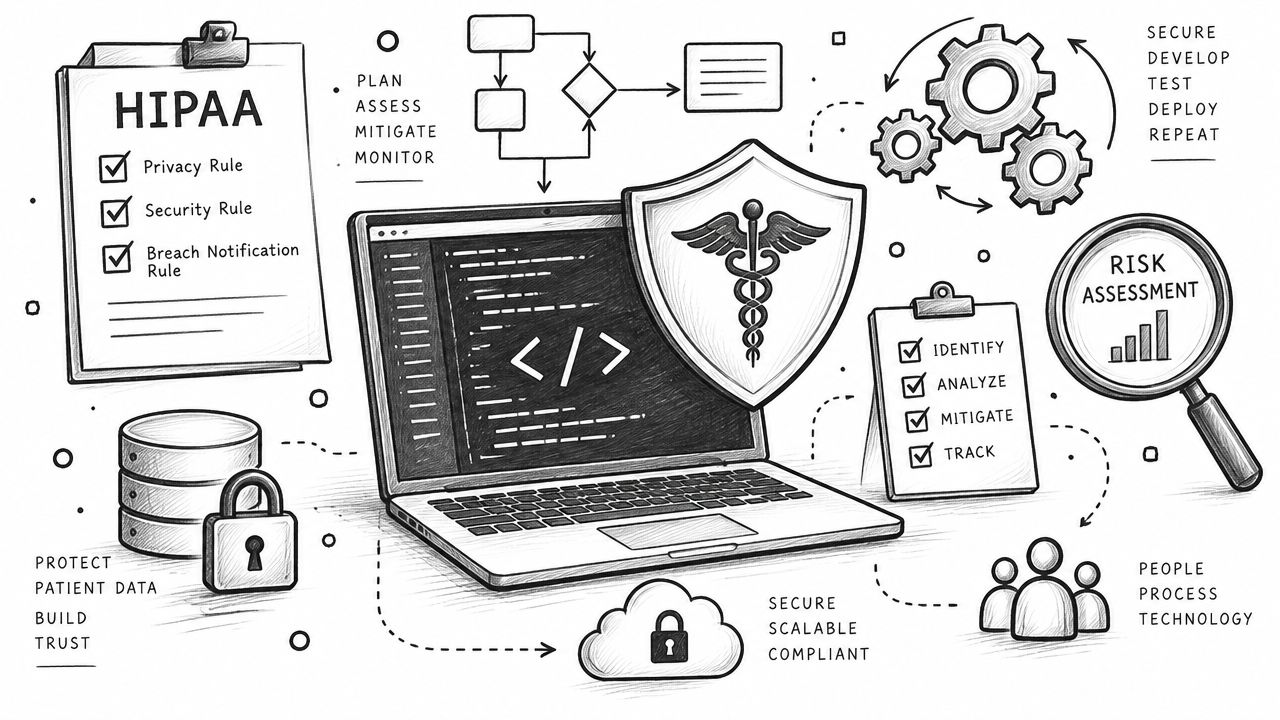
Learn HIPAA compliance for software development with practical guidance on safeguards, risk assessments, audit logging, and breach response built into the SDLC.

Learn what AI transformation healthcare industry means, from EHR integration to governance, ROI, and adoption roadmap for healthtech leaders.
Connect with our team to explore how AI expertise can transform your business.