
AI in Healthcare
HIPAA-Compliant AI: How to Use LLMs With PHI Safely
How to build HIPAA-compliant AI: when LLM providers need a BAA, data minimization, de-identification, audit controls and a reference architecture.
October 16, 2026Read more
AI adoption in healthcare is accelerating, bringing new opportunities and challenges. Explore key trends, barriers, and how organizations can unlock value while improving patient care and outcomes.
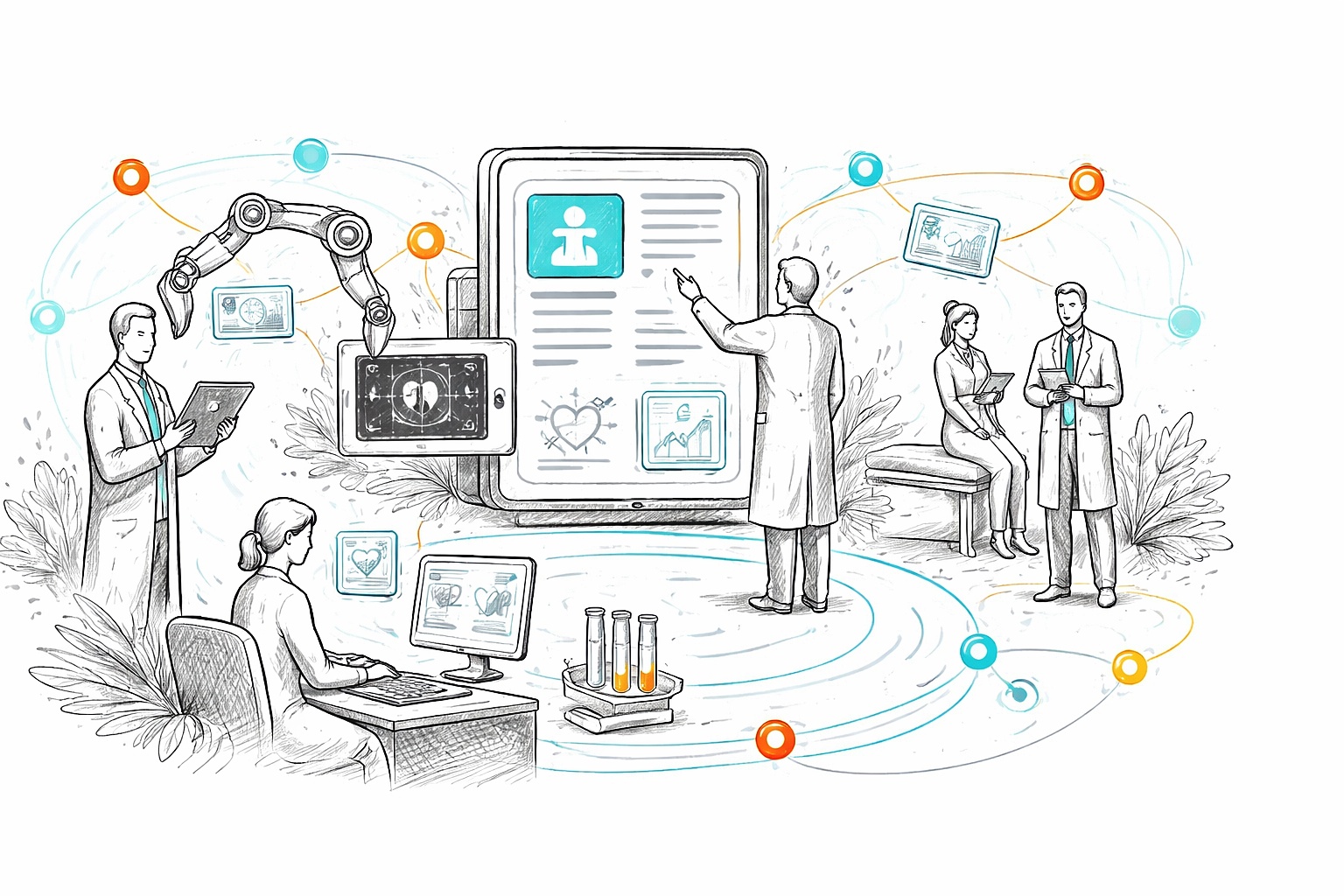
Healthcare systems face increasing pressure. They must manage growing amounts of data, deliver faster diagnoses, and run operations more efficiently. Artificial intelligence is shaping this change by bringing data-driven insights, automation, and precision into clinical and administrative work. AI adoption in healthcare today marks a shift where technology is becoming part of everyday medical practice.
Hospitals and health systems are searching for new ways to improve care delivery and fix inefficiencies. This growing interest shows we need to understand where adoption stands right now, what challenges are slowing progress, and what opportunities lie ahead. This blog covers current adoption levels, key trends, challenges, benefits, and future opportunities shaping AI in healthcare.
AI adoption in healthcare organisations is growing, but most are still in the early or middle stages of maturity. Many institutions are testing solutions through pilot programmes and controlled settings, often with guidance from a healthtech engineering partner. Full-scale deployment remains limited because of operational and technical challenges.
Adoption levels vary widely depending on organisation size, available budgets, and digital readiness. Larger institutions usually have the resources to explore advanced solutions, while smaller providers take a more careful approach. Interest runs high across the industry, and execution keeps improving as organisations gain clarity and hands-on experience.

AI is changing how diagnoses work. AI improves accuracy in medical imaging and early disease detection. Advanced models examine complex datasets and find patterns that traditional analysis often overlooks. This leads to faster diagnosis and stronger clinical results.
Administrative workload remains a big challenge in healthcare. AI automation services handle scheduling, billing, and documentation with greater ease. This shift reduces manual work and gives staff more time for patient care. This shift reduces manual work and frees up more time for patient care.
Predictive analytics is gaining ground as healthcare providers focus on proactive care. AI systems examine patient data to predict risks and guide treatment choices. This approach supports early intervention and improves long-term health outcomes.
Virtual assistants improve how patients interact with healthcare providers. They respond fast and stay engaged with patients throughout the conversation. These tools help with appointment scheduling, basic questions, and follow-ups, creating a smoother experience for patients.
Connecting AI with electronic health records makes data easier to access and improves coordination across departments. AI workflow automation strengthens data flow, so patient information becomes more organised and useful. This integration sharpens decision-making across clinical teams.
AI brings precision to diagnosis by examining large amounts of clinical data with steady consistency. This lowers the risk of missing important signs and strengthens treatment planning. Many healthcare AI services already contribute to more dependable diagnostic processes.
Quick decisions matter a great deal in healthcare. AI-driven systems process data rapidly and present clear, useful insights, which reduces delays in treatment. This improves response times in both emergency care and routine situations.
Hospitals face constant pressure to use resources well. AI implementation support plays a key part in smoothing out workflows, reducing blockages, and raising overall efficiency across departments.
AI adoption leads to long-term cost savings. AI reduces manual tasks, distributes resources more effectively, and decreases operational waste. A well-planned custom AI strategy report gives direction for sustainably managing costs.
AI makes the patient experience better. It improves communication, shortens wait times, and tailors care to each person. Tools like chatbots and digital assistants create smoother interactions between patients and providers.
Healthcare data holds very sensitive patient information. This includes medical history, diagnostic reports, and personal identification details. Any misuse or leak of this data can lead to serious trouble, such as losing patient trust and facing legal problems. AI systems require vast amounts of data to function properly. The risk of exposure grows when proper safeguards are absent. Organisations must follow strict data governance policies, put strong security measures in place, and comply with privacy laws to keep information confidential. In many cases, unclear data ownership and sharing rules also make healthcare providers hesitate, which slows down AI adoption.
Successfully adopting AI in healthcare depends heavily on skilled professionals who understand both technology and medical workflows. Demand is rising for experts in data science, machine learning, and healthcare informatics, but the supply remains low. Many healthcare organisations struggle to find people who can design, deploy, and manage AI solutions effectively. This gap often causes delays in implementation and reduces the efficiency of existing systems. In addition, training current staff to work with AI tools takes time, money, and structured learning programmes, which many institutions are still building.
Many healthcare institutions still run on legacy systems that were never built to work with modern AI technologies. These outdated systems often lack the flexibility needed for smooth integration, leading to compatibility problems and isolated data silos. When AI tools come in, organisations face challenges connecting them with existing electronic health records and operational systems. This creates disruptions in workflow and limits how well AI applications can perform. Upgrading or replacing old infrastructure takes careful planning and significant investment, which further slows down the entire adoption process.
The financial investment required for AI adoption can be a major barrier, especially for small and mid-sized healthcare providers. Costs include infrastructure upgrades, software development, data management, and hiring skilled professionals. On top of that, there are ongoing expenses for system maintenance, updates, and monitoring. Many organisations find it hard to justify these costs without clear and immediate returns. Since AI projects often take time to show measurable results, decision makers tend to move carefully. They focus on smaller pilot programmes before committing to large-scale implementation.
Healthcare follows some of the strictest rules of any industry. Any new technology must meet strict standards and guidelines. AI solutions, including SaMD solutions, must satisfy regulatory requirements for safety, accuracy, and data protection before they can be widely adopted. This is especially critical for solutions used in diagnosis and treatment, where errors can carry serious consequences. The approval process can be complex and time-consuming, which creates delays in deployment. Organisations must also stay current with changing regulations, and this adds another layer of difficulty to AI implementation.
Trust remains a critical factor when adopting AI in healthcare. Clinicians need to understand how AI systems reach their conclusions before they can rely on them in real-world situations. Many AI models operate like black boxes, where the decision-making process is not easy to explain. This lack of transparency makes healthcare professionals hesitate, because they are responsible for patient outcomes. Clear, easy-to-understand insights and well-defined AI use cases are necessary to build confidence and encourage adoption. When clinicians trust the system, they are more likely to bring AI into their daily work.
AI adoption will likely expand across hospitals, clinics, and research institutions. More organisations are now partnering with a healthtech engineering partner to build solutions that can grow and perform reliably.
AI is advancing personalised medicine by studying patient-specific data and shaping treatment plans to fit each person. This leads to more accurate and effective care strategies.
Preventive care is becoming more important as healthcare moves from reactive to proactive models. AI systems spot early warning signs and guide timely action before problems get worse.
AI strengthens clinical decision support by offering recommendations based on real data. This gives healthcare professionals a stronger foundation for making informed choices.
AI improves resource distribution by examining patient flow, staff requirements, and operational demands. This leads to more efficient use of hospital resources and better service delivery.
AI continues to reshape healthcare as more systems adopt it, though full maturity remains a work in progress. The current state of AI adoption in healthcare shows both forward movement and real obstacles. Benefits like better accuracy, faster decisions, and smoother operations are clear. Challenges tied to cost, integration, and trust need focused attention. Contact us to learn how organisations can take practical steps toward responsible AI adoption. Healthcare organisations that adopt AI wisely today will shape the future of patient care.
AI adoption in healthcare refers to using AI technologies to improve efficiency, accuracy, and patient outcomes through various AI use cases.
Healthcare AI services enable AI workflow automation and AI automation services to streamline operations and enhance clinical decision-making.
A healthtech engineering partner provides AI implementation support and ensures smooth integration of SaMD solutions into healthcare systems.
A custom AI strategy report helps identify the right AI use cases and guides successful AI adoption in healthcare organizations.
AI workflow automation reduces manual tasks, improves efficiency, and supports AI adoption in healthcare through smarter process management.
How to build HIPAA-compliant AI: when LLM providers need a BAA, data minimization, de-identification, audit controls and a reference architecture.

Practical data migration planning guide for healthcare teams. Scope, mapping, compliance, validation, cutover and rollback decisions explained end to end.

Smart on FHIR guide for healthtech engineers. Learn the OAuth 2.0 launch model, scope syntax, backend services, and US regulatory requirements.
Connect with our team to explore how AI expertise can transform your business.