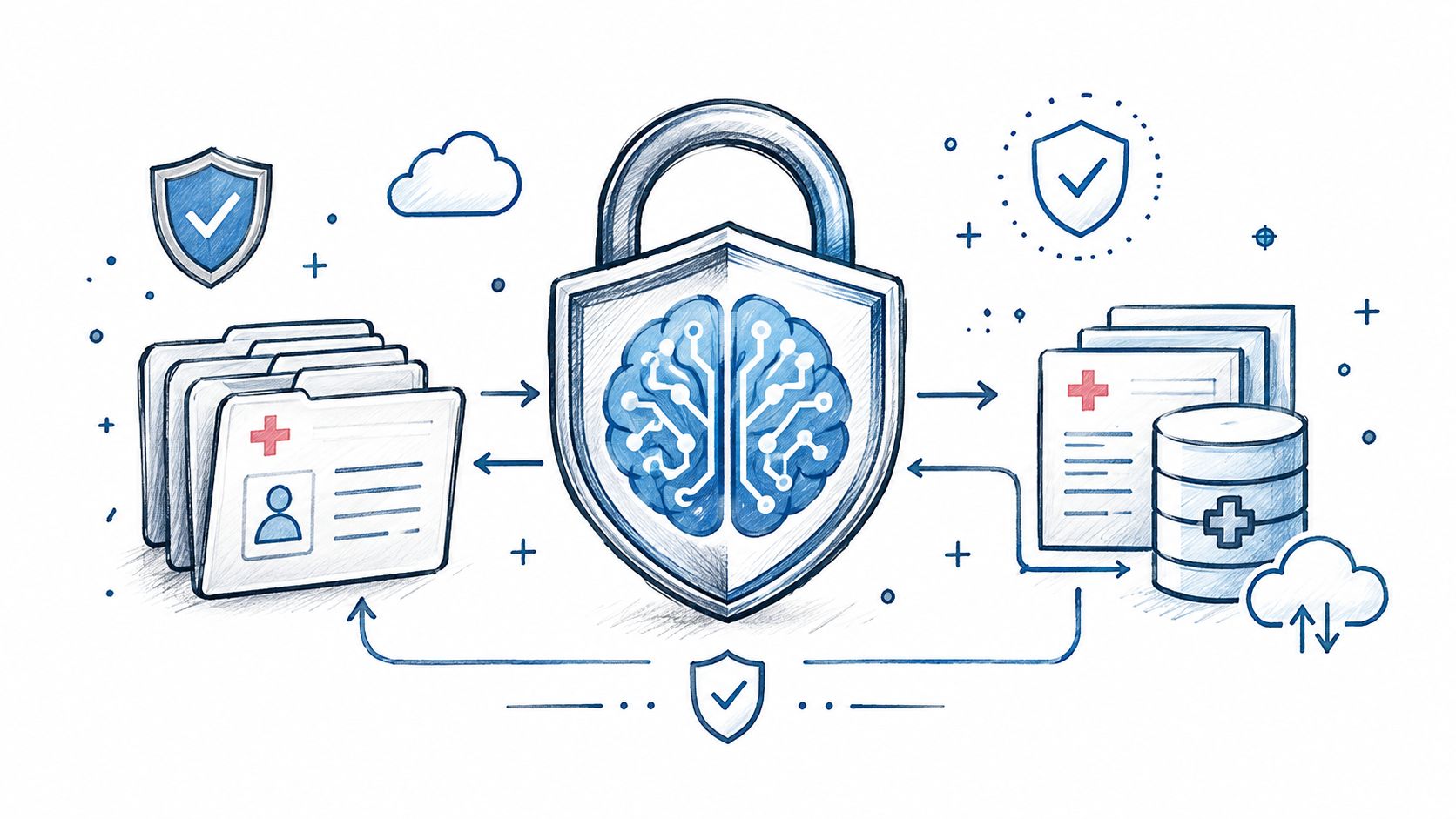
AI in Healthcare
HIPAA-Compliant AI: How to Use LLMs With PHI Safely
How to build HIPAA-compliant AI: when LLM providers need a BAA, data minimization, de-identification, audit controls and a reference architecture.
October 16, 2026Read more
Discover how value based care technology improves outcomes, lowers costs, and enables AI-driven care for HealthTech leaders.

Value based care technology has moved from a niche care model accessory to core operating infrastructure. McKinsey estimates that about 160 million total lives sit in value-based care arrangements across roughly $1.6–$1.7 trillion in medical spend, and the ecosystem has already created about $500 billion in enterprise value with room to reach $1 trillion as the market matures (McKinsey). That scale changes the buying conversation. Providers and payers aren't choosing dashboards for convenience anymore, they're building the systems that carry risk, coordination, and outcomes measurement across entire populations.
The organizations that succeed in this environment don't just buy software. They wire together data, workflows, governance, and reimbursement logic so the platform can survive real-world care delivery. That's the difference between a pilot that looks good in a steering committee and an operating layer that supports contracts in production.

Value based care technology now sits inside the operating model, not beside it. Health systems, physician groups, and payers use it to manage risk across attributed populations, coordinate work across settings, and track whether outcomes are improving in ways that matter to the contract. The model is built around payment for outcomes rather than volume, so data flow, staffing, and financial reconciliation all change at once (Commonwealth Fund).
The buying signal is also different from what it was a few years ago. Capital has moved toward value-based care because investors now see it as durable infrastructure, not a reimbursement pilot, and that changes how providers and payers evaluate the stack (McKinsey). The question is no longer whether the category will matter. It is whether the platform can support risk contracts, care coordination, and outcomes reporting under live operational pressure.
The economics make the operational stakes harder to ignore. McKinsey's analysis puts potential savings at 3% to 20% of medical spend depending on the model (McKinsey). That range explains why teams now treat data integration, care management workflows, and performance analytics as core operating capabilities. If the platform cannot surface care gaps, identify risk, and reconcile contract performance quickly, the financial case weakens fast.
For health systems and physician groups managing risk, the practical test is whether the software reduces friction in daily operations, not whether it adds another dashboard. Teams evaluating healthcare operations platforms for risk-bearing provider organizations need systems that support measurement, workflow, and accountability in the same environment. In production, that usually means fewer handoffs, cleaner data, and faster action on patients who need intervention.
Practical rule: if a platform cannot support measurement, workflow, and accountability in the same environment, it is probably a point solution, not value based care infrastructure.

The stack starts with EHR interoperability and standardized data definitions, because outcome-based contracts depend on comparing cost against measurable clinical results, not just counting visits. Academic review literature on VBHC points to a patient-centric, cross-continuum data model with standardized metrics as the foundation for data interchange, quality measurement, care coordination, and reimbursement rules (PMC review). If diagnosis codes, labs, measures, and hospitalizations don't line up cleanly, every downstream layer inherits the mess.
From there, the platform needs analytics and risk stratification. That layer tells care teams who is drifting, who is likely to miss follow-up, and where intervention is most likely to change the trajectory. Remote monitoring and telehealth extend that visibility between visits, while care management workflows turn signals into assigned tasks that someone can complete. If you want a practical overview of the remote side of the stack, Qaly's remote heart monitoring is a useful reference point for how ongoing data capture fits into care delivery.
The remaining layers complete the operating model:
The stack fails when teams buy these pieces separately and expect integration to happen later. It usually doesn't.
That's why architecture decisions matter as much as product selection. A unified platform reduces handoffs, but only if the underlying data model is stable enough to support the full care-and-payment loop.
For teams building this layer, an AI-based extraction workflow can help reduce manual chart work and normalize incoming data faster. One example is the AI-powered data extraction engine, which fits naturally into intake, abstraction, and documentation-heavy environments where structured data is still incomplete.
In value based care, the metric problem is bigger than the dashboard problem. You can't prove contract performance with generic activity counts if the agreement is anchored to outcomes and total cost of care. The measures that show up repeatedly in the literature are concrete, including 30-day mortality, 1-year mortality, and 30-day readmissions across cardiovascular care, orthopedic surgery, oncological surgery, and cancer care (systematic review). Those metrics give you a clean way to connect platform behavior to clinical performance.
The commercial side matters just as much. A 2026 Journal of Medical Internet Research article reports that AI-enabled value-based care can reduce episode costs by about 20% under favorable implementation conditions, and it also cites a bundled payment example where Care for Joint Replacement hospitals reduced episode payments by an average of $1,012 per joint replacement and $1,171 per elective replacement versus fee-for-service hospitals while maintaining quality outcomes (JMIR). That's the kind of evidence finance teams understand because it ties technology-enabled process control to paid episodes, not abstract efficiency.
| Technology Component | Primary KPIs | Measurement Approach |
|---|---|---|
| EHR interoperability | Data completeness, measure capture, closed-loop referrals | Audit data flow across systems and reconcile missing fields |
| Analytics and risk stratification | High-risk patient identification, gap closure, avoidable utilization | Compare flagged cohorts against actual downstream outcomes |
| Remote monitoring | Escalation timeliness, adherence, episode stability | Track alerts, outreach completion, and trend changes |
| Telehealth | Follow-up completion, no-show reduction, access continuity | Measure kept visits and post-discharge touchpoints |
| Care management workflows | Task closure, outreach speed, care-plan adherence | Review task aging and unresolved work queues |
| Patient engagement | Response rates, self-management participation, portal activity | Monitor patient actions tied to specific interventions |
| Financial reconciliation | Attribution accuracy, claim alignment, payment variance | Compare contract logic to adjudicated results |
| Reporting and compliance | Submission accuracy, audit readiness, measure timeliness | Validate report integrity against source records |
The best KPI frameworks do one thing well. They make it obvious whether a technology change altered care delivery, contract performance, or both. If a platform can't show that connection, it's producing activity, not operating advantage.
Buying the right tools does not guarantee scale. Analysts at Mathematica found that organizations were widely using AI, usage had increased across providers and payers, and nearly everyone treated AI as important, yet commitment and oversight lagged behind day-to-day adoption. Their report shows the gap clearly. Technology is arriving faster than the operating model can absorb it.
The problem is operational maturity, not model availability. Mathematica reported that many providers and payers still find their platforms too complex for effective use, even while they rate cross-system data integration highly. That combination shows up in production all the time. Systems connect on paper, but the workflow still breaks at handoffs, exception handling stays manual, and users are left to act like integration specialists instead of care operators.
A lot of VBC programs fail for a simple reason. They optimize for feature breadth instead of operational clarity.
What works in practice: fewer handoffs, fewer duplicate fields, and explicit ownership for every AI-generated output.
That governance layer matters even more because many organizations still do not have enough staff training to support the tooling they have already deployed. The operational side also needs a way to connect evidence, economics, and implementation decisions without getting lost in vendor language, and master your HEOR analysis is a useful reference point for that kind of work. In practice, that means defining who reviews outputs, what gets escalated, and which workflows are allowed to move without human review.
The best teams stop asking what else a platform can do and start asking what work it removes, who handles the exceptions, and how they know the output is safe. That is the difference between a polished deployment and a system that changes contract performance. The technology can be right and still fail if the operating rules are weak.
A realistic rollout starts with a hard inventory of current state. One provider network I worked with had three separate sources for attribution, two ways to identify rising-risk patients, and no agreed definition for a closed care gap. Their first move wasn't model training. It was data reconciliation, because nobody trusted the numbers enough to use them in a contract review. That kind of reset is boring, but it's usually where the work has to start.
The cleanest roadmap has four phases.

Start by mapping contract requirements, source systems, and manual workarounds. The goal is to identify which data elements matter for attribution, quality, utilization, and payment reconciliation, then establish the minimum shared definitions that every team will use. If the organization can't agree on those terms, the technology won't save it.
Run one workflow end to end, usually a narrow population or a single contract line. This involves data integration, staff training, and exception handling getting tested under real conditions. The question isn't whether the pilot looks efficient in a demo. It's whether people can close the loop without constant engineering support.
Once the workflow is stable, expand the population and tighten the governance layer. Add review checkpoints for AI outputs, and assign owners for data quality, clinical escalation, and payment variance. If a control fails here, the issue usually isn't the model. It's the absence of operational discipline.
At this stage, the platform should support continuous improvement, not just monitoring. That means using contract results, user feedback, and exceptions to refine workflows. For teams that need implementation support around systems design and rollout discipline, AI Product Development Workflow is a relevant internal reference point.
The strongest governance frameworks don't slow delivery. They make scale possible because teams know who approves what, what gets escalated, and where the source of truth lives.
A vendor should be judged on execution, not presentation quality. If it cannot explain how it handles interoperability, exception management, staff adoption, and the handoff from analytics to day-to-day work, it is not ready for a live risk contract. That gap shows up early in production, especially in organizations trying to connect platform adoption with actual contract performance, as TechTarget summary reported in its discussion of underrepresented populations and uneven model participation.
A practical evaluation split is simple.
| Execution Readiness | Strategic AI Approach |
|---|---|
| Proven implementation methodology | AI augmentation vs. automation roadmap |
| Demonstrated health system references | Bias mitigation and governance plan |
| Transparent total cost of ownership | Continuous learning infrastructure |
The table is useful because it separates delivery risk from AI ambition. A partner can have a credible roadmap and still fail in production if the implementation team cannot align interfaces, training, exception routing, and ownership for bad data. The reverse also happens. Some vendors know integration well but have no answer for how AI outputs are reviewed, corrected, and monitored once clinicians and care managers start relying on them.
A strong partner also needs to understand regulatory and clinical boundaries. If your organization needs a regulatory compliance partner, that capability should be explicit, not implied. The same goes for build-versus-buy decisions. Some teams need custom healthcare software development, others need workflow design, and others need a mix of integration and analytics support. The point is to match the operating model to the contract portfolio, not to buy the flashiest feature set.
The equity question belongs in vendor review too. TechTarget's summary of a JAMA Network Open-based analysis found CMS model participants were disproportionately White, urban or suburban, and higher-income, with White beneficiaries making up 83.3% of participants, while Black beneficiaries were underrepresented by about 34%, Hispanic beneficiaries by 57%, and rural beneficiaries by about 57% (TechTarget summary). That means a platform tuned for the easiest populations may not hold up in safety-net settings, rural markets, or dual-eligible groups where documentation gaps, referral leakage, and manual review are part of normal operations.
A good partner should be able to show how its workflow behaves when data is messy, populations are diverse, and manual review is unavoidable. Ask for the failure modes, not just the happy path. Show me how exceptions are queued, who resolves them, what gets logged, and how AI decisions are overridden when the model is wrong. If a vendor cannot answer those questions clearly, it is not a value based care platform. It is a demo.
The next competitive advantage in value based care won't come from collecting more data. It'll come from turning that data into governed action at the point where clinical work, financial risk, and equity intersect. The organizations that win will be the ones that simplify workflows, operationalize AI safely, and build platforms that function across different populations instead of only the easiest-to-manage cohorts.
That also changes what “good” looks like in the market. Buyers will care less about isolated feature sets and more about whether a system can integrate cleanly, explain its decisions, and support the people who have to use it every day. AI governance, data quality, and workflow discipline will matter more than another dashboard layer.
The platform strategy is becoming clearer. Build for interoperability. Design for exception handling. Measure outcomes that matter to the contract. Then make sure the tools fit the way clinicians, care managers, and finance teams work in production.
If your team is trying to move from pilots to durable value based care operations, Ekipa AI helps healthtech organizations with platform design, AI workflow implementation, and healthcare system integration. Visit Ekipa AI to discuss how that kind of execution support can help turn your VBC roadmap into a working operating model, and connect with our expert team when you're ready to pressure-test the architecture.
How to build HIPAA-compliant AI: when LLM providers need a BAA, data minimization, de-identification, audit controls and a reference architecture.
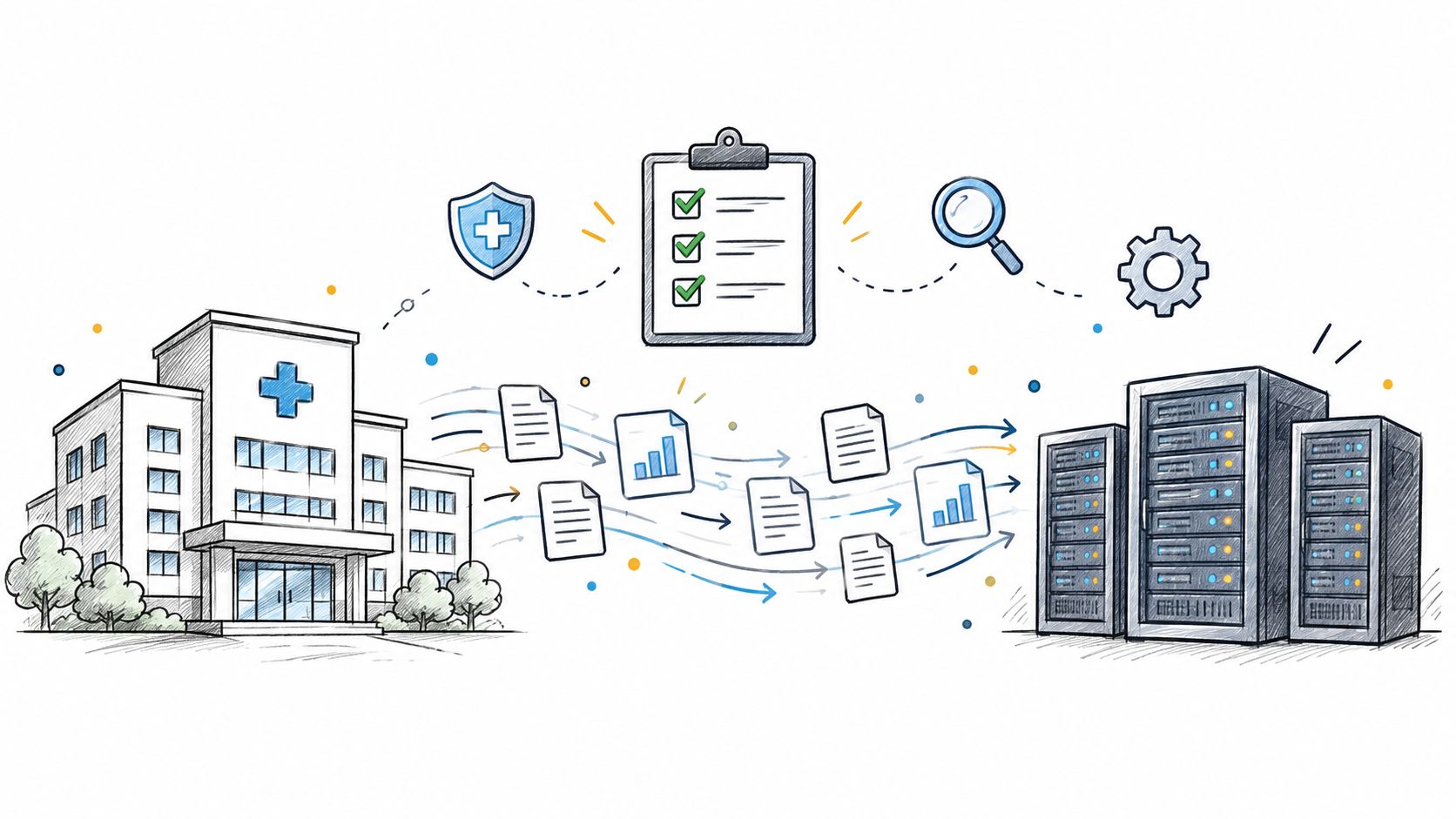
Practical data migration planning guide for healthcare teams. Scope, mapping, compliance, validation, cutover and rollback decisions explained end to end.
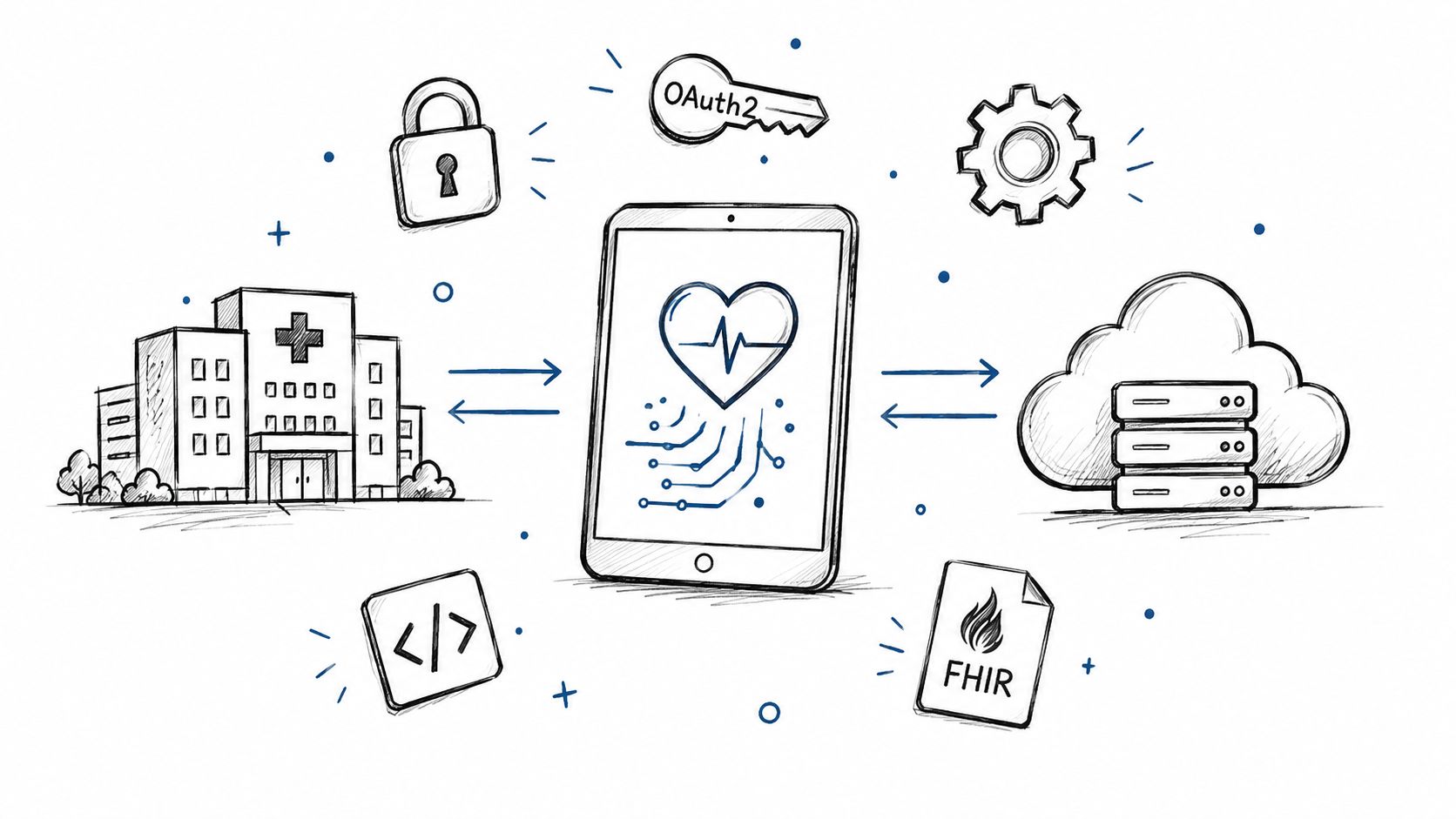
Smart on FHIR guide for healthtech engineers. Learn the OAuth 2.0 launch model, scope syntax, backend services, and US regulatory requirements.
Connect with our team to explore how AI expertise can transform your business.