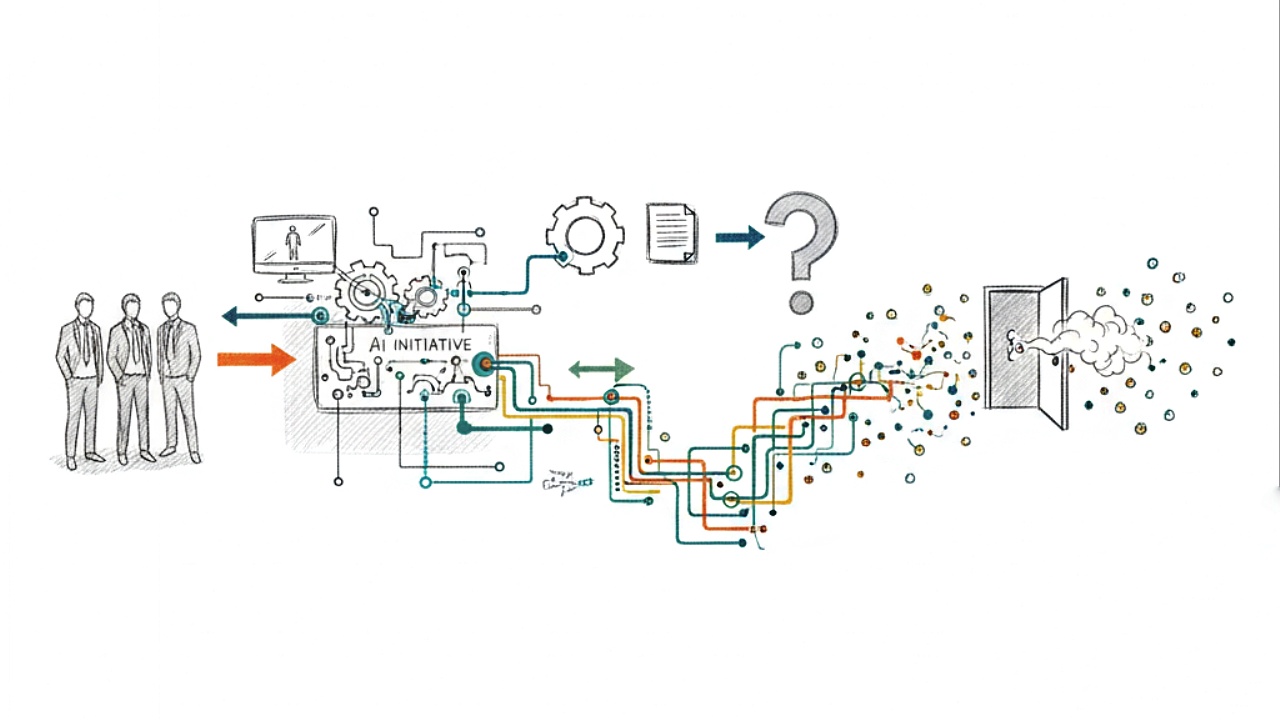
Many business leaders invest resources in AI with high hopes for a significant return. The plans are promising, the early tests look great, and the demonstrations earn genuine excitement. Yet, months later, those very projects have often stalled without a sound. There is no official termination or decisive meeting to end things. Budgets gradually shrink, team members move on to new tasks, and the initiative quietly fades away. This pattern repeats frequently. It originates from hidden flaws in planning, collaboration, and execution, often hidden behind technical progress reports.
The Illusion of Progress in Enterprise AI
In many AI projects, the early stages feel promising. Teams successfully train models, construct data pipelines, and see proofs of concept work well in tests. On the surface, all signs point to steady forward momentum. The real trouble begins when this technical progress fails to integrate into the actual work of the business.
Companies adopt AI Solutions without a clear view of how the results will become part of a team's daily routine. If the insights generated do not help people make clearer decisions or take useful action, engagement falls. The system may continue to operate, but its real value stays low. Gradually, leaders pay less attention to what it achieves, and the project fades into the background without fanfare.
Strategy Gaps That Lead To Quiet Failure
A clear plan guides every successful AI project. Without it, teams focus more on trying new things than on delivering real results. This is a key area where AI strategy consulting plays an important role. Unfortunately, this guidance is often requested too late or treated as a formality.
These projects can launch without agreed-upon goals or a clear owner. On one side, business teams hope for change. On the other hand, technical teams concentrate on perfecting the model's performance. This disconnect leads to confusion. When the final product fails to meet business expectations, the project does not end with a dramatic failure. Instead, it loses momentum, adding to the list of silent AI failures within the company.
When Use Cases Lack Real Business Weight
AI succeeds when it solves a clear and present problem. Too often, organizations choose AI use cases because they sound advanced, rather than because they address a genuine business need. These projects may look good on a slide, but they bring little actual value to the work floor.
When employees see outputs that do not connect to their daily struggles, they hesitate to trust or use them. Adoption slows, feedback fades, and the tool remains largely untouched. Without genuine user engagement, even a perfectly built model loses its purpose. The system may stay switched on, but its impact disappears without a sound.
The Missing Link Between Build and Scale

Getting an AI project from a test phase to full operation is a major hurdle. A skilled AI implementation partner can lead this change. Yet companies often rely solely on internal teams, which may lack the specific experience needed when automation becomes part of daily work routines.
Problems arise when new AI must work with old company systems. Security checks drag on past deadlines. Real-world use shows that the model is not ready. Faced with these barriers, teams often postpone hard decisions. The project remains stuck in testing, paused between failure and success with no clear way forward.
Are Reports Replacing Real Execution?
Companies often ask for detailed reports to support their investment in AI. A custom AI strategy report can be created, full of sharp observations and proposed steps. But these documents, by themselves, cannot create movement.
If leaders view a report as the ultimate goal, the drive to act loses its momentum. Teams then shift their attention to the next new project, and the report's advice goes unread. The AI project remains unfinished, with no single person responsible for driving it forward.
Capability Without Organizational Alignment
Organizations can sometimes think they are ready for AI before they truly are. An AI maturity model may rank them highly because they possess the right software and data. However, the company culture and daily processes might still not be prepared.
Skipping a frank AI readiness assessment leaves skill gaps and unclear leadership roles hidden. Teams work around problems quietly, changing their own work to fit the AI instead of letting it help them. The system becomes just another piece of software in the background, not a true force for improvement.
Execution That Fades Over Time
A strong AI adoption roadmap outlines phases, responsibilities, and timelines. The problem arises when that document is filed away and never looked at again. Business needs evolve, team members come and go, and deadlines start to slip away.
Without check-ins to update it, the roadmap no longer reflects reality. AI projects gradually move away from their initial purpose. No one announces an end, but forward movement comes to a standstill. This gradual, unannounced stall is what defines silent AI failures in large companies.
Governance and Accountability Gaps
Clear oversight keeps AI work connected to business results. Many companies lack a defined system for this, which spreads responsibility too thin. Decision-making becomes slow, and accountability weakens.
Conversations in the field about enterprise AI governance reveal how a solid oversight framework builds long-term AI value. Without this structure, projects struggle to continue after the first excitement fades.
Conclusion
AI projects rarely fail just because the technology is wrong. They lose steam when the plan, the people, and the daily work do not pull in the same direction. Silent AI failures occur when people measure busy work and not real results. Companies that want real value need to connect their plan with real action, bring teams into the process from the start, and regularly check their goals. If your own efforts feel stuck, it is a good moment to step back, adjust your focus, and move forward. Contact us to get started.
FAQ
1. What Are Silent AI Failures?
Silent AI failures occur when AI projects stall quietly despite early technical success, failing to deliver real business impact.
2. How Can AI Solutions Prevent Silent Failures?
Effective AI Solutions integrate with daily workflows, align with team needs, and support measurable outcomes to avoid quiet project stalls.
3. Why Is AI Strategy Consulting Important?
AI strategy consulting helps define clear goals, select the right AI use cases, and create actionable plans to reduce silent AI failures.
4. How Do AI Readiness Assessments and AI Maturity Models Help?
An AI readiness assessment identifies skill gaps and system preparedness, while an AI maturity model guides organizations toward sustainable adoption.
5. What Role Does an AI Implementation Partner Play?
An AI implementation partner ensures smooth deployment, aligns projects with business needs, and helps execute the AI adoption roadmap effectively.