
AI in Healthcare
HIPAA-Compliant AI: How to Use LLMs With PHI Safely
How to build HIPAA-compliant AI: when LLM providers need a BAA, data minimization, de-identification, audit controls and a reference architecture.
October 16, 2026Read more
Many AI pilots in healthcare fail to scale due to poor integration, unclear ROI, and weak operational planning. Learn how to design AI initiatives for sustainable, enterprise-wide impact.
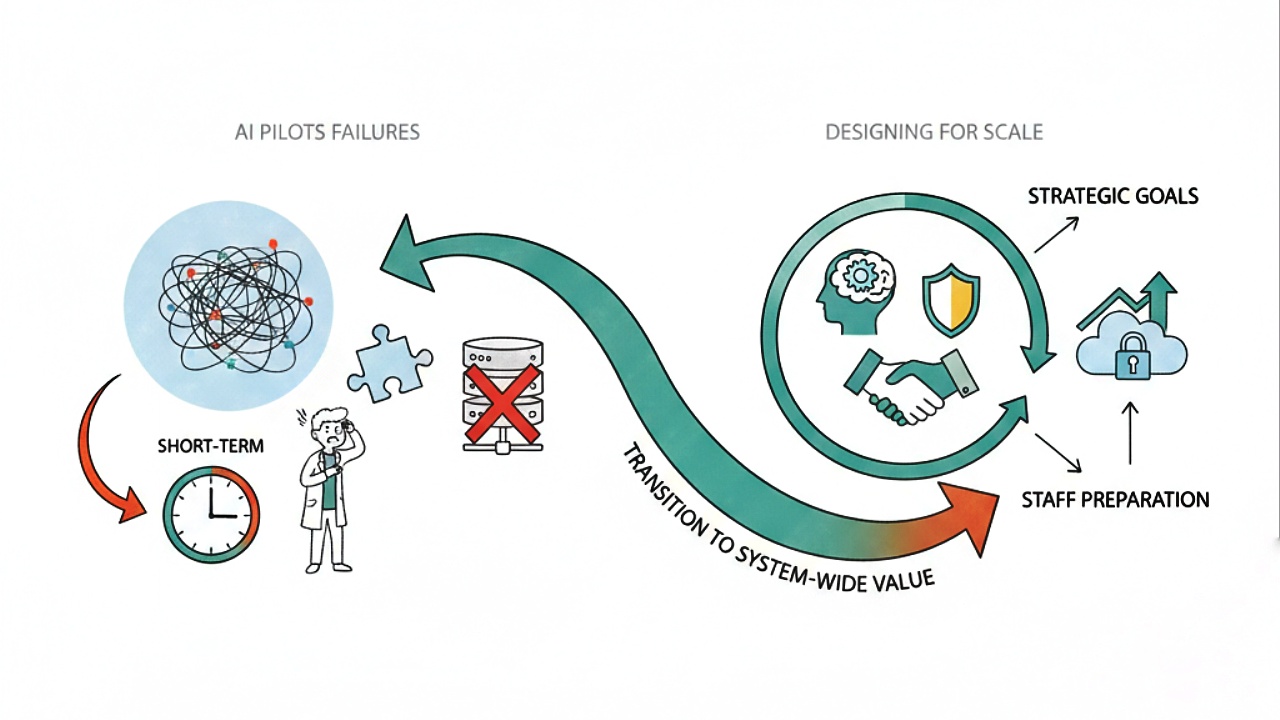
AI holds a simple promise for healthcare, offering a path to advance patient outcomes, streamline operations, and assist clinical decisions. Organizations often dedicate significant resources to initial AI test projects, known as pilots, with the hope of quick and visible returns. A common story emerges where these pilots struggle to move beyond the testing phase into widespread, practical use. Recognizing the typical reasons for this disconnect and learning how to build projects with growth in mind can protect investments and unlock genuine, system-wide value.
Many AI pilots take their first steps without a map for where they are going. Without specific goals, tracking progress is difficult. This makes it hard to show concrete results. Some projects become more about trying a new technology than fixing a real problem in patient care or hospital work. Defining clear AI use cases that tackle a direct clinical or operational need keeps the pilot grounded and purposeful.
Healthcare data is complex, scattered, and protected. AI projects need information that is clean, uniform, and complete. An AI pilot failure in healthcare often occurs when teams fail to account for the work required to prepare, connect, and manage data. Investing in healthcare AI services skilled in secure data handling and initial processing can make a real difference in a pilot's outcome.
AI pilots often run alone, disconnected from daily hospital routines and existing computer systems. When they do not connect smoothly with electronic health records, lab systems, or patient management tools, people are less likely to use them. Choosing an AI implementation partner with a background in healthcare technology can fit these AI solutions into everyday work.
Many pilots are viewed as short-term tests, not the start of a lasting solution. A project that works in one small area can struggle when asked to expand across many departments. Starting with a complete AI adoption roadmap creates a growth plan. This means a successful pilot can transition to wider use more smoothly.

Projects that link AI initiatives to broader organizational goals achieve more. Setting clear goals, expected results, and progress metrics guides the design of a pilot. It also provides a standard to judge future growth. Working with AI strategy consulting services allows healthcare teams to align their AI plans with operational priorities and patient care needs.
The success of any AI project depends on the quality, availability, and safety of its data. Building strong methods for data cleaning, connection, and control forms a necessary base. Organizations can gain value from a custom AI strategy report to review their existing data systems and preparedness for AI deployment.
Healthcare operates under firm guidelines, and AI projects must address all privacy and compliance requirements. Building governance frameworks that manage ethical questions, regulatory needs, and risk supports trust and use within an organization while laying the foundation for trustworthy AI systems. An AI maturity model identifies gaps and measures progress toward AI solutions that can grow.
The most advanced AI solution will not work if staff lack training or if daily routines remain unchanged. Moving to a larger scale requires education, change management, and integration into existing clinical processes. An AI readiness assessment provides a clear view of an organization's preparedness and highlights areas that need attention before expansion.
Finding projects with a strong impact and realistic execution is very important. AI pilots should concentrate on areas where the technology can show clear progress. This could include predictive analysis for patient outcomes, workflow automation, or diagnostic support. Focusing on these important solutions means resources are used wisely. This approach also creates solid results that can support a larger rollout.
Healthcare organizations can gain a clear advantage by partnering with experts who specialize in AI deployment. Partnering with an AI implementation partner can provide practical skills, project management, and a clear understanding of the healthcare field. This outside view makes certain pilots are built for practical use and lasting growth.
An AI pilot failure in healthcare often stems from unclear goals, data challenges, poor integration, and short-term thinking. Designing AI projects for growth from the start makes a difference. This involves linking them to broader organizational goals and applying expert support. This approach can turn a small pilot into a broad, effective solution. Contact us to discuss how planned AI design and healthcare AI services can advance a path to effective AI adoption.
AI pilot failures in healthcare typically result from unclear objectives, inadequate data preparation, poor integration, and a lack of long-term planning.
Healthcare AI services strengthen data management, compliance, and workflow integration to ensure AI Solutions move beyond small-scale testing.
Well-defined AI use cases focus efforts on real clinical or operational problems, improving outcomes and reducing wasted investment.
An AI readiness assessment and AI maturity model evaluate preparedness, governance gaps, and scalability before following an AI adoption roadmap.
AI strategy consulting provides direction through a custom AI strategy report, while an AI implementation partner ensures practical deployment and growth.
How to build HIPAA-compliant AI: when LLM providers need a BAA, data minimization, de-identification, audit controls and a reference architecture.

Practical data migration planning guide for healthcare teams. Scope, mapping, compliance, validation, cutover and rollback decisions explained end to end.

Smart on FHIR guide for healthtech engineers. Learn the OAuth 2.0 launch model, scope syntax, backend services, and US regulatory requirements.
Connect with our team to explore how AI expertise can transform your business.