
AI in Healthcare
HIPAA-Compliant AI: How to Use LLMs With PHI Safely
How to build HIPAA-compliant AI: when LLM providers need a BAA, data minimization, de-identification, audit controls and a reference architecture.
October 16, 2026Read more
Uncover the critical reasons why healthcare AI projects fail. Learn to navigate data challenges, clinical adoption, and integration to achieve lasting success.

Healthcare AI projects often fall apart because of a toxic combination of bad data, pushback from clinicians, and brutal integration problems. The idea of AI-powered diagnostics is incredible, but projects often crash and burn because they skip the foundational work needed to connect the tech with how medicine is actually practiced.
The ambition behind artificial intelligence in medicine is massive. It promises to speed up diagnoses, customize treatments, and unburden overworked hospital staff. But the road from a great idea to a working solution is paved with expensive failures.
It's a tough pill to swallow, but a shocking number of projects—some say over 80%—never actually deliver. They just leave healthcare leaders feeling frustrated and watching their budgets shrink. The real reason why healthcare AI projects fail isn’t usually one big disaster, but a chain reaction of smaller, underestimated problems.
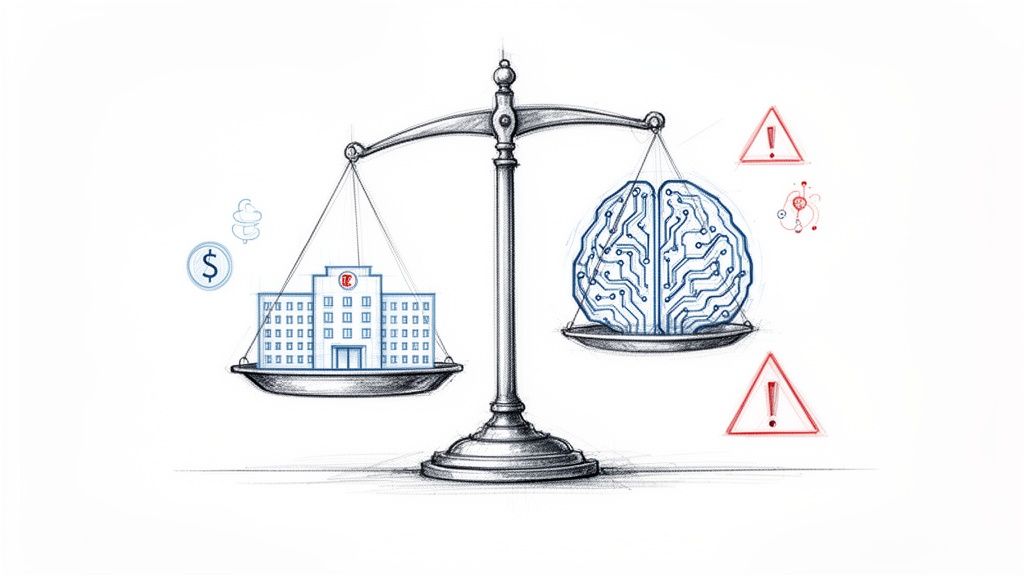
This guide gets real about this challenge. We’re cutting through the hype to give CEOs, CTOs, and operations leaders a clear, no-nonsense roadmap for navigating this tricky space.
Before we dive deep into each failure point, here’s a quick overview of the key culprits we’ll be exploring.
| Failure Point | Primary Cause | Impact On Project |
|---|---|---|
| Data Problems | Inconsistent, biased, or messy data sets | Skewed, unreliable model performance |
| Poor Governance | Lack of clear ownership and data standards | Inconsistent data quality and security risks |
| Clinical Adoption | Resistance from clinicians; workflow disruption | Low usage rates and zero real-world impact |
| Procurement Issues | Misaligned expectations between buyers and vendors | Purchasing a tool that doesn't solve the core problem |
| Integration Hurdles | Incompatibility with existing EMR/EHR systems | The AI tool remains a silo, unable to access data |
| Validation & ROI | Inability to prove clinical or financial value | Project gets defunded or is seen as a failure |
| Regulatory Maze | Navigating complex compliance (HIPAA, FDA) | Delays, legal risks, or complete project shutdown |
These are the major hurdles we see time and time again. Let’s start breaking down the biggest ones.
The vision is always so compelling: algorithms that spot cancer on a scan faster than a radiologist, or systems that predict which patients are likely to be readmitted. The reality on the ground, however, is a lot messier.
Here are the top three hurdles that turn promising ideas into cautionary tales:
The harsh truth is that successful AI in medicine requires more than just a smart algorithm. It demands a masterful blend of data science, clinical empathy, and deep technical integration—a balance that many organizations struggle to achieve on their own.
Getting past these obstacles isn't impossible, but it demands a specialized game plan. It means accepting the unique, complex nature of the medical field from day one. Working with experts who get both the technology and the clinical environment is a game-changer. This is where dedicated Healthcare AI Services can make all the difference, providing the focused expertise needed to build a strategy that actually works.
Imagine spending millions on a state-of-the-art skyscraper, only to erect it on a foundation of loose sand. It's a disaster waiting to happen. That’s precisely what many healthcare organizations do when they launch AI projects on a bedrock of poor-quality data. It's the number one silent killer of AI initiatives, turning promising ventures into expensive failures before they even get off the ground.
This isn't just some technical hurdle; it’s the strategic ground floor of your entire project.

Pouring resources into an AI model without first sorting out the underlying data is a recipe for disaster. It’s a harsh but unavoidable reality: an estimated 85% of AI models fail due to poor data quality, a problem that’s magnified tenfold in healthcare. Here, critical data is scattered everywhere—siloed in electronic health records (EHRs), labs, imaging archives, and billing platforms. It's a chaotic mess of inconsistent formats, gaps, outdated info, and hidden biases.
The consequence? Your shiny new model spits out biased or unsafe recommendations, instantly eroding clinician trust and opening the door to massive liability risks. For CEOs and CTOs, the lesson is painful but clear: skip the data readiness step, and your initiative will almost certainly join the scrap heap of failed projects. This is where a thorough AI requirements analysis acts as your first line of defense against a data-driven collapse.
Unlike other industries where data often lives in a neat, centralized system, healthcare data is a chaotic mosaic. A single patient's journey can create dozens of data points, each one trapped in a separate system that doesn’t talk to the others.
Just think about the data trail for one person:
Each system has its own language for labeling, formatting, and storing information. Trying to stitch it all together to train an AI model is like assembling a puzzle with pieces from a dozen different boxes. It’s a core challenge that our Healthcare AI Services are specifically designed to tackle head-on.
Beyond just being messy, healthcare data is frequently packed with hidden biases that can lead an AI model to make dangerously skewed predictions. If a training dataset is built primarily from one demographic, the resulting algorithm will inevitably perform poorly—or even make harmful mistakes—for underrepresented patient groups.
AI doesn't invent bias out of thin air; it simply amplifies the biases already lurking in the data it's fed. An algorithm trained on historical data will replicate historical inequalities in care, potentially making them even worse by baking them into automated, everyday systems.
For example, an algorithm trained on data from a wealthy, urban hospital might completely misdiagnose conditions common in patients from rural or lower-income areas. The AI isn't being malicious; it’s just reflecting the incomplete, skewed picture of the world it was shown. This is exactly why any solid AI strategy consulting engagement must start with a deep dive into data representation and fairness.
Treating data preparation as a simple IT checklist is a fundamental, and often fatal, misunderstanding. It’s a strategic imperative that demands a cross-functional team of clinicians, data scientists, and IT staff working in lockstep.
Getting your data ready isn't one step; it's a discipline. It involves:
This foundational work ensures your project is built on solid ground. Without it, you're not just risking the project's budget; you're risking patient safety and your institution's credibility. Investing upfront in a robust data strategy is the single most effective way to de-risk your entire AI investment and build solutions that actually improve care. For many, partnering with specialists in custom healthcare software development is the key to bridging the gaps in their existing data infrastructure.
You can build the most technically brilliant AI model in the world, but if clinicians don't actually use it, the project is a failure. It’s a harsh truth. After navigating the treacherous terrain of data readiness, the next great mountain to climb is human resistance. This is where so many projects die—not with a technical crash, but with a quiet, collective shrug from the very people they were designed to help.
The reasons why healthcare AI projects fail at this stage often have little to do with an algorithm's accuracy and everything to do with its practicality in a chaotic clinical setting. If a tool disrupts workflows, adds extra clicks, or just creates more noise than signal, it will be abandoned. This isn't stubbornness; it's a survival mechanism for professionals already stretched to their absolute limit.
Clinicians are drowning in notifications. Between patient vitals, lab results, and administrative pings, their attention is a finite and incredibly precious resource. Dropping a new AI tool into this environment that just adds to the cacophony, without providing clear and immediate value, is a recipe for disaster.
This phenomenon, known as alert fatigue, is one of the biggest killers of adoption. Ever launched a shiny new AI tool in your hospital, only to watch clinicians ignore it amid a barrage of useless alerts? It’s a painfully common story.
Studies show that frequent false alarms cause providers to simply tune out and abandon systems entirely. And in today's complex healthcare setups, this is a massive hurdle. Even though two-thirds of physicians use some form of health AI, a staggering 95% of projects still fail because of poor integration and the burnout it causes. Research in PLOS One shows how testing multiple models at once just overwhelms staff, creating fatigue from constant alerts that need to be dismissed, especially when the workload spikes. While hospitals are busy vetting AI for bias and accuracy, engagement remains dangerously low for high-risk uses like treatment recommendations, all due to a deep-seated fear of errors. You can discover more about these clinical adoption challenges and the research behind them.
A classic mistake is designing AI solutions in a vacuum, completely detached from the daily realities of clinical practice. An algorithm might predict patient deterioration with 99% accuracy, but if a doctor has to log into a separate system, navigate three different screens, and manually key in patient data to see that prediction, it will never get used. Ever.
The most successful AI tools feel less like a new piece of technology and more like an invisible, intelligent assistant. They integrate seamlessly into the existing workflow, augmenting the clinician's judgment without interrupting their focus.
From the very beginning, you have to nail the answers to these critical workflow questions:
The only way to sidestep these landmines is to make clinicians co-creators of the solution from day one. Involving them isn't a box-ticking exercise; it's a non-negotiable requirement for success. Engineers and data scientists know the tech inside and out, but only doctors, nurses, and other frontline staff truly understand the intricate, high-pressure world where it has to perform.
This collaborative approach is the heart of effective AI strategy consulting. By bridging the gap between technical teams and clinical end-users, you guarantee the final product is not only powerful but also practical and genuinely wanted. It means embedding clinicians in every phase, from identifying the initial problem all the way through to designing the user interface.
Our proven AI Product Development Workflow is built on this very principle of continuous collaboration. We facilitate workshops and feedback sessions that translate real clinical needs into technical specifications, ensuring the end result solves a real-world problem in a way that users will actually embrace. It’s about building a tool with them, not just for them. To learn more about how to engage healthcare providers effectively, check out our insights on the HCP Engagement Co-pilot.
A brilliant AI model is useless if it's trapped on a developer's laptop. After you've wrestled with data quality and convinced clinicians to give it a try, the next great hurdle is making the AI actually work inside the complex, often ancient IT systems that keep a hospital running. This is where so many projects, even those with accurate models and willing users, simply die on the vine.
The problem isn't the AI itself. It's the breakdown in communication between the shiny new tool and the legacy systems that hold all the patient data. A standalone algorithm can't provide real-time value if it can’t talk to the Electronic Health Record (EHR), the Picture Archiving and Communication Systems (PACS), or the billing software. This isn't just a technical detail; it’s the difference between a useful tool and a piece of shelfware.
On paper, getting different software systems to talk to each other seems straightforward. In the real world of healthcare IT, it's a nightmare. The entire landscape is dominated by proprietary systems with rigid, closed-off architectures that were never built to play nicely with outsiders.
This lack of interoperability creates massive data bottlenecks. Think about an AI tool designed to predict the early onset of sepsis. It needs a constant, live feed of data from the EHR—vitals, lab results, and nursing notes. If the EHR’s data connection is slow, restrictive, or just plain clumsy, the AI's predictions will be based on stale information. That makes it useless, or even dangerous.
Many healthcare IT systems operate like fortified castles with very few, heavily guarded drawbridges. The data is locked inside, and getting it out to an AI model—and then feeding insights back in—requires navigating a maze of custom-built, often fragile, connections.
This reality often leaves hospitals stuck with the "good enough" analytics provided by their main EHR vendor, even when far better solutions exist for specific clinical problems. Innovation gets stifled.
Adding another layer of complexity is the hodgepodge of data exchange protocols. While newer standards like Fast Healthcare Interoperability Resources (FHIR) are making real progress, they are nowhere near universally adopted. The truth is, many hospitals still lean on older, clunkier standards or, worse, custom-coded integrations for every single new tool they bring in.
This creates a cascade of painful problems:
Without a common language for data exchange, every AI project risks becoming a one-off science experiment instead of a scalable part of the hospital's operational toolkit. For any organization hoping to deploy multiple AI tools for business, this lack of standardization quickly becomes an insurmountable financial and technical wall.
Successfully getting through this technical maze requires a dedicated integration strategy from day one. Just hoping a new AI tool will "plug and play" is a surefire way to fail. You have to plan for the messiness of integration right from the start.
One effective strategy is to use AI Automation as a Service to manage the complicated workflows and data pipelines between siloed systems. These services can act as a specialized go-between, handling the tough work of pulling data from legacy sources, feeding it to the AI model, and pushing actionable insights back where clinicians can actually see them.
Often, the best move is to build targeted internal tooling to bridge very specific gaps. This could be a custom middleware application that acts as a translator between your AI and the EHR. While that might sound daunting, working with experts in custom healthcare software development can help you create sturdy, maintainable bridges that finally unlock the value of your AI investment without forcing you to rip out your core infrastructure.
After diving deep into the reasons healthcare AI projects go off the rails, let's switch gears and build a practical framework for getting it right. There’s no magic bullet for success. Instead, it’s about a disciplined, systematic approach that tackles the biggest risks—data, adoption, and integration—from day one.
Think of this as your pre-flight checklist. By methodically addressing the right questions at each stage, you can steer your project away from common pitfalls and toward a successful landing. This turns risk from a potential disaster into a managed part of the process. A huge part of this is mastering good old-fashioned software project risk management, which gives you the tools to spot and fix problems before they escalate.
The best AI projects never start with someone saying, "we should use AI." They begin with a real, painful, and expensive problem that desperately needs a solution. Before a single line of code is written, your very first job is to find a genuine clinical or operational headache where AI can make a measurable impact.
Start by asking these simple, but crucial, questions:
Getting clear answers here grounds your project in reality, preventing it from becoming just another "tech for tech's sake" experiment. This initial clarity is the bedrock of any solid AI strategy, and it’s something we hammer home in our strategy sessions.
Let’s be blunt: bad data is the number one project killer. A thorough data readiness assessment isn't just a nice-to-have; it's a non-negotiable step. You need an honest, clear-eyed view of your data landscape before committing serious time and money.
Your assessment absolutely must cover:
Going through this process ensures your project is built on a solid foundation, not quicksand. Skipping it is just gambling with your budget.
Never, ever build in a vacuum. The biggest mistake you can make in healthcare tech is designing something brilliant without the deep, ongoing involvement of the people who will actually use it. Your clinicians have to be true partners in the process from the very beginning.
Make sure your engagement plan includes:
This simple diagram shows how an AI model is useless on its own—it has to be integrated into the existing systems to have any value in the real-world clinical workflow.
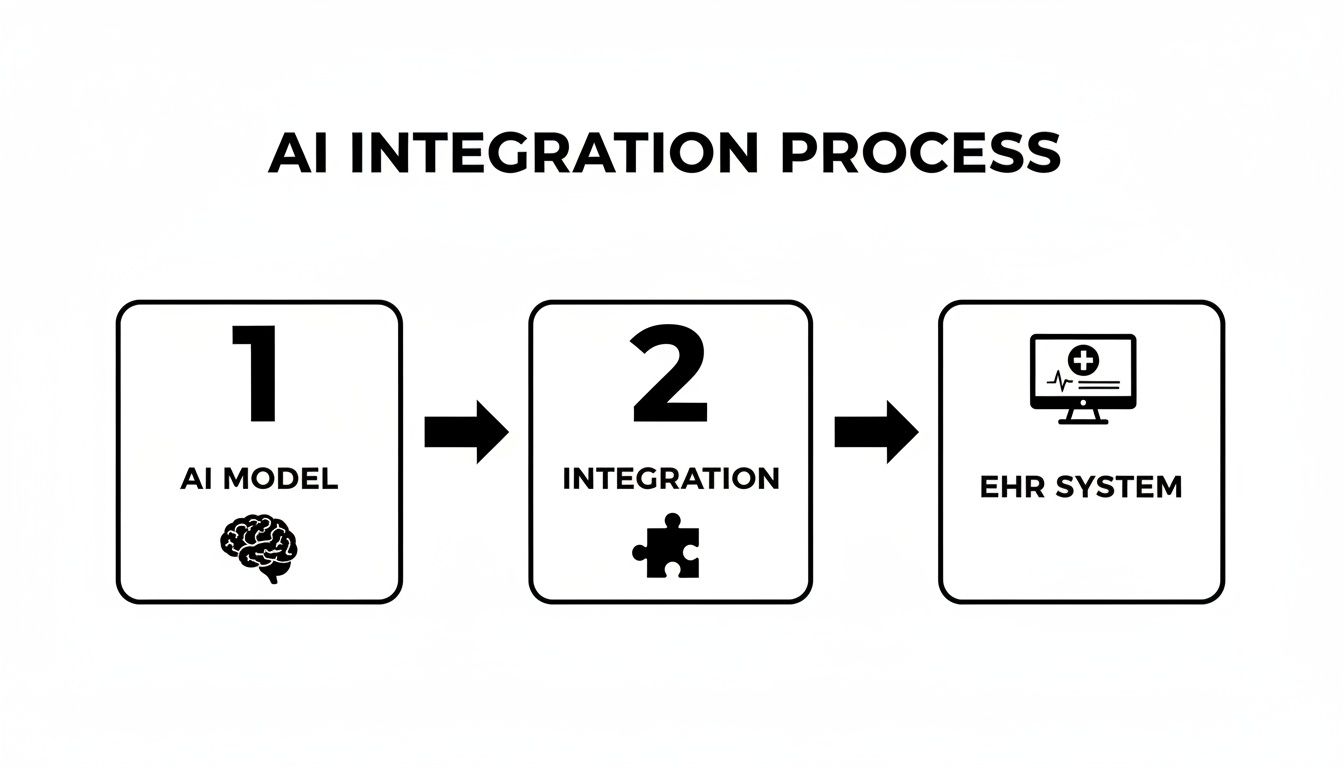
As the visual makes clear, the AI model and the EHR are two separate islands. The integration piece is the critical bridge that makes the whole system work. If you're looking for a personalized roadmap to navigate these challenges, our team can develop a plan based on successful real-world use cases we've seen work. You can learn more about that here: https://www.ekipa.ai/strategy.
To help you put these principles into action, we've created a straightforward checklist. Use this table to guide your team through each phase of your AI initiative, keeping everyone aligned on what truly matters for success.
| Project Phase | Key Action Item | Success Metric |
|---|---|---|
| Strategy & Planning | Define a specific, high-value clinical or operational problem to solve. | Problem is tied to a core hospital KPI (e.g., readmission rates, LOS). |
| Data Readiness | Conduct a thorough data audit for availability, quality, and bias. | Data quality report signed off; data sources confirmed and accessible. |
| Governance & Ethics | Establish a clear data governance framework and an ethics review board. | Documented compliance with HIPAA; ethical guidelines are published. |
| Model Development | Engage clinicians in co-design workshops to map workflow integration. | >80% positive feedback from clinicians on initial prototypes. |
| Integration & IT | Develop a detailed integration plan with the IT department and EHR vendor. | Successful API test connection to the EHR sandbox environment. |
| Clinical Validation | Run a pilot study in a controlled, real-world clinical setting. | Pilot results meet or exceed pre-defined success metrics (e.g., 10% accuracy lift). |
| Deployment & Adoption | Identify and train clinical champions to lead peer adoption. | >75% of the target user group actively using the tool within 90 days. |
| Post-Deployment | Implement a continuous monitoring system for model drift and user feedback. | Quarterly performance reports show model accuracy remains stable. |
By following this checklist, you’re not just building an AI tool; you’re building a solution that works for the people who need it most. It’s about being deliberate and proactive, ensuring your investment delivers real, measurable value to your patients and your organization.
Let's be honest: the common reasons why healthcare AI projects fail are well-known. We're talking about messy data, clinicians who won't use the tool, and integration nightmares that bring everything to a grinding halt. But seeing these as just roadblocks is a huge mistake.
Think of them as signposts. Each one points directly to a critical lesson you need to learn. A history of these setbacks isn't a record of failure; it's a practical, battle-tested guide for what to do next.
The biggest lesson is this: successful AI in medicine is never just about a clever algorithm. It's the result of a holistic strategy that weaves together technology, people, and process. If you ignore any one of these, you're practically guaranteeing failure.
Instead of getting discouraged by these all-too-common pitfalls, you can use them to build a much stronger foundation for your next project. It’s about reframing the problem.
A failed project is only a true failure if you learn nothing from it. When you analyze what went wrong, you get a priceless, real-world blueprint of exactly what not to do next time. That insight can save you millions in future missteps.
This shift in perspective is what separates the winners from the losers. It helps your organization move past a fear of failure and toward a deliberate, strategic execution model.
The goal isn't just to build AI. It's to build the right AI—the kind that solves a real problem and actually gets used. This is what turns expensive experiments into successful healthcare software solutions.
The path forward requires a clear vision and, often, a little help from those who have been there before. Don't let past challenges prevent your next breakthrough. With a strategic approach and guidance from our expert team, you can build what's next and make sure it succeeds.
Stepping into AI in healthcare can feel like navigating a minefield. It's natural to have questions. Based on what we see in the field, here are some of the most common ones that come up with hospital leaders, along with straightforward answers.
Jumping straight to the "cool" algorithm without doing the foundational data work first. It's the most common and fatal error. Many leaders get excited about a specific AI model but completely underestimate the effort needed to get their data ready. Bad data in means bad predictions out—it’s that simple. Before a single line of code gets written, you need a solid data governance strategy and a clear picture of exactly what data you need to solve the problem. A thorough AI requirements analysis isn't just a nice-to-have; it's mission-critical.
You build it with them, not for them. This is a non-negotiable for success. Don't just drop a finished product in their lap and expect a warm welcome. Bring clinicians into the process from the very beginning. The AI has to feel like it belongs in their natural workflow, not like another clunky system they're forced to log into. Run pilot programs, gather constant feedback, and make them feel like co-creators. As we explored in our AI adoption guide, you're aiming to build an indispensable assistant, not just another piece of tech.
Yes, absolutely—but you have to be smart about it. You don’t need to rip and replace everything overnight. Think in phases. Start with smaller, targeted projects that don't require deep, complex integrations. The key is to map out a long-term AI roadmap that lines up with your plans for modernizing your IT infrastructure. Our AI strategy consulting tool often focuses on finding these initial "quick wins"—low-complexity projects that deliver high impact. This helps build momentum and makes it much easier to justify future investments in better internal tooling.
You define what success looks like—in hard numbers—before you even start. Your return on investment can be measured in a few different ways:
It's also crucial to track metrics like clinician satisfaction. You need to measure these against a baseline taken before the AI was implemented. That’s how you prove real, tangible value and build a case for future projects.
Ready to build an AI strategy that sidesteps these common failures and delivers genuine clinical and operational wins? The experts at Ekipa AI can help. Get your Custom AI Strategy report in 24 hours and start building what's next, the right way. Meet our expert team to see who can guide you on your AI journey.
How to build HIPAA-compliant AI: when LLM providers need a BAA, data minimization, de-identification, audit controls and a reference architecture.

Practical data migration planning guide for healthcare teams. Scope, mapping, compliance, validation, cutover and rollback decisions explained end to end.

Smart on FHIR guide for healthtech engineers. Learn the OAuth 2.0 launch model, scope syntax, backend services, and US regulatory requirements.
Connect with our team to explore how AI expertise can transform your business.