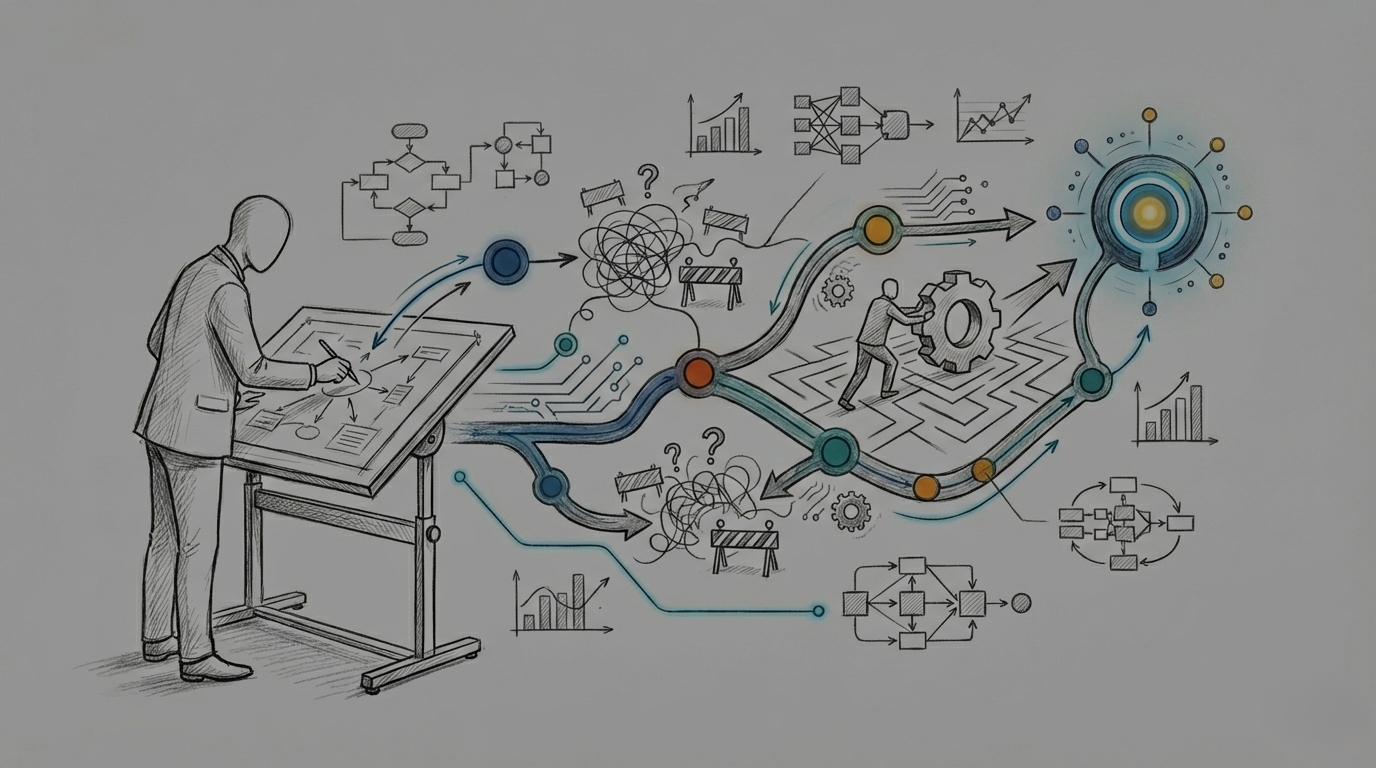
Many companies begin their AI journey with great confidence. Later, they often realize their plans are unclear, unrealistic, or disconnected from their actual business needs. Leaders hope for quick results. Teams try out new tools. The excitement builds up. Yet, the final results often fall short. This gap between what we hope for and what we actually do is where most AI roadmap strategies break down. A successful plan requires patience, clarity, and a clear understanding of where AI can truly make a difference.
The Common Reasons AI Roadmaps Collapse
Uncertain Goals Lead to Confusion
Some organisations rush to adopt
AI solutions without first deciding which problems they want to solve. When there is no clear target, teams struggle to find the right direction. This often results in a collection of disconnected projects that fail to move the business forward.
Lack of User Trust Slows Progress
AI systems only succeed when people feel comfortable using them. Many teams overlook the fact that users need time to build
user trust in a new system. Without careful design, hesitation can build, and even the most promising ideas will struggle to find support.
No Connection to Real Business Needs
A roadmap loses its strength when it is built only around new trends and tools. Companies do better when they focus on practical
AI use cases that solve everyday problems. When the plan does not link to actual business needs, AI becomes just a side project instead of a meaningful change.
Building an AI Roadmap Strategy That Truly Works
Identify Problems That Matter
A strong AI roadmap strategy begins by identifying problems that cause friction or repeated errors. These are the areas where AI can make a real impact. Instead of choosing random ideas, focus on tasks where automation or intelligence can genuinely help your teams work better.
Study Capabilities and Limitations
Before moving forward, a company must understand its current position. An AI readiness assessment provides a clear picture of what the organization already has and what it still needs. This step helps avoid setting unrealistic goals and keeps the roadmap grounded in reality.
Design the Experience for Users First
AI is more than just technology. It is also about how people behave. People need to feel comfortable using the system. This is why planning with the user in mind matters. A good step is to create a simple visual journey. This illustrates how the future AI system will simplify daily tasks. This approach makes the plan simple for everyone to understand.
Use Data and Continuous Learning as Strengths
The true power of AI emerges when systems can continue to learn. A reliable AI implementation partner helps you build the right foundation. This allows the system to grow, adapt, and become more intelligent over time. This steady improvement is what turns small experiments into lasting value.
Build a Balanced Portfolio of Projects
A successful roadmap includes both small wins and long-term goals. A
custom AI strategy report helps you list projects that deliver quick results while also planning for future growth. This balanced approach keeps teams motivated and leaders confident in the process.
Pick the Right Teams
AI work needs collaboration across product, engineering, data, and business experts. When these teams work together, decisions happen faster, and the results are better. When teams are not aligned, even simple tasks can become complicated and slow.
Turning the Roadmap Into Action
Translate Plans Into Steps
A roadmap only works when it leads to real action. The AI maturity model helps define what to do first, what comes next, and what to do later. Each stage supports the one that follows, allowing the organization to grow steadily without rushing.
Prepare for Safe and Responsible AI
Responsible AI is a necessary part of any effective plan. Clear rules protect users, reduce mistakes, and guide the system to behave in a predictable manner. Trust is built on a foundation of safety and transparency.
Track Progress and Adjust Often
AI strategies are most successful when they are flexible. The AI adoption roadmap should be reviewed regularly, especially as teams learn from actual results. Updating the plan keeps it relevant and increases the chances of success.
Add Perspective From Outside Experts
Sometimes, an outside perspective can make a big difference. Many organizations engage
AI strategy consulting to review their plans, refine their priorities, and propose practical changes. This brings clarity and keeps the roadmap in line with industry standards.
Conclusion
A strong AI roadmap strategy is not built on hype. It is built on clarity, user trust, and a commitment to learning. When companies focus on meaningful problems, plan with care, and build for both immediate and future goals, AI can truly change how people work. If you would like support in building a strong plan for your organization,
contact us for guidance.
FAQ
1. What is an AI roadmap strategy, and why do most fail?
An AI roadmap strategy is a structured plan for adopting AI solutions. Most fail due to unclear goals, lack of user trust, and weak connection to real business needs.
2. How can AI strategy consulting help my organization?
AI strategy consulting offers expert guidance to refine priorities, assess AI use cases, and align your AI adoption roadmap with business objectives.
3. What is included in a custom AI strategy report?
A custom AI strategy report outlines practical AI use cases, prioritizes projects, and recommends steps for AI implementation, ensuring measurable business impact.
4. How do I assess my organization’s AI readiness?
An AI readiness assessment evaluates current capabilities, infrastructure, and skills, helping identify gaps before partnering with an AI implementation partner.
5. What role does an AI maturity model play in AI adoption?
The AI maturity model defines stages for AI implementation, guides project sequencing, and ensures steady growth, supporting both short-term wins and long-term success.