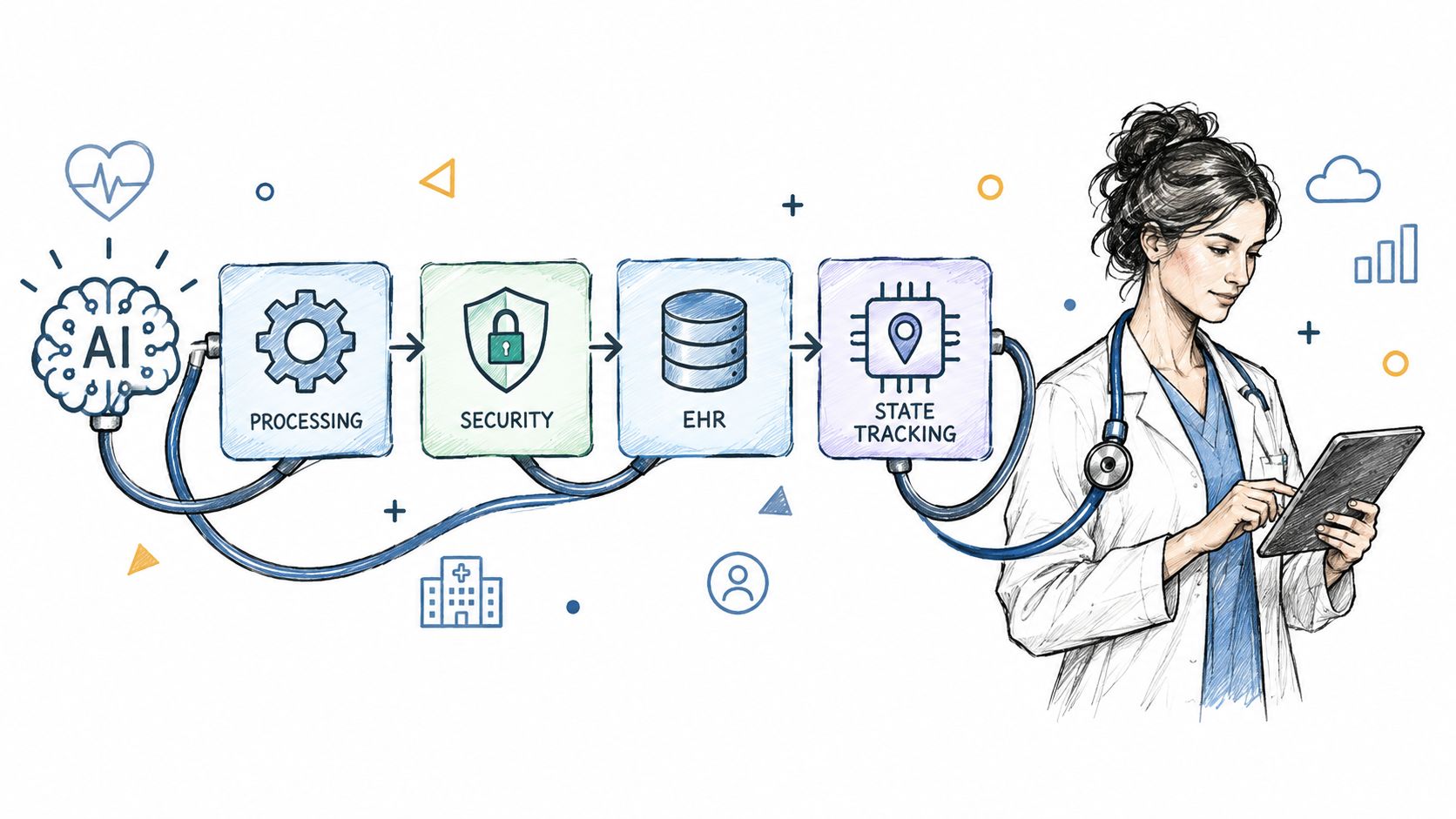
In November 2024, Anthropic introduced and open-sourced the Model Context Protocol, and that milestone matters because it standardizes how AI agents connect to external tools, systems, and data sources. In healthcare, that's only the starting point, because production systems still need authorization, auditability, validation, and clinical safety around every action.
ai agent architecture for healthcare is really a control-system problem. This article looks at the parts that hold up in production, from FHIR scopes and HIPAA safeguards to failure handling and evidence for compliance.
Why Healthcare AI Agents Require Different Architecture
The Model Context Protocol marked a real shift in how agents connect to tools, because it separates the reasoning model from the context and connector layer in a standardized way, but healthcare adds obligations that generic agent stacks don't solve on their own. The architectural gain is obvious, a cleaner way to connect models to EHRs, databases, files, and APIs. The harder problem is that clinical software also has to prove who did what, on which data, under which permission boundary, and with what fallback when something is stale or missing. See the healthcare angle in Ekipa's Healthcare AI Services.

What changes in healthcare
An agent in a clinical workflow needs more than a prompt and a tool call. It needs authenticated identity, explicit authorization, deterministic logging, and a human path for ambiguous or irreversible steps. MCP helps with interoperability, but it does not prove clinical safety, and it does not replace controls like access control, validation, or oversight as Anthropic describes.
The right question is not whether the model can call a tool, but whether the system can prove that the call was allowed, traceable, and safe to repeat.
That distinction matters because healthcare data flows cross EHRs, scheduling systems, knowledge bases, claims workflows, identity services, and audit stores. Each hop expands the control surface, so the architecture has to treat permissions and context as first-class components instead of appending them later. A helpful reference point for practical agent deployment patterns is real-world agent deployment examples, especially where task boundaries and escalation rules are visible.
The implication is straightforward. Healthtech teams should design for explicit permission boundaries and separate trust layers, then keep the reasoning model inside those boundaries rather than letting it directly own them. That's the difference between a useful assistant and a system that can stand up in regulated production.
Core Components of Production Agent Architecture
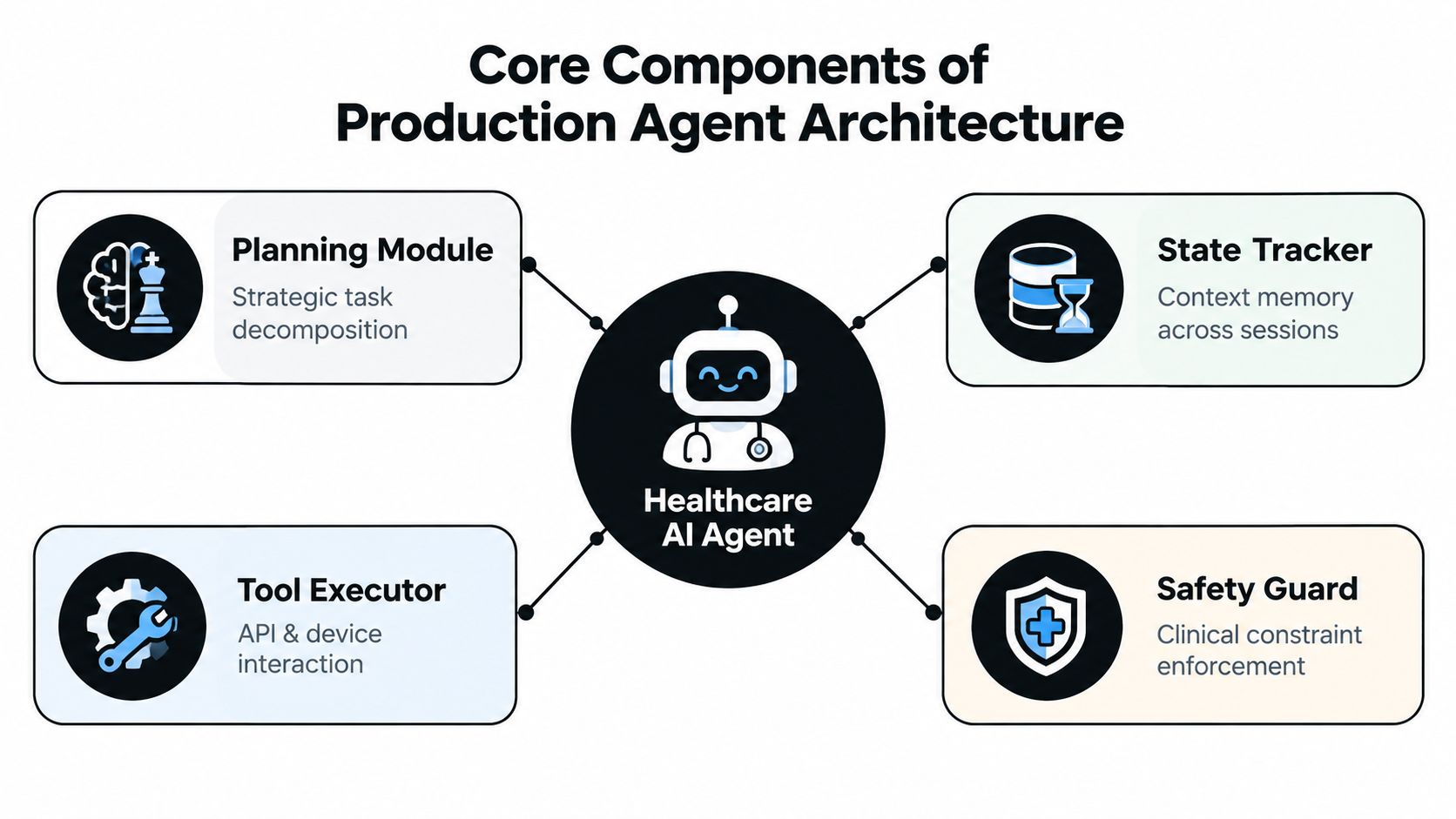
A production ai agent architecture for healthcare works best when each responsibility is isolated. Planning, state tracking, tool selection, execution, observation, error recovery, and memory should not live in one opaque loop, because long workflows fail at every action boundary. Tool-use research points in the same direction, explicit state tracking and recovery are necessary if the agent is expected to complete real tasks instead of producing a plausible final answer as shown in the agent architecture analysis.
Separate the model from the workflow state
The model should propose actions, not implicitly own workflow truth. We keep typed state outside the model, validate arguments against schemas, and store each observation and side effect as a durable record. That makes retries, rollback, and audit possible without asking the model to reconstruct what happened from memory.
A bounded loop is usually the safer pattern:
| Layer |
Responsibility |
What breaks if it's missing |
| Planning module |
Breaks a task into steps |
The agent wanders or skips constraints |
| State tracker |
Stores verified workflow state |
The agent repeats actions or loses context |
| Tool executor |
Calls APIs or services |
Errors become invisible side effects |
| Safety guard |
Checks policy and permissions |
Unauthorized or irreversible calls slip through |
Make checkpoints deterministic
A good clinical workflow does not let the model “decide” to update an EHR, submit an order, or send a patient message without a checkpoint. A policy layer should verify that the request matches the authorized scope, the current patient or tenant context, and the required schema. Then an isolated tool runner executes the call and the state manager persists the result.
Record the observation before you trust the next step.
That pattern makes failures replayable, which matters when a clinician or auditor needs to see exactly why a result was accepted or rejected. It also keeps untrusted retrieved content from becoming executable instruction, which is one of the common ways agent systems drift into unsafe behavior.
Modular Pipelines versus Orchestration Patterns
Two patterns show up again and again in healthcare: modular pipelines and orchestration layers. A modular pipeline is easier to reason about because each stage has a narrow job, clear inputs, and a predictable failure mode. Orchestration is more flexible when a workflow needs to coordinate across EHRs, claims, identity, and clinical tasks, but the control surface gets wider very quickly.
When a pipeline is the better fit
Pipelines work well when the task boundary is clean. A scheduling triage flow, a document extraction flow, or a chart-summary flow can often be broken into simple stages with human review at the edges. The audit story is cleaner, and if one stage fails, the system can degrade in a controlled way instead of cascading across every downstream dependency.
When orchestration earns its complexity
Orchestration helps when the agent has to route subtasks across multiple systems or specialized workers. That can be useful for care coordination, prior authorization prep, or mixed clinical and administrative workflows. The trade-off is that every additional route makes policy enforcement, traceability, and rollback harder unless those controls sit above the individual workers.
| Pattern |
Strength |
Main risk |
Best use |
| Modular pipeline |
Simpler audit trail |
Less flexible coordination |
Narrow workflows with clear stages |
| Orchestration layer |
Handles heterogeneous systems |
Control drift across agents |
Cross-system clinical operations |
If the workflow can't be explained step by step to a reviewer, it's too loose for regulated production.
For teams comparing architecture options, the question is usually not which pattern is “advanced.” It's which one keeps the system understandable when something goes wrong. For a broader implementation context, custom healthcare software development often needs the same clarity, especially when multiple systems and vendors are involved.
Implementing FHIR Authorization and Patient Context
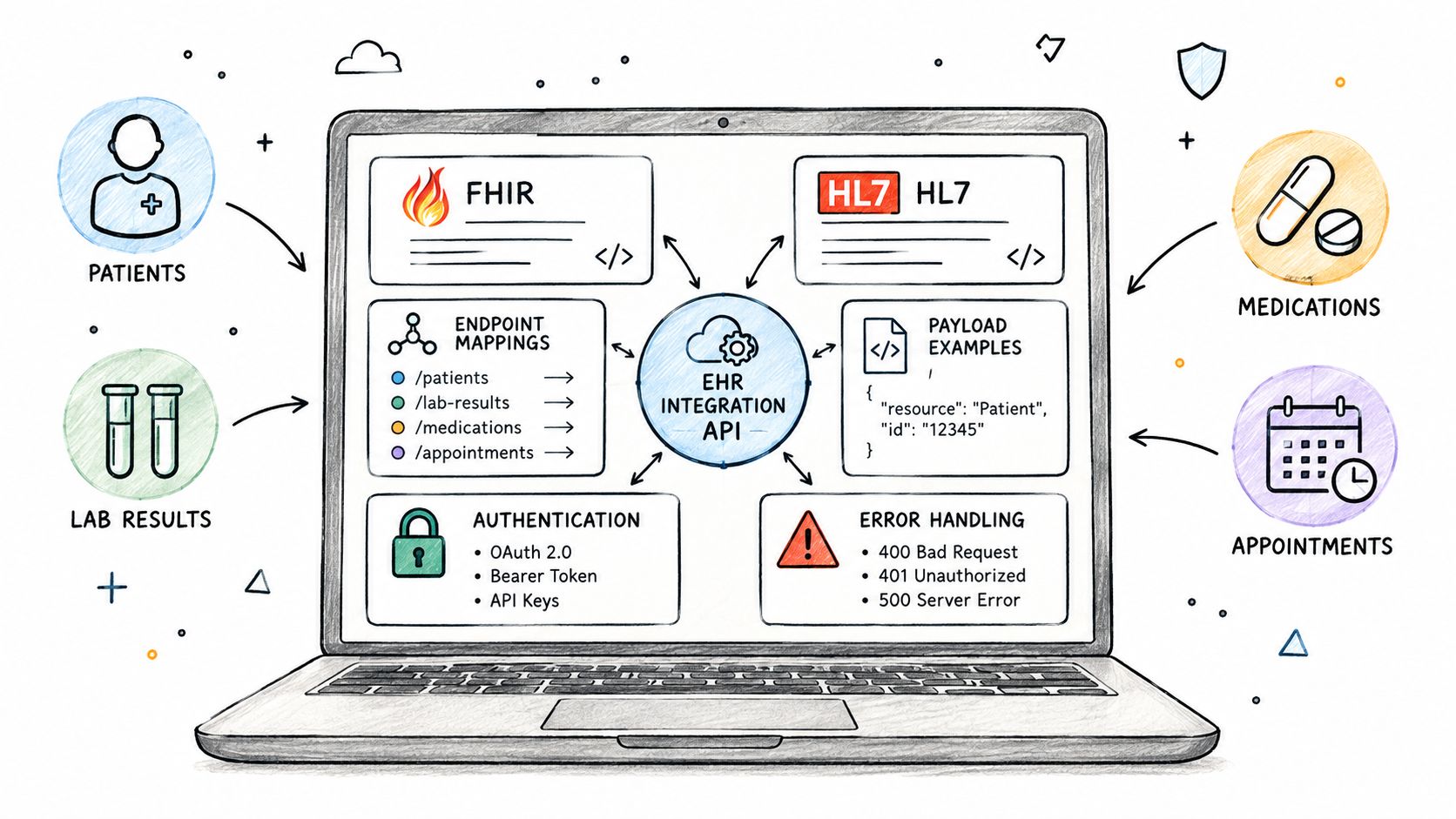
SMART App Launch 2.0 gives healthcare agents a better authorization shape than broad EHR access because scopes can match the task. The syntax <patient|user|system>/<FHIR-resource>.<c|r|u|d|s>[?param=value] lets a client request narrow access instead of a generic credential that can reach too much. For example, patient/Observation.rs?category=http://terminology.hl7.org/CodeSystem/observation-category|laboratory limits read and search access to laboratory observations for one patient as defined in the HL7 scope spec.
Build authorization around task scope
The authorization server should issue the smallest scope that matches the task, and the FHIR server must enforce that scope on every request. Recording a requested scope in your orchestration layer does not count as enforcement if the downstream server never validates it. That gap is the difference between documentation and actual access control.
For long-running work, token handling matters as much as the scopes themselves. SMART on FHIR separates patient, user, and system contexts, and it also defines launch context and offline access for workflows that continue after the user is no longer present per the SMART launch spec. Token introspection matters too, because the resource server needs to inspect what the token is allowed to do before it honors the request.
A practical implementation sequence looks like this:
- Bind identity to the tool call. Each request should carry an authenticated service identity, not just a model-generated intent.
- Pass the patient or tenant context explicitly. Do not infer it from prior turns.
- Enforce scopes on the FHIR server. The server, not the agent, decides what is allowed.
- Treat refresh tokens carefully. Long-running workflows need revocation and auditability, not permanent authority.
Teams building a monitored agent stack for clinical or operational work can use patterns similar to a secure monitoring agent for DevOps, because the same control model applies, tool access should be tied to identity, context, and reviewable logs. In implementation, scope design is translated into service configuration and policy tests, and a clinic-focused AI Product Development Workflow should reflect those checks before the agent touches live patient data.
Managing Reliability and Failure in Clinical Workflows
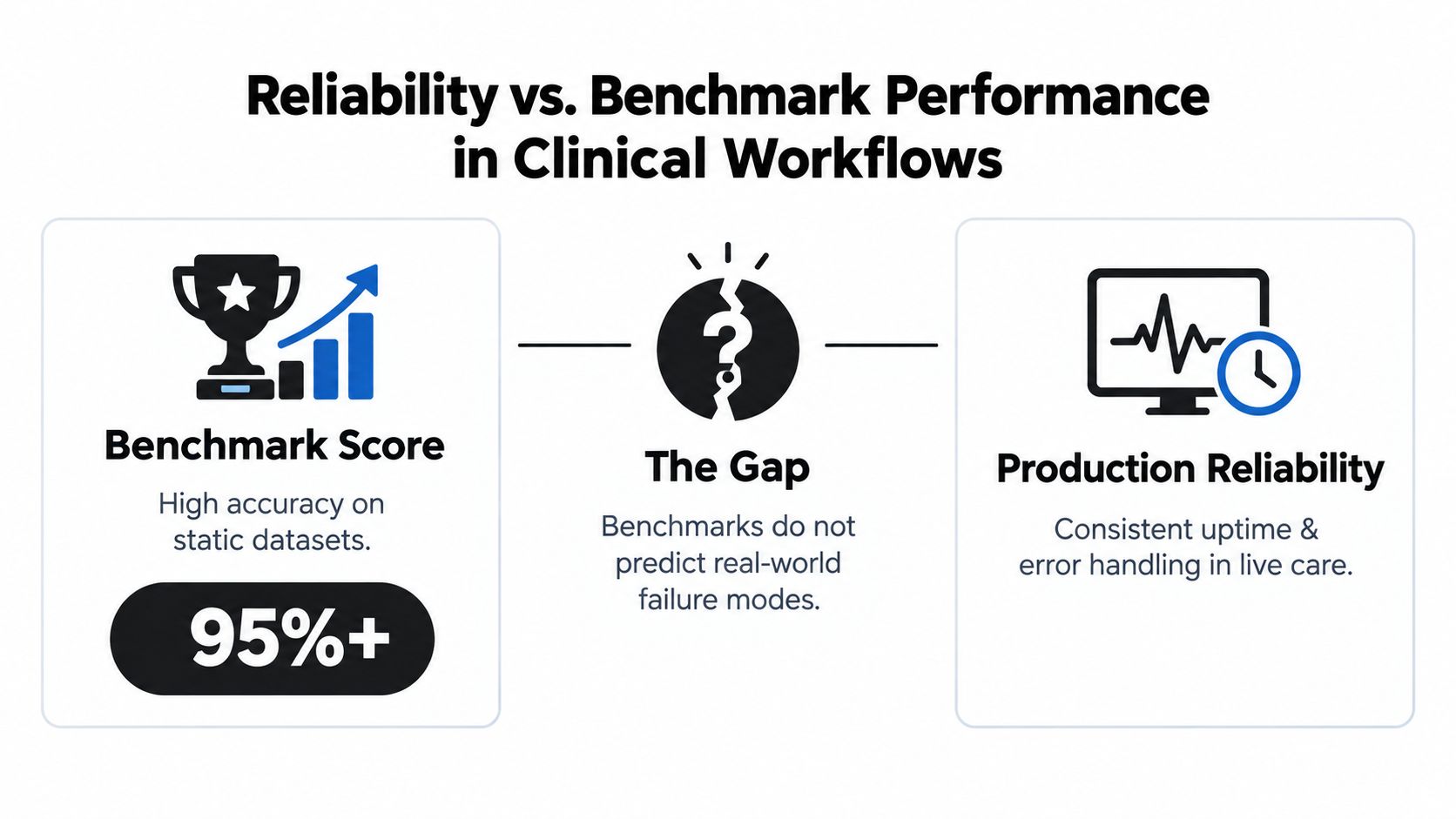
Reliability in agent systems cannot be judged by a single successful run. Workflows that look fine once may still be unsafe when repeated, perturbed, or partially degraded. One benchmark reported a best-case probability of succeeding across eight attempts at only 6.34%, which shows how quickly small errors can accumulate in long clinical workflows as reported in AgentArch.
Measure the failure-management plane
The useful unit of design is the failure-management plane. It includes confidence thresholds, permission boundaries, rollback, escalation, provenance, and human approval. A benchmark score does not tell you whether the agent knows how to stop safely when patient identity cannot be established, data freshness is unclear, or a tool response conflicts with policy.
The decisive test is how the system behaves when it cannot trust the next action.
A separate reliability result showed pass@1 falling from 96.9% in an unperturbed setting to 88.1% under a perturbation level of 0.2, an 8.8-percentage-point decline. That kind of drop is why healthtech teams should test repeated runs, changed wording, missing fields, timeout handling, API failure recovery, idempotency, and human-approval escape hatches.
Treat memory as controlled state
Memory should be selective and typed. Keep verified patient or workflow state, provenance, access controls, and expiry rules, but do not let raw retrieved text become an instruction source. That keeps the agent from reusing stale or untrusted material as if it were current truth.
A practical review checklist for production readiness:
- Repeated-run pass rates: Verify the workflow stays stable across multiple executions.
- Perturbation tests: Change wording, drop fields, and break dependencies on purpose.
- Recovery behavior: Confirm the system can retry or hand off without inventing actions.
- Safe degradation: Decide what happens when the tool layer is down.
- Escalation path: Make sure a human can take over without losing state.
Interoperability and Governance as First-Class Concerns
Healthcare deployment is where policy centralization starts to matter more than model cleverness. Agents often need to coordinate EHRs, claims systems, identity services, consent management, audit logs, and role-based access. The control point should sit in the context and tool-execution layers, because duplicating policy inside each agent creates inconsistent authorization and poor auditability.
Put controls where actions happen
When multiple agents retrieve and act on the same sensitive data, task-scoped access and data-freshness checks belong close to the tools themselves. That way, provenance is attached to the action, not reconstructed later from logs that may disagree. This is especially important in clinical environments where minimum-necessary access and decision traces need to be visible to reviewers and compliance teams.
That gap between experimentation and scale is still wide. Reported figures indicate that 62% of organizations are experimenting with agents, 23% have scaled an agentic system beyond a pilot, and fewer than 10% report agents operating at scale in any single function as summarized in healthcare architecture guidance. Those numbers are a reminder that many teams are still figuring out governance, not just model choice.
Own the control boundary clearly
Vendor teams, customer teams, engineering, and compliance each own different pieces of the system. A BAA or policy document helps, but it doesn't prove the software respects the boundary in production. For a useful legal and operational backdrop, the business associate agreement guide is a helpful companion when you're mapping responsibilities across vendors and covered entities.
For teams that need a practical implementation partner, Ekipa's Clinic AI Assistant is one example of how workflow automation, integrations, and guarded task execution can be packaged into a production system. The broader point is the same regardless of product choice, governance has to be built into the architecture, not attached as paperwork afterward.
From Architecture to Implementation, Next Steps
Clinical agent work should start with the workflow that has the clearest boundary and the highest risk if it fails. Define where the system needs explicit state, where a human must approve the action, and where the tool layer should reject the request even if the model sounds confident. Bounded loops come first in healthcare, because they are easier to inspect, test, and constrain before broader rollout.
What to implement first
A practical order helps.
- Identity and authorization. Create a scope matrix that maps each workflow, such as lab-result summarization, to the minimum SMART scopes. Test in staging that the FHIR server denies out-of-scope requests.
- State and logging. Persist workflow state, observations, and side effects outside the model, then verify that a replay reconstructs the same clinical context.
- Policy enforcement. Put deny rules at the tool or resource layer, and add a negative test suite for prohibited reads, writes, and cross-patient access.
- Recovery and handoff. Add retries, idempotency keys, and a human escalation path with clear handoff criteria.
- Evidence collection. Keep the configuration snapshots, authorization traces, and test artifacts needed for review and audit.
HIPAA's Security Rule requires administrative, physical, and technical safeguards for electronic protected health information, including access control under 45 CFR §164.312 as stated by HHS. For production evidence, teams should retain access-control configuration, authorization logs, token or identity mappings, and test results that show unauthorized requests are denied. A policy document alone will not carry an audit if the system cannot prove the control works.
Match the architecture to the regulatory boundary
FDA's CDS guidance makes the boundary clear, regulatory status depends on intended use and function, not on whether the product is called an agent or chatbot per FDA guidance. If the system crosses into device territory, the implementation package should include intended-use statements, input and output specs, human-review controls, version tracking, validation, and post-deployment monitoring. If it does not, the team still needs evidence that the system behaves as designed and stays inside its access boundaries.
If your team is designing a new clinical workflow or reworking an unsafe one, implementation support can help turn these controls into a system that can be reviewed, tested, and maintained.
Conclusion
Healthcare agent systems succeed when the architecture makes trust visible. That means narrow authorization, typed state, explicit checkpoints, replayable failures, and audit records that survive real clinical use.
If you're building or reworking a clinical AI workflow, visit Ekipa AI to discuss how we can help design the controls, integrations, and evidence trail around it.
FAQs
What is ai agent architecture in healthcare?
It's the full system design around the model, including planning, state, tools, authorization, logging, and recovery. In healthcare, that architecture has to support clinical safety, auditability, and access control, not just task completion.
Do I need SMART on FHIR for every healthcare agent?
Not every agent, but any agent that reads or writes EHR data should usually be scoped through SMART on FHIR or an equivalent access pattern. The key is least privilege, patient or user context, and enforcement at the FHIR server, not just in the app.
Why isn't a good benchmark score enough for a clinical agent?
Because benchmark success often measures one run on a controlled task, while production systems face retries, missing fields, stale data, and tool failures. Reliability has to be tested across repeated executions and perturbations, not just a single clean pass.
What evidence do auditors usually expect for a healthcare agent?
They usually need access-control configuration, authorization logs, token or identity mappings, and test results showing unauthorized requests are denied. If the workflow affects regulated data or decisions, version history, intended use, and monitoring records matter too.
Should failure handling be part of the agent or the platform?
Both, but the platform should own the hard boundaries. The agent can propose actions and recover from routine issues, while the platform should enforce authorization, rollback rules, logging, and human escalation.
How do I decide between a modular pipeline and orchestration?
Choose the simpler pipeline if the task is narrow, auditable, and has a clear handoff point. Use orchestration only when the workflow needs to coordinate across multiple systems or agents, and only if you can centralize policy and traceability.