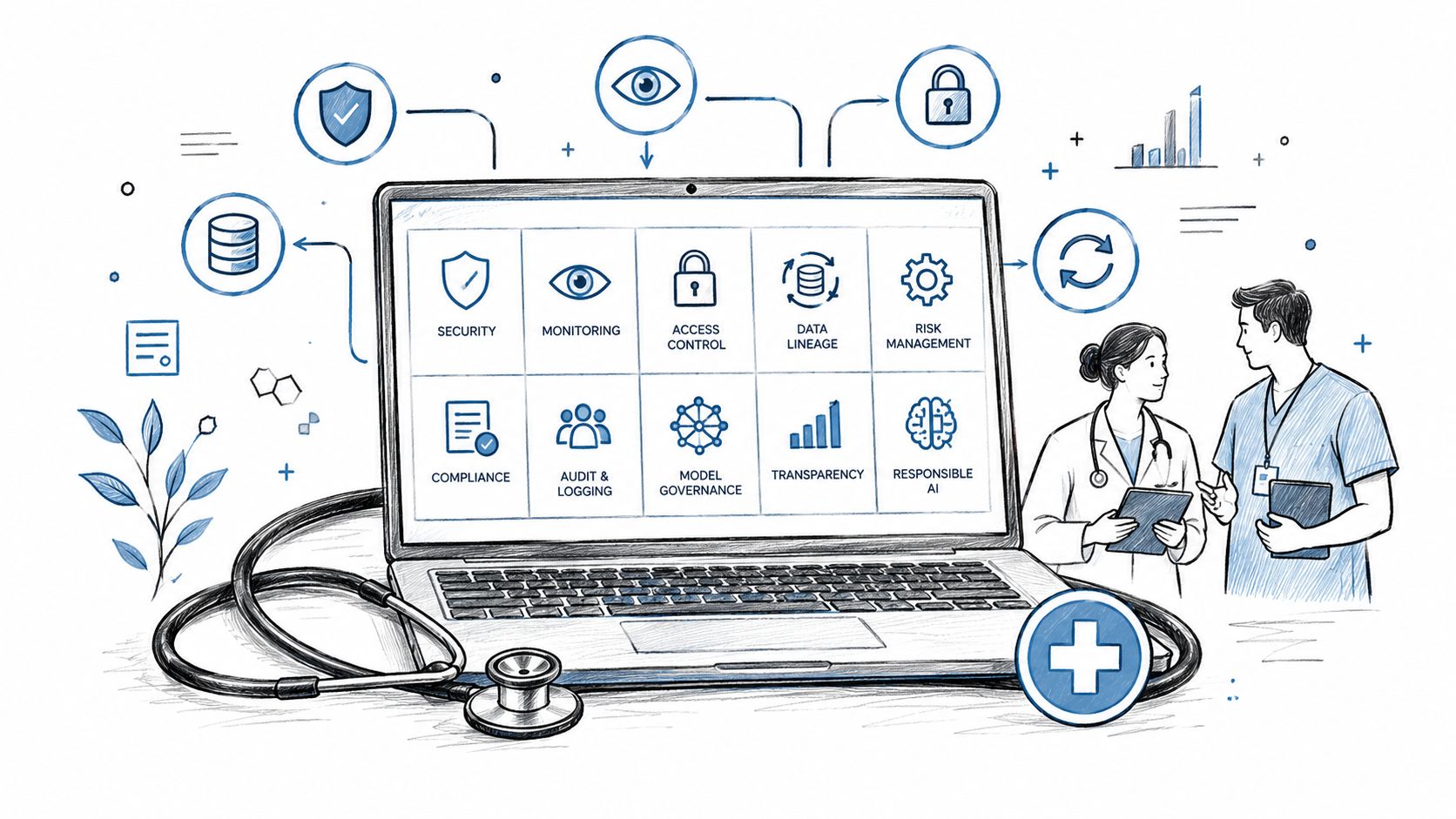
Choosing an AI governance platform for healthcare usually starts in the middle of a real workstream, not in a policy workshop. A product team has an AI use case ready for review, compliance wants lineage and evidence, security needs access controls around sensitive data, and leadership wants a defensible answer before the next release goes live. The hard part is that some tools govern the full lifecycle, some strengthen cloud-native model operations, and others only add runtime guardrails, so they're not interchangeable.
That's why the comparison below uses healthcare implementation decisions, not generic feature marketing. Look at governance scope, model lineage, monitoring, access controls, evidence collection, deployment environment, and integration effort before you compare names on a shortlist. If internal governance capacity is stretched, teams often bring in a healthtech engineering partner, Healthcare AI Services, AI requirements analysis, or a regulatory compliance partner to help define ownership and controls before platform selection. For broader corporate governance guidance, the same principle applies, the tool should fit the decision process, not the other way around.
1. Credo AI
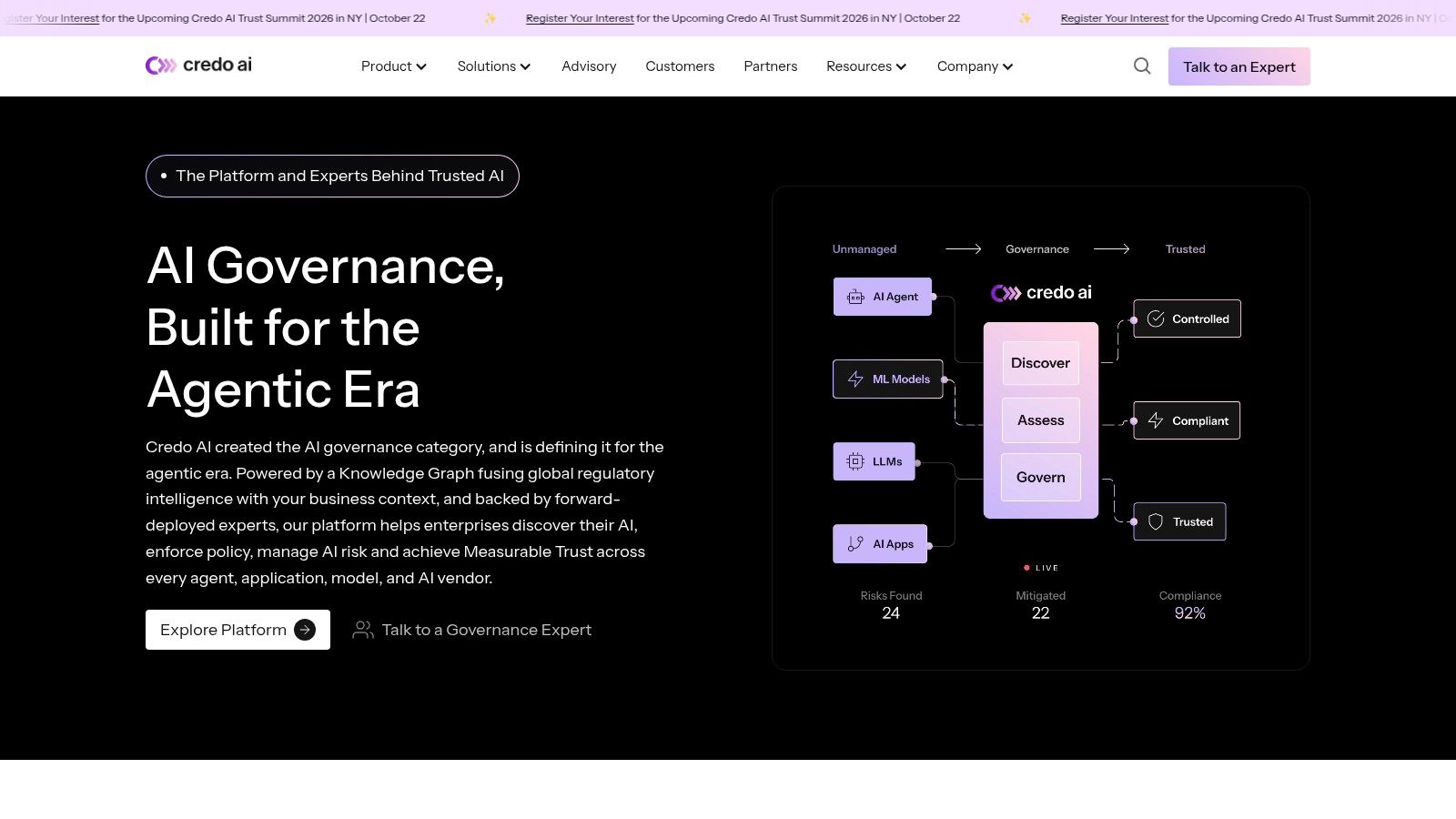
Credo AI is a strong fit when a healthcare organization needs a centralized governance layer rather than a narrow technical control. Its public positioning emphasizes AI inventory, policy and controls mapping, and evidence collection across AI/ML and GenAI use cases, which matters when product, compliance, and security all need the same record. The platform site shows the tool is aimed at enterprise governance rather than ad hoc review.
Where it fits best
The strongest case for Credo AI is a program that needs to map controls to frameworks like NIST AI RMF and the EU AI Act while also managing third-party AI and shadow AI. That's the kind of environment where healthcare software teams need traceable ownership, use-case registers, and audit evidence that can survive a review. Its healthcare-oriented guidance is useful when disclosures, consent workflows, and regulated deployment decisions all sit in the same approval path.
Practical rule: choose this kind of platform when the compliance team needs a system of record, not a folder of PDFs.
The trade-off is straightforward. Enterprise governance only works if the organization is willing to maintain structured workflows, not just buy software and hope the process appears on its own. Pricing is contract-based, so teams should expect a sales-led evaluation rather than a quick self-serve trial.
2. Monitaur
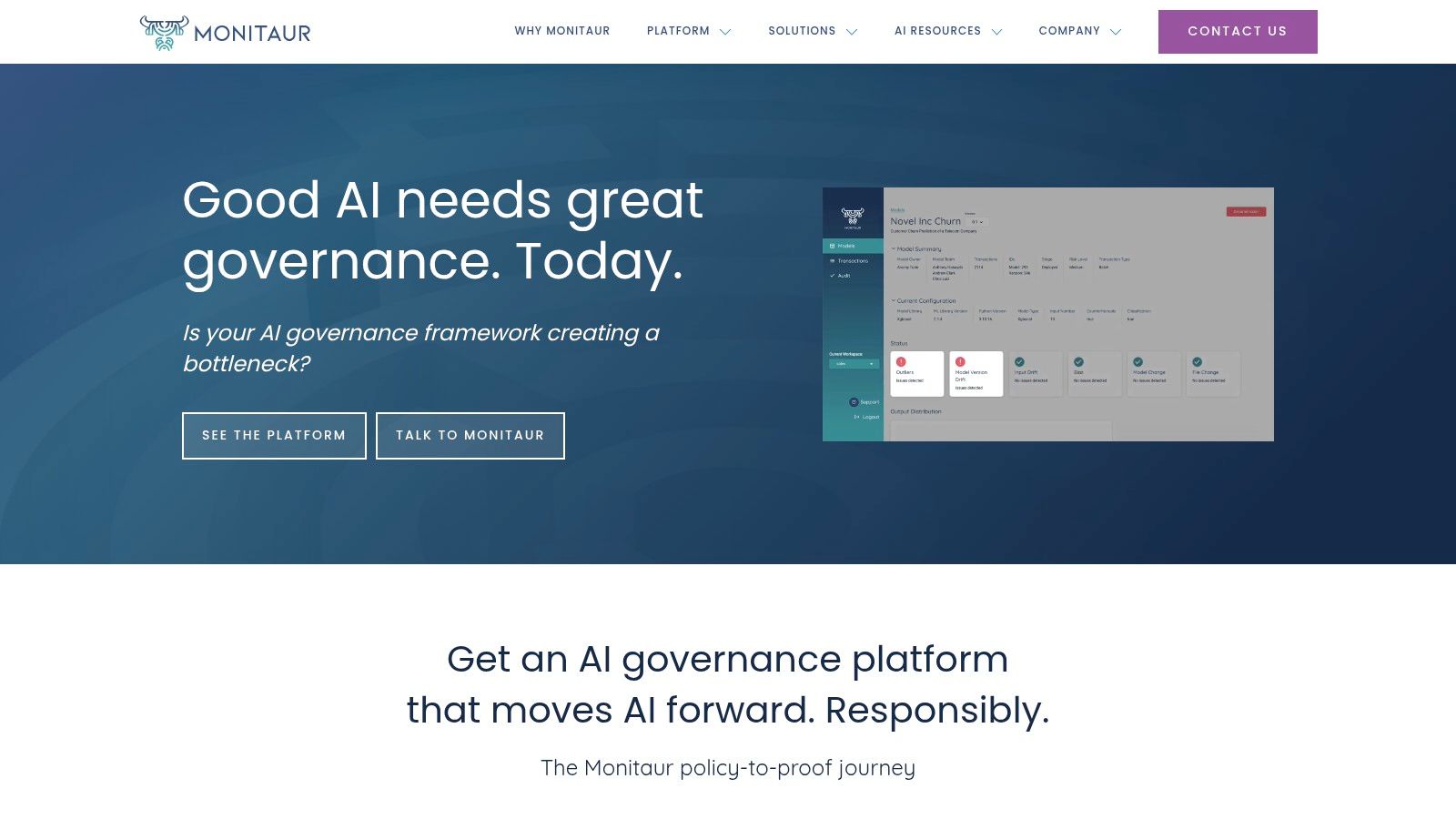
Monitaur makes sense for regulated teams that care as much about assurance as about initial approvals. Its site positions it around lifecycle governance, risk controls, monitoring, and audit-readiness, which lines up well with healthcare programs that need evidence after deployment, not just before it. The platform is especially relevant where ownership boundaries and vendor governance matter.
Why regulated teams look at it
Monitaur's appeal is that it treats governance as an ongoing operational process. That fits healthcare product teams that need approvals, monitoring, and evidence collection to stay connected across the lifecycle of a model or GenAI use case. If your organization is trying to separate vendor responsibility from internal ownership, that structure is useful.
The trade-off is implementation effort. Like most enterprise governance tools, it will need alignment with internal risk and compliance systems before it becomes the record your teams trust. Public pricing is limited, so procurement will probably need a demo-led cycle and time for stakeholder mapping.
Practical rule: if the goal is auditability across the whole lifecycle, don't buy a point solution that only looks strong at launch time.
3. IBM watsonx.governance
IBM's governance offering is a natural fit for organizations that already operate inside the IBM ecosystem and want governance adjacent to their model workflow. The watsonx.governance page highlights approvals, lineage, monitoring, explainability, and audit trails across traditional ML and GenAI. In practice, that makes it attractive when a healthcare team wants governance close to the modeling environment instead of in a separate business workflow tool.
The main advantage is integration depth. If the organization already uses IBM infrastructure, the path to policy, documentation, and controls can be more direct than stitching together disconnected products. The downside is that deployment and pricing can become harder to compare cleanly, especially when the question is SaaS versus software and how much setup is needed to make the controls meaningful.
The mandatory link for implementation context is worth treating as a signal, not a slogan: AI delivery framework. If a team can't explain how a governance platform fits into delivery, release gating, and oversight, it'll stay a dashboard instead of becoming a control plane.
What to watch
IBM is strongest when the governance problem is mostly inside IBM-run workflows. It is less useful as a cross-platform layer for organizations that have models, SaaS AI features, and vendor tools scattered across several environments. That's not a flaw, it's a scope choice.
4. ModelOp Center
ModelOp Center suits healthcare organizations governing ML, GenAI, agents, and vendor AI across one operating model. The website describes it as an AI system of record with enforceable policies and approval workflows. The ModelOp Center interface is therefore relevant when spreadsheets and ticket queues no longer provide enough lineage or evidence.
Why it stands out
Its main value is orchestration across different AI assets. A healthcare team can use a shared record to track which model or vendor system was approved, by whom, and for what purpose. That supports lifecycle governance, including intake, review, policy decisions, and evidence collection. Teams should still verify how runtime monitoring, production access controls, and incident workflows connect to their existing deployment and observability tools.
The trade-off is implementation effort. Connecting model lineage, deployment systems, monitoring, risk reviews, and security workflows may require substantial integration, particularly in a mixed-cloud or vendor-heavy environment. Pricing is not public, so procurement should plan for a sales-led evaluation.
When governance depends on bespoke review paths, attestation flows, or internal control dashboards, treat that as internal tooling work and design it before deployment rather than patching it in later.
5. Dataiku Govern
Dataiku Govern fits organizations that already standardize on Dataiku and want governance embedded in the same environment where analysts and data scientists work. The Dataiku site makes it clear that Govern is part of the broader platform, not a standalone governance layer. That's the point, and also the limitation.
Best for existing Dataiku shops
For healthcare teams already using Dataiku for data science work, the advantage is adoption. Governance becomes part of daily workflow rather than a separate system people forget to update. That helps with inventories, approvals, documentation, and oversight dashboards across projects.
The trade-off is that the value drops fast if you need a cross-platform governance layer. It's not the first choice for organizations trying to govern AI across multiple clouds, SaaS tools, and vendor systems. Govern also tends to matter most in higher tiers, so procurement should check where the governance features sit in the edition structure.
If the team already lives in Dataiku, embedded governance can feel natural. If it doesn't, the platform can become one more place to sync records.
6. Cranium
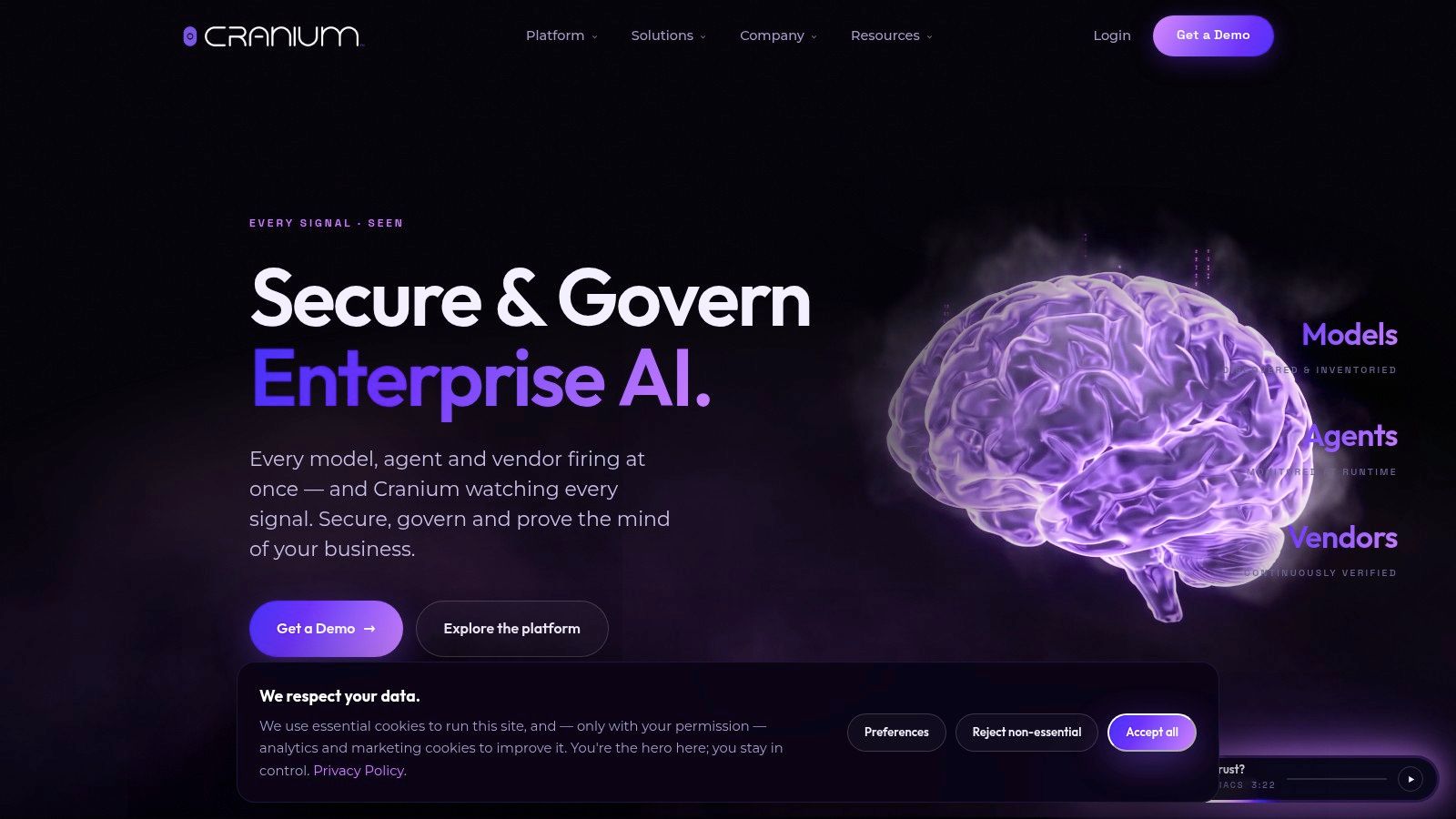
Cranium is more interesting when security and governance are already being discussed together. The platform combines AI security posture management with governance, including an “AI System” record, runtime visibility through Guardian, and evidence artifacts through AI Cards. That blend is useful in healthcare environments where security and governance teams need the same proof set.
Why security teams like it
The value here is the bridge between security posture and governance evidence. If a healthcare organization is trying to inventory first- and third-party AI, understand runtime visibility, and keep attestations in one place, Cranium reduces the number of disconnected handoffs. It also fits multi-model, multi-vendor environments, which is where many healthtech teams now operate.
The trade-off is scope. A platform with a strong security posture angle may still need extra work to model deep regulatory controls, especially if the compliance team wants framework-specific mapping and more formal lifecycle workflows. Pricing is not public, so enterprise evaluation is required.
A useful way to think about this category is simple. It helps prove that AI is being watched. It does not, by itself, prove that every governance requirement is covered.
7. CalypsoAI Moderator Platform
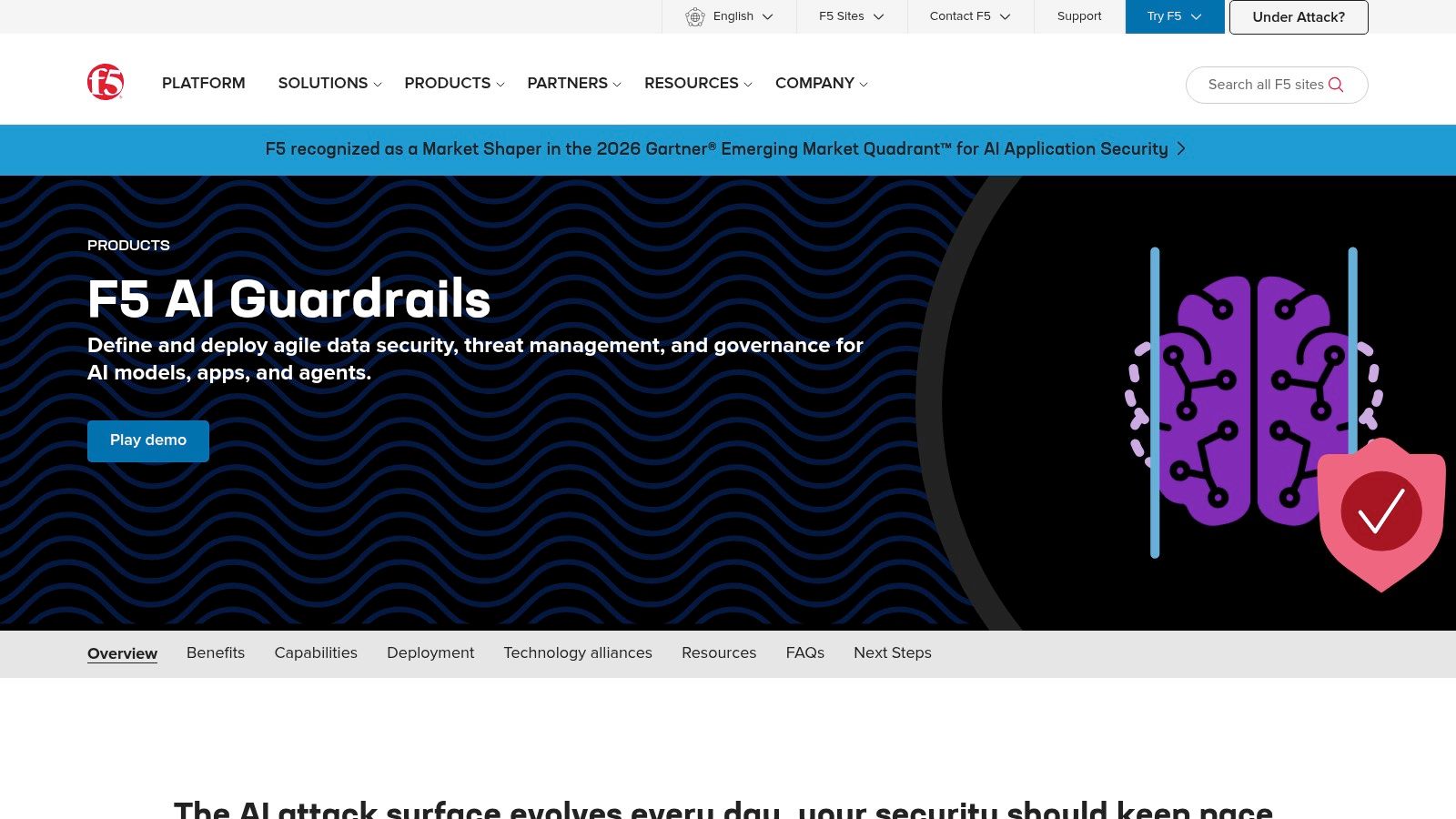
CalypsoAI is the clearest fit on this list for teams that need runtime guardrails more than lifecycle governance. The Moderator Platform focuses on configurable scanners and policies that can block, allow, or audit prompts and responses, with audit logs and deployment options that support regulated data handling. That makes it practical for organizations rolling out GenAI fast across users and tools.
Runtime control first
This is the kind of platform teams use when the immediate problem is prompt injection, sensitive data exposure, or content policy enforcement at the edge. On-prem and Kubernetes options matter in healthcare, because many organizations don't want PHI flowing through a governance layer they can't fully control. Enterprise SSO and roles also help when access needs to be tied to corporate identity.
The limitation is equally clear. Runtime content governance is not the same as lifecycle governance. If the organization still needs inventory, approvals, risk assessment, evidence management, and vendor oversight, this tool should be part of the stack, not the whole stack.
Practical rule: guardrails protect the live interaction. They don't replace the record of why the interaction was approved.
8. Fairly AI
Fairly AI sits closer to the AI GRC end of the market, which is why it suits teams that need regulatory mapping and automated evaluations tied to assurance work. The site positions it around end-to-end governance for high-risk AI, including healthcare, with policy libraries, testing, evaluations, and post-market monitoring.
Where the fit is strong
This is a sensible option when a healthcare team wants automated reporting and mapping to frameworks like NIST AI RMF or the EU AI Act without starting with a blank sheet each time. Marketplace availability can make procurement easier for pilot-style engagements, which matters when governance teams need to move before the next project phase.
The caution is that smaller ecosystems often require more validation against the organization's actual stack. Integrations should be tested carefully, especially if the environment spans multiple clouds or a mix of vendor and in-house models. Public pricing remains limited, so enterprise buyers should expect a formal evaluation.
The most useful question here isn't whether the platform can generate reports. It's whether those reports reflect a real operational process or just a compliance veneer.
9. Amazon SageMaker Model Governance Capabilities
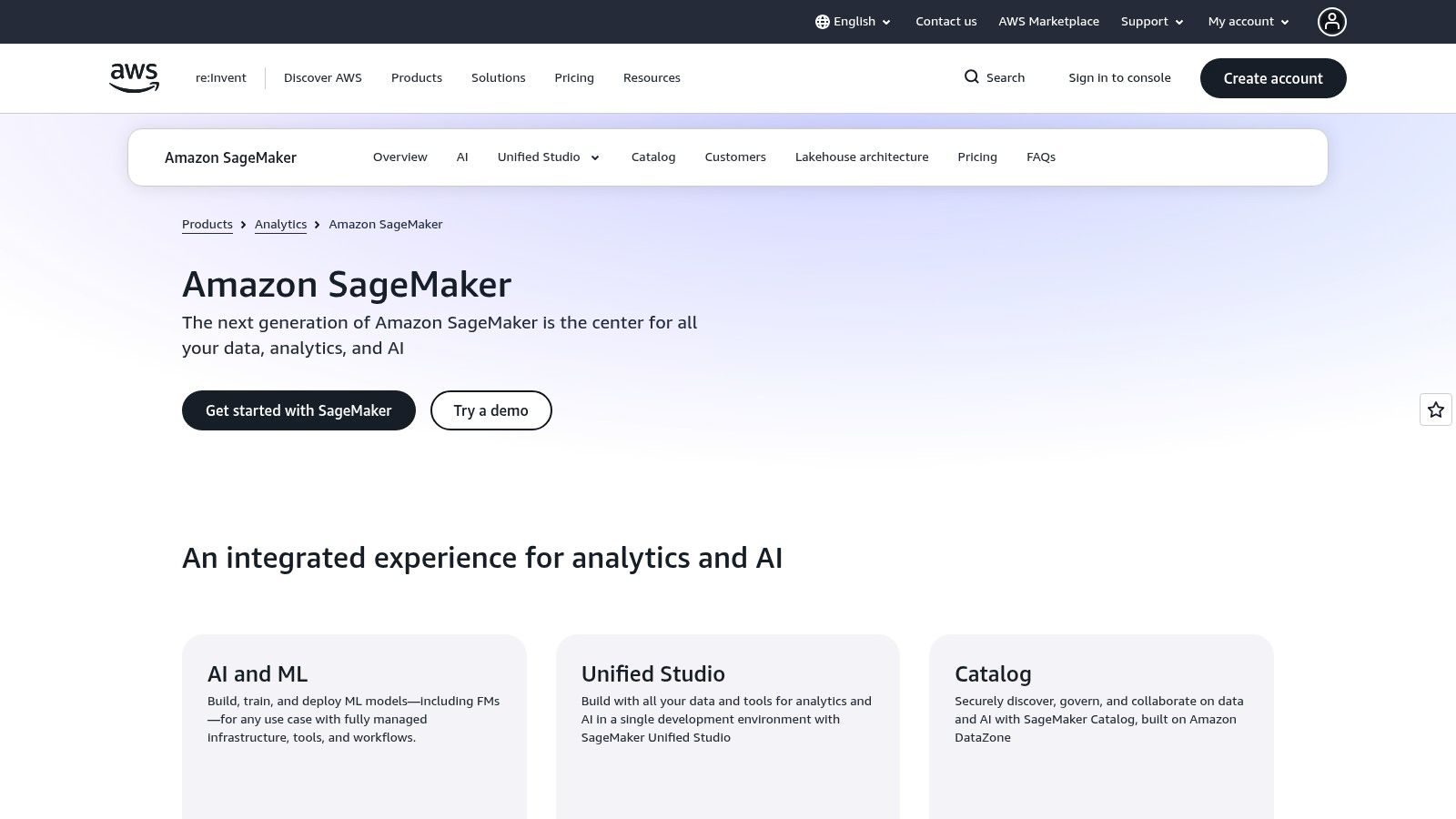
A healthcare team already operating in AWS may find SageMaker's governance features sufficient for a narrower deployment. The AWS page points to model registry, model cards, drift and bias monitoring, lineage, and integration with IAM and CloudTrail. That fits teams that want governance close to the ML workflow.
AWS-native governance
The main advantage is depth inside AWS. Multi-account patterns and reference architectures help security and platform teams keep records aligned across a cloud estate, and the native connection to AWS primitives can simplify access control and audit preparation.
The trade-off is scope. Once models or AI services move outside AWS, governance becomes fragmented, because these capabilities are tied to the cloud stack. Pricing and feature access also depend on the underlying services and region, so teams still need to validate what is available in their environment.
That is why many healthcare teams pair cloud-native controls with separate evidence workflows, especially when compliance reviews need model documentation outside the console. A product like Verifai: evidence collection for healthcare AI is relevant when governance has to follow the model across teams, tools, and deployment environments.
For broader governance beyond one cloud, a governance tooling for AI products beyond a single cloud layer may be a better fit than relying on provider controls alone.
10. Google Cloud Vertex AI
Vertex AI makes sense for teams that build and deploy on GCP and want governance features close to the model lifecycle. The Google Cloud page emphasizes model registry, model cards, responsible AI evaluations, explainability, fairness, audit logging, security controls, and emerging agent governance patterns.
Strong on first-party governance
The strength here is provenance and centralized logging inside the same cloud environment where the work runs. That helps teams that want technical governance without adding another vendor layer on top. It also aligns well with standards-oriented programs that want model documentation and evaluation evidence in a consistent operational flow.
The trade-off is the same one that applies to most cloud-native governance capabilities. The deeper the organization runs on GCP, the more useful Vertex AI governance becomes. As workloads spread across clouds and SaaS tools, extra integration work is needed. Some governance artifacts are also solution-specific, so teams may need to adapt the guidance to their own risk model.
If your AI stack already sits in GCP, this is a sensible native option. If not, it can become one more partial answer.
Top 10 AI Governance Platforms, Feature Comparison
| Product |
Core features |
Unique selling points |
Target audience |
Healthcare & compliance fit |
Pricing & adoption effort |
| Credo AI |
Central AI inventory, policy/control mapping, vendor risk, evidence collection |
Leader in enterprise/public sector; strong policy→controls mapping; healthcare workflows |
Large enterprises, regulated healthcare orgs, digital health vendors |
HIPAA‑adjacent controls, consent workflows, mapped to NIST/EU AI Act |
AWS Marketplace & enterprise deployments; contract pricing; requires governance process |
| Monitaur |
End‑to‑end lifecycle governance, risk assessments, monitoring, audit workflows |
Purpose‑built for regulated sectors with strong audit/evidence workflows |
Regulated industries (healthcare, insurance); compliance teams |
Pre‑mapped controls; audit‑readiness; vendor governance |
Enterprise‑oriented; limited public pricing; integration effort likely |
| IBM watsonx.governance |
Model lifecycle approvals, policy mgmt, explainability, lineage, monitoring |
Backed by IBM ecosystem; flexible deployments and enterprise integrations |
Enterprises using IBM stack or needing enterprise compliance tooling |
Explainability/fairness support; enterprise compliance integrations |
Multiple plans and VPC pricing; SaaS vs software complexity; mixed adoption speed |
| ModelOp Center |
AI system‑of‑record, enforceable policies, orchestration, operational intelligence |
Strong orchestration across ML/GenAI/agent/vendor models; cost/control focus |
Large enterprises, MLOps and model risk teams |
Focused on model risk and production governance across model types |
Enterprise product; implementation/integration effort; demo‑led pricing |
| Dataiku Govern |
Central governance node in Dataiku: inventory, approvals, dashboards, docs |
Governance embedded into data science workflows; aids adoption when on Dataiku |
Organizations standardized on Dataiku; analytics teams |
Portfolio oversight within Dataiku; good for in‑platform regulatory evidence |
Add‑on in higher tiers; pricing varies by edition; best when already on Dataiku |
| Cranium |
Central AI record, runtime visibility (Guardian), AI Cards for attestations |
Bridges AI security posture and governance; runtime traffic visibility |
Security, risk, and governance teams in multi‑vendor environments |
Security‑first approach; may need extra mapping for regulatory controls |
Enterprise engagement required; pricing not public |
| CalypsoAI (Moderator) |
Runtime policy scanners (prompt/content), block/allow/audit, centralized logs, on‑prem/K8s |
Rapid runtime guardrails across LLMs; on‑prem for PHI/regulated data handling |
Teams needing runtime/content controls and PHI protection |
Strong for runtime PHI/regulatory protection; not full lifecycle governance |
Enterprise/POC‑led pricing; focused scope reduces lifecycle coverage |
| Fairly AI |
End‑to‑end AI GRC: policy libs, automated testing, regulatory mapping, monitoring |
Strong regulatory mapping and automated evaluations; marketplace presence |
High‑risk AI producers, compliance teams, healthcare assurance pilots |
Maps to EU AI Act, NIST; suited for assurance and reporting |
Primarily enterprise engagements; limited public pricing; smaller ecosystem |
| Amazon SageMaker (Governance) |
Model registry/cards, model monitor (drift/bias), lineage, IAM/CloudTrail integration |
Deep AWS stack integration; reference architectures for multi‑account governance |
Organizations building on AWS; ML teams at scale |
Good for AWS‑hosted PHI workflows; integrates with AWS security primitives |
Pay‑as‑you‑go via AWS services; region/feature variability; extra work off‑AWS |
| Google Cloud Vertex AI |
Model registry/cards, responsible AI evaluations, explainability, audit logging |
Strong NIST/ISO alignment; first‑party provenance and logging |
Organizations on GCP, regulated workloads on Google Cloud |
Responsible AI features and provenance; best when workloads run on GCP |
GCP‑native pricing; multi‑cloud requires integration; solution docs may need adaptation |
Turn the Shortlist Into a Governance Program
The shortlist gets useful only after you decide what kind of control problem you have. Start with the healthcare use cases and the ownership boundaries, then map the lineage, monitoring, access controls, approvals, and evidence each use case needs. After that, decide whether you need a cross-platform governance layer, a cloud-native capability, or runtime guardrails, because those are different buying decisions and they solve different problems.
That sequencing matters because lifecycle governance and runtime control are not interchangeable. A platform like Credo AI or Monitaur is more appropriate when the team needs an organizational record, approvals, and audit evidence. SageMaker or Vertex AI can be enough when the work stays mostly inside one cloud and the main need is technical oversight. CalypsoAI is useful when the immediate pain is prompt-level control, but it won't replace the lifecycle record a compliance team expects. For healthcare teams, the right question is not “which vendor has the longest feature list?” It's “which vendor matches our workflow, our deployment environment, and our evidence burden?”
Pricing transparency and implementation effort should be part of the comparison too. Enterprise tools often hide total cost behind sales-led packaging, while cloud-native tools can look cheaper until integration and maintenance are added. Third-party AI is another dividing line. If vendor models, embedded SaaS features, and agentic tools are part of the environment, the platform has to handle more than internally hosted models. Audit readiness also matters. A useful system doesn't just store documents, it links ownership, decisions, validation, incidents, and remediation in a way auditors can follow without reconstruction.
For teams that need help turning the buying decision into a working process, Ekipa AI can support an AI Product Development Workflow, custom healthcare software development, internal tooling, or AI Automation as a Service. That support can sit alongside platform evaluation, not replace it. If your program also needs SaMD solutions, a Custom AI Strategy report, AI tools for business, or more real-world use cases, those are useful inputs before procurement locks in. For deeper capability review, our expert team can help map the controls to the delivery model.
FAQ
What does an AI governance platform do?
It helps organizations inventory AI use cases, assign owners, assess risk, map controls to frameworks, track evidence, and document incidents and remediation. In healthcare, that record matters because model behavior, vendor updates, and workflow integration can all change the risk profile.
How should healthcare teams assess model lineage and monitoring?
They should require traceability from use case to data sources, model version, validation evidence, deployment status, monitoring metrics, and corrective actions. Lineage should be auditable, and monitoring should show whether the live system still behaves as approved.
When are cloud-native tools sufficient?
They can be sufficient when the AI stack stays inside one cloud and the organization mainly needs technical governance close to the model. If AI use spans SaaS products, multiple clouds, or vendor tools, a broader governance layer usually becomes necessary.
Why don't runtime guardrails replace lifecycle governance?
Because runtime tools only control what happens at the point of interaction. They don't handle inventory, ownership, approvals, framework mapping, or evidence collection. Healthcare teams need both if they want to show control before and after deployment.
Before publication, verify any related Ekipa AI blog URLs and slug availability, and use only clean, non-watermarked, uncropped visuals. If you need expertise support, visit the linked team page and use it as the starting point for a governance review that matches your workflow, not just your vendor list.
Ekipa AI helps healthcare teams turn AI governance into a practical delivery process, from use case definition through deployment and oversight. If you're comparing platform options and need support aligning product, compliance, and engineering decisions, start with Ekipa AI and map the next step to your workflow.