Healthcare App
Branch Deep Links Guide for Healthcare Apps
Master branch deep links for healthcare apps. Learn SDK setup, routing, deferred deep linking, and mobile/desktop behavior
October 04, 2026Read more
Practical guide to ehr software development covering architecture, FHIR interoperability, HIPAA, security, testing, and team choices for healthtech leaders.

You can have a clean demo in front of the board and still inherit a mess six months later. The build works in the lab, the vendor says the integration is stable, and then one downstream clinic loses its intake flow every time you release a documentation update. Clinicians stop trusting the system, support tickets pile up, and leadership starts asking why the EHR still feels fragile.
That's the core trap in EHR software development. The hardest problems usually aren't the visible ones like screens, form fields, or even the API layer, they're the operational seams, identity mismatches, mapping debt, reconciliation gaps, and the hidden cost of every new connection. If you're funding a build, the question isn't whether the system can connect, it's how much drag each connection creates over time.
A CTO should worry when an EHR integration looks clean at launch and turns brittle by month six. Every release starts risking a downstream clinic's workflow, the support queue grows, and no one wants to own the mapping logic end to end. The board sees instability. The root cause is usually that the project was treated like a build instead of an operating system for care delivery.
That is why EHR software development fails so often in practice. The code compiles, but the clinic cannot trust the data because patient identity does not line up cleanly, the workflow was not modeled around real charting behavior, and the integration backlog keeps getting pushed until it becomes product debt. A small interface issue can still create a week of manual cleanup, and once that happens, the pattern is already clear.
Practical rule: if no one owns the post-launch behavior of an integration, it is already a liability.
The fix is to think in operating terms from the start. The platform has to survive release cycles, source-system quirks, and staff turnover, so architecture choices should reflect the slow-changing parts of healthcare, identity, data structure, and compliance-bound workflows. A healthtech engineering partner with delivery depth can help here, especially when the build includes SaMD solutions or other clinical components that cannot be patched casually.
Budget pressure changes the decision, but it does not change the risk. You are not buying a feature list. You are buying a long-running integration system that must stay correct while real clinicians depend on it every day.
The regulatory surface area is wider than many teams budget for, and it shapes the system long before launch. HIPAA, HITECH, ONC certification rules, and the 21st Century Cures Act all push engineering decisions in different ways, and state privacy rules can add another layer when the product handles resident data in specific jurisdictions. For a commercial product sold to covered entities, this is not a paperwork exercise, it affects architecture, logging, export paths, access control, and the release calendar itself.
For a custom internal tool, the bar can be narrower, but it doesn't disappear. You still need BAAs where applicable, documented risk analyses, and controls that align with the data you're handling, because the presence of PHI changes how every environment gets built and monitored. For a market-facing system, certification and compliance timelines can stretch a seemingly modest build far beyond the original scope.
The engineering implication is straightforward. Encryption at rest, audit logging, certified data export, access reviews, and least-privilege access aren't nice-to-haves, they're features with design impact. If you're scoping a platform for healthcare, the architecture should be reviewed alongside compliance work, not after it, and it helps to have a Healthcare AI Services team or equivalent clinical software expertise involved early.
| Regulatory and Standards Map for EHR Software Development | What It Requires of Engineering | Build-Phase Impact |
|---|---|---|
| HIPAA Privacy and Security Rules | Access controls, auditability, safeguard design | Affects identity, logging, storage, and support workflows |
| HITECH breach notification | Incident detection and response paths | Forces monitoring, alerting, and breach runbooks |
| ONC certification | Conformance, export, and interoperability behavior | Adds test evidence, API requirements, and certification work |
| 21st Century Cures Act | Patient access and information-sharing behavior | Influences FHIR APIs and app integration decisions |
| State privacy rules | Data handling and consent boundaries | Can change retention, access, and product rollout plans |
A simple way to scope this is to separate “must comply to operate” from “must comply to sell broadly.” That distinction decides whether you're building an internal utility or a product that must survive certification scrutiny.
A useful EHR architecture starts with the parts you will regret changing later. A FHIR-first API layer belongs near the center because interoperability is now resource-based, and the ONC treats FHIR as the standard for representing and exchanging health information in the U.S. FHIR investment overview. Just as important is the clinical data model, which must support structured growth without turning every downstream service into a guessing exercise about what a “record” means.
Identity should sit close to the core of the system, not out at the edge. A master patient index or identity service, plus a clear policy for duplicates and merges, is one of the hardest decisions to unwind later. Encounter modeling matters just as much, because the way you define encounters, visits, and episodes shapes reporting, workflows, and integration behavior more than the user interface does.
A modular architecture usually makes sense when the product has to grow across scheduling, orders, documentation, and exchange. A monolith can move faster at the start, but it concentrates risk. A modular stack lets you separate the clinical data repository, workflow engine, and integration services, so a change in one area does not force a rewrite everywhere else. Split the system where clinical behavior or change velocity justifies the boundary.
The best EHR architecture usually reflects what changes slowly, not what looks easiest in a diagram.
There are reverse-cost decisions worth naming early. Choosing a custom FHIR server versus a platform such as HAPI or Firely changes the maintenance burden for years, and a weak identity service can lock your data model into early assumptions. The workflow engine should also mirror how clinicians chart, because if the software fights the charting sequence, users will build workarounds instead of trust.
A conversation with a clinical software team can help clarify where automation belongs and where clinical determinism has to stay intact. The right architecture is rarely the fanciest one. It is the one that survives the slowest-changing realities of healthcare.
The industry likes to describe interoperability as if it ends when the interface connects. In practice, it turns into recurring cost, because every source system brings its own identity rules, data shape, vocabulary, and release cadence. Independent and government sources note that exchange still breaks on patient matching, non-standard formatting, customized interfaces, and different-vendor connectivity, and one cited figure says only 40% of hospitals can use incoming information without manual data entry interoperability cost burden.
That means the real expense starts after go-live. Your team keeps paying for mapping updates, reconciliation, and test maintenance every time an endpoint changes or a source system upgrades its payload structure. If you budget interoperability as a one-time implementation task, the project will look cheaper than it really is.
The recurring work usually comes from four places.
A practical decision matrix helps here. Use bulk FHIR exports when the consumer needs population-level movement and auditability. Use SMART on FHIR when the goal is app launch inside the clinical workflow. Keep point-to-point HL7v2 bridges only where a legacy dependency is real and short-term replacement isn't feasible.
| Interoperability Cost Drivers Over Time | Build Phase | Year 1 Maintenance | Year 3 Maintenance |
|---|---|---|---|
| Identity resolution | High setup effort | Ongoing reconciliation | Persistent cleanup and merge review |
| Resource mapping | Heavy initial mapping | Frequent source changes | Stabilization, but not elimination |
| Vocabulary normalization | Design-time modeling | Occasional terminology updates | Continued governance work |
| Endpoint testing | Test suite creation | Release validation | Regression and compatibility upkeep |
The key mistake is treating “FHIR-ready” as enough. It isn't, unless identity resolution, mapping, and reconciliation are first-class features, not side tasks for the integration team. If you're comparing product options, ask how each connection is costed over time, not just whether it passes certification.
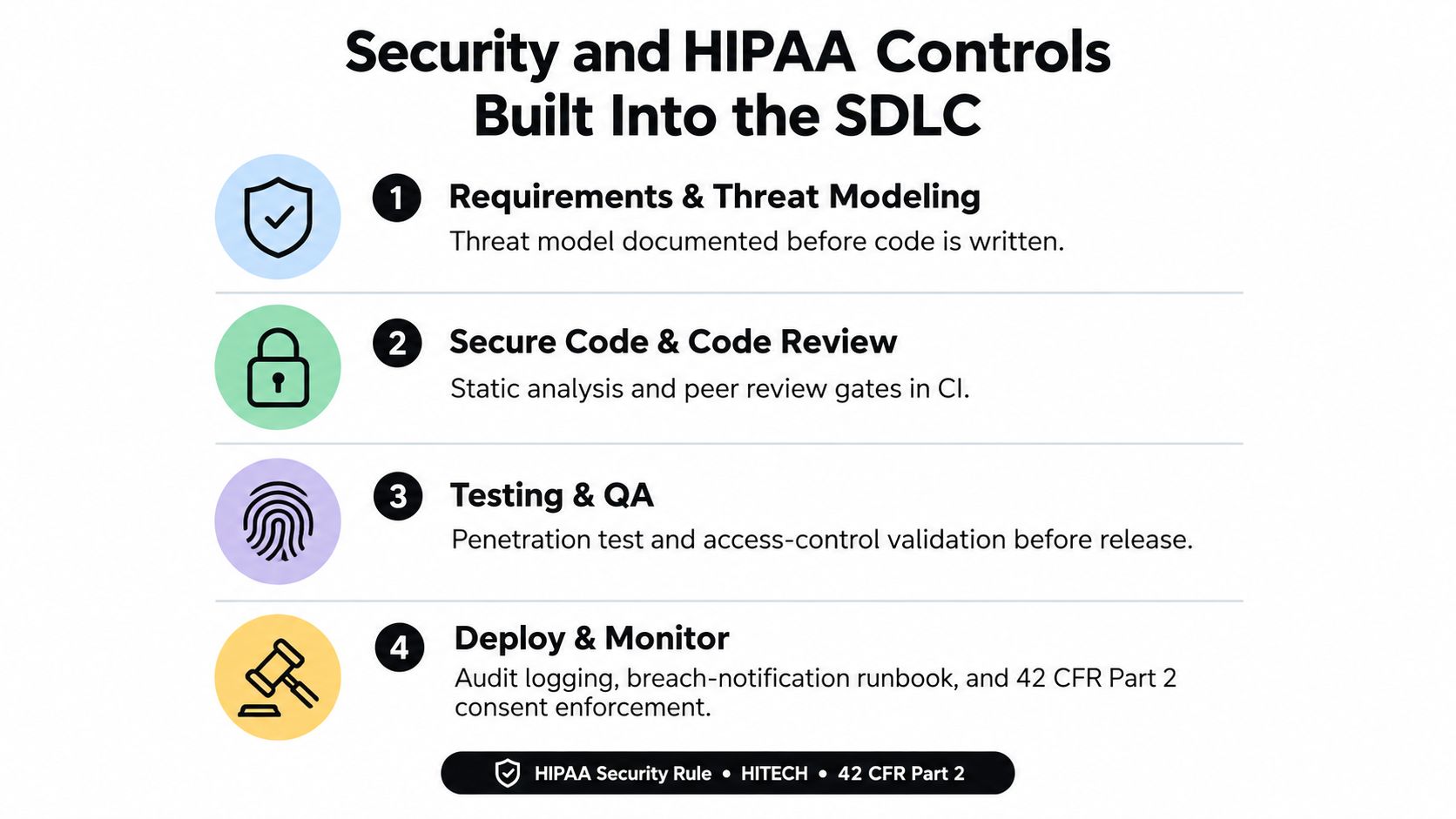
Security in EHR work has to be built into the SDLC, because the attack surface grows as soon as you expose APIs, third-party apps, or support tooling. Authoritative guidance says HIPAA requires “reasonable and appropriate” administrative, physical, and technical safeguards for electronic protected health information, and FHIR-based guidance typically leans on OAuth 2.0, OpenID Connect, TLS in transit, least privilege, and strong audit trails security architecture guidance. The point isn't to bolt on controls before launch, it's to make them part of design, code review, and release gates.
A practical security SDLC for an EHR should include threat models before code is written, STRIDE-style reviews during design, SAST and dependency scanning in CI, and immutable audit events for every PHI touchpoint. Authentication should stay separate from authorization, support teams should use just-in-time access, and break-glass access needs explicit logging and review. PHI should also be segmented in logs so support teams don't accidentally expose sensitive data while debugging.
If your product uses external apps, scope management matters as much as MFA. OAuth2 scopes for clinical apps, federation with enterprise identity providers, field-level encryption at rest, and short-lived tokens all reduce exposure when integrations multiply. Teams that need to align these controls with broader SaaS expectations often compare HIPAA requirements to SOC 2 or HITRUST obligations, then design to the stricter buyer profile.
For teams mapping the broader compliance stack, the Loopfour piece on HIPAA compliant AI tags is a useful reminder that classification and governance matter as soon as automated workflows touch PHI. That's especially relevant if you're planning AI-assisted charting, routing, or documentation.
Audit checklist: auditors usually want the threat model, access policy, logging evidence, incident response runbook, and proof that support access is controlled and reviewed.
If you're considering a regulatory compliance partner, make sure the person owning the engagement can discuss actual access paths, audit trails, and release controls, not just policy language. For healthcare software, security only works when it's embedded in the way the product is shipped.
A difficult EHR launch usually fails on operational cost, not standards compliance. Moving records is the easy part. Preserving identity, mapping clinical meaning, and keeping integrations alive after go-live is where budgets get consumed.
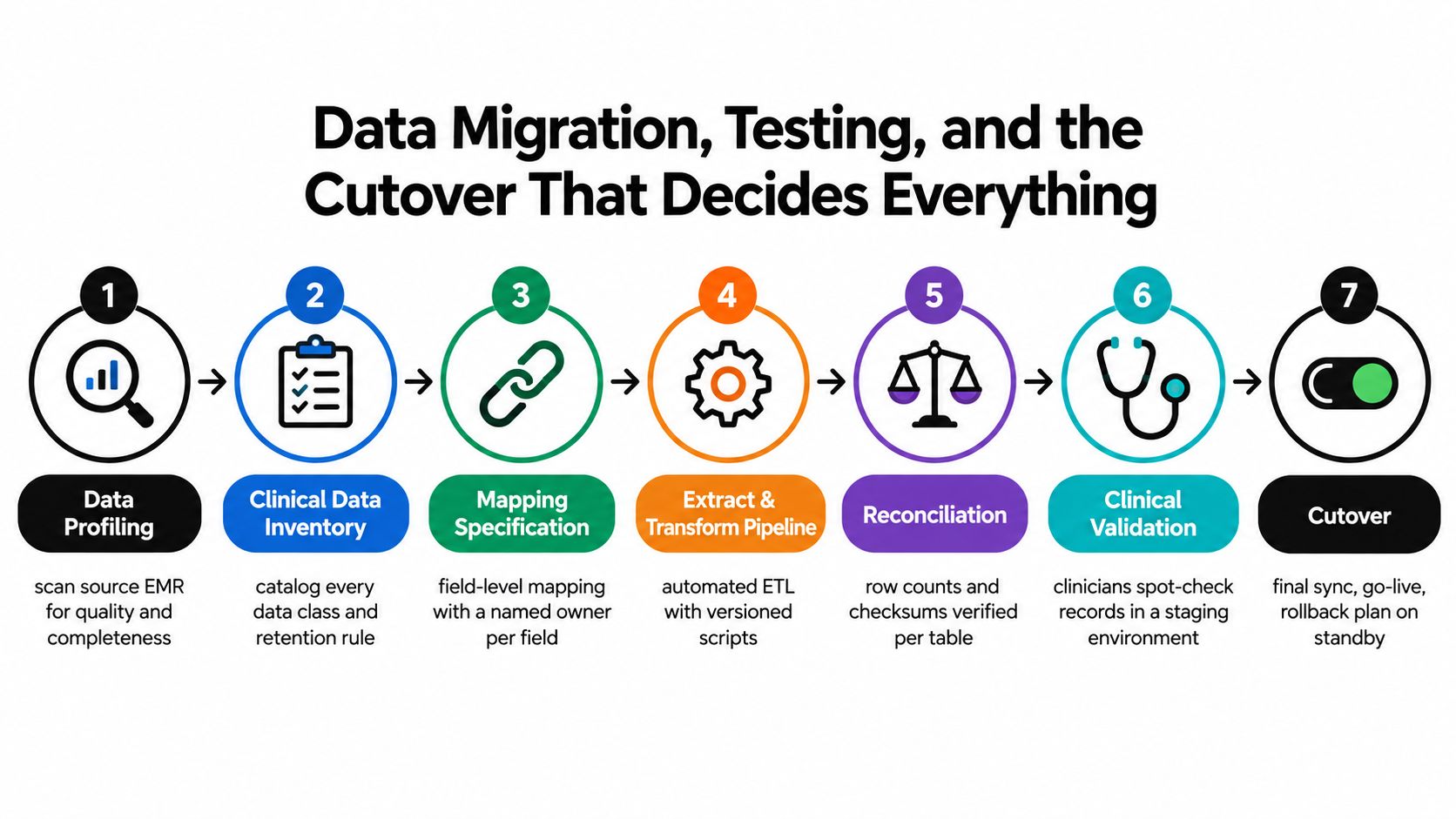
A workable migration process starts with source profiling, then a clinical data inventory, then field-level mapping with a named owner for each field. After that comes the extract and transform pipeline, reconciliation, shadow run, and final cutover with rollback criteria.
The failure points are predictable. Mapping specs go unowned, dual-keying happens during shadow runs because nobody shuts down the old path cleanly, orphan results never get routing rules, and cutovers get scheduled against clinician productivity instead of operational reality. Once that happens, the team spends the first weeks after go-live doing manual triage instead of building confidence.
Testing needs the same discipline. Unit tests should validate FHIR resource builders, contract tests should cover each connected system, integration tests should run synthetic cohorts, performance tests should mimic peak clinic load, and UAT has to be led by clinicians on real workflows. If the system cannot survive real charting behavior in staging, it will not behave at go-live.
The seven-step workflow below is the practical order that keeps teams honest:
If the team needs help with extraction and mapping, an AI-powered data extraction engine can reduce manual handling, but it still needs human validation. Legacy records still need explicit migration rules, reviewable mappings, and audit-ready outputs.
The cutover decision should be simple. If reconciliation is drifting, clinicians are still dual-entering data, or shadow-run issues have not been closed, do not cut over yet. Roll back, fix the mapping, and keep the old path live until the data matches the workflow.
The hardest EHR skills are scarce, and that should change how you staff the program. FHIR modeling, HIPAA-grade engineering, and clinical workflow design aren't generic backend tasks, they're specialized capabilities that tend to break when they're spread too thin across a general software team. That's why the build-vs-buy question often becomes an in-house-vs-partner question.
A credible healthtech engineering partner should be able to show prior ONC-aligned work, named clinical informaticists, production HL7/FHIR integrations, and a security program that can survive both BAA and SOC 2 review. You also want clear ownership of migration planning, because vague “we'll help move the data” language usually means the hard work hasn't been priced yet.
There are a few red flags I'd probe immediately.
| In-House Team vs. Healthtech Engineering Partner | In-House Team | Healthtech Engineering Partner |
|---|---|---|
| Domain depth | Varies by hiring success | Usually stronger in healthcare workflows |
| Speed to staffing | Slow for niche talent | Faster access to specialized skills |
| Compliance maturity | Depends on internal leadership | Often more repeatable across projects |
| Integration experience | Can be uneven | Should include production HL7/FHIR work |
| Post-launch support | Fully internal responsibility | Can share on-call and stabilization duties |
A partner is useful when they're willing to share the operational burden after launch, not just hand over code. If you're evaluating options, ask who gets paged when an interface breaks, who owns the audit trail review, and who updates the mapping when the source system changes.
A sane delivery plan starts with compliance scoping and discovery, moves into architecture and a FHIR prototype, then into secure build and integration hardening, and only then reaches pilot migration and go-live. That sequence matters because the most expensive mistakes happen when teams push regulation and integration to the end. A threat model, conformance evidence, a penetration test report, and a cutover runbook should each exist before the project moves forward.
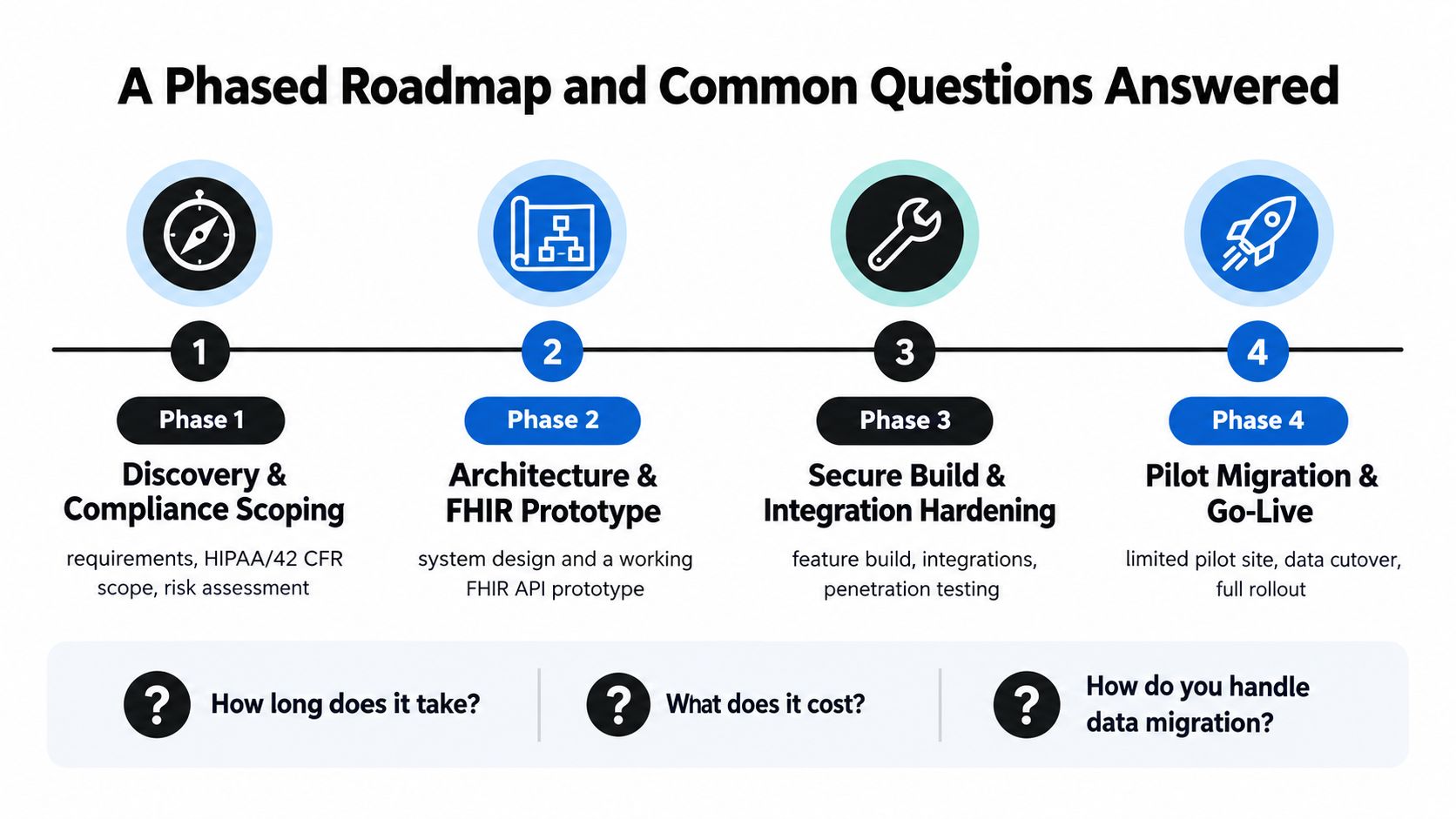
A few questions come up every time.
How long does it take? It depends on scope, integrations, and certification needs, but healthcare projects rarely stay small once real workflows are included.
Does every EHR need ONC certification? No, but anything sold into regulated healthcare markets should be evaluated against the certification and access rules that apply to its use case.
How do you handle legacy HL7v2 and FHIR together? Keep HL7v2 where the dependency is real, and bridge it carefully while the target state is modeled around FHIR.
If you want a practical planning artifact, a Custom AI Strategy report can help clarify where automation fits in the stack without overcommitting the clinical core. And if your team needs support in the middleware, internal tooling can reduce the manual effort around reconciliation, monitoring, and support workflows.
For teams mapping future enhancements, real-world use cases are more useful than abstract roadmaps because they show where the operational burden sits. If you're still shaping the team, our expert team is the right place to see who's available to help with healthcare delivery software.
If you're planning an EHR build or trying to stabilize one that's already live, Ekipa AI can help you scope the integration, compliance, and workflow work before the budget gets locked. Visit Ekipa AI to review how the team approaches healthcare software, then use that conversation to pressure-test your architecture, migration plan, and launch path.
Master branch deep links for healthcare apps. Learn SDK setup, routing, deferred deep linking, and mobile/desktop behavior
A practical engineering guide to HIPAA compliance on AWS. Covers BAA, shared responsibility, encryption, audit logging, and AI workload governance.

Plan healthcare software modernization with a practical roadmap covering assessment, re-architecture, migration, and compliance for legacy systems.
Connect with our team to explore how AI expertise can transform your business.