Healthcare App
Branch Deep Links Guide for Healthcare Apps
Master branch deep links for healthcare apps. Learn SDK setup, routing, deferred deep linking, and mobile/desktop behavior
October 04, 2026Read more
Plan healthcare software modernization with a practical roadmap covering assessment, re-architecture, migration, and compliance for legacy systems.
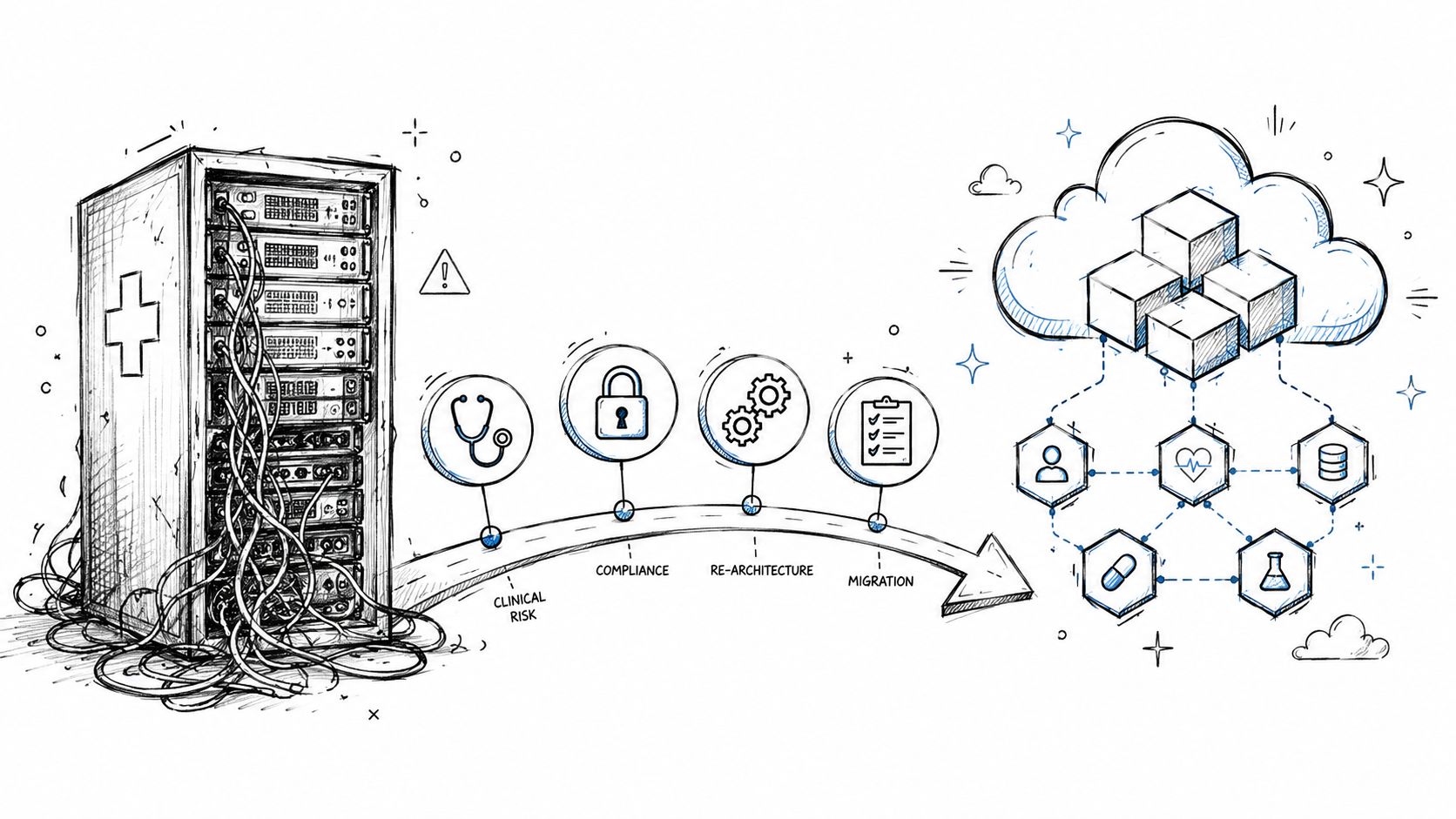
A newly hired CIO discovers that the hospital's most important clinical workflows depend on an aging EHR, unsupported infrastructure, undocumented interfaces, and a small group of engineers who know how the whole system works. Clinicians have built workarounds around the gaps. Finance relies on extracts nobody wants to change. Every proposed improvement appears to create another dependency.
That situation is common, but the standard response is usually wrong. Healthcare software modernization isn't a procurement exercise and it isn't a glamorous rewrite. It's an operating-model redesign that must protect patient care while changing how applications, data, teams, vendors, and compliance controls work together. The safest sequence is contain, connect, then replace.
The CIO in this situation may be tempted to write a large RFP for a replacement EHR and declare the legacy estate finished. That move feels decisive, but it often transfers the risk into a larger, more concentrated program. A hospital can replace a platform and still retain the same broken ownership, duplicate workflows, weak data governance, and untested downtime procedures.
The case for modernization is still strong. Since 2009, hospital EHR use increased 10-fold, while physician EHR use increased 5-fold, and certified EHR adoption reached 96% of U.S. hospitals by 2021. That history shows that digitization is no longer the central problem. The harder problem is making digital systems exchange usable data safely and support care at scale, as documented in this peer-reviewed review of EHR adoption and interoperability.
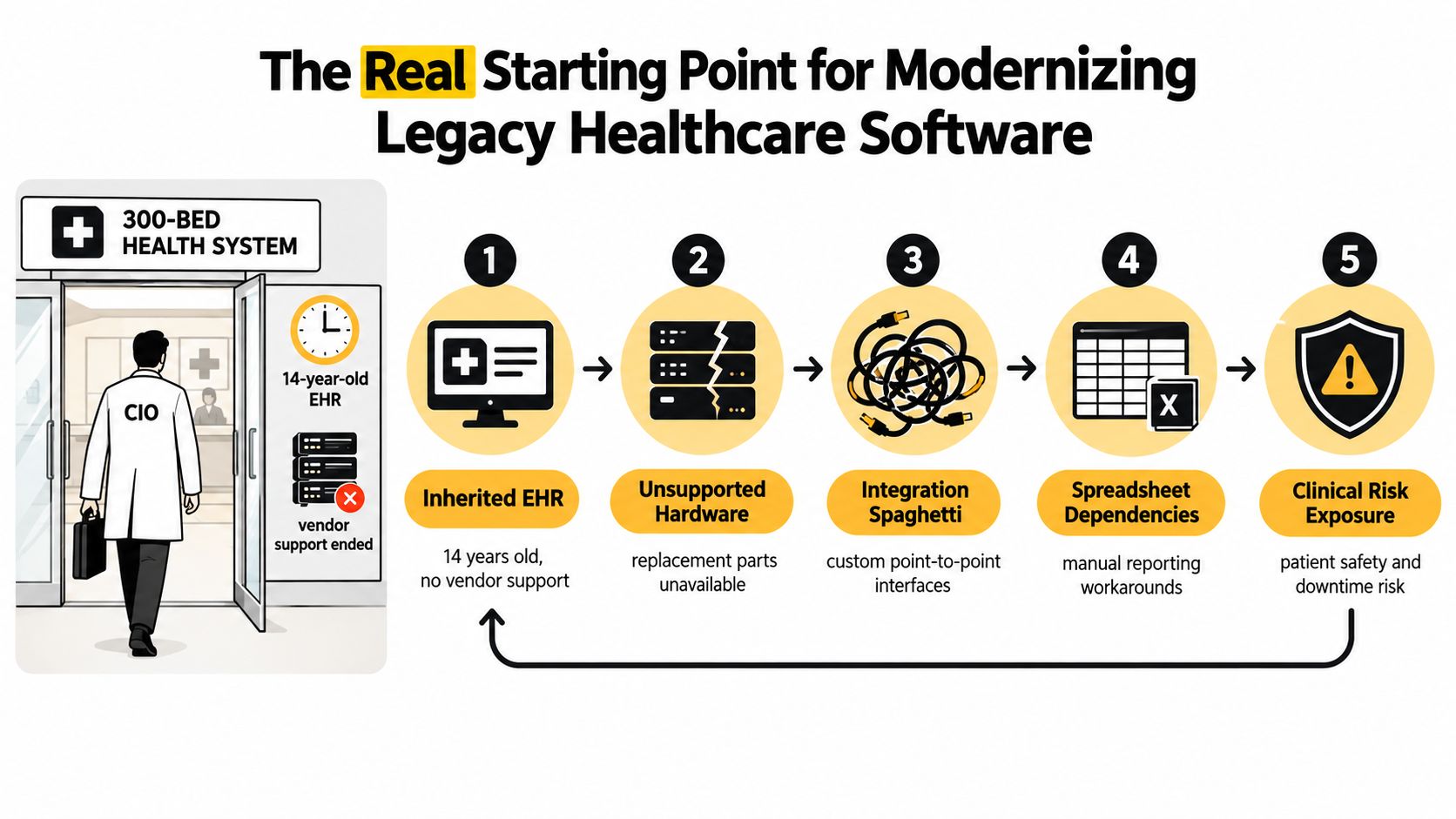
Contain means stabilizing the current estate. Freeze undocumented interface changes, identify unsupported components, centralize credentials, document downtime procedures, and establish ownership for every critical workflow. Don't start by building a new patient portal if the existing system can't reliably expose medication, allergy, or appointment data.
Connect means creating a controlled integration fabric around the legacy platform. That can include an interface engine, API gateway, canonical data models, event monitoring, and explicit rules for which system owns each record. The point isn't to make the old system modern. The point is to stop every new capability from becoming another point-to-point dependency.
Replace means moving individual workloads after their clinical, technical, and compliance risks are understood. Start with bounded capabilities, not the most tightly coupled clinical documentation workflow.
The ROI tips for legacy modernization resource from Technovation LLC is useful when building the financial case, but ROI shouldn't be calculated only from infrastructure savings. Include avoided downtime, reduced reconciliation work, retiring redundant vendors, and the capacity recovered when clinical and IT teams no longer maintain fragile workarounds.
A capable Healthcare AI Services team should help you connect modernization decisions to clinical operations, not just recommend a cloud migration. The first question is not “Which platform replaces this one?” It's “Which risk must the organization remove before it can safely change anything else?”
A system inventory is not an assessment. A list of applications tells you what exists. It doesn't tell you which workflow will fail at 2 a.m., which database owns the patient identifier, or which interface carries an undocumented clinical dependency.
Use four lenses and score each major workload consistently. A simple scale of low, medium, and high is sufficient if the team defines the evidence required for each rating.
| Lens | Key Questions | Scoring Approach | Red Flags |
|---|---|---|---|
| Technical debt | Which runtimes, language versions, databases, and operating systems are unsupported? How much custom code exists? Which interfaces exchange the same message types? | Low means supported components, documented code, automated tests, and visible dependencies. Medium means partial documentation or upgrade friction. High means unsupported infrastructure, tribal knowledge, or tightly coupled point-to-point flows. | No named owner, no reproducible build, unsupported hardware, or an interface that only one person understands. |
| Clinical risk | Which clinical workflows depend on the system? What happens during downtime? Can staff continue safely, and how are delayed transactions reconciled? | Low means bounded impact and tested downtime procedures. Medium means operational disruption with manual recovery. High means direct impact on orders, results, medication, registration, or active encounters. | Unknown downtime tolerance, missing clinical sign-off, unsafe manual workarounds, or no patient-safety escalation path. |
| Data gravity | Where does PHI live? How does it move? Who owns master data? What retention and reconciliation obligations apply? | Low means mapped flows, clear ownership, and validated quality. Medium means duplicate stores or incomplete lineage. High means unmapped PHI, conflicting identifiers, or historical records that cannot be reconciled. | Unowned master data, incomplete retention rules, undocumented extracts, or conversion mappings that have never been clinically reviewed. |
| Organizational readiness | Which skills are available? How much change fatigue exists? Who can make clinical decisions? Can leaders sustain a multi-year program? | Low means accountable owners, protected capacity, and an active clinical champion. Medium means competing priorities. High means no decision authority, weak sponsorship, or a team already operating at its limit. | A program funded only for implementation, no on-call model, no product owner, or executive disagreement about the target state. |
Don't average the scores into a comforting single number. A high clinical-risk score should constrain the architecture even if the application is technically easy to move. Likewise, a technically old system may be a reasonable candidate for replatforming if its workflows are stable, its data is understood, and its downtime impact is limited.
The assessment should produce four concrete outputs:
Historical data deserves special attention. In a large healthcare and life-sciences modernization study, 50% of legacy applications were expected to modernize within two years, and 70% to 90% within five years. The same study highlights data conversion as a major failure point, particularly when historical records aren't fully mapped. That risk is not administrative. Losing clinical history can affect patient safety and continuity of care, as detailed in the Infosys healthcare and life-sciences modernization study.
There is no prize for choosing the most fashionable architecture. Choose the path that matches the workload's clinical risk, coupling, data condition, team capability, and validation burden.
| Path | Best Fit | Transition Risk | Skill Demand | Validation Cost | Choose When |
|---|---|---|---|---|---|
| Strangling | A stable legacy capability that must remain continuously available while new behavior is introduced around it | Controlled but persistent, because old and new paths coexist | Strong integration, observability, testing, and domain skills | High for each workflow boundary, but distributed over time | The workload is safety-critical, tightly coupled, and impossible to take offline safely |
| Replatforming | A reporting, data, or administrative layer whose behavior can remain mostly unchanged | Moderate, with concentration around infrastructure, performance, and data movement | Platform engineering, migration, security, and operations | Moderate if behavior remains stable, higher if hidden dependencies emerge | The application works but its infrastructure, scalability, or support model is the liability |
| Microservices | New patient-facing capabilities, analytics services, and bounded domain functions | High if boundaries are poorly defined or clinical transactions are split prematurely | Advanced distributed-systems, security, testing, and platform skills | High because every service and integration adds validation scope | The domain boundary is clear, the team can operate distributed systems, and the capability is not the first target for core documentation replacement |
A strangler approach places a new service or interface around a selected capability while the legacy function remains available. A scheduling search layer, for example, might first read from an approved data service while booking remains in the existing system. The team can then move behavior in controlled slices.
Its failure mode is coexistence without retirement. If nobody defines exit criteria, the organization ends up operating two systems indefinitely.
Replatforming can move a data warehouse, reporting service, or application runtime to a more supportable environment without changing every business rule. It's useful when the software still performs its job but the underlying hardware, operating system, or hosting model creates unacceptable risk.
It won't simplify a bad workflow or resolve unclear data ownership. Treat it as a risk-reduction move with a defined next decision, not as proof that modernization is complete.
Microservices can work well for a patient-facing notification service, an analytics pipeline, or a bounded workflow with a clear owner. They're a poor opening move for core clinical documentation when the team hasn't established transaction ownership, audit behavior, resilience patterns, and clinical validation.
Decision rule: If a workload is safety-critical and tightly coupled to legacy data, contain and connect first. If it is high-friction and patient-visible, modernize on the edge first.
Migration is clinical-risk management, not a deployment event. A successful plan gives clinicians a safe way to validate behavior, gives engineers a tested rollback path, and gives executives a clear threshold for stopping the cutover.
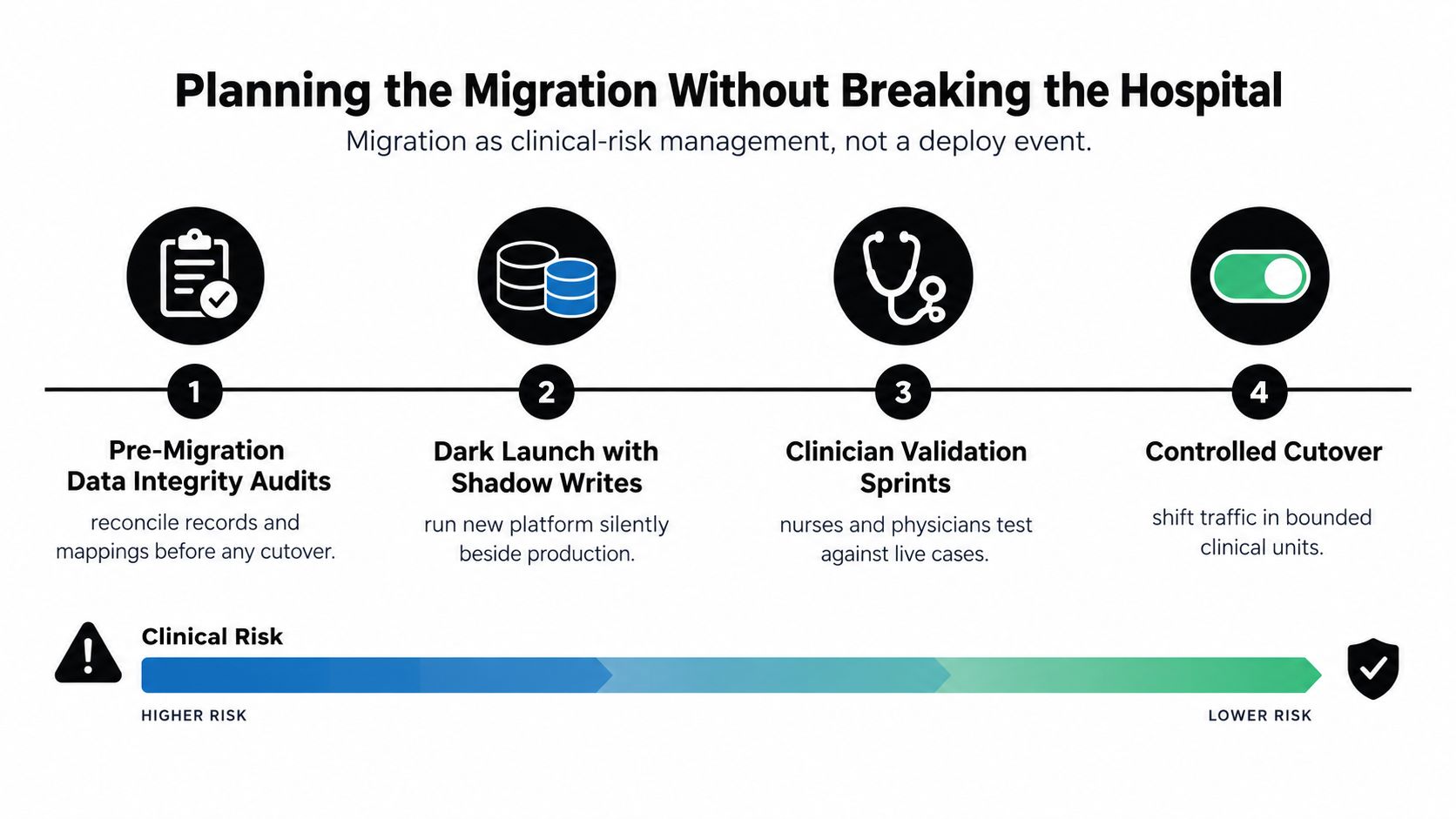
Phase one, audit data before migration. Reconcile patient identifiers, record counts, code sets, timestamps, attachments, clinical terminology, and ownership. Run conversion tests against representative records, including incomplete, corrected, merged, and historical cases.
Phase two, launch dark with shadow writes. Run the new platform beside production without making it the system clinicians depend on. Where appropriate, send shadow transactions to test validation, latency, audit trails, and downstream interfaces. Don't allow shadow writes to create duplicate orders, claims, or notifications.
Phase three, rehearse the cutover. Perform the procedure with the teams, dependencies, communications, access controls, interface throttling, and recovery scripts. Define the rollback window in writing. The clinical informatics lead must have authority to stop the change when observed behavior threatens patient safety.
Phase four, provide hypercare. Staff a command center, monitor transactions and queues, review clinical incidents, and keep escalation routes visible. Hypercare ends only when the new workflow is stable, support ownership is clear, and unresolved defects have a documented disposition.
Move read-only reference data before transactional data. Then address non-clinical workflows, followed by revenue-cycle processes, and leave active clinical encounters until the organization has evidence that the new path behaves correctly.
Run EHR endpoints in parallel where the architecture permits it. Throttle the interface engine so a replay or routing error doesn't create an HL7 message storm. Set a formal change window, freeze unrelated releases, and define patient-safety escalation paths before anyone touches production.
A disciplined AI Product Development Workflow can support the engineering side of this work, but clinical validation must remain owned by people who understand the care process. Automated tests can prove that a transformation behaves consistently. They can't decide whether a nurse can safely complete the workflow during a busy shift.
HIPAA, GDPR, SOC 2, and ISO 27001 shouldn't appear at the end as a checklist for audit preparation. They should shape the architecture, evidence model, release process, and data flows from the first assessment.
The most valuable artifact is a PHI data-flow map. It should show where protected data enters, where it is transformed, where it is stored, which services can access it, how long it remains there, and what evidence proves the controls work. A practical healthcare software modernization compliance guide also emphasizes documenting access controls, test results, security checks, release approvals, data flows, and remediation actions.
| Lifecycle Phase | HIPAA | GDPR | SOC 2 | ISO 27001 |
|---|---|---|---|---|
| Assessment | Identify PHI systems, business associates, access risks, and required safeguards | Determine processing purpose, lawful basis, data-subject considerations, and DPIA needs | Define control scope and evidence owners | Establish asset inventory, risk treatment, and information-security scope |
| Re-architecture | Design least-privilege access, encryption, and resilient services | Minimize data, control transfers, and manage processor responsibilities | Define secure development, change management, and availability controls | Map architecture to risk treatment and documented operating procedures |
| Migration | Protect extracts, validate access, preserve auditability, and control break-glass access | Prevent unauthorized transfer or retention during conversion | Evidence test results, approvals, incidents, and exceptions | Record migration risks, controls, and acceptance decisions |
| Post-cutover | Monitor access, disclosures, incidents, and recovery | Monitor rights, retention, transfer, and processor obligations | Operate continuous control monitoring and remediation | Run internal reviews, corrective actions, and continual improvement |
Security mechanics must be explicit. Use role-based identity and access management, encryption in transit and at rest, immutable auditability for sensitive transactions, environment segregation, and monitoring for abnormal access or data movement. These controls are described in this overview of healthcare platform modernization security practices.
Three failures deserve special attention:
For regulated clinical products, SaMD solutions should be evaluated with the same lifecycle discipline as any other software component. Modernization changes the evidence trail, so update validation plans, release approvals, incident handling, and audit ownership at the same time as the code.
A new architecture creates new responsibilities. If leadership doesn't assign them, the old organization will fill the gaps informally, usually through personal workarounds and escalating on-call fatigue.
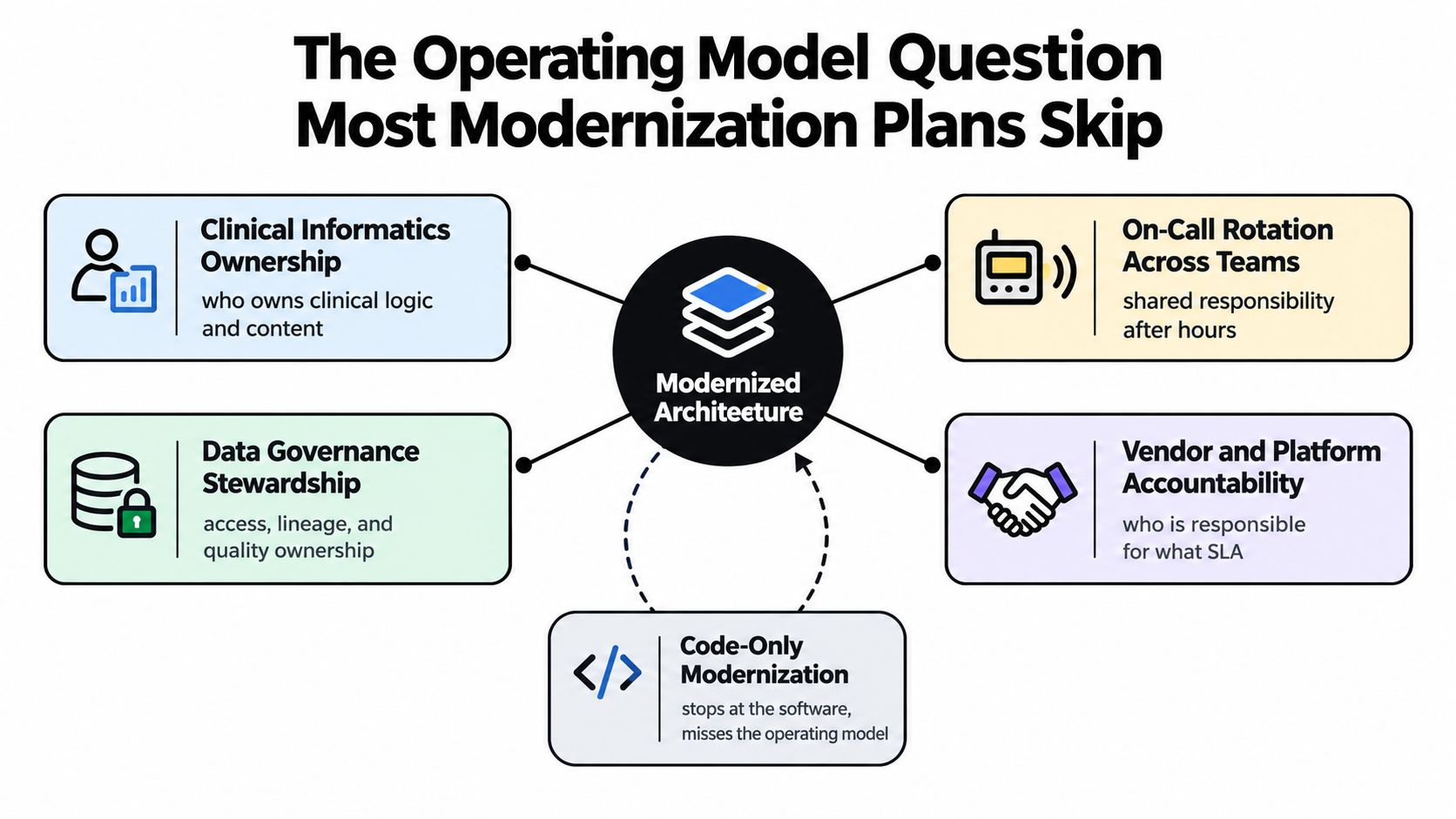
Clinical informatics needs an explicit owner for clinical logic, terminology, content, and workflow acceptance. Engineering needs a support model that covers both the remaining legacy estate and the modernized services. Data governance needs named stewards for lineage, access, quality, and master-data decisions.
Vendor accountability must also change. A modernization program should identify which suppliers own infrastructure, interfaces, clinical content, security controls, support response, and data extraction. If two vendors provide overlapping capabilities, decide whether to consolidate, extend one platform, or retain both for a defensible reason.
Budget constraints are the top barrier to change for 85% of healthcare technology leaders in a 2026 survey. Integration with existing systems is a key platform-selection factor for 74%, while 31% were actively exploring vendor consolidation, according to the APHL data modernization survey report. Those findings reinforce a practical point: modernization must reduce coordination burden, not add another collection of point solutions.
Every strangled capability is an opportunity to remove something unnecessary. Delete a duplicate form. Retire a midnight reconciliation job. Eliminate a manual spreadsheet that exists only because two systems disagree about ownership. Don't preserve a bad process merely because it has become familiar.
Public health and laboratory environments show why this matters. Legacy LIMS, incompatible data formats, limited instrument connectivity, and the cost and risk of replacement remain major barriers to modernization. A healthcare software development trends analysis also describes legacy technology as widespread and recommends a containment-first approach rather than assuming every organization can afford a full replacement.
A contained and connected platform can produce useful operating improvements before the core system is replaced. A rushed replacement can take years while leaving the same fragmented ownership in place. Judge the program by the workflows retired, risks removed, and decisions clarified, not by the number of services deployed.
The first 90 days must produce an investment-grade modernization program, not another strategy deck. Organize the work into four two-week sprints. Use the remaining time to resolve open decisions, budget the first workstream, and secure executive approval.
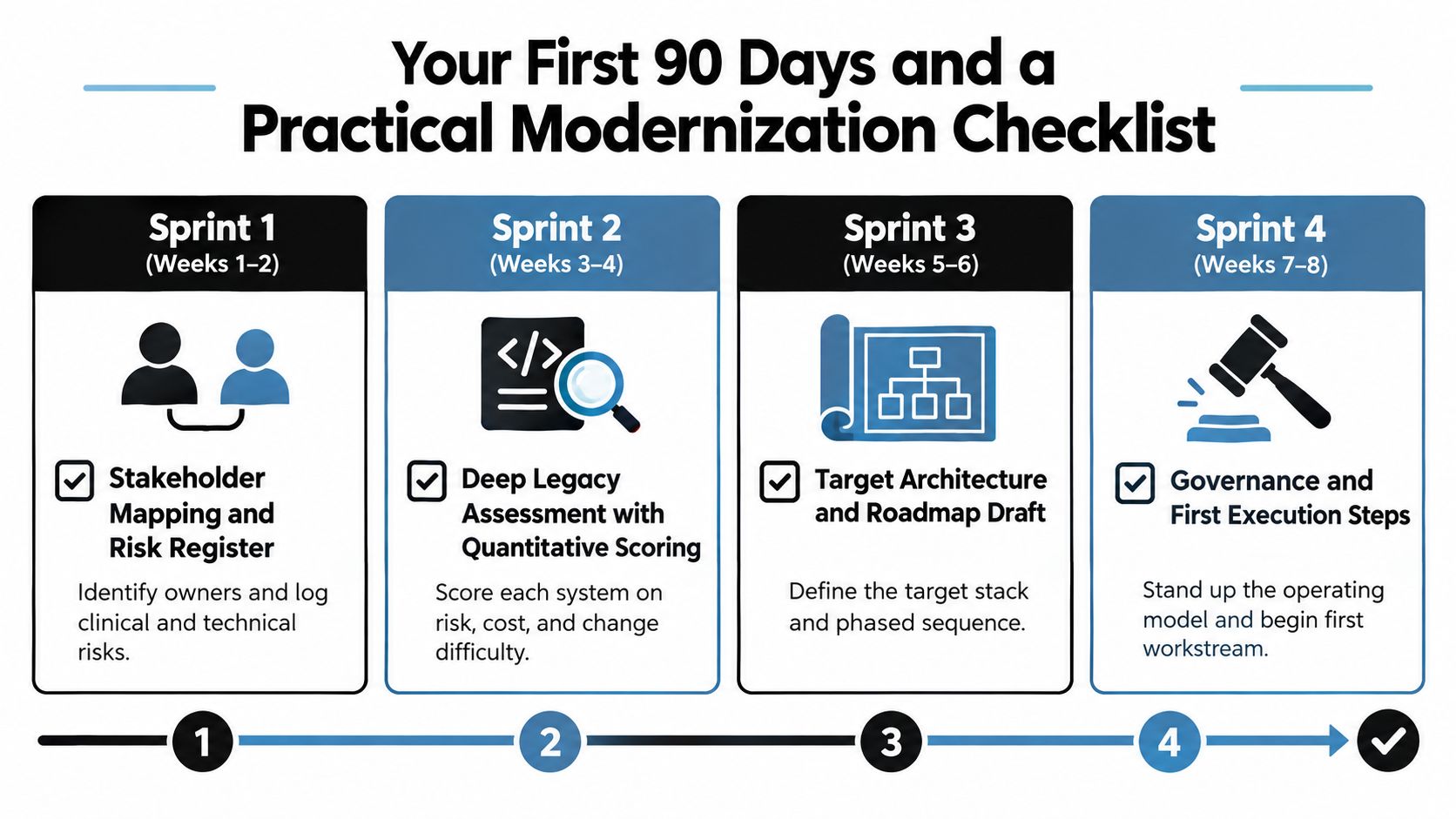
Map executives, clinical leaders, application owners, vendors, security, compliance, finance, and frontline users. Create a risk register with an owner, evidence, impact, and next action for every material risk. Give each critical workflow a clear escalation route before architecture decisions begin.
Exit criterion: Each critical workflow has a named business owner, technical owner, clinical reviewer, and escalation route.
Run the four-lens assessment across technical debt, clinical risk, data gravity, and organizational readiness. Record unsupported components, undocumented dependencies, PHI flows, data-quality concerns, downtime requirements, and skills gaps. Tie each finding to a decision, rather than collecting observations that cannot change the roadmap.
Exit criterion: Leadership can see which workloads should be contained, connected, replatformed, strangled, replaced, or retired.
Draft the target architecture and sequence the roadmap around clinical risk. Add compliance checkpoints for data flows, identity, encryption, auditability, retention, vendor contracts, and validation. Define the first bounded workload, its dependencies, and the conditions that make it safe to proceed.
Exit criterion: The target state includes ownership, interfaces, data boundaries, testing, rollback, and operating costs.
Turn the roadmap into a budgeted business case. Assign the first delivery team, establish governance, confirm the change window, and identify the clinical champion who can stop unsafe work. Include vendor-consolidation decisions and a twelve-month roadmap artifact that executives can review without technical translation.
Exit criterion: The organization has approval, accountable owners, a funded first workstream, and a measurable decision gate for the next investment tranche.
Use this checklist before implementation:
Healthcare software modernization changes how the organization operates. Contain risk first, connect the estate with discipline, then replace only what the evidence supports. Review our expert team before selecting an execution partner.
Master branch deep links for healthcare apps. Learn SDK setup, routing, deferred deep linking, and mobile/desktop behavior
A practical engineering guide to HIPAA compliance on AWS. Covers BAA, shared responsibility, encryption, audit logging, and AI workload governance.
Clarify the distinction between ai agent vs agentic ai and learn practical implications for healthcare design, governance, and real-world deployment.
Connect with our team to explore how AI expertise can transform your business.