
AI in Healthcare
7 Biggest EMR Companies for HealthTech Partnerships
Compare the 7 biggest emr companies by platform strengths, weaknesses, market reach, and integration potential for digital health partnerships.
September 30, 2026Read more
Clarify the distinction between ai agent vs agentic ai and learn practical implications for healthcare design, governance, and real-world deployment.
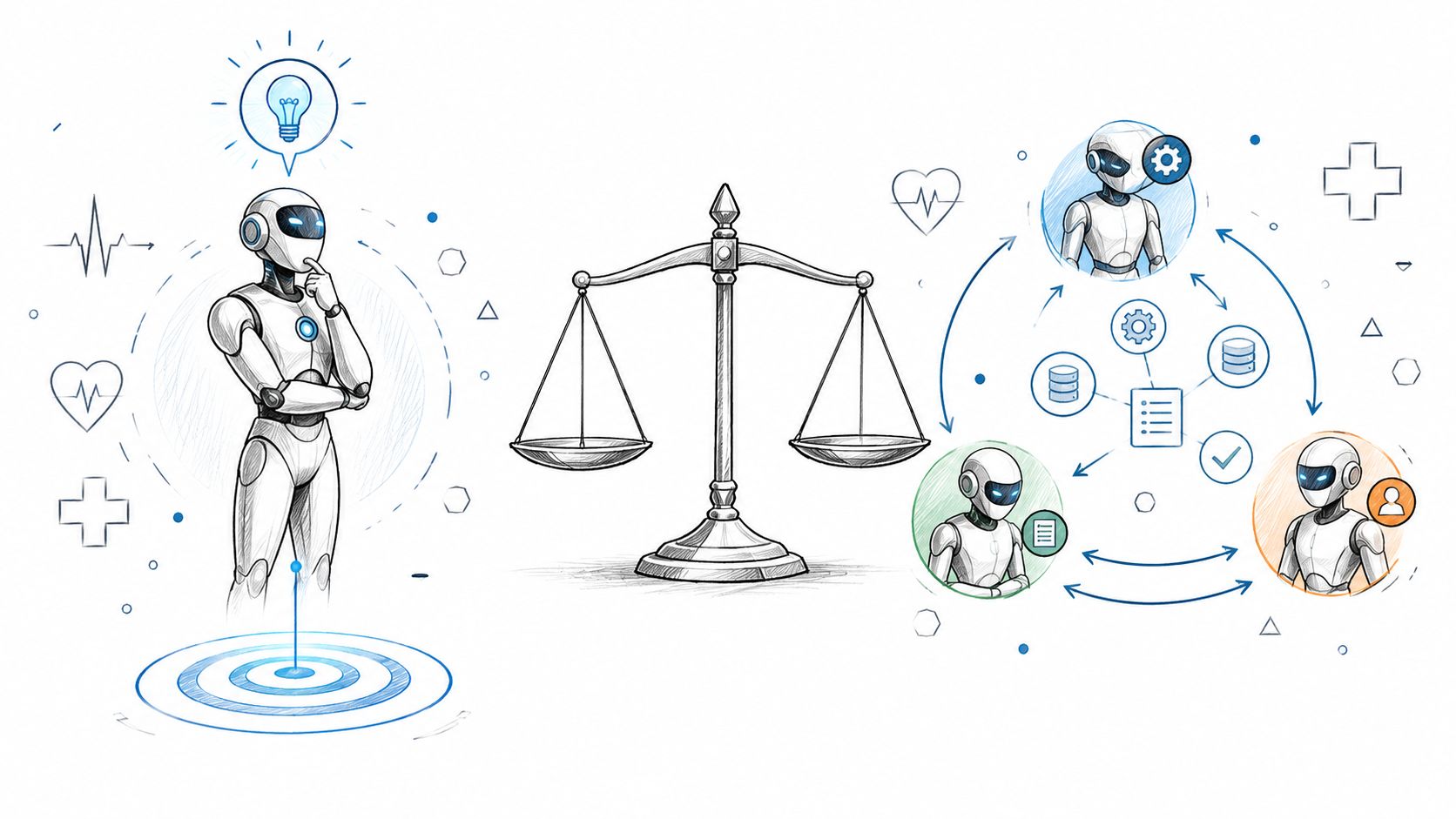
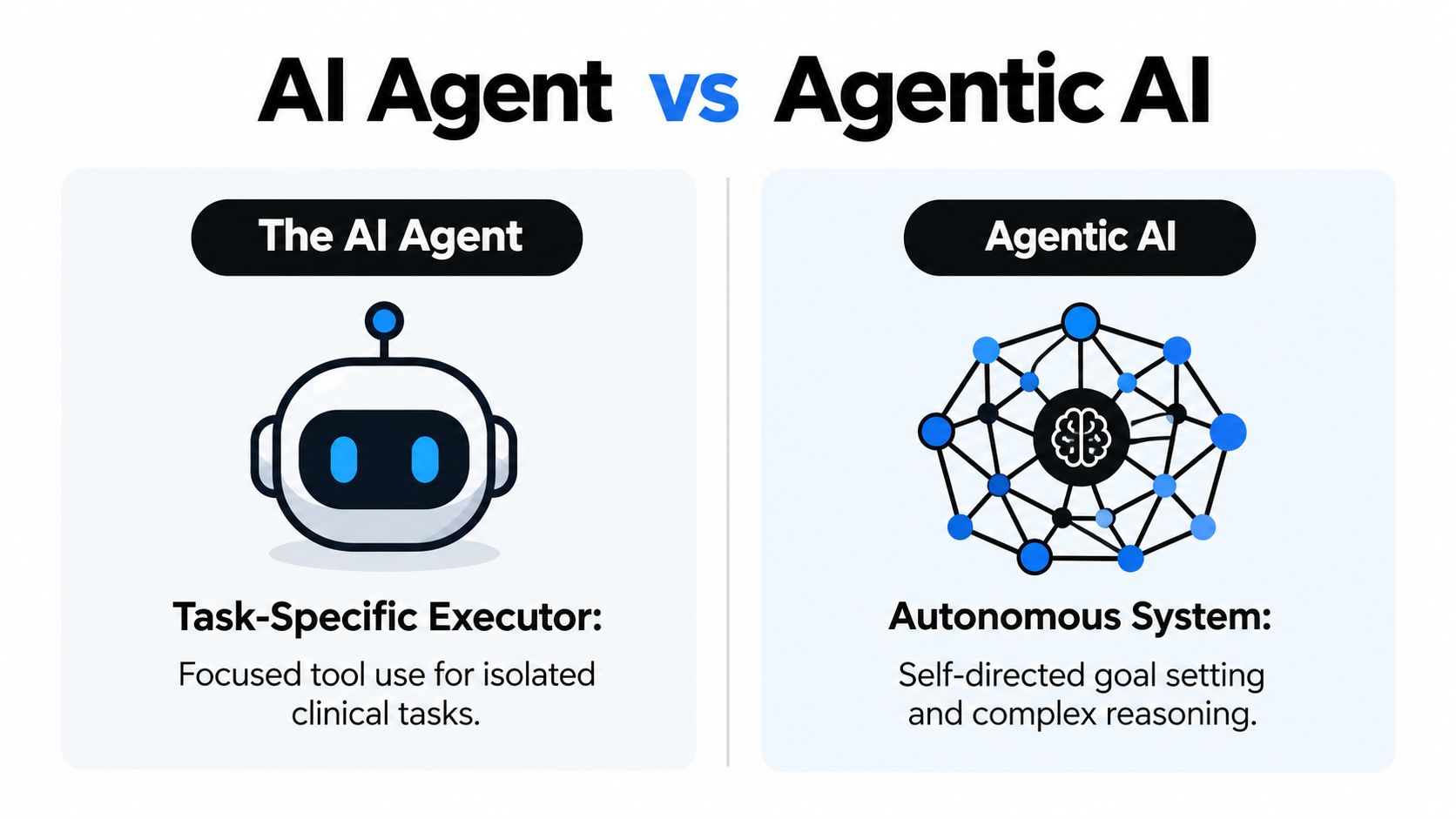
Single-agent systems held the largest share of healthcare deployments in 2024, while only 19% of healthcare respondents had reached agentic-AI maturity and 51% were still pursuing proofs of concept. An AI agent is usually a single autonomous system executing a specific goal, while agentic AI describes coordinated systems that orchestrate broader missions across workflows.
That distinction matters more than the terminology suggests. In a clinical environment, the question isn't whether a product is “autonomous.” The question is who owns the decision, which tools can be called, what happens when a handoff fails, and how the organization proves that the workflow stayed within policy.
The popular advice is to start with the most autonomous architecture available. That advice is often wrong for healthcare. A bounded agent that schedules an appointment, prepares a clinical brief, or drafts documentation can create useful operational value without assuming control over an entire care pathway. A multi-agent system may eventually support complex referral coordination or longitudinal care navigation, but it introduces more state, permissions, interfaces, audit events, and failure modes.
The practical choice in AI agent vs agentic AI isn't a contest between old and new technology. It's an architecture decision shaped by workflow boundaries, clinical risk, integration maturity, and the cost of proving that the system behaves correctly.
The terms are frequently treated as synonyms, which encourages product teams to specify a capability before they specify its boundaries. A single AI agent can perceive information, decide what to do next, use approved tools, and act toward a defined goal. Agentic AI generally describes the broader system around one or more agents, including planning, coordination, memory, adaptation, and workflow control.
A useful distinction is the level at which the system operates:
| Dimension | AI agent | Agentic AI |
|---|---|---|
| Primary role | Executes a specific goal or task | Coordinates broader goals across workflows |
| Typical architecture | One autonomous system with bounded permissions | One or more specialized agents with an orchestration layer |
| Planning | Local or limited multi-step planning | Decomposes missions into subtasks and manages dependencies |
| Context | A defined task, user, or system | Shared context across tools, teams, and workflow states |
| Governance burden | Easier to scope, test, and audit | More complex because of handoffs, routing, and recovery |
| Healthcare fit | Scheduling, documentation support, intake, or narrow triage | Care navigation, referral coordination, and cross-department workflows |
The distinction doesn't mean every agentic system must contain multiple independent models. It means the system owns coordination at the workflow or outcome level. A collection of disconnected agents isn't automatically agentic AI. Without shared state, routing logic, permissions, and recovery behavior, the organization has separate automations, not a coherent operating system for work.
A single agent might retrieve a patient's approved history, classify an intake request, or draft a follow-up message for human review. Product owners can usually define its input, permitted tools, output, escalation path, and evaluation set without modeling an entire enterprise process.
An agentic system needs a different product specification. The team must define how the system interprets the overall goal, selects agents, preserves context, handles conflicting outputs, retries failed actions, and stops when a policy boundary is reached. That is why pipeline-moving AI workflows are best evaluated as operating processes, not just as prompts with more autonomy.
Practical rule: If you can't draw the workflow's permissions and escalation points on one page, the system is probably too broad for an initial clinical deployment.
For a patient-facing conversational experience, an AI chat assistant may be an appropriate bounded component. It can answer within an approved knowledge scope, collect information, and route a case. It must not become a care coordinator with authority to change appointments, interpret clinical risk, and trigger downstream actions unless those capabilities have been separately designed and validated.
That is the central answer to AI agent vs agentic AI. The agent is a building block. Agentic AI is the coordinated environment that turns building blocks into a longer-running mission.
Accuracy is necessary, but it isn't a sufficient release criterion for healthcare AI. A fluent answer can conceal a wrong tool choice, an invalid parameter, an omitted handoff, or an action taken outside the system's authorization. Evaluation must cover the complete system, including what it did before producing the final response.
Enterprise guidance commonly divides agent evaluation into outcome, trajectory, reasoning, safety and compliance, and efficiency dimensions. Outcome measures include task completion rate, goal accuracy, and final-answer correctness. Trajectory measures include tool-call accuracy, argument accuracy, and step order, which reveal whether the system reached a good result through an acceptable path. The Hugging Face guidance on evaluating AI agents provides this complete-system framing.
For a single agent, evaluation can stay close to the task boundary. A scheduling agent should be tested on whether it identifies the right appointment type, checks the correct availability source, applies scheduling rules, and requests human intervention when the request is ambiguous. A documentation agent should be assessed for faithful extraction, missing information, source traceability, and correct handling of uncertainty.
A practical test set should include:
These tests should run against ordinary cases and deliberately difficult cases. Include incomplete forms, conflicting records, unavailable systems, ambiguous patient language, and requests that appear routine but cross a policy boundary.
Agentic AI adds system-level evaluation. The team now tests not only whether each specialist agent works, but whether the orchestrator assigns the right work, preserves state, reconciles outputs, and recovers from failure. A diagnostic agent can produce a technically sound result while the routing layer sends it to the wrong queue. A billing agent can follow its own rules while receiving incomplete context from a triage agent.
Operational KPIs also need to reflect behavior under load. AWS guidance describes latency as time to first token for streaming agents or end-to-end completion time for task-oriented agents, and describes throughput through concurrent sessions, sustained requests per second, and queue depth. It also emphasizes task completion, tool selection and parameter accuracy, grounding, and response faithfulness in quality evaluation. These measures support comparisons based on cost per successful task, latency budgets, and reliability under concurrency, rather than autonomy alone. See the AWS agentic AI performance guidance.
Compliance testing should sit beside performance testing. Log data access, tool calls, approvals, model outputs, retries, and escalation decisions. A production-ready healthtech agent must reliably complete tasks, choose the right tools, and remain within policy boundaries, because a fluent underlying model doesn't guarantee safe system behavior.
The architectural difference becomes clear when a workflow fails. In a single-agent design, one system generally owns the reasoning loop and tool interactions. Investigators can inspect its input, intermediate actions, permission set, and final output through a relatively direct audit trail.
Multi-agent orchestration distributes responsibility. A coordinator may plan the work, route subtasks to specialist agents, maintain state, send messages between them, retry failed operations, and recover when a step produces an unusable result. The architecture of AI agent orchestration highlights these workflow-layer responsibilities.
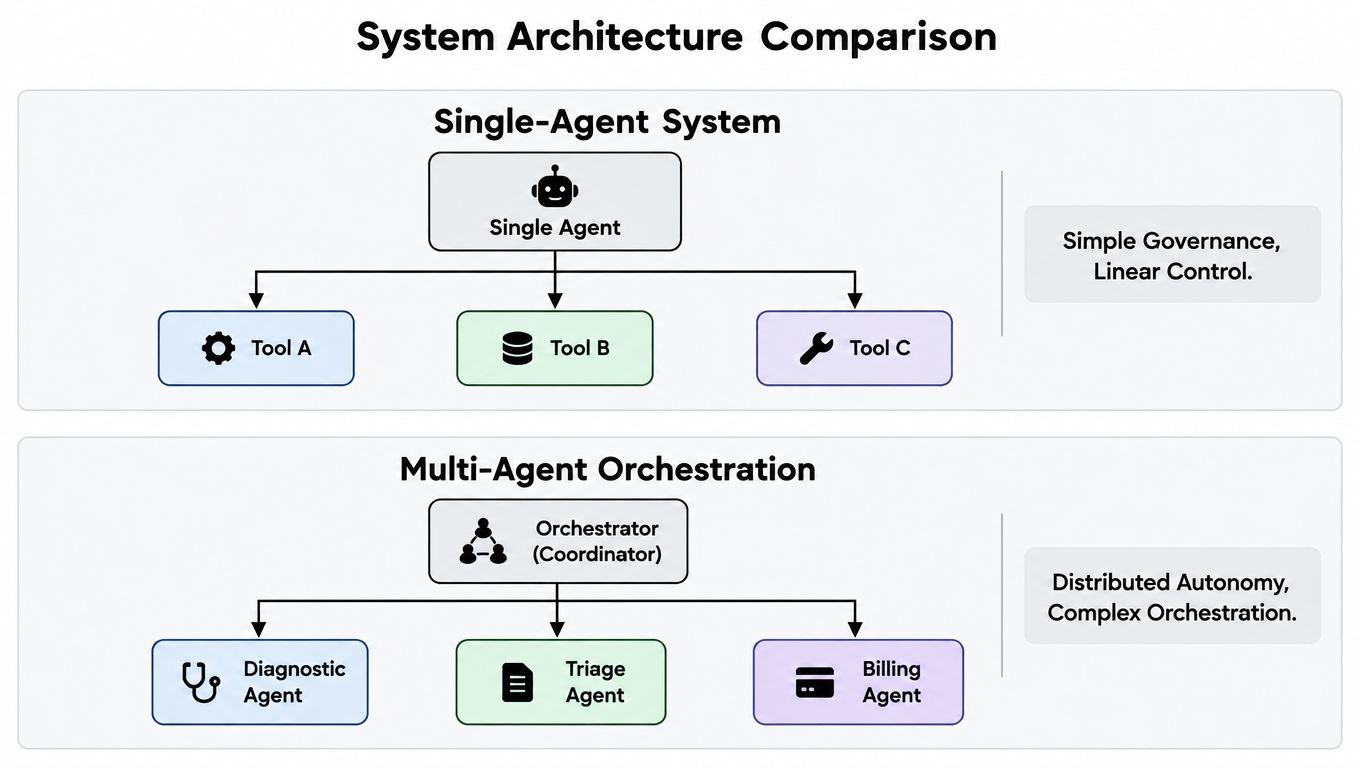
A single agent doesn't eliminate risk. It can still hallucinate, select an inappropriate tool, mishandle protected information, or take an action that should have required approval. Its advantage is containment. The team can narrow the data sources, limit the tools, define a clear failure state, and assign accountability to one workflow owner.
Multi-agent designs offer specialization. A triage agent can focus on intake signals, a diagnostic support agent can organize relevant information, and a billing agent can handle administrative rules. But every boundary creates an interface. The orchestration layer must decide what context to pass, how to resolve disagreement, and which agent is allowed to act.
For healthcare leaders, that produces a different risk profile:
| Control question | Single-agent concern | Multi-agent concern |
|---|---|---|
| Accountability | Did the agent make the wrong decision? | Which agent or coordinator caused the failure? |
| Context | Did it receive enough relevant information? | Was context lost or altered at a handoff? |
| Authorization | Did one tool call exceed its scope? | Did permissions remain consistent across agents? |
| Recovery | Can the agent stop and escalate? | Can the coordinator retry without duplicating actions? |
| Auditability | Is the decision path readable? | Can reviewers reconstruct distributed state and messages? |
Single-agent systems held the largest share in healthcare in 2024 because they were easier to deploy and scale than multi-agent architectures, according to the OECD report on the agentic AI landscape. That doesn't make them universally superior. It indicates that healthcare buyers often value governability and implementation control before they expand autonomy.
For teams evaluating productized automation, an example such as how Agentone works with WebinOne can help clarify the difference between a focused embedded capability and a broader automation environment. The same architectural test applies in healthtech: identify the owner of each action, the source of truth, and the recovery path before adding another agent.
A workflow automation implementation should therefore begin with explicit state transitions and approval points. Orchestration is valuable when the workflow requires it. It isn't valuable merely because a diagram with more agents appears more advanced.
A hospital intake workflow usually reveals the right architecture faster than a strategy workshop. A patient submits a request, the system identifies the service, checks required information, and routes the case. If the process stays within a narrow set of rules, a single agent can assist without owning the full care pathway.
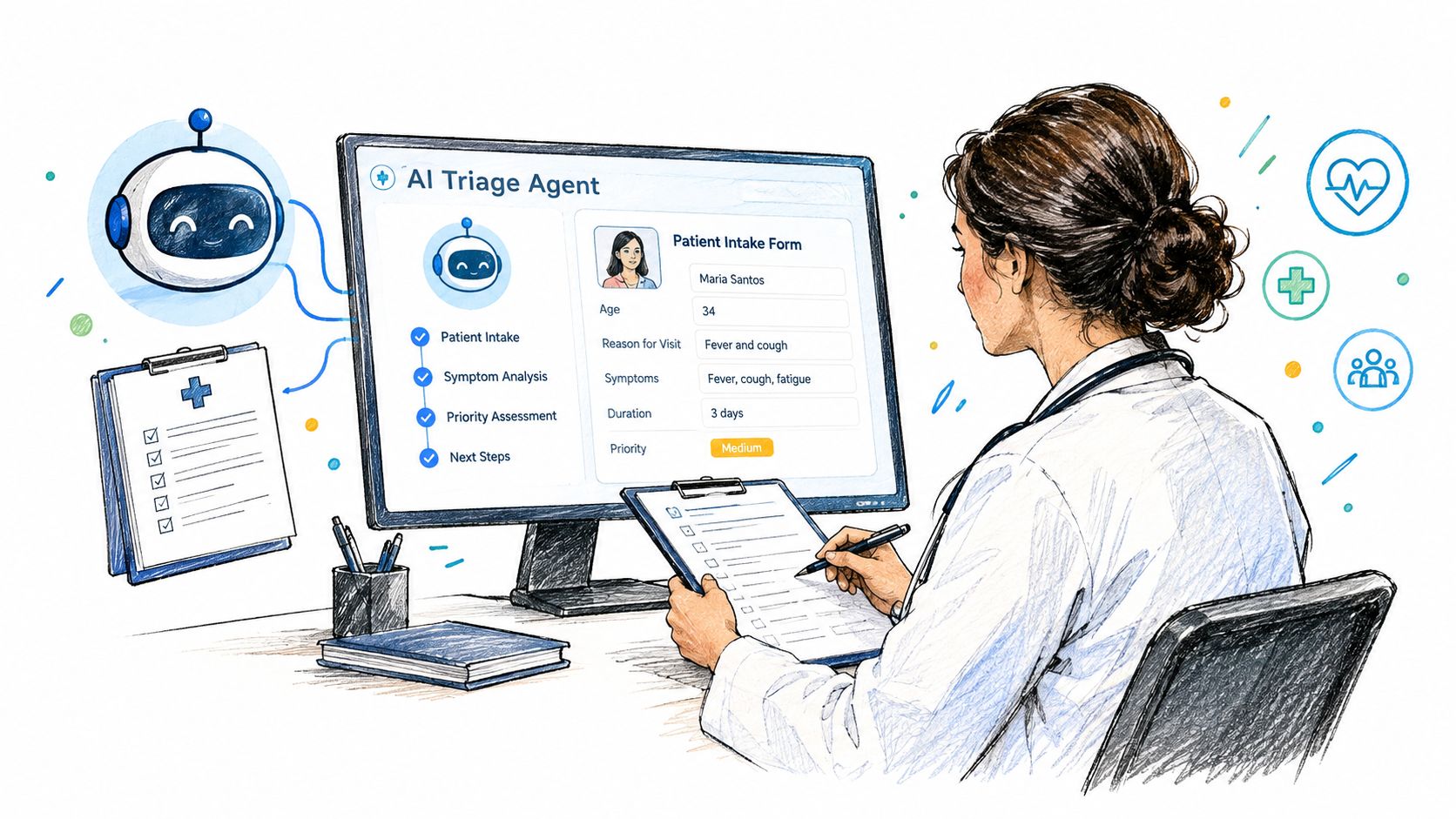
Bounded agents work well when the organization can specify the input, action, and escalation condition. Typical examples include:
These workflows benefit from narrow permissions. The agent can read only the data needed for the task and can write only to a controlled destination. A human checkpoint can sit before an irreversible action, such as changing a clinical record, sending a sensitive message, or initiating a referral.
A healthcare product team building Healthcare AI Services should define that boundary in the workflow specification, not leave it to prompt wording. Prompts can guide behavior, but permissions, API controls, validation rules, and escalation logic provide the stronger safety boundary.
Consider a patient who needs coordinated care across primary care, a specialist, diagnostic services, benefits administration, and follow-up outreach. The workflow may require multiple information sources, conditional routing, reminders, exception handling, and communication with different teams. A coordinated system could assign discrete work to specialized agents while a workflow layer maintains the overall state.
That architecture can support broader care navigation, referral coordination, and longitudinal planning. It also creates more places for failure. A referral agent might identify the correct specialty, while an eligibility agent returns incomplete coverage information. The coordinator must detect the conflict, request clarification, preserve the case state, and avoid sending a misleading appointment instruction.
The strongest pattern in regulated workflows is often semi-autonomous execution. The system can plan and prepare work, but people approve high-impact actions. Role-specific tools, including ambient clinical scribes and AI voice agents, have attracted strong healthcare interest because they address concrete jobs without requiring an organization to delegate an entire clinical mission.
The distinction is operational, not cosmetic. If the use case has one responsible owner and a clear endpoint, start with an agent. If it has multiple teams, changing conditions, and meaningful dependencies, assess agentic orchestration, but budget for the governance layer as part of the product.
Choose the smallest architecture that can complete the workflow safely. That principle protects healthcare teams from paying the integration and governance cost of multi-agent orchestration before they have demonstrated a business need for it.
Start with the workflow, not the vendor category. Document the trigger, systems involved, data accessed, decisions made, irreversible actions, human approvals, and definition of completion. Then use four decision filters.
Ask what happens when the system is wrong. A missed reminder, an incorrect referral destination, and an unsafe clinical recommendation don't carry the same consequence. High-consequence decisions need stronger review, narrower permissions, and a more conservative autonomy level regardless of whether the underlying capability is labeled an agent or agentic AI.
A single agent may be the right choice when the task is contained, reversible, and easy to inspect. A multi-agent system may be justified when coordination itself is the bottleneck and the organization can assign accountability across the workflow.
Count the systems that must exchange information, but don't treat the count as the only criterion. The key question is whether the workflow needs shared state and dynamic routing. If the sequence is stable, a deterministic workflow with one AI step may be safer than an autonomous planner. If conditions change mid-process, orchestration may provide useful recovery and continuity.
A Custom AI Strategy report can help teams turn this assessment into an architecture decision, while AI strategy consulting can support the broader prioritization work. The output should be concrete: the proposed autonomy boundary, approved tools, evaluation plan, ownership model, and conditions for expansion.
Autonomy creates costs outside inference. Teams must implement connectors, identity controls, observability, test cases, human review, incident response, and audit reporting. Gartner predicts that more than 40% of agentic AI projects will be canceled by the end of 2027 because of cost, unclear value, or weak risk controls, while it projects that 33% of enterprise software applications will include agentic AI by 2028. Those projections appear in Gartner's agentic AI forecast.
The lesson isn't to avoid agentic systems. It is to require a measurable outcome before adding autonomy. Define the successful task, acceptable latency, human intervention point, and cost per successful completion.
A practical sequence is:
This approach works with internal teams and external specialists. An AI Product Development Workflow should preserve the same discipline from requirements through deployment, rather than treating compliance as a final documentation exercise.
The label matters less than the control model behind it. Calling a scheduling assistant “agentic” does not improve patient access. Calling a care-navigation platform an “agent” does not make its handoffs easier to govern. Product leaders need terminology that clarifies ownership, evidence, permissions, and operational behavior.
A practical model has three layers:
Healthcare products often need all three. A workflow may use one agent for information extraction while deterministic code handles routing. A care-navigation product may use specialized agents for separate functions, while keeping high-impact decisions behind explicit approval gates. The orchestration cost appears in the connections between these layers: shared context, permissions, monitoring, failure handling, and accountability for the final outcome.
Buyers do not purchase autonomy as an abstract capability. They want shorter administrative cycles, clearer work queues, better documentation support, fewer dropped handoffs, and evidence that the system stays within its intended scope. Those results depend on controls that remain visible instead of being hidden behind a conversational interface.
An organization evaluating AI tools for business should ask whether the product supports identity management, permissions, logging, evaluation, and human intervention. It should also establish what happens when a connected system is unavailable, data is incomplete, or two sources disagree. These failure paths often determine the actual operating cost of an agentic design.
That is where AI requirements analysis earns its place. Before selecting a model or orchestration framework, teams should document data access, clinical responsibility, failure handling, escalation, and the evidence required for review. The same work helps determine whether SaMD solutions are implicated by the product's intended use and decision-support behavior.
Healthcare organizations are still deciding where agentic systems belong and which workflows justify their operational burden. A bounded deployment with strong measurement may therefore be more appropriate than a broad autonomous platform. The decision should follow the organization's ability to supervise actions, investigate failures, and assign responsibility.
Teams can review real-world use cases to identify workable patterns, then test those patterns against their own workflows, data, and clinical responsibilities. Integration-heavy environments may require custom healthcare software development. A product whose intended use requires specialized oversight may also need a regulatory compliance partner.
Ekipa AI's HCP Engagement Co-Pilot illustrates a product approach using specialized intelligent agents for preparing briefs, optimizing travel with AI scheduling, drafting customized follow-ups, and supporting CRM automation. The architectural question is not whether those components carry an “agent” label. It is whether each action has a defined boundary, review path, audit record, and clear connection to the user's operational workflow.
No. An AI agent usually pursues a defined goal within set permissions and boundaries. Agentic AI describes a broader operating model in which systems plan, coordinate tools or agents, adapt across steps, and manage dependencies. Several disconnected agents do not become agentic just because they appear in one product.
A bounded single agent is generally easier to scope, test, audit, monitor, and stop. Start with a contained workflow such as appointment support, documentation drafting, or intake routing. Add permissions, escalation rules, and human review as evidence supports them. Use orchestration when coordination across systems is required for the outcome, not because multiple agents sound more advanced.
Evaluate both the result and the route taken to produce it. Test task completion, goal accuracy, tool and argument selection, step order, policy adherence, latency, resource use, and human intervention. Include ambiguous requests, incomplete records, failed systems, and out-of-scope cases. These tests expose governance costs that a simple success rate can hide.
Healthcare teams should define review requirements by consequence, reversibility, and regulatory obligations. Semi-autonomous execution often offers a workable balance: the system can prepare or propose actions, while people approve decisions that affect patients, records, or regulated processes.
Record intended use, users, data sources, permissions, tool actions, escalation rules, audit events, evaluation cases, incident ownership, and rollback procedures. A regulatory compliance partner can structure that work, while a healthtech engineering partner can connect requirements to implementation and integration decisions.
Deployment test: If the team cannot explain how the system fails, who gets notified, and how the organization proves what happened, the design is not ready for production.
The terminology matters only when it improves an architecture decision. Start with a specific operational problem, define evidence of success, and expand autonomy only when the workflow and governance model can support it.
Ekipa AI helps digital health teams define use cases, design bounded agents and orchestrated workflows, integrate healthcare systems, and build compliance-aware products from strategy through deployment. Visit Ekipa AI to discuss your workflow with our expert team and assess whether a single agent or broader agentic architecture fits your clinical and operational requirements.
Compare the 7 biggest emr companies by platform strengths, weaknesses, market reach, and integration potential for digital health partnerships.

Plan, run, and remediate a HIPAA compliance audit in 2026 with this practical guide covering scope, evidence, gaps, and reporting for IT and execs.

Explore connected care solutions, from FHIR-based architectures and RPM workflows to scaling strategies for healthtech leaders and clinical operators.
Connect with our team to explore how AI expertise can transform your business.