
AI in Healthcare
Connected Care Solutions: Architecture and Scale
Explore connected care solutions, from FHIR-based architectures and RPM workflows to scaling strategies for healthtech leaders and clinical operators.
September 28, 2026Read more
Plan, run, and remediate a HIPAA compliance audit in 2026 with this practical guide covering scope, evidence, gaps, and reporting for IT and execs.

Your CIO gets the OCR notification while your security lead is still cleaning up a phishing incident and your compliance team is chasing screenshots from five different systems. That's the actual shape of a HIPAA compliance audit in 2026, not a neat checklist and not a paperwork drill. It's a test of whether your team can prove, with live operational evidence, that you control access, track risk, and respond to breaches with discipline.
The hard part is that regulators are no longer impressed by policies sitting in a shared drive. They want evidence that your controls ran, that someone reviewed the output, and that the result changed behavior. In healthcare, that means the audit has to connect to the way your engineers, IT operators, and security analysts already work.
The reason this feels heavier now is simple. OCR's current focus is not on cosmetic documentation, it's on the controls that matter when hackers, ransomware, and unsecured systems hit real patient data. If your evidence package still looks like a binder of policies and annual attestations, it's already behind.
A healthtech engineering partner sees the same pattern over and over. Teams can produce a policy, but they can't show who reviewed the access logs, how key rotation was enforced, or when the vendor inventory was last reconciled against active PHI flows. That gap matters because the Security Rule §164.308 administrative safeguards are only defensible when they're backed by operational records, not promises.
Practical rule: if a control doesn't leave an artifact, it didn't happen in a way an auditor can trust.
The better model is continuous evidence. Query logs, encryption exports, risk-analysis outputs, ticket history, and vendor subprocess inventories carry more weight than a clean PDF policy because they show activity over time. For healthcare teams building software or running cloud-heavy environments, that's exactly the kind of proof worth preserving.
If you're working through that shift, the healthcare delivery context is especially unforgiving, which is why teams in this space often anchor their control work to guidance aligned with Healthcare AI Services. The point isn't to collect more files. The point is to produce audit-grade evidence on a predictable cadence so the audit doesn't become a month-long scramble.
Start by naming every system that touches PHI. That includes EHR integrations, telehealth platforms, analytics warehouses, support ticket exports, shared inboxes, and any workflow where a human can move patient data into another tool. If it touches PHI, it belongs in scope until you prove otherwise.
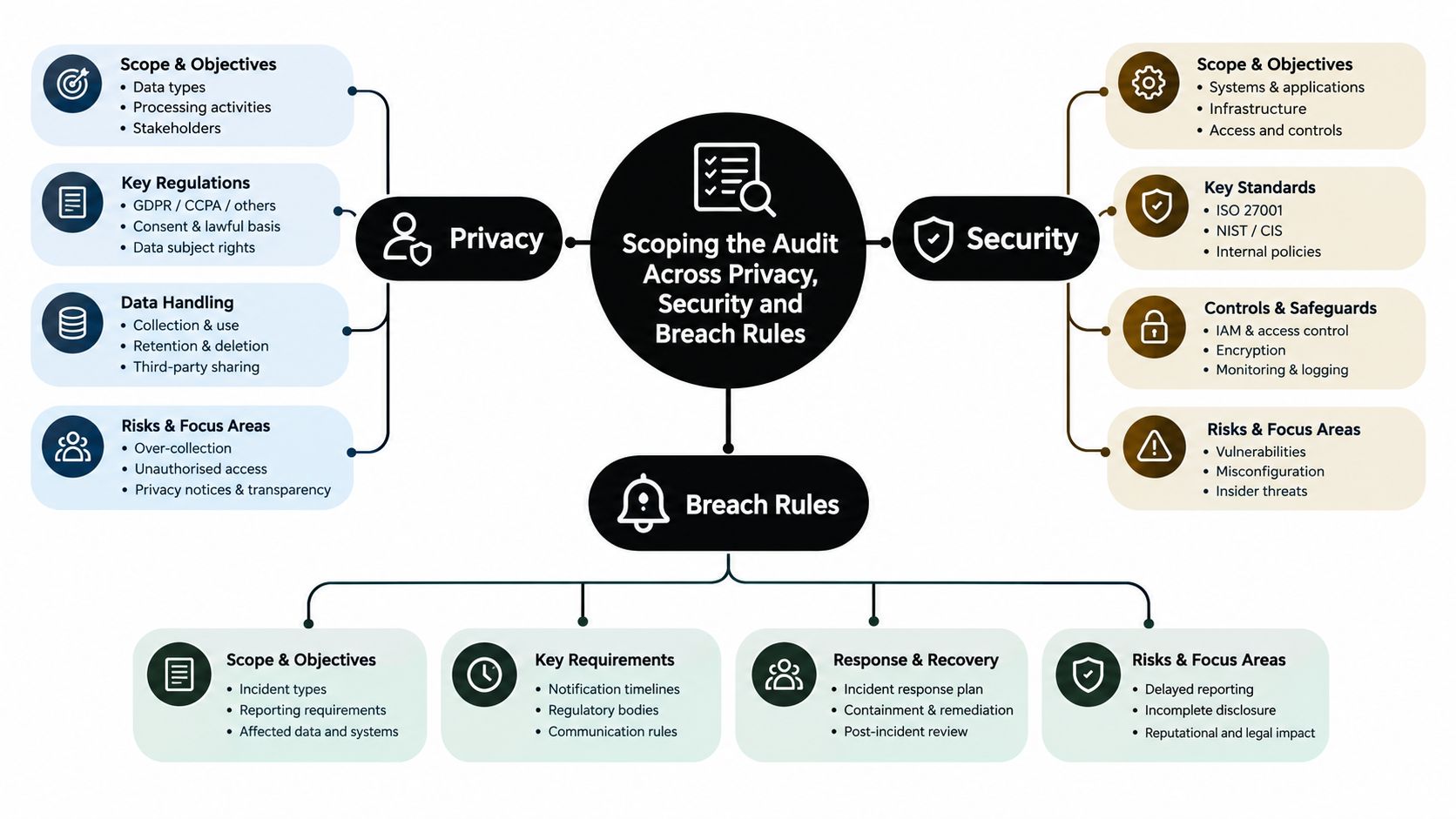
Map each system against three things. The Privacy Rule tells you what can be used or disclosed, the Security Rule tells you how electronic PHI must be protected, and the Breach Notification Rule tells you what happens when something goes wrong. That mapping stops the common mistake of gathering random artifacts that don't answer an audit question.
If you want a clean way to think about the structure, ISO 27001 explained for business is a useful external reference point because it forces the same discipline around scope, controls, and evidence. The difference in healthcare is that you must also prove privacy and breach-handling workflows, not just information security governance.
A patient portal is a good example. One portal can quickly expand into user access management, encryption, vendor management, logging, incident response, change control, backup handling, and data retention. Add the business associate layer, and you need to decide whether the audit covers external processors, whether research datasets are carved out separately, and whether de-identified data stays outside the PHI inventory.
Use a one-page scope memo. It should list the systems in scope, the business associates in scope, the rules being tested, and the BAAs attached to each vendor relationship. Before you do any evidence work, get that memo signed. If the scope shifts later, update the memo first and the evidence second.
For privacy-specific documentation and what your use and disclosure boundaries should look like, keep your scope notes aligned with the organization's privacy policy so the audit trail and the public policy don't drift apart.
An auditor won't fail you because you were “close.” They fail teams because the evidence can't be trusted. Stale screenshots, shared credentials, and training certificates with no curriculum detail fall apart the moment someone asks who ran the report, what changed since last month, and whether the result was reviewed by the right owner.
These are the evidence types that usually survive scrutiny because they prove activity, timing, and ownership:
| Evidence Artifact | Security Rule Citation | Credibility Signal |
|---|---|---|
| Asset inventory tied to PHI flow | 45 CFR §164.308(a)(1)(ii)(A) | Current owner, system tag, and PHI classification |
| Risk analysis with threat catalog | 45 CFR §164.308(a)(1)(ii)(A) | Date-stamped, versioned, and tied to remediation items |
| Access review logs with sign-off timestamps | 45 CFR §164.312(a) | Reviewer identity, review date, exception notes |
| Workforce training records with role-based modules | 45 CFR §164.308(a)(5) | Completion log plus curriculum reference |
| BAA inventory including subprocessors | 45 CFR §164.308(b) | Executed contract dates and vendor mapping |
| Encryption configuration exports from production | 45 CFR §164.312(a) and §164.312(e) | System-generated output from the live environment |
| Incident response tabletop outputs | 45 CFR §164.308(a)(6) | Scenario, attendees, decisions, and follow-up tickets |
| Vulnerability scan trend reports | 45 CFR §164.308(a)(1)(ii)(A) | Repeated runs, dated deltas, and closure evidence |
The HHS risk-analysis guidance says the analysis must be an accurate and thorough assessment of risks and vulnerabilities to the confidentiality, integrity, and availability of ePHI held by the organization, so your evidence pack has to show that depth, not just the existence of a document HHS risk analysis guidance. That means immutable storage, automated collection where possible, and signatures where human review is required.
If the evidence came from a manual export, capture the export date, the person who ran it, and the source system path. Otherwise you're handing the auditor a story, not proof.
Treat the evidence repository like a controlled system, not a file dump. Version everything, keep the raw output, and store the transformed version separately. When the auditor cross-checks the control against the artifact, the chain of custody needs to be obvious.
The fastest way to lose time is to review controls in the order they're written in the policy manual. Don't do that. Start with the places HHS has historically shown people stumble, then score your controls against what's in place, not what's promised.
Score each safeguard as absent, partial, documented, or tested. “Documented” means the policy exists. “Tested” means the control produced evidence and someone reviewed the result. If a control regressed since the last review, mark it immediately and route it to remediation.
The strongest pattern from the HHS 2016–2017 audits was not heroic compliance, it was uneven execution. Some requirements were handled well, while others showed major gaps, especially around patient access and notice completeness. That should shape your review: don't spend all day checking boxes that were never the core issue.
| Failure Area | What Auditors Look For | Where the Gap Usually Lives |
|---|---|---|
| Risk analysis | Updated, organization-specific threat review | One-time assessment that never changed |
| Contingency planning | Recovery, backup, and emergency procedures | Plans written, drills never done |
| Workforce training | Role-specific training and proof of completion | Generic onboarding slide deck |
| Patient access | Workflow that actually returns records correctly | Manual steps no one owns |
| Notice of Privacy Practices | Current content and correct posting | Website copy out of sync with legal text |
| Access controls | Unique access, least privilege, and review cadence | Overprovisioned accounts and stale exceptions |
| BAAs | Current agreements with vendors and subprocessors | Contract list disconnected from live systems |
| Backups | Encrypted, restorable, and tested | Backup jobs exist, restore never validated |
The 2016–2017 HHS audit report also showed strong performance in breach-notification timing and website posting of the Notice of Privacy Practices, but it also showed how badly some core workflows failed, including the individual right of access and content requirements for the NPP HHS audit protocol. So don't confuse a visible document with a working process.
Write each finding in statement-of-condition, criterion, cause, and effect form. That structure forces honesty. It also makes the eventual ticket clean enough for engineering and security owners to act on without rewriting the issue from scratch.
A remediation plan dies when it lives in a spreadsheet nobody trusts. Put every finding into the same ticketing system your engineering team uses for production work, because that's where dependencies, priority, and escalation already live. If a control owner can't see it in their normal workflow, they won't treat it as real.
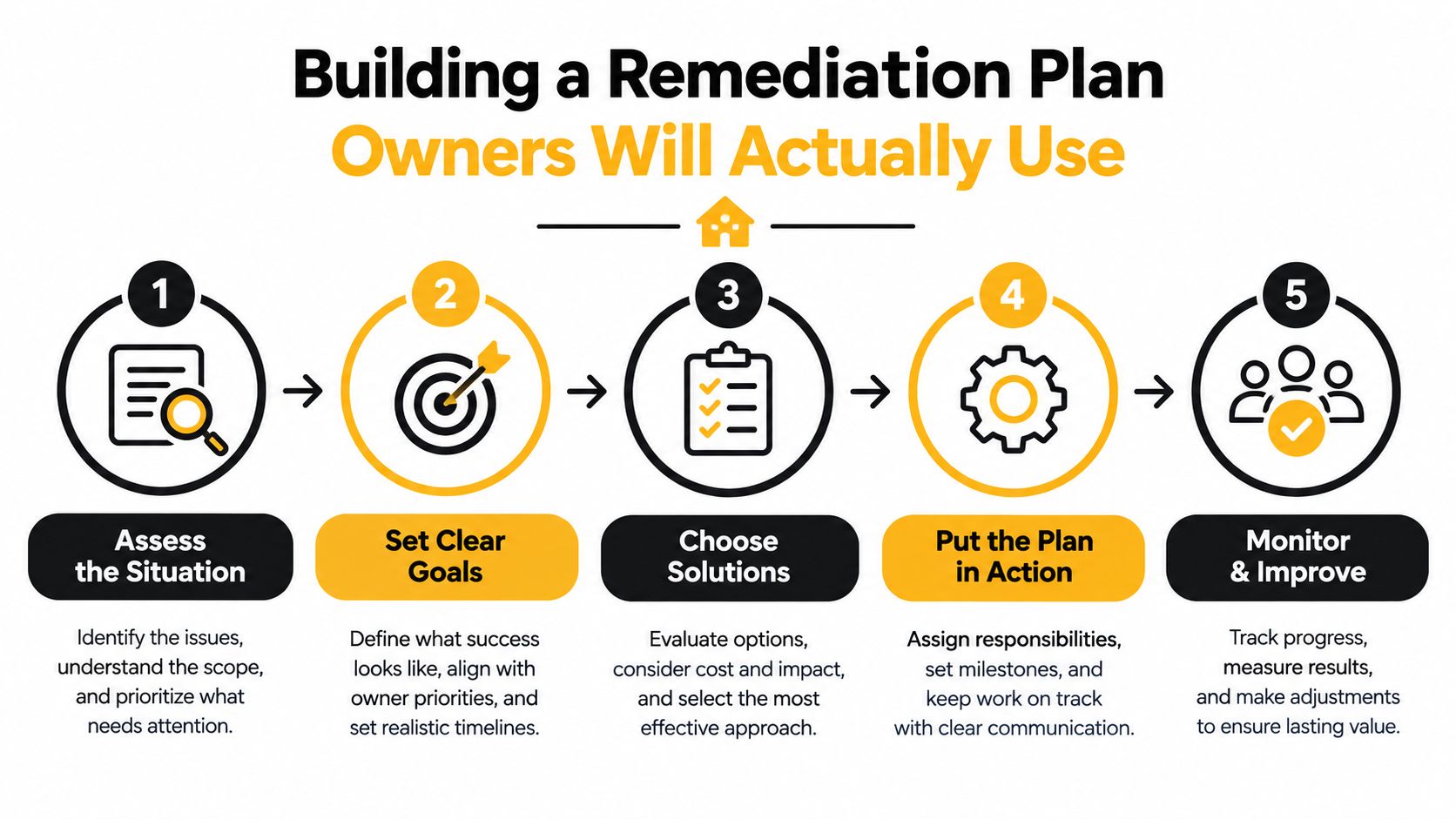
Each item should name the finding, the single accountable owner, the target date, and the re-test trigger that proves closure. No shared ownership. No vague “security team” bucket. No closure without a new artifact.
A practical way to sort the backlog is by time horizon. Quick fixes fit in 30 days, structural changes in 90 days, and program upgrades in 6 to 12 months. That's the sort of cadence that makes room for engineering reality instead of pretending every gap can be solved immediately.
If you need support turning findings into a workable delivery plan, the AI Product Development Workflow model is useful because it treats controls like deliverables with owners, review gates, and evidence output. That mindset matters more than the tool itself.
Best practice: every closed ticket should attach the replacement evidence artifact before the status changes to resolved.
Run a weekly remediation standup with security, IT operations, and compliance. If a dependency is blocked, surface it in the meeting, not in an email thread. Once a fix is complete, require a written closure note signed by the control owner before the item is marked done.
Executives don't need your entire control matrix. They need the truth about residual risk, the timeline to reduce it, and the amount of work still sitting in front of them. If you bury that in technical language, they'll miss the core issue and you'll inherit the blame later.
Use a two-page executive narrative and one board slide. Start with the audit scope and method in plain English, then group findings by severity and tie each one to patient impact and regulatory exposure. Keep the language blunt. Sanitized reporting creates false comfort.
A good summary says what still isn't safe even after the remediation plan starts. That includes unresolved access gaps, weak vendor proof, incomplete logging, or untested restore paths. If leadership doesn't understand what remains at risk, they can't make a real funding or acceptance decision.
The board should see three things: what changed, what's still open, and what resources you need to close the gap. Don't hide behind a heat map. Use it only if it helps, not if it obscures the story.
A direct executive ask works better than a vague summary. Ask for resources, ask for milestone review dates, and ask for formal acceptance of residual risk where a fix can't happen immediately. Then put the quarterly progress cadence in writing so accountability doesn't disappear after the meeting.
A hipaa compliance audit should be the checkpoint, not the annual disaster. The true win is when the audit forces a control system that keeps producing evidence all year, with the least possible manual effort. That's the only way to survive a healthcare security environment where access, logging, and remediation need to be visible on demand.
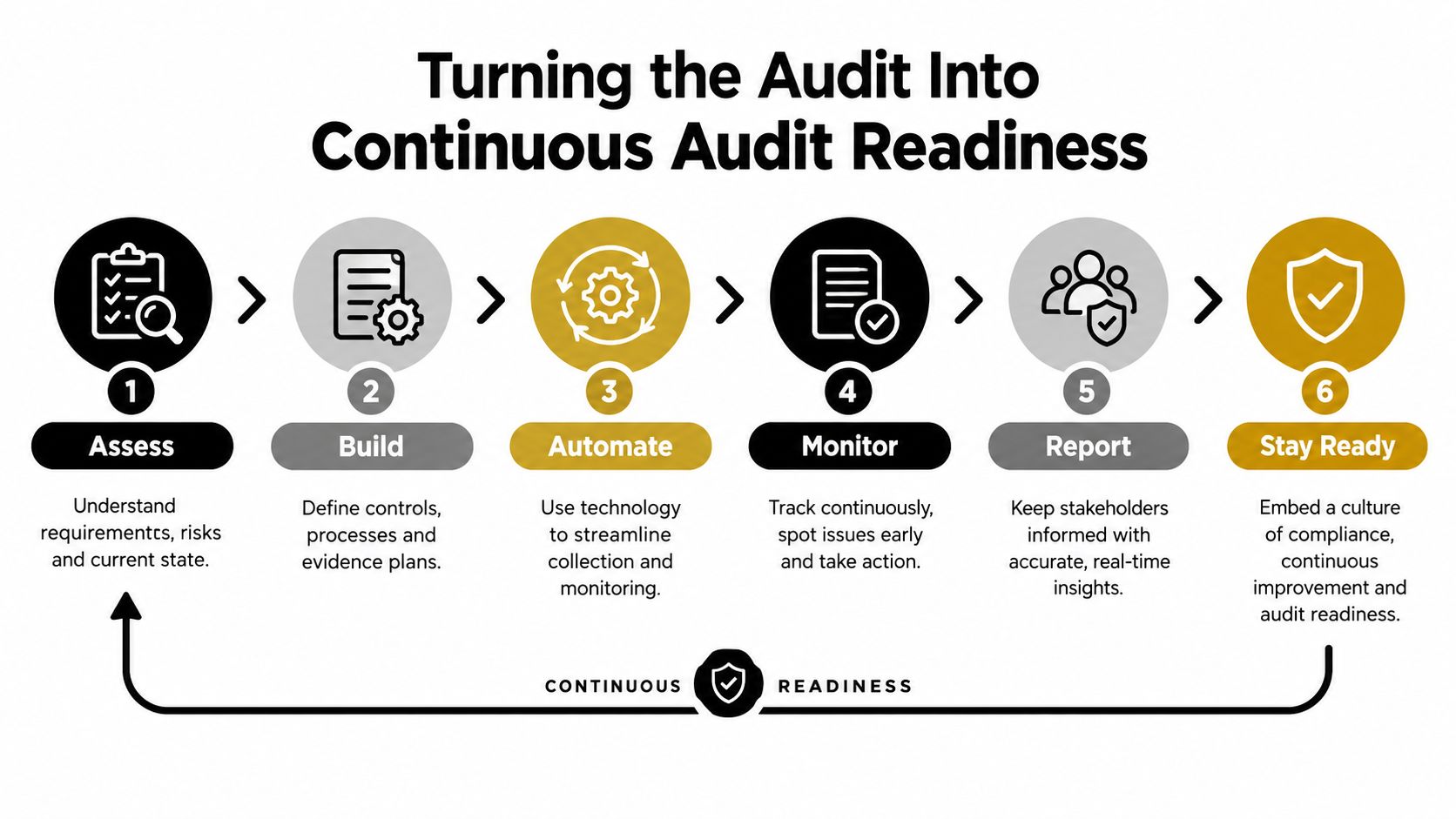
The controls that deserve repeat testing are the ones auditors care about most. That means access reviews, BAA currency, encryption baselines, backup restore drills, and training completion records. Tie each one to a calendar, a system owner, and a live artifact.
Connect your evidence collection to SIEM, IAM, and ticketing systems wherever possible. If your logs, access reviews, and remediation tickets already live in operational tools, script the pulls instead of recreating them by hand. That reduces drift and makes the evidence harder to dispute.
This is also where a provider like Ekipa AI can fit as one option among others, because it builds healthcare software and internal tooling with privacy, security, audit trails, and risk controls in mind. Use the toolchain that fits your environment, but insist that the output is evidence you can defend, not just dashboards that look tidy.
Quarterly mock audits should mirror OCR's current interest in hacking and ransomware exposure. That means testing whether a control can be proved, not whether a policy exists. If a control breaks, route the issue back into the same remediation loop and re-test it after closure.
A realistic 90-day readiness plan looks like this. First, lock the scope and inventory. Second, refresh the risk analysis and access reviews. Third, close the top remediation items and collect replacement evidence. Fourth, run a mock audit against the current control matrix. Fifth, brief executives on residual risk and the next quarter's work.
If you want a team that can help you turn evidence collection, control mapping, and audit readiness into a repeatable system, visit Ekipa AI and talk through the controls you need to prove, not just the policies you've already written.
Explore connected care solutions, from FHIR-based architectures and RPM workflows to scaling strategies for healthtech leaders and clinical operators.

Discover how AI in healthcare operations transforms scheduling, revenue cycles, and workflows. Learn implementation strategies, ROI metrics, and governance.
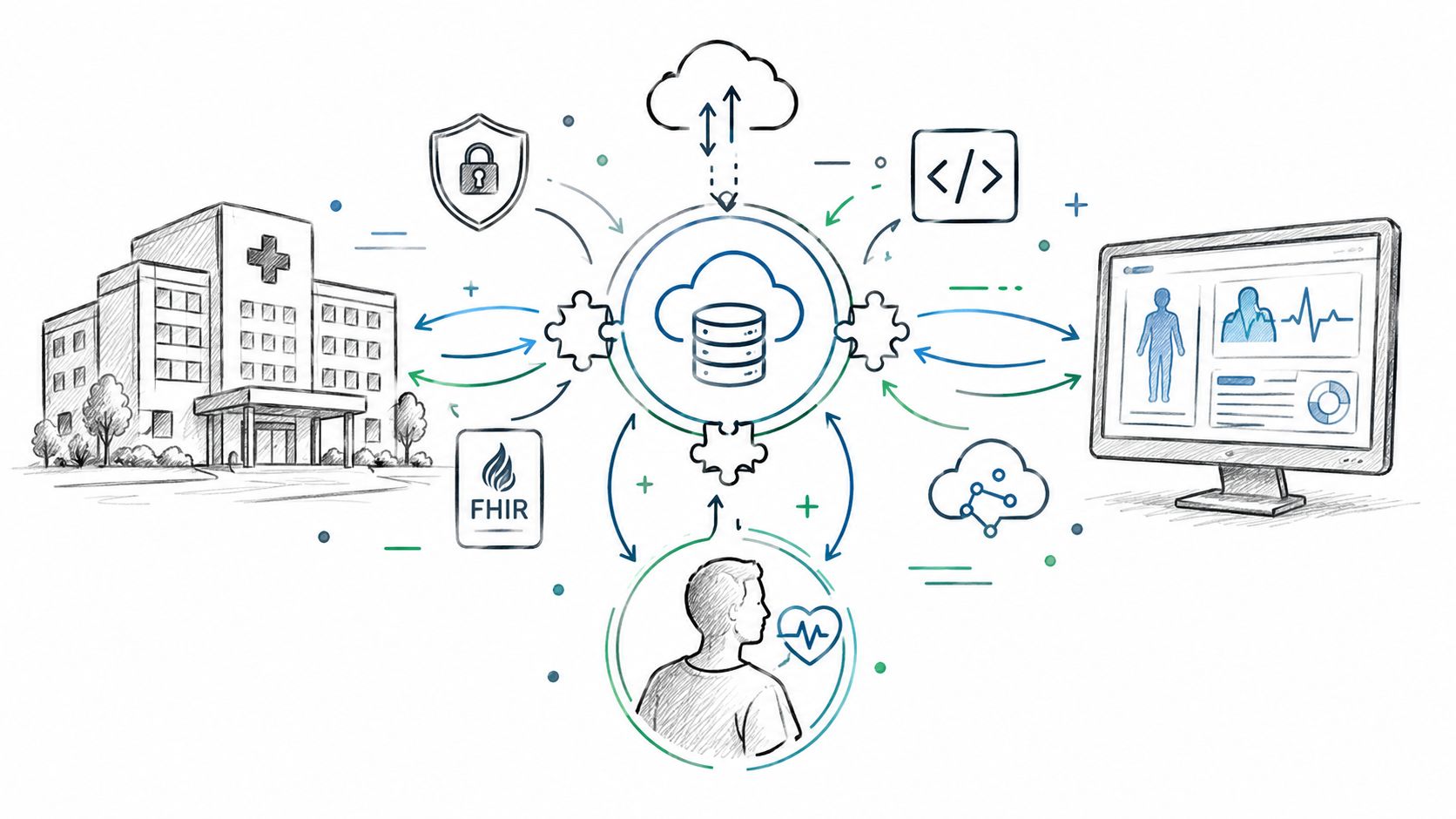
A practical guide to healthcare data interoperability: FHIR, APIs, patient matching, governance, compliance, and an implementation roadmap with real trade-offs.
Connect with our team to explore how AI expertise can transform your business.