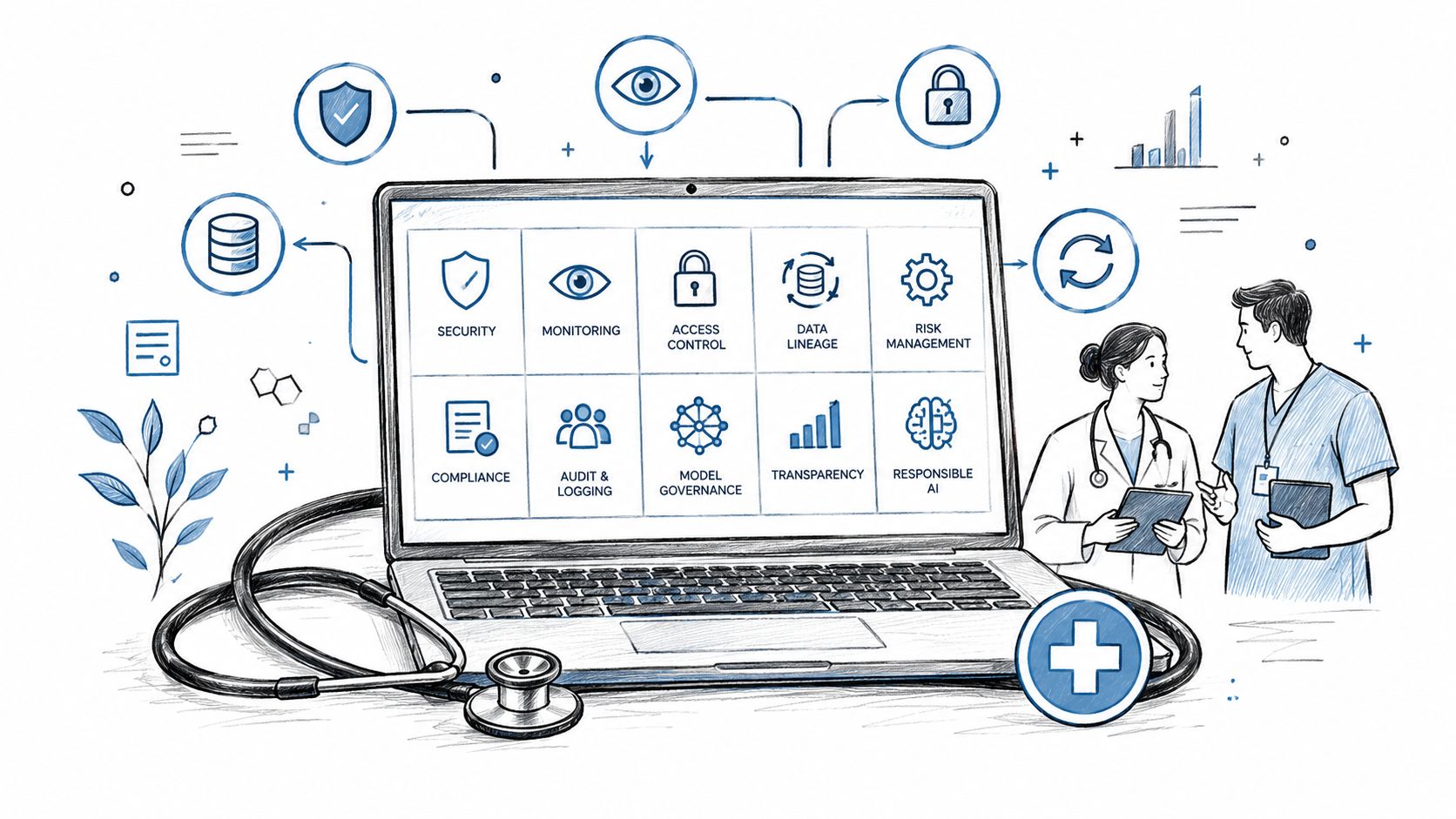
For healthcare leaders today, understanding AI isn't just a "nice-to-have" skill—it’s now a fundamental part of the job. This isn't about learning to code. It's about developing the strategic vision to guide AI adoption safely and effectively.
As the industry fights clinician burnout and spiraling operational costs, the days of scattered, experimental AI projects are over. It's time for a governed, strategic approach.
Why AI Literacy Is Now a Core Leadership Competency
The biggest risk I see in healthcare organizations right now is the growing divide between grassroots AI adoption and executive oversight. Frontline staff, from clinicians to administrators, are already finding their own AI tools to cope with impossible workloads—what we call "shadow AI."
But without leadership's guidance, this ad-hoc approach creates massive blind spots. Executives who lack a solid grasp of AI fundamentals can't harness this energy, manage the inherent risks, or scale the small wins into something meaningful. It's a recipe for missed opportunities and serious operational vulnerabilities.
Genuine AI literacy for a leader is about understanding the art of the possible. It gives you the confidence to ask the right questions, critically evaluate vendor claims, and tell the difference between a game-changing solution and overblown hype.
The Pressures Forcing the Change
This push for AI literacy isn't just about chasing the next shiny object. It’s a direct response to very real, very urgent pressures that demand a new way of thinking.
- Crushing Clinician Burnout: AI-powered ambient clinical documentation tools are already giving doctors back hours in their day, letting them focus on patients instead of paperwork.
- Deep Operational Inefficiencies: We're seeing AI optimize everything from surgical scheduling to supply chain logistics, which has a direct and immediate impact on the bottom line.
- Sky-High Patient Expectations: People now expect personalized, on-demand care. AI-driven chatbots and triage tools are becoming essential for meeting that demand.
The data backs this up. Recent industry studies show that 74-75% of data leaders say their staff urgently need training in both data and AI literacy. That’s a massive skills gap that stands between dabbling in pilots and truly integrating AI into the core of the organization.
The real goal here is to move beyond just buying tools. It’s about building a culture where AI is a natural part of your strategic toolkit. Think of it as a cultural transformation, not just a tech project.
Ultimately, the first step to become an AI-first company starts with leadership getting up to speed. Our team's Healthcare AI Services are built to develop these exact capabilities within your organization's leadership.
To get started, let's look at the foundational skills every healthcare leader needs. The table below breaks down the essential, non-technical competencies that form the basis for a strong AI strategy.
Core AI Literacy Competencies for Healthcare Leaders
This table outlines the essential, non-technical competencies healthcare leaders must develop to effectively guide AI transformation.
| Competency Area |
Description |
Leadership Action |
| Strategic Vision |
Understanding how AI can solve core business problems, not just serve as a technology project. |
Aligning AI initiatives with top-level goals like improving patient outcomes or reducing operational costs. |
| Risk & Governance |
Grasping the ethical, legal, and clinical risks associated with AI, including bias, privacy, and model reliability. |
Establishing a cross-functional AI governance council to vet tools and set clear usage policies. |
| Data Acumen |
Recognizing that high-quality, accessible data is the fuel for any successful AI initiative. |
Championing data infrastructure modernization and promoting a culture of data-driven decision-making. |
| Change Management |
Leading the cultural shift required to integrate AI into clinical and operational workflows effectively. |
Communicating a clear vision for AI's role and engaging clinical staff early in the selection and design process. |
With these competencies as our framework, we can build a practical plan for developing them across your entire leadership team.
So, How AI-Ready Is Your Organization, Really?
If you want to build an AI roadmap that actually leads somewhere, you first need an honest map of where you're starting. A real assessment of your AI readiness is much more than a simple survey. It’s a deep, multi-faceted audit designed to uncover the hidden risks and untapped potential lurking within your organization. The whole point is to get a clear, ground-level view of your people, processes, and platforms.
Think of this audit as the essential first step. It’s what makes your strategy both ambitious and realistic. It involves digging into your technical capabilities, sure, but more importantly, it means having candid conversations with people at every level of the organization. The insights you pull from this process will directly shape your Custom AI Strategy report, making sure it’s a perfect fit for what you actually need.
Ditching the Survey for a Multi-Faceted Audit
A proper readiness assessment has to look at three critical areas: your leadership and culture, your data and technology, and your governance and risk management. Each one needs its own line of questioning to get the full picture.
People and Culture: This is where you conduct structured interviews, from the C-suite all the way to the clinical front lines. You're trying to gauge perceptions, existing skills, and day-to-day workflows. Are teams secretly using generative AI to draft patient communications? Are department heads pulling their hair out over the data quality from the EMR?
Technology and Data: You absolutely need a technical review. This means taking a hard look at your data infrastructure, interoperability standards, and security protocols. Can you even get to the data you need from different systems? And once you get it, how clean and structured is it?
Governance and Risk: It’s time to analyze your current policies—or lack thereof. Do you have a process for vetting new AI vendors? Who is actually on the hook for monitoring a model’s performance after it goes live? Finding these gaps now is the key to building an AI program that's both safe and compliant.
This whole process is about connecting the problems you see every day to the underlying gaps in your organization's AI literacy and capability.

As the flow shows, recognizing a problem like clinician burnout is just the start. The critical next move is to connect that problem to a specific knowledge or skill gap before you can even begin to define a solution.
Uncovering "Shadow AI" and Hidden Strengths
One of the most eye-opening parts of any audit is discovering "shadow AI." This is when your staff, trying to solve immediate problems, start using unapproved AI tools for business. While it sounds like a risk to be stamped out, it’s actually a powerful signal telling you exactly where your biggest operational bottlenecks are.
For instance, if you find your billing department is using a free online tool to summarize dense insurance policies, that’s a flashing neon sign pointing to a need for an approved AI Automation as a Service solution. If nurses are using their personal phones to translate discharge instructions, it's a clear opportunity for a secure, integrated language model. The goal isn’t to play whack-a-mole, but to understand the why and channel that proactive energy toward sanctioned and secure internal tooling.
Here's the bottom line: Shadow AI is a map of your organization's pain points. Don't just shut it down. Use it as your guide to prioritize which official tools and training to roll out first. This way, your AI investments are solving real, validated problems from day one.
Actionable Questions to Guide Your Audit
To make this feel less abstract, here are some specific questions to get the ball rolling with your stakeholders. These are designed to push past generic answers and get to the heart of your AI readiness.
For Clinical Leaders (CMO, CNO):
- What’s our process right now for validating a new AI model’s clinical safety and efficacy?
- What are the biggest administrative tasks that pull our clinicians away from patient care?
- How confident are you in your team’s ability to interpret—and question—the output of a diagnostic AI?
For Operational & IT Leaders (COO, CTO/CIO):
- What percentage of our most critical data is actually structured, accessible, and ready for an AI model to use?
- How are we currently handling data governance and patient privacy when we bring in third-party software?
- Do we have the talent in-house to manage and maintain AI models, or are we going to be completely reliant on vendors?
The answers you get become the raw material for a truly robust strategy. This level of detail, which often requires a full-blown AI requirements analysis, is what separates successful AI programs from those that never quite deliver. It's the foundational work that makes everything else—from training to implementation—actually work.
Designing Role-Specific AI Learning Paths
If you roll out a generic, one-size-fits-all AI training program, you're setting it up to fail. It's that simple. The AI insights a CEO needs to steer market strategy are miles apart from what a Chief Medical Officer needs to guarantee patient safety. For this to stick, the learning has to be tailored to the specific world each leader lives in—their responsibilities, their pressures, their decision-making.
This is how you move training from a theoretical, check-the-box exercise to a practical toolkit. When leaders see exactly how AI can help them tackle their biggest headaches—whether that’s ROI, clinical validation, or operational bottlenecks—the lightbulb goes on. That’s the secret to making education a real strategic enabler for the entire organization.

From the Boardroom to the Bedside
Before you can build these learning paths, you have to know where you're starting from. The first step is to get a clear picture of your team's current capabilities to spot the gaps. A good way to start is to conduct a skills gap analysis, which gives you a solid foundation for what comes next.
Once you have that baseline, you can start building modules that actually speak to each leader.
For the CEO and CFO: The conversation here is all about the business case. Their training needs to focus on market trends, competitive analysis, and how to model the ROI for major AI investments. They need the language and frameworks to talk about AI with the board and investors, always tying it back to value creation and strategic advantage.
For the Chief Medical Officer (CMO) and Chief Nursing Officer (CNO): Here, the lens shifts entirely to clinical governance and patient safety. Their learning path must dive deep into the ethical minefield of AI in diagnostics, the rigorous process of validating clinical models, and the very real danger of algorithmic bias. This training has to be grounded in real-world use cases showing how AI can support clinicians, not replace their judgment.
For the COO and CIO/CTO: This group needs to be fluent in both strategy and technology. Their curriculum should cover the nuts and bolts of data infrastructure, criteria for assessing AI vendors, and the change management required to weave AI into the daily fabric of the organization. They are the ones who have to make it all work, bridging the gap between the technology and day-to-day operations.
Structuring Learning for Real Impact
Let's be honest: a string of passive lectures is a surefire way to lose an executive audience. The most effective learning paths blend different formats to keep people engaged. Think high-level briefings, hands-on workshops where leaders can get their hands dirty, and expert-led Q&A sessions.
The goal is to create a space where executives can ask the tough questions, challenge assumptions, and connect AI concepts directly to their own strategic priorities. That active, hands-on engagement is what truly builds understanding and confidence.
It's also important to remember what's happening on the ground. As we explored in our AI adoption guide, healthcare is already seeing a wave of "shadow AI," with stressed-out staff using unapproved generative AI tools to get through the day. This reality adds urgency for leadership to create formal governance and training. Knowing this helps you build guardrails that both empower your people and protect the organization.
Putting these tailored learning paths together quickly and effectively often means bringing in some outside perspective. An experienced partner offering AI strategy consulting can help you design and deploy these programs, making sure they’re aligned with best practices. This is especially valuable when the newfound knowledge sparks ideas for new projects, helping you turn education into tangible, high-impact AI initiatives.
Launching Strategic AI Pilots That Deliver Value
Once your leadership team is up to speed, it’s time to move from theory to practice. This is where the rubber meets the road—proving the value of AI through carefully selected pilot projects. The goal here is to get away from scattered, low-impact experiments and launch strategic initiatives that build real, tangible momentum.

This shift from tinkering to full-on execution is a make-or-break moment. We've seen that successful AI deployment hinges on focusing your energy on high-impact opportunities, not spreading your resources thin across dozens of disconnected pilots. Top-tier organizations zero in on a small number of opportunities with major potential, like automating clinical workflows or advancing precision medicine. You can dig into the data on this approach from research by leading healthcare consultants.
Selecting the Right Pilot Project
Choosing your first few pilot projects is one of the most critical decisions you’ll make on your AI journey. Get it right, and you can create a groundswell of support. Get it wrong, and you could set back adoption for years.
Forget trying to boil the ocean. Instead, pinpoint one or two initiatives with the potential to make a real difference.
Look for projects that tackle a significant, well-known pain point and already have clear champions within the organization. Great starting points I’ve seen work well include:
- Automating Clinical Documentation: A pilot using ambient voice AI to transcribe patient encounters directly into the EHR can deliver an immediate, measurable drop in clinician burnout. It’s a win everyone can see.
- Optimizing Surgical Scheduling: An AI tool that sifts through historical data to predict case duration and optimize OR block use can directly increase throughput and revenue.
- Reducing Patient No-Shows: A predictive model that flags patients at high risk of missing appointments allows your team to intervene proactively, which improves both care continuity and operational flow.
The best pilots are highly visible, solve a problem everyone acknowledges, and offer a clear path to measuring success. They become powerful stories that fuel broader adoption.
The selection process itself has to be rigorous. A comprehensive AI requirements analysis isn't just a nice-to-have; it's essential. This deep dive makes sure the project is not just strategically sound but also technically doable.
Key Criteria for Pilot Selection
Before you commit a single dollar, run your potential projects through a clear set of criteria. This ensures you’re making smart bets with your initial AI investments.
| Criterion |
Why It Matters |
Example Question |
| Business Alignment |
The pilot must clearly support a top-level organizational goal, like improving patient safety or driving down operational costs. |
Does this project directly help us achieve one of our top three strategic priorities for the year? |
| Data Availability |
An AI model is only as good as the data it’s trained on. You need access to clean, structured, and relevant data. |
Do we have at least 12-24 months of high-quality historical data for this specific workflow? |
| Clear Success Metrics |
You absolutely must define what "success" looks like in concrete, measurable terms before the project even kicks off. |
Can we define 3-5 specific KPIs (e.g., a 15% reduction in documentation time) to track? |
| Clinical Buy-In |
Without the enthusiastic support of the frontline clinicians who will use the tool, even the best technology is doomed to fail. |
Have we involved department heads and clinical staff in the selection and design process from day one? |
Structuring the Pilot for Success
Once you’ve picked a winner, how you structure it is everything. This isn't a casual experiment; it’s a formal project that demands a dedicated team and a rock-solid plan.
Pull together a cross-functional team with clinical champions, IT specialists, data analysts, and a project manager. The entire process, from brainstorming to deployment, should follow a structured AI Product Development Workflow.
Be careful to avoid common pitfalls, like choosing a project that's too technically ambitious for a first go or, just as bad, failing to manage the change with your people. Your first pilots are as much about learning and building confidence as they are about the technology itself. By focusing on tangible results through solutions like AI Automation as a Service or new internal tooling, you can demonstrate value quickly and build a solid foundation for scaling AI across the entire organization.
Measuring the Payoff and Scaling Your AI Capabilities
Getting a pilot project across the finish line is a huge win, but it's just the first step. The real change—the kind that makes a lasting impact—comes from moving beyond isolated successes and building an organization-wide AI capability. This is where you unlock the true value, but it demands a smart, disciplined approach to measuring what works and managing the change that follows.
To get the buy-in and budget you need for the next phase, you have to prove your pilot delivered. The problem is, standard ROI formulas that only look at financial gains just don't cut it in healthcare. A far better approach is what we call a "balanced scorecard," which captures the full picture of an AI initiative's impact.
This method looks past the bottom line to give you a complete, 360-degree view. It recognizes that in our world, value is just as much about better patient outcomes and staff well-being as it is about dollars and cents.
Building a Balanced Scorecard for AI
A solid balanced scorecard for healthcare AI should track metrics across four crucial areas. This ensures you're actually measuring what matters to your mission.
Financial Impact: These are your classic ROI metrics, and they're essential for showing fiscal responsibility.
- Example: Reduced operational costs from automating the soul-crushing prior authorization process.
- Example: A clear increase in revenue from optimizing surgical suite schedules.
Clinical Outcomes: This is the heart of what we do. These numbers show exactly how AI is improving the quality and safety of patient care.
- Example: A 30% drop in diagnostic errors for specific conditions after implementing an AI-powered imaging tool.
- Example: Tangibly shorter patient wait times in the ED thanks to an AI-driven triage system.
Operational Efficiency: Here, you're tracking how AI smooths out workflows and makes the entire organization run better.
- Example: A 25% decrease in the time clinicians spend on administrative charting per patient visit.
- Example: Lower patient no-show rates because a predictive scheduling model is doing its job.
Staff & Patient Satisfaction: This is all about the human element. A less-burdened, happier team provides better care, and patients who feel seen and heard are more engaged in their own health.
- Example: An uptick in clinician satisfaction scores, specifically tied to comments about reduced administrative tasks.
- Example: Higher patient engagement scores with new digital front-door and communication tools.
When you track this mix of KPIs, you're not just presenting data; you're telling a powerful story. You can show leadership that you didn't just save money—you improved care, streamlined the way we work, and made life better for your people.
From Pilot Success to a Scalable Strategy
Once you have compelling data from your pilot's balanced scorecard, you can start mapping out how to scale. This isn't about just copying and pasting the same technology into different departments. It’s about taking what you learned and using it to build a sustainable AI infrastructure across the entire organization.
A few critical steps are involved here. First, turn the lessons from your pilot into institutional knowledge. Document what worked, what failed, and create a playbook so other teams aren't starting from square one every single time.
Next, use your real-world findings to refine your AI governance policies. Your initial policies were probably built on theory. Now you have hands-on experience to make them more practical and effective.
Finally, start thinking about the long-term infrastructure required to support your Healthcare AI Services. This means looking at technology platforms, data management protocols, and—most importantly—fostering a culture where continuous learning is the norm. Scaling is, at its core, a change management challenge.
Turning promising pilot results into enterprise-wide healthcare software solutions is a complex journey. It takes a clear vision, strong governance, and a deep understanding of both the technology and the unique pressures of the healthcare environment. To navigate this path effectively, getting guidance from our expert team can be invaluable in helping you turn those early wins into lasting change.
Frequently Asked Questions (FAQ)
What is the first step in building AI literacy for healthcare leadership?
The first step is a comprehensive readiness assessment. Before investing in technology, you must understand your current state: identify existing "shadow AI" usage, evaluate your data infrastructure, and—most importantly—have candid conversations with clinical and operational leaders to pinpoint their biggest challenges. This audit provides the baseline for a strategy that solves real-world problems.
How can we ensure the ethical and responsible use of AI in our organization?
Ethical AI use starts with establishing a robust governance framework before deploying high-stakes tools. This requires a cross-functional committee (clinicians, data scientists, ethicists, legal) to create and enforce policies. Key components include principles prioritizing patient safety, a rigorous vetting process for new tools, mandatory training on data privacy and algorithmic bias, and a system for continuous real-world performance monitoring.
How do we measure the ROI of AI pilots in a healthcare context?
Standard financial ROI is insufficient. A "balanced scorecard" approach is essential. This includes tracking:
- Financial Impact: Cost savings, revenue increases.
- Clinical Outcomes: Reductions in diagnostic errors, improved patient safety metrics.
- Operational Efficiency: Decreased administrative time for clinicians, lower no-show rates.
- Staff & Patient Satisfaction: Higher engagement scores, reduced clinician burnout.
This holistic view demonstrates the true value of your AI investments.
Should our healthcare organization build its own AI tools or buy them?
For most healthcare systems, a "buy and integrate" strategy is more practical and cost-effective than building complex AI from scratch. Partner with established vendors for proven solutions to common problems (e.g., clinical documentation, imaging analysis). This allows your in-house IT and data teams to focus on the critical tasks of integration with your EMR, workflow optimization, and developing smaller, custom healthcare software development projects for unique organizational needs.
Ready to build a culture of AI fluency and drive real, meaningful change in your organization? The journey starts with a clear, actionable strategy. At Ekipa AI, our expert team helps healthcare leaders like you move from theory to impact. Get your Custom AI Strategy report and start building your AI-ready future today. Meet our expert team to learn how we can guide you.