
Enterprise AI
Enterprise Workflow Automation: How AI Changes It
Enterprise workflow automation explained: RPA, AI document processing, AI agents, architecture, governance and how to measure results with a baseline.
November 13, 2026Read more
AI product recommendations explained: placements, models, data inputs, offline and A/B evaluation, plus privacy and DSA transparency for ecommerce teams.

AI product recommendations are ranked catalog items selected for a shopper and a particular moment, using product data, behavioral events and transactions. This guide covers placements, model choices, data pipelines, business rules, evaluation, integration, privacy and transparency, with an emphasis on the logging and data checks that make results trustworthy.
A shopper can meet the recommender on the home page, product page, cart and inbox before one order is complete. Each surface is a different join in the same pipeline: the product ID has to resolve across catalog, inventory, events and consent, and the exposure has to be logged before click or purchase metrics mean anything.
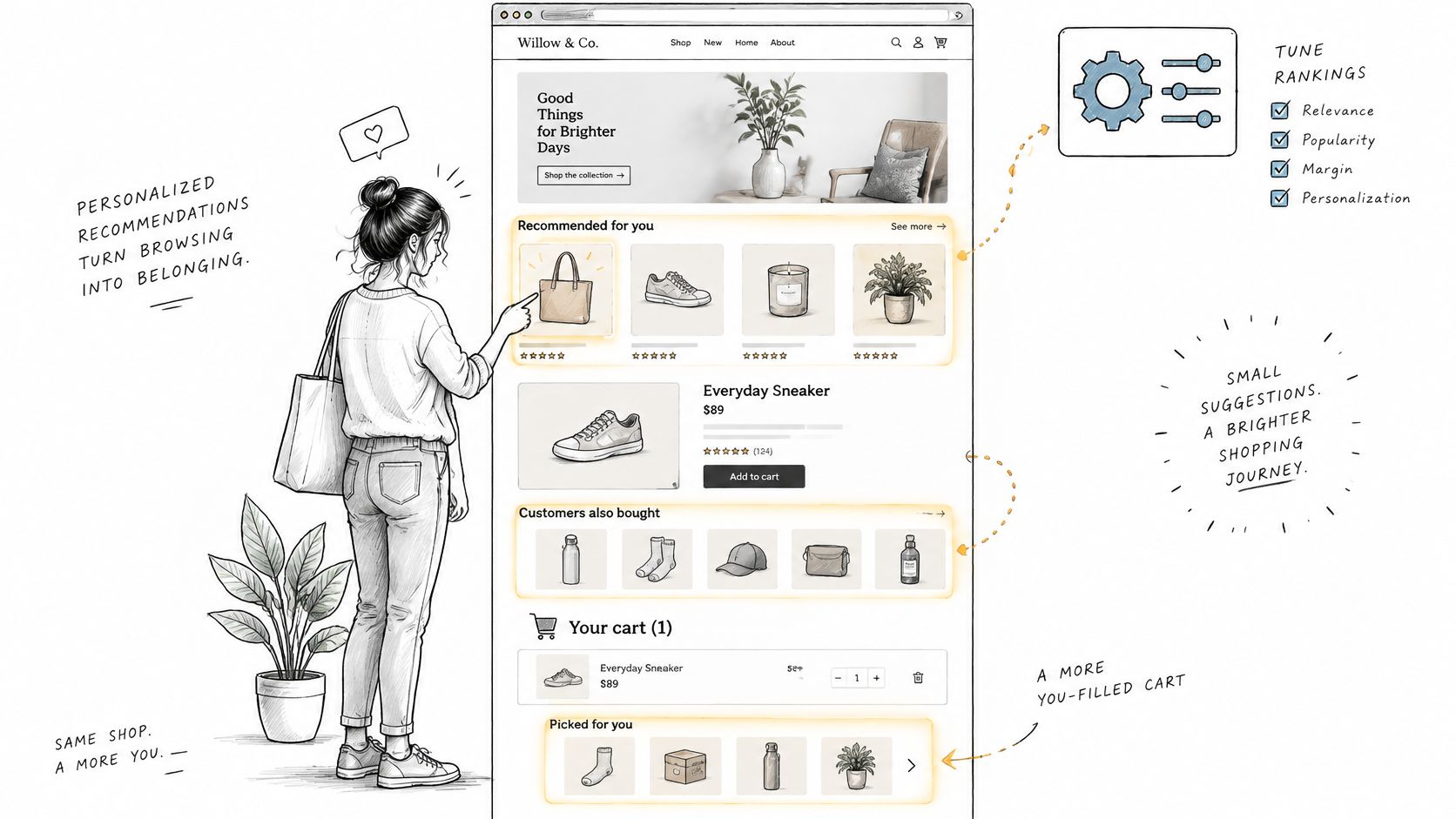
The table uses reference patterns from common practice. Treat the cells as defaults to challenge with your own catalog size, event coverage and margin rules. For the broader personalization strategy around these surfaces, see Ekipa's article on AI hyper-personalization.
| Placement | Job | Primary signals | Usual starting approach | Common failure |
|---|---|---|---|---|
| Home page | Re-engage returning visitors and surface new or relevant items | Past purchases, browsing history, segment popularity | Popularity baseline with personalized re-ranking | Bestseller loop, stale cached lists, impressions missing from logs |
| Product page | Suggest substitutes or complementary items | Item similarity, co-view and co-purchase, attributes, stock status | Content-based or item-to-item collaborative filtering | Variant or SKU ID mismatch, same product in another variant, out-of-stock items |
| Cart | Suggest add-on items before checkout | Cart contents, price, shipping thresholds, margin tier | Frequently bought together rules with business filters | Suggestions that break shipping rules, added latency, late cart events |
| Re-engage lapsed customers and promote relevant items | Past orders, time since last order, email engagement | Batch-generated lists with popularity fallback | Items out of stock at send time, consent limits on profiling, broken links after ID changes |
Build the backlog around each module's signal source, latency budget, empty-state fallback and exposure event name. Those fields decide whether later offline and online metrics can be trusted; weak placements usually trace back to dropped events, mismatched product IDs or impressions that were never logged.
Legal scope still shapes the label above a module: the Digital Services Act on EUR-Lex applies Article 27 recommender-system explanations from February 17, 2024, and Article 19 excludes micro and small enterprises. For a related view of how recommendation surfaces connect to product identity, inventory and consent, see Ekipa's ecommerce industry page.
Start every comparison with a popularity or frequently-bought-together baseline. On a small catalog or sparse interaction data, these methods are hard to beat, and they give the team a reference point before model complexity grows. Recommender systems grew out of early work on information filtering and collaborative filtering; the ACM's overview of recommender-system research describes how content-based and hybrid approaches expanded the field.
| Approach | Input data | Main strength | Cold start behavior | Typical failure |
|---|---|---|---|---|
| Popularity | Aggregate views, sales or clicks by segment | Simple, cheap and a strong baseline | Works for new users and items once counts exist | Reinforces bestsellers and reduces diversity |
| Content-based | Item attributes, categories, text descriptions | Can recommend new items immediately | Works for new items if attributes are complete, weak for new users | Narrow suggestions and sensitivity to attribute quality |
| Collaborative filtering, user-item or item-item | Matrix of ratings, purchases or clicks | Finds patterns that attributes miss | Weak for new users and new items | Sparse data and popularity bias |
| Session-based and sequence models | Ordered events within the current session | Captures current intent without a login | Works from the first click in a session | Needs ordered, timestamped events, sufficient session volume and a latency budget |
| Hybrid | Combines the inputs above through weighting or stacked models | Covers cold start while keeping personalization | Uses another component to fill a cold-start gap | Harder to attribute gains and to debug |
Match the approach to the events a placement logs. A module that records only product views and no order history can support a popularity list or a session-based model, but it gives collaborative filtering trained on purchases nothing to work with. Attribute-driven matching has a second use here: it exposes gaps in catalog data early, and fixing inconsistent product data often improves recommendation quality before any model change.
Consider a hypothetical case: on a category page for a specialized B2B catalog with a few hundred SKUs and mostly anonymous traffic, a segment-level popularity list can outperform a hybrid stack. The hybrid's collaborative component starves on sparse interactions, and its extra scoring steps add latency the placement cannot use.
When a newer model underperforms the baseline, check event tracking, product ID mismatches between catalog and order systems, and missing exposure logs before changing the model. Keep the baseline on the same evaluation split as every later candidate; otherwise the comparison measures differences in the data or the test rather than a better recommender.
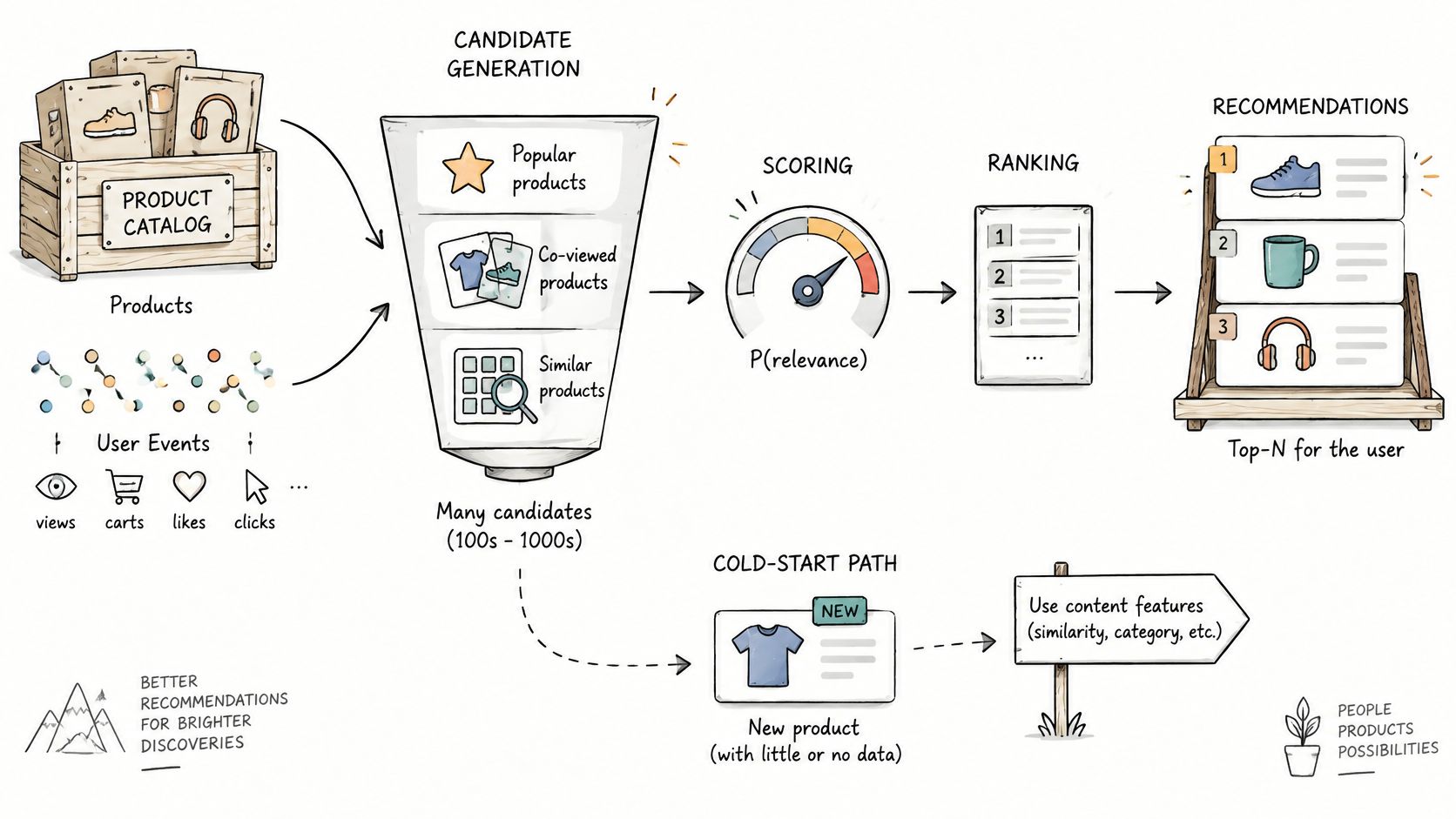
A recommendation service is a data pipeline with a ranking step, not just a model endpoint. A practical request flow is:
Ingest catalog records and behavioral event streams.
Generate candidates from popularity lists, co-view patterns and similarity indexes.
Score those candidates with the ranking model.
Apply hard filters, including stock status and age or regulatory restrictions.
Re-rank for margin, substitutes and diversity.
Check inventory again when rendering the recommendation.
Log every impression with its rank, placement, product ID and model version.
| Data source | Required fields | Check before training | Symptom when broken |
|---|---|---|---|
| Catalog | Product ID, parent ID, category, attributes, price, margin tier, stock status | Product IDs match event and order IDs; stock refreshes on a fixed schedule | Out-of-stock or discontinued items recommended |
| View events | User or session ID, product ID, timestamp, placement, position | No duplicate events; timestamps in one time zone | Inflated popularity from duplicate views |
| Add-to-cart events | Session ID, product ID, variant, quantity, timestamp | Each add logged once; removals logged | Weak or distorted co-purchase signals |
| Purchase transactions | Order ID, line items, quantity, revenue, return flag | Order lines reconcile to order totals; returns linked to orders | Model learns from canceled or returned orders |
| Exposure logs | Recommended product IDs, rank, placement, timestamp, model version | Every rendered recommendation logged | Click-through and bias analysis cannot be reproduced |
| Consent status | Consent state per user and purpose, timestamp | Profiling signals excluded for users who opted out | Profiling of users who withheld consent |
When recommendations underperform, check event tracking before changing algorithms: look for missing or duplicated view, add-to-cart and purchase events, mismatched product IDs between catalog and event data, and out-of-stock products still being recommended. Historical logs also reflect what an earlier system chose to show. Research on offline recommendation evaluation and exposure bias supports time-based validation and preserving exposure timestamps and ranking positions, which help teams distinguish personalization from broad popularity.
Cold starts need explicit fallbacks. For a new user, use current-session signals, then category popularity. For a new item, use attribute matching and allocate a limited, measured amount of exploration. For a new store or catalog, rely on popularity and editorial rules until enough interaction data accumulates.
A quick data check is to join catalog IDs to product IDs in event records and count unmatched rows. Investigate the mismatches before training; a model can't recover information lost when identifiers don't line up.
Let the model estimate relevance, then make business rules visible and testable. Hard filters remove items that must not appear; soft re-ranking adjusts the order of eligible candidates.
Apply hard filters to out-of-stock and discontinued items during candidate generation and again at render time, since inventory can change between those stages. Apply age restrictions and contractual blocks before ranking results reach the page. Record filter outcomes so the team can audit whether restricted products were correctly excluded.
Soft rules need separate tests. A low-margin cap can improve margin while reducing clicks, so compare margin per session with and without the cap. Suppress near-duplicate substitutes and measure duplicate frequency among the top results; add category diversity and compare category spread against a control. If a promotion changes ranking, label that intervention and measure its effect on returns as well as relevance.
Each rule should have a named owner, an expected direction and a metric. Keep the rule only if the targeted measure improves without a larger loss in relevance or revenue per visitor. Don't bury these adjustments inside an opaque ranking score: separate filters and re-ranking stages make it possible to diagnose why an item was excluded or moved.
Ecommerce AI
Planning product recommendations for your store?
We build recommendation systems that connect your catalog, events and storefront, with testing and measurement built in.
Offline metrics can disagree. A study of 800 recommender variants across 18 metrics found substantial disagreement between measures, so picking the model with the highest score on one metric can mislead. The same study also found that excess novelty reduced online outcomes for novice users, while ranking measures such as MRR and nDCG correlated positively with online performance for that group.
| Metric | What it measures | Use it when | Caveat |
|---|---|---|---|
| Precision@k | Share of the top k items that are relevant | Checking whether the visible list is mostly correct | Ignores items the list never shows |
| Recall@k | Share of a user's relevant items found in the top k | Checking candidate generation and retrieval | Rewards long lists and popular items |
| NDCG@k | Ranking quality with higher weight on top positions | Comparing ordering quality between models | A high score can still hide poor novelty or user experience |
| MRR@k | Position of the first relevant item | Testing a product-page lead item or other single-best-item placement | Says nothing about the rest of the list |
| Catalog coverage | Share of catalog items recommended at least once | Detecting narrow recommendations | Coverage can rise from irrelevant items |
| User coverage | Share of users who receive recommendations | Checking cold-start and fallback behavior | Does not measure quality |
| Novelty and diversity | How unfamiliar or varied the recommendations are | Balancing relevance with breadth | Excess novelty can reduce outcomes for novice users |
Every number in that table depends on the exposure log. If the pipeline never recorded which items were shown to which users, Precision@k and coverage rest on guesses, and the evaluation fails before any model comparison starts. Fix event tracking and ID consistency first, then score models.
Use a time-based split for offline evaluation: train on earlier interactions and test on each user's latest interaction. Report Recall@k or NDCG@k by item-popularity bucket, along with coverage. Random splits can make popular items look more useful than they are in a live setting.
For online tests, randomize at the user level, set a primary metric and guardrails before launch, estimate the sample needed to detect a meaningful lift, and run through at least one full weekly cycle. Keep the existing experience or simple baseline as the control. Track module click-through, add-to-cart rate, conversion rate, average order value, revenue per visitor, margin per order and return rate.
Click-through alone is a poor decision rule: it can rise while margin falls. If a properly powered test finds no lift in conversion or revenue per visitor against the control or simple baseline, or if the feature hurts margin or raises returns, redesign or remove it. Set targets from your own baseline rather than relying on an invented benchmark. Where age or regulatory restrictions apply, count violations as hard-filter failures alongside ranking metrics.
Build versus buy depends on catalog-specific rules, event volume and freshness, render latency, evaluation capacity and whether an auditor needs to inspect recommendation logic. A purchased service still needs reliable IDs, consent enforcement and exposure logging; a custom service adds the ongoing work of model evaluation, monitoring and fallback behavior.
An integration should handle four paths: sync catalog IDs, attributes, prices and stock on a schedule the filters can trust; write view, cart and purchase events idempotently using event IDs; request recommendations with a live stock check; and return a named fallback on timeout, with the failure captured in logs. Ekipa AI's implementation support is built around designing tools that fit a client's existing systems and workflows, which is the same integration discipline an ecommerce stack requires.
Behavioral data needs a defined purpose and lawful basis. Under the GDPR, Article 6 addresses lawful bases for processing, Article 7 sets conditions for consent when consent is the basis, and Article 21 provides a right to object to processing for direct marketing, including related profiling. Article 5(3) of the ePrivacy Directive addresses storing information on, or accessing information from, a user's device. In the United States, Section 5 of the FTC Act prohibits unfair or deceptive practices, including deceptive claims about AI. Have privacy counsel review the applicable rules and document how consent, opt-outs and processor terms work.
The Digital Services Act's Article 27 transparency obligation applies to providers of online platforms that use recommender systems; whether a given store meets the platform definition is the scope question addressed earlier. Where the obligation applies, keep parameter disclosures versioned and coordinate ownership between product and legal.
A consent opt-out shows why the ownership split matters. A user withdraws consent, the consent flag updates, but a cached event keeps feeding the profiling signal into candidate scoring. Engineering catches it only if the opt-out test exercises the full recommendation request path rather than just the consent banner. Privacy counsel then confirms the suppression matched what the consent records promised, and legal checks the processor terms to establish who fixes the leak. The retained evidence is the opt-out test log, the timestamped consent record and the processor terms themselves.
| Owner | Evidence to retain |
|---|---|
| Product and engineering | Baseline results and latency tests |
| Engineering and merchandising | Product-ID reconciliation |
| Engineering | Timeout and fallback test |
| Privacy counsel | Consent records and opt-out test |
| Legal | Processor terms and reviewed disclosures |
| Data science | Drift alerts and rollback record |
Hypothetical example: an outdoor gear retailer adds a product-page module using its catalog, view events, purchase events and a popularity list. The data pipeline has one serious gap: no exposure log records which recommendations shoppers saw.
First, join the catalog to event data on product ID. Map variant IDs in view events to parent product IDs where needed, then count unmatched rows as an acceptance check. Before evaluating stock-related failures, add an exposure log containing product ID, rank, placement, timestamp and model version. If the log reveals out-of-stock variants, update both candidate generation and page rendering to check stock and exclude those IDs.
Next, train an item-to-item co-view baseline and record its results. Train a sequence model on earlier view and purchase interactions, test it on each user's latest interaction, and compare both models using NDCG@10 and catalog coverage. If ranking quality improves but margin falls for a segment, add a margin cap after scoring and test the change against margin per session.
Finally, have the experiment service randomize by user, retain the baseline as control, and set revenue per visitor as the primary metric, with margin and return rate as guardrails. For example, redesign candidate selection or adjust the margin cap if NDCG@10 and catalog coverage rise while margin per session or return rate falls, then rerun the test on the same segment. Ekipa AI's implementation support runs from use case definition and requirements through proof of concept, MVP and full-scale AI solution.
Data quality limits recommendation performance before model choice does. The first check worth running this week is a join between the catalog and the event feed on product ID, counting unmatched rows, duplicated events and missing add-to-cart records. That one query exposes the failures that distort training data and live rankings at the same time.
From there, treat the recommender as a pipeline with logging at each stage. Rank candidates by relevance, apply stock and legal filters, then re-rank on margin and diversity, testing each rule separately so its effect is measurable. Decide on revenue per visitor with margin and returns as guardrails rather than click-through alone, and name an owner for consent records, processor terms and applicable parameter disclosures before launch.
A recommendation feature earns its place through logged evidence and controlled tests. Anything less is guessing with a model attached.
For related reading, see how AI improves customer experience. To plan recommendations for your store, explore Ekipa's ecommerce AI services and implementation support, or book a consultation with Ekipa's ecommerce AI team.
Low traffic means longer test windows or pooled placements across several pages before the result reaches adequate power. Assign users, not sessions or page views, to each arm so the same shopper never sees both versions. Fix one primary metric such as revenue per visitor before launch, and do not call the test early because one arm pulled ahead for a few days.
Treat an inconclusive result as evidence that the effect is small. Extend the window if traffic allows, or run the feature against a simpler fallback model rather than a page with no recommendations. When uncertainty persists after a fair window, the cheaper option to maintain wins.
Score candidates on relevance first, apply stock and legal restrictions as hard filters, then re-rank with margin and diversity rules. Evaluate each rule on its own so you can see which one moves clicks, revenue or margin before stacking them.
Pull it back when a properly powered test shows no lift in conversion or revenue per visitor against the control. A drop in margin or a rise in returns alongside flat or rising clicks is equally a reason to revise or remove it.
Article 27 targets online platforms that run recommender systems. A store selling only its own products is generally outside that definition unless it lists third-party sellers or hosts user-generated content; confirm your case against the Act's scope definitions.
Enterprise workflow automation explained: RPA, AI document processing, AI agents, architecture, governance and how to measure results with a baseline.

The full journey from AI strategy to scaled implementation in four stages: align and assess, choose and plan, prove and build, govern and scale.

Explore how AI in healthcare industry is reshaping clinical and operational workflows. Learn use cases, ROI, regulation, and a practical roadmap
Connect with our team to explore how AI expertise can transform your business.