
AI in Healthcare
Clinical AI Model Validation: A Practical Framework
Clinical AI Model Validation for product leads: staged testing, subgroup bias checks, TRIPOD+AI reporting, GMLP and post-launch monitoring.
November 11, 2026Read more
The full journey from AI strategy to scaled implementation in four stages: align and assess, choose and plan, prove and build, govern and scale.

Most organizations no longer ask whether to use AI. They ask how to choose the right use cases, prove value, and get from pilot to production without wasting budget. Eurostat reports that 19.95% of EU enterprises with 10 or more employees used AI in 2025, rising to 55.03% of large enterprises, yet a RAND study notes estimates that more than 80% of AI projects fail. The difference is rarely the model. It is strategy, data, planning, and governance. This guide maps the full journey from strategy to scaled implementation in four stages, with links to a detailed guide for each step.
| Stage | Key question | Main outputs | Guides |
|---|---|---|---|
| 1. Align and assess | Where can AI help, and are we ready? | Business goals, readiness scorecard, gap list | Aligning AI with goals, readiness assessment, maturity models, gap analysis |
| 2. Choose and plan | Which use cases first, and what will they cost and return? | Prioritized use cases, strategy roadmap, requirements, budget | Use case discovery, strategy roadmap, requirements planning, cost, ROI |
| 3. Prove and build | Does it work, and do users get value? | Proof of concept results, MVP, production system | Proof of concept, AI MVP, implementation roadmap |
| 4. Govern and scale | Can we run AI safely and repeat success? | Governance framework, data policies, skills and operating model | Governance framework, data governance, enablement framework |
Start from the business, not the technology. Pick the three to five goals that matter most, such as growth, cost, quality, or customer experience, and identify where AI could move them. Our guide to aligning AI with business goals shows how.
Then check whether the organization can deliver. An AI readiness assessment reviews strategy, data, technology, people, governance, and culture. An AI maturity model scores overall capability over time, and an AI gap analysis lists exactly what stands between you and a specific use case.
Build a long list of use cases, then score each on value, feasibility, and risk. Our guide to AI use case discovery explains the method, and AI applications in business shows documented examples by function.
Turn the priorities into an AI strategy roadmap that sequences use cases and shared foundations across time horizons. For each initiative, write clear requirements with our AI requirements planning checklist, estimate the budget using our guide to AI implementation costs, and agree how value will be measured with our guide to AI ROI.
Reduce risk in steps. A proof of concept tests whether AI can do the task with your data, against success criteria agreed in advance. An AI MVP then puts a narrow, supported version in front of real users. Our AI implementation roadmap covers the full seven phases from discovery to production and ongoing operation, with decision gates at each step.
Scaling AI safely needs governance that does not slow delivery. The NIST AI Risk Management Framework organizes AI risk into govern, map, measure, and manage functions, and ISO/IEC 42001 specifies requirements for an AI management system. In the EU, obligations for high-risk AI systems listed in Annex III of the AI Act apply from December 2, 2027. Our guides to building an AI governance framework and data governance for AI show practical setups, and the AI enablement framework covers the skills and operating model needed to repeat success.
The RAND study's interviews with 65 AI practitioners identified five root causes: misunderstanding the problem AI should solve, lacking the necessary data, focusing on technology instead of user needs, missing the infrastructure to deploy and manage models, and applying AI to problems that are too difficult for it. Each stage above addresses one or more of these. Our article on AI adoption pitfalls covers the warning signs and fixes.
For healthcare organizations, see our AI readiness framework for healthcare organizations and the healthcare AI governance and compliance guide.
Successful AI programs follow a clear path: align with business goals and assess readiness, choose and plan the right use cases, prove value with a proof of concept and MVP, then govern and scale what works. Each stage has its own outputs and decision points, and skipping one is the most common reason initiatives stall. To plan and deliver your AI program, see our AI strategy reports, join an Ekipa AI workshop, explore our implementation support, or book a consultation.
Identify the business goals AI should support, then assess your readiness across strategy, data, technology, people, and governance. Use cases come after you know what you want to achieve and what you can deliver.
An AI strategy decides which problems to address and in what order across the organization. An implementation plan covers how one chosen initiative moves from idea to a supported system in production.
Most should start with a small, time-boxed test of the riskiest assumption, usually whether AI can do the task well enough with your data. If that is already proven, you can move straight to an MVP with real users.
Agree on a business metric and a baseline before each initiative starts, such as hours saved, error rate, or conversion. Track adoption and risk alongside it, and review results at each stage gate.
Research from RAND points to unclear problems, missing data, chasing technology instead of user needs, inadequate infrastructure, and applying AI to problems it cannot solve. Clear goals, data checks, and staged delivery address most of these.
Clinical AI Model Validation for product leads: staged testing, subgroup bias checks, TRIPOD+AI reporting, GMLP and post-launch monitoring.
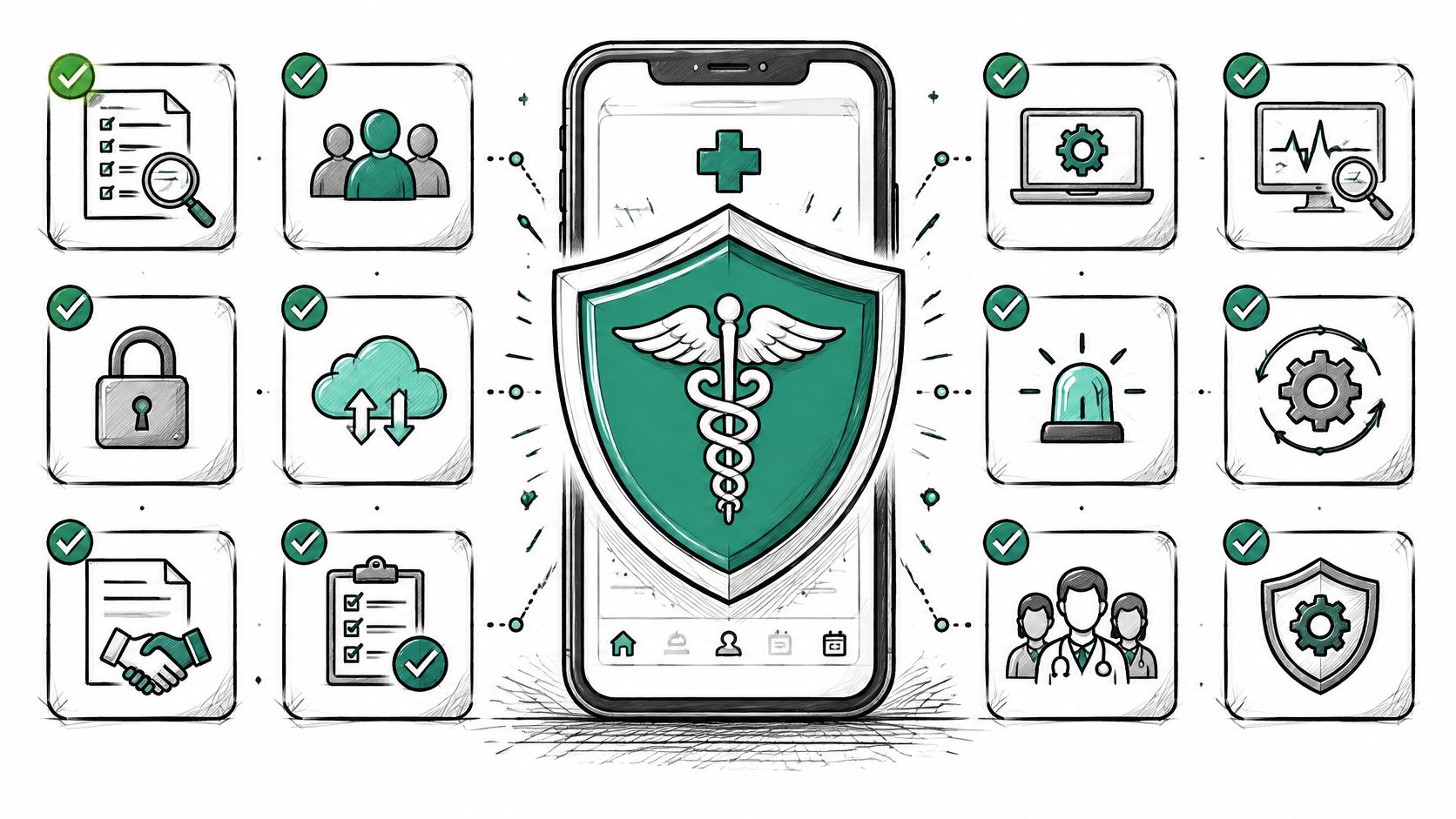
How HealthTech companies meet security and compliance expectations: HIPAA safeguards, business associate agreements, safe data handling, and SOC 2 or HITRUST.
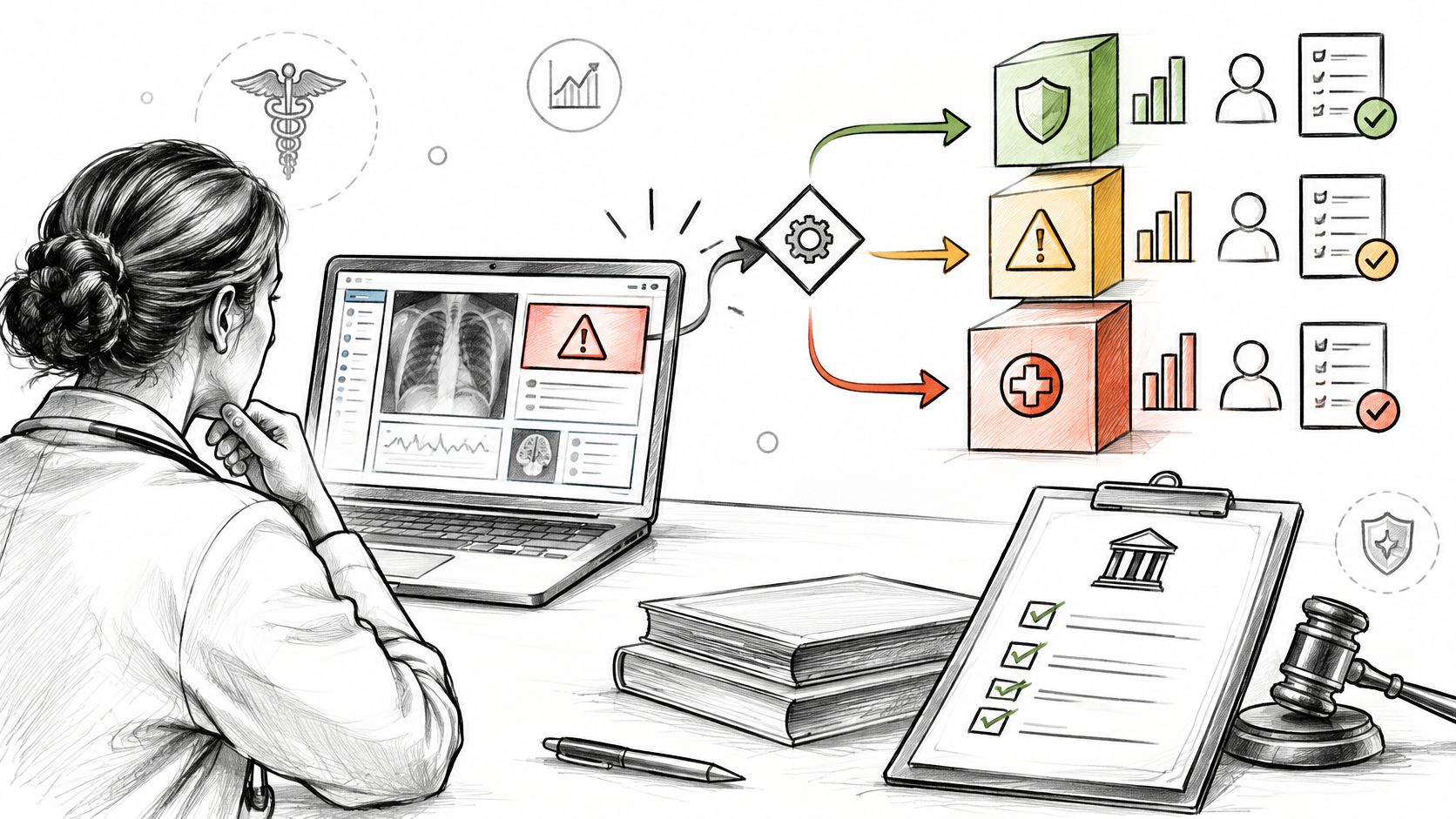
How medical device software is regulated in the US and EU: device status, classification, routes to market, the engineering standards and what changes for AI.
Connect with our team to explore how AI expertise can transform your business.