
AI in Healthcare
Smart on FHIR: What It Is and How It Works in Practice
Smart on FHIR guide for healthtech engineers. Learn the OAuth 2.0 launch model, scope syntax, backend services, and US regulatory requirements.
October 14, 2026Read more
How much does it cost to implement AI? Our guide breaks down data, talent, tools, and hidden costs to help you budget for real-world AI solutions.

Trying to pin down a single number for the cost of AI implementation is like asking, "How much does a vehicle cost?" Are we talking about a scooter or a freight train? The answer is a spectrum, and it all comes down to what you're trying to accomplish. A simple pilot project using off-the-shelf tools might only set you back a few thousand dollars, whereas a completely custom, enterprise-wide system can easily run into the millions.
The final price tag really hinges on things like the state of your data, the talent you have on hand, the infrastructure you'll need, and the specific AI solutions required to get the job done.
Thinking about an AI project is a lot like building a house. You could go for a pre-fabricated model—it's quick, affordable, and does what you need. Or, you could hire an architect to design a custom masterpiece from the ground up. Both are "houses," but their costs, timelines, and complexity are worlds apart. The same logic applies here; figuring out how much it costs to implement AI starts with understanding the scale of your ambition.
Interestingly, the biggest cost drivers are rarely the AI models themselves. It's all the foundational work that supports them: cleaning up your data, getting the right people on board, and making sure your tech infrastructure can handle the load. Nail these, and you're on your way to building a budget that actually makes sense.
To give you a clearer idea of what to expect, let's break down the typical investment levels. The initial outlay can swing wildly depending on whether you're just dipping your toes in the water or diving in headfirst for a full business overhaul.
An AI pilot project can cost as little as $10,000, while a complex, custom system can easily surpass $200,000. The trick is to make sure your investment is tied directly to a clear business goal.
This initial scoping phase is absolutely critical. A project with a fuzzy objective is a surefire way to watch your budget evaporate. This is exactly why strategic planning, like our hands-on AI Ideation & Strategy Workshop, is so important. It helps align your budget with what's actually achievable right from the start.
To help you visualize this, I've put together a table that breaks down typical costs and timelines based on how complex a project is.
This table gives a high-level estimate of what you can expect to invest, depending on the scope of your AI initiative.
| Project Tier | Typical Cost Range | Common Use Cases | Estimated Timeline |
|---|---|---|---|
| Pilot / MVP | $10,000 – $50,000 | AI-powered chatbots, internal process automation, basic data analysis dashboards. | 2-4 Months |
| Mid-Tier Custom | $50,000 – $200,000 | Sales forecasting models, personalized marketing engines, customer churn prediction. | 5-9 Months |
| Enterprise-Scale | $200,000+ | Custom deep learning models, advanced robotics, enterprise-wide transformation. | 12+ Months |
As you can see, the range is significant. It's also worth noting that different pricing models—from simple subscriptions to pay-as-you-go fees—will affect your total cost of ownership over time. For a concrete example of what direct platform costs look like, checking out comprehensive pricing details from a provider can be a useful exercise. Getting a handle on these different components is the key to building a budget that turns your AI vision into a reality.
When someone asks, "how much does it cost to implement AI," there’s no simple answer. It’s not like buying off-the-shelf software with a single price tag. The real cost is a blend of several key ingredients, and getting any one of them wrong can throw your entire budget off track.
Think of it like building a custom home. You don't just pay for the finished house; you pay for the architect, the raw materials, the construction crew, the permits, and the landscaping. An AI project is the same. To get an accurate picture, you have to break it down into its core components.
The infographic below gives a great high-level view of what drives your final budget.
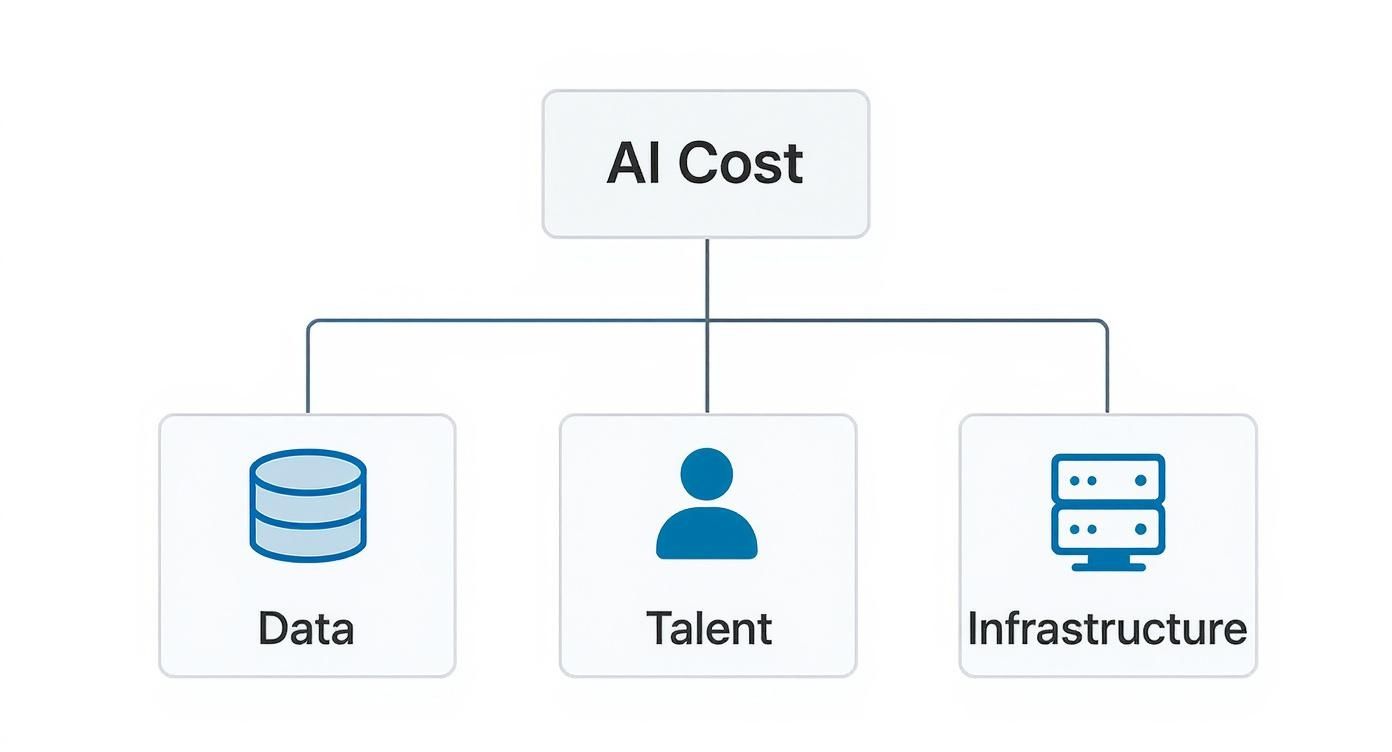
As you can see, the final number is a mix of the people you hire, the data you use, and the technology that makes it all run. Let's dig into the seven pillars that make up nearly every AI initiative.
This is almost always the biggest chunk of your budget. You’re not just hiring software developers; you need a specialized team of data scientists, machine learning engineers, and AI architects. These roles are in high demand, which means they command premium salaries, whether you hire them in-house or bring in a specialized agency.
Data is the lifeblood of any AI model, but it almost never arrives clean and ready to use. This stage is notoriously deceptive, often eating up as much as 80% of the project's entire timeline.
The costs here come from a few different places:
Your AI model needs a place to run, and you have two main options: the cloud or your own hardware.
There’s no need to reinvent the wheel. Your team will rely on a mix of development platforms, pre-built models, APIs, and other software tools. Each of these often comes with its own licensing or subscription fees, which need to be factored into the budget. This is where an AI Strategy consulting tool can help identify the most cost-effective options.
Your shiny new AI system can’t exist in a silo. It needs to talk to your CRM, ERP, and other business-critical software. This requires skilled developers to build custom APIs and connectors to ensure data flows smoothly across your entire tech stack.
Launching your AI model isn't the end of the project—it's just the beginning. AI models need constant care and feeding to stay accurate. This involves retraining the model with fresh data to combat "model drift," which is the natural decline in performance as the world changes around it.
If you're in a regulated industry like finance or healthcare, this is a big one. You have to ensure your AI system meets strict standards like GDPR or HIPAA. This means spending money on security audits, data governance, and making sure your model's decisions are transparent and fair.
When you're trying to nail down the financial side of an AI project, it's crucial to understand the costs associated with people and outside help. For example, a good resource for estimating talent costs is this guide on Decoding Offshore Software Development Costs.
At the end of the day, the price for an AI solution can vary wildly. In 2024, a small pilot project might start around $30,000, while a complex, enterprise-grade system can easily top $300,000. And with the cost of computing for AI expected to jump by 89% between 2023 and 2025, careful planning is absolutely essential to keep your project on track and on budget.
So, what's the real price tag on an AI project? The honest answer is: it depends entirely on what you're trying to achieve. The budget for a startup getting its first AI feature off the ground looks completely different from a global company aiming to disrupt an entire market. The key is to match your investment to your strategic goals and the potential payoff.
A common pitfall we see is a mismatch between budget and ambition. Some companies overspend on a solution that’s far too complex for their immediate needs, while others underspend on a pilot so limited it can't possibly prove real business value. Finding that sweet spot means realistically mapping your financial commitment to the scale of the problem you're trying to solve.
For a startup or small business just dipping its toes into AI, the name of the game is speed and validation. You’re not trying to build the perfect, all-knowing system right out of the gate. You're trying to launch a Minimum Viable Product (MVP) that solves one specific customer problem and proves the core idea is solid.
This lean approach usually involves a few key things:
A well-planned MVP project for a startup usually lands somewhere between $20,000 and $50,000. The goal isn't perfection; it's learning. This initial investment is all about gathering real-world data, testing your assumptions, and building a strong case for the next round of funding.
Small and medium-sized businesses (SMEs) often come at AI from a different angle. They're usually looking to streamline an existing process to boost efficiency, cut operational costs, or level up their customer experience. For them, the investment is about sharpening their competitive edge and scaling up without having to hire more people for every new customer.
Projects at this stage might involve automating a core business function with a custom-trained model or developing sophisticated internal tooling that makes their teams more effective. Diving into some real-world use cases can give you a concrete idea of what's achievable here.
An SME aiming to automate a key process should expect a project to cost between $80,000 and $200,000. This budget accounts for more intensive data preparation, custom model development, and trickier system integrations. Following a structured AI Product Development Workflow becomes absolutely critical at this point to keep the project on track and ensure the final product delivers a measurable return.
For large enterprises, AI isn't just an optimization tool—it's a strategic weapon for market leadership. The goal shifts from simply improving a process to a complete transformation that can redefine entire business models. These are massive, complex projects designed for significant, long-term impact.
At this scale, you’re looking at:
A full-scale enterprise transformation project can easily start at $500,000 and often climbs into the millions. This massive figure reflects the immense resources needed for top-tier talent, enterprise-grade infrastructure, strict data governance, and continuous maintenance.
Success at this level hinges on a crystal-clear vision, unwavering executive sponsorship, and a rock-solid strategy. This is where high-level AI strategy consulting becomes invaluable, ensuring that a huge investment is directly tied to concrete business outcomes. Kicking things off with a Custom AI Strategy report is the first step in making sure that kind of investment is built on a strong foundation.
To give you a clearer picture of how these costs break down, let's look at where the money typically goes in a small pilot versus a large enterprise project.
The table below offers a glimpse into how budget allocation shifts dramatically depending on the project's scale. In a pilot, the focus is on quick development and validation, whereas in an enterprise system, the long-term costs of integration, compliance, and maintenance take center stage.
| Cost Component | Pilot / MVP Project (Approx. % of Budget) | Enterprise System (Approx. % of Budget) | Key Considerations |
|---|---|---|---|
| People / Talent | 40-50% | 25-35% | An MVP is heavily reliant on a small, expert team. Enterprise projects require larger, more diverse teams, but the cost is spread across a much bigger budget. |
| Data | 10-15% | 15-20% | Data acquisition and cleaning are crucial at all stages, but enterprises face greater complexity with data governance, security, and large-scale pipelines. |
| Tooling & Licensing | 15-20% | 10-15% | Pilots often use pay-as-you-go SaaS tools. Enterprises invest in long-term licenses and platforms that can scale across the entire organization. |
| Infrastructure | 10-15% | 15-20% | Cloud costs are manageable for an MVP but become a major expenditure for enterprises running massive, high-availability systems 24/7. |
| Integration | 5-10% | 15-20% | A pilot may only need a few simple API connections. An enterprise system must integrate deeply with dozens of complex legacy systems. |
| Compliance & Change Mgt. | <5% | 10-15% | Barely a factor for a small-scale test. A massive, mission-critical component for large organizations dealing with regulation, training, and adoption. |
As you can see, the financial DNA of an AI project changes completely with its ambition. Understanding this shift is the first step toward building a realistic budget that sets your project up for success from day one.
When you’re budgeting for an AI project, it’s the costs you don't see coming that pack the biggest punch. Everyone accounts for the obvious stuff—servers, software licenses, and expert salaries. But it's the hidden expenses lurking beneath the surface that quietly sabotage timelines and blow up budgets. Truly understanding how much it costs to implement AI means dragging these financial traps into the light before they trip you up.
A successful AI initiative is built on a rock-solid foundation of planning. Miss just one of these hidden costs, and you can trigger a domino effect that turns a promising project into a very expensive lesson. Your best defense is a proactive and thorough AI requirements analysis, which is a cornerstone of the AI strategy consulting we provide to help businesses see around these corners.
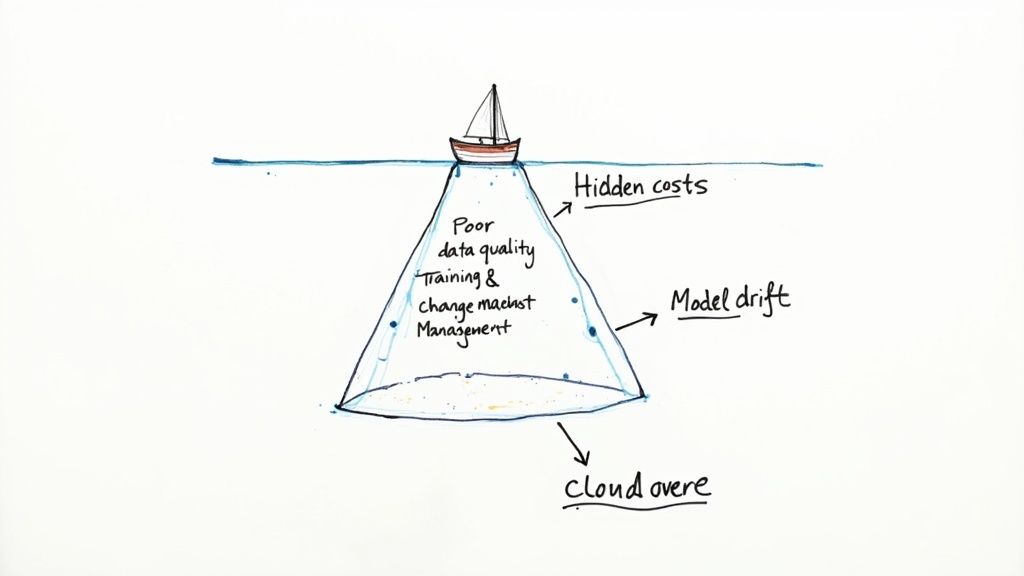
Think of data as the fuel for your AI engine. If you put dirty, low-grade fuel in a high-performance car, you’re going to have problems. It's the same with AI. Many companies massively underestimate the time, effort, and money it takes to get their data ready for prime time. This isn’t a small chore; it can easily balloon into a significant project all on its own.
The costs here come from a few key areas:
Skipping these steps is like building a skyscraper on a shaky foundation. It's not a matter of if it will fail, but when.
You can build the most sophisticated AI system imaginable, but it's completely worthless if your team doesn't know how to use it—or worse, actively resists it. The "human element" is a massive hidden cost that many tech-focused budgets completely ignore.
Change management isn't a soft skill; it's a hard financial necessity. Effective training and clear communication are essential for ensuring your AI investment actually delivers a return.
Budgeting for this means setting aside real money for good training programs, creating user-friendly documentation, and sometimes even redesigning entire workflows. It’s all about helping your people move from "the way we've always done it" to a new, smarter way of working with AI as a partner.
The ongoing, operational costs are where many AI budgets really start to unravel. Two of the biggest culprits are the pay-as-you-go nature of cloud services and the unavoidable reality of "model drift."
Cloud Pricing Sticker Shock: The flexibility of cloud platforms is amazing, but their pricing models can be notoriously complex and hard to predict. A recent study found that 65% of IT leaders got hit with unexpected costs from AI's consumption-based pricing. An AI tool that gets used more than you anticipated can lead to a surprise bill that's several times what you forecasted. As we explored in our AI adoption guide, you have to monitor usage like a hawk to keep these costs from spiraling.
Model Drift Maintenance: An AI model is not a "set it and forget it" piece of tech. The real world is constantly changing, and as it does, your model's predictions will slowly get less accurate. This phenomenon is called model drift. Fighting it requires constant monitoring and periodically retraining the model with fresh data, which eats up both computing power and your team's time. This ongoing maintenance, which can be managed efficiently through services like our AI Automation as a Service, is a permanent operational expense you have to bake into your long-term budget.
The financial picture is getting more complex, with a dramatic 75.2% year-over-year jump in spending on AI-native applications. Companies are now shelling out an average of $400,000 a year. With vendors all using different models—from Microsoft's per-user fee to ChatGPT's consumption-based pricing—forecasting is a huge challenge. Our expert team can help you navigate this maze. You can read more about the rising costs and pricing complexities of AI to get ahead of the curve.
It’s easy to get caught up in the technology, but let's be blunt: if you can't prove the value of an AI project, it's just an expensive hobby. Thinking of AI as a simple line-item cost is the first mistake many leaders make. It’s an investment, and like any smart investment, it needs a clear path to paying for itself—and then some.
This is where the rubber meets the road. Many ambitious AI initiatives die on the vine, not because the tech failed, but because the business case was flimsy from the start. To get the green light and actually see your project succeed, you have to talk in the language of the business: Return on Investment (ROI).
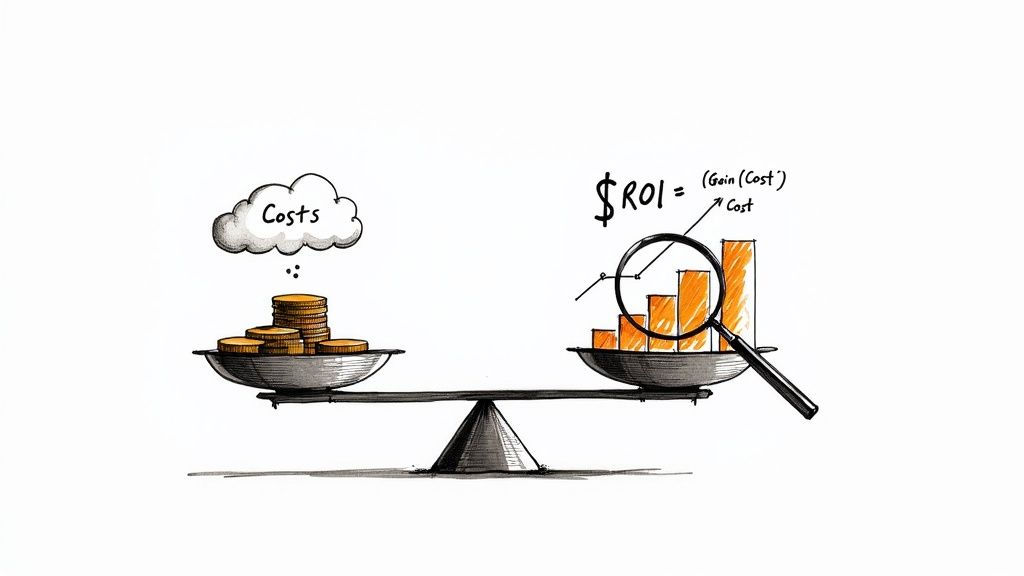
So, how do you actually figure out the ROI? It all boils down to where the value is coming from. Every successful AI project delivers results in one of two ways: it either saves you money or makes you money. Sometimes, it does both.
1. Cost Savings (The Efficiency Engine) This is often the most straightforward part to quantify. You're looking for places where AI can make your operations leaner and more efficient.
2. Revenue Growth (The Growth Catalyst) This side of the coin is about how AI can help you grow the top line. It’s about creating new value and making customers happier.
Once you’ve got a handle on the potential benefits, the math itself is pretty simple.
ROI (%) = [(Financial Gain - Project Cost) / Project Cost] x 100
Let's make that real. Imagine a retail company spends $150,000 on an AI tool to better forecast customer demand. In the first year, it saves $80,000 by not overstocking unpopular items. It also boosts sales by $120,000 because the products people do want are always available. The total financial gain is $200,000.
Plugging that in: ROI = [($200,000 - $150,000) / $150,000] x 100 = 33.3%
Showing a positive ROI like that within the first year is a powerful way to make your case.
The global appetite for AI is undeniable. Private capital investment in the space hit an incredible $130 billion in 2024, a jump of 40% from the year before. That kind of money doesn't get thrown around without an expectation of serious returns. To make sure you're on the right track, a tool like our Financial Insights Dashboard is essential for tracking your actual performance against the ROI you projected from day one.
Trying to navigate the maze of AI implementation on your own is one of the fastest ways to watch your budget spiral out of control. It’s a minefield of hidden costs and unexpected delays. Answering the big question—how much does it cost to implement AI—becomes a lot less daunting when you have an experienced guide showing you where to invest for the biggest impact.
Partnering with a specialist isn't just about avoiding rookie mistakes like a messy data strategy or picking the wrong tech. It’s about building a real, sustainable advantage that pays for itself over and over again.
One of the biggest, and often overlooked, costs is talent. Trying to hire, onboard, and retain a specialized in-house AI team is a slow, expensive process. The high salaries alone can drain your budget before you've even started building.
Working with an expert partner gives you a massive shortcut. You get a seasoned team in your corner from day one, ready to hit the ground running.
Our whole approach is built to get you from idea to impact as quickly as possible, starting with a rock-solid strategy. We help you:
A good partner doesn’t just build things; they give you a clear roadmap that connects your initial spend to long-term returns. It all starts by getting under the hood of your business—understanding your specific challenges and biggest opportunities. This is the foundation of a smart AI strategy, and it’s what keeps you from pouring money into projects that sound cool but don't actually move the needle.
Focusing on strategy first is what turns AI from a potential money pit into a powerful engine for growth. It’s the foundational work that prevents wasted effort on projects that aren't aligned with what your business truly needs.
In the end, getting the most out of your AI budget comes down to making smart, informed decisions at every step. Whether it’s crafting a plan that maps out your entire journey or implementing efficient solutions, a strategic partner acts as a force multiplier for your investment.
Ready to build a powerful business case for AI with a budget that makes sense? Let's talk. We can help you develop a cost estimate that’s tied directly to your goals and make sure your first steps into AI are both successful and financially sound.
When it comes to artificial intelligence, the conversation always turns to cost. It's a big topic with a lot of moving parts. Here are some straightforward answers to the questions we hear most often from leaders trying to get a handle on their AI budget.
While you definitely need to think about your data and your team, the complexity of the AI model itself usually has the biggest impact on the final price tag. There's a huge difference between plugging in a pre-built API for a common task, like analyzing customer feedback sentiment, and building a custom deep learning model from scratch.
Think of it this way: using an API is like renting a professional tool, while building a custom model is like designing and manufacturing that tool yourself. The custom route requires more data, more specialized expertise, and a ton of computing power for training—all of which drive up the cost significantly. The more unique your problem, the more bespoke (and expensive) the solution will be.
You absolutely can. Working with a smaller budget—say, under $20,000—just means you need to be smart about your approach. Instead of a massive custom build, you'll focus on using existing AI tools for business to get the job done.
You can run a highly successful pilot project by tapping into "AI as a Service" platforms for things like customer service chatbots, smarter marketing campaigns, or intuitive data dashboards. The trick is to pick a very specific, well-defined problem and solve it with an off-the-shelf solution. This lets you prove the value of AI quickly without a massive upfront investment.
The timeline for an AI project can vary just as much as the cost. But to give you a rough idea, here’s what we typically see:
Keep in mind these are just estimates. The actual timeline will depend on how clean your data is, the complexity of your existing systems, and how much change management is needed across your organization.
For your first few forays into AI, bringing in a consultancy is almost always the more cost-effective path. The hourly rate might look higher on paper, but you skip the massive and often hidden costs of recruiting top-tier talent, paying their high salaries, and waiting for a new team to get up to speed.
Partnering with an external team like our expert team gives you immediate access to a seasoned group with a battle-tested process. It's the fastest way to sidestep common pitfalls, avoid expensive rookie mistakes, and start seeing a real return on your investment from day one.
Ready to turn your AI ideas into scalable impact? At Ekipa AI, we deliver tailored strategies and end-to-end execution to transform your business. Get your Custom AI Strategy report today.
Smart on FHIR guide for healthtech engineers. Learn the OAuth 2.0 launch model, scope syntax, backend services, and US regulatory requirements.
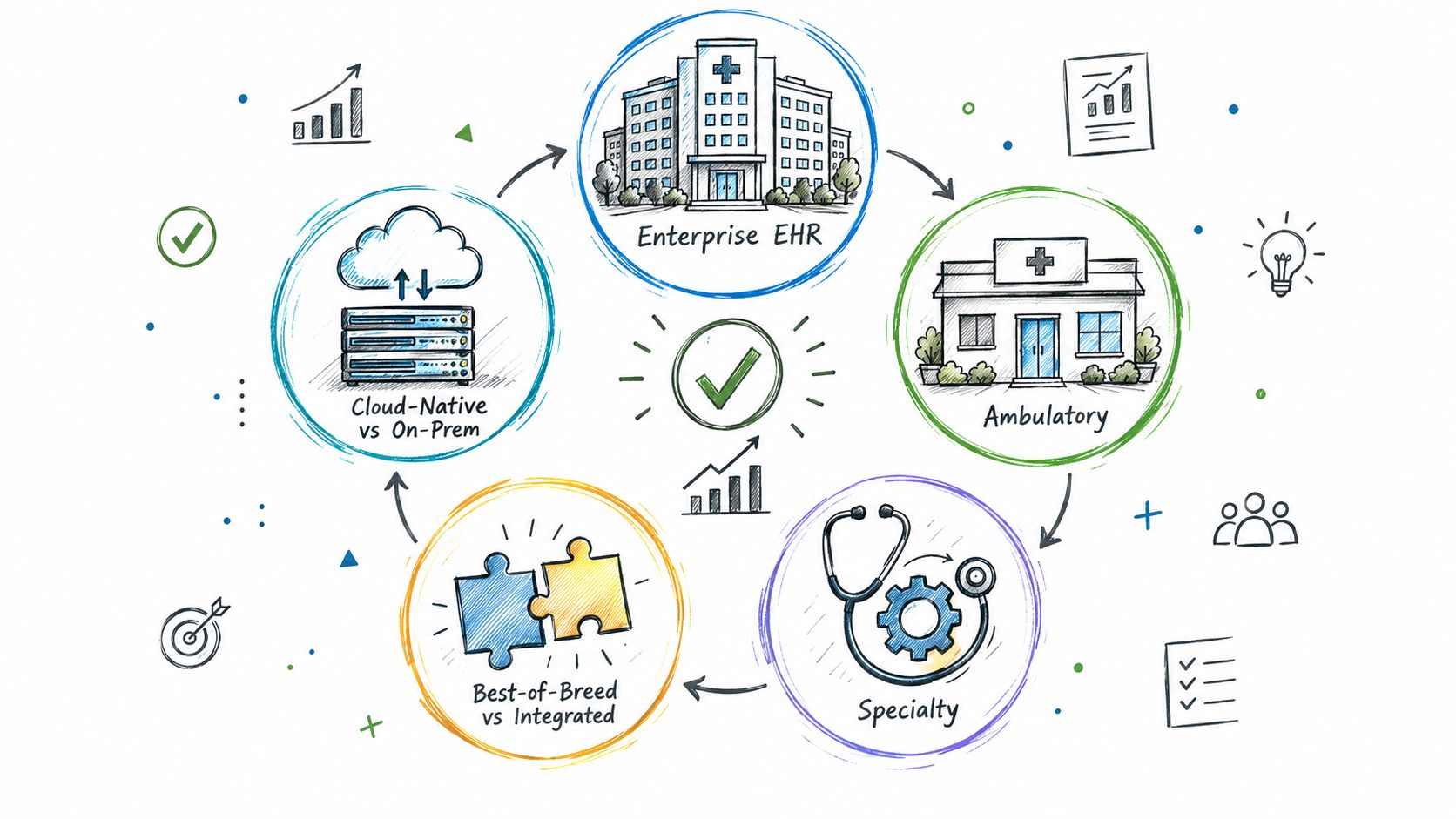
Explore the types of EHR systems by deployment model, care setting and scope. Compare integration options, trade-offs and selection tips for healthtech teams.
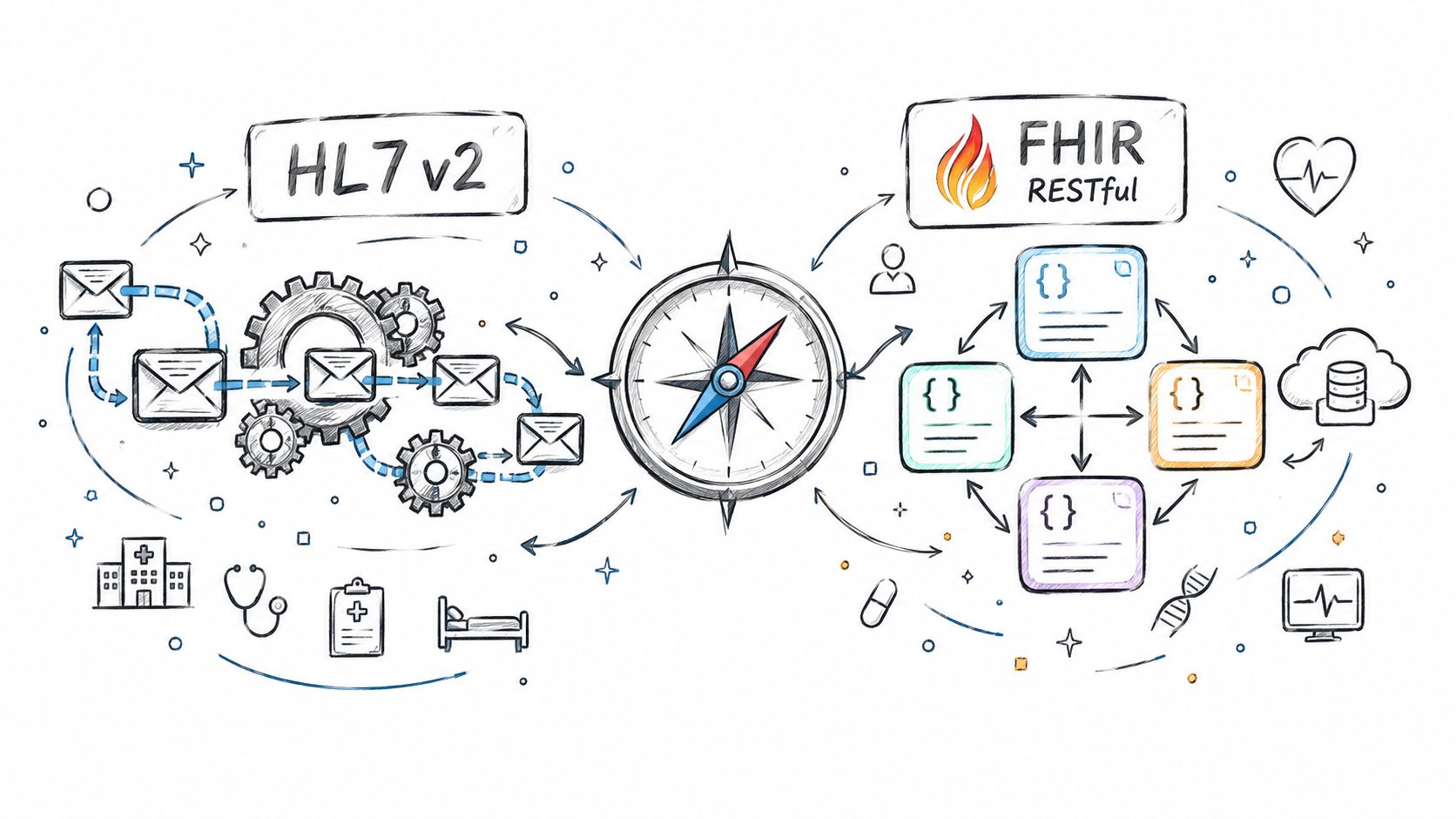
Compare Fhir vs. hl7 standards for healthtech integration. See how HL7 v2 and FHIR differ in use, mechanics, regulation, and real-world architecture.
Connect with our team to explore how AI expertise can transform your business.