
AI Integration
EHR Integration Services: Scope, Standards and Partners
Learn what EHR integration services include, from HL7 v2 and FHIR R4 to SMART on FHIR, security, timelines and how to vet a partner.
November 12, 2026Read more
Clinical AI Model Validation for product leads: staged testing, subgroup bias checks, TRIPOD+AI reporting, GMLP and post-launch monitoring.

Oxford-led guidance on evaluating clinical prediction models includes worked examples in which an external validation with a continuous outcome needs 886 participants to estimate four key performance measures precisely, and one with a binary outcome needs at least 949 participants and 408 outcome events, as the published evaluation guidance sets out. Teams that plan validation around a held-out split and a headline AUC end up with a number that describes a dataset instead of a decision about whether the model can go live. This framework treats clinical AI model validation as a sequence of release gates, each with its own data source, evidence artifact, named owner and rollback path.
The short answer for product leads: internal validation on a locked test set, external validation on data from other sites, prospective or silent-mode evaluation on live cases, then monitored deployment. Every stage produces evidence a reviewer can audit and a threshold that triggers action when it fails.
The International Medical Device Regulators Forum (IMDRF), whose members include FDA, splits the clinical evaluation of Software as a Medical Device into three parts: a valid clinical association between the output and the clinical condition, analytical validation that the software processes input data correctly and reliably, and clinical validation that the output achieves its intended purpose in the target population. That framework is guidance rather than regulation. The engineering requirement behind it holds regardless: each stage needs data the model had no part in shaping, and a named person who signs off on the result.
Freeze the model before any testing begins. Write down the intended population, the users, the clinical decision the output informs, the comparator and the success criteria. A threshold chosen after you have seen test results turns the test set into a tuning set, and the evidence that comes out of it cannot support a release decision.
The stages run in a fixed order, and skipping one leaves a gap a reviewer will find:
Internal validation on a locked test set. Data never used for training, tuning or threshold selection, reported with discrimination, calibration and confidence intervals rather than a single AUC.
External validation on data from other sites, periods or devices. This measures transportability, which a random split cannot.
Prospective or silent-mode evaluation. The model scores live cases while clinicians see nothing, so you learn what happens when inputs arrive late, missing or in different units.
Monitored deployment. The model informs care while drift, calibration and override patterns are tracked against predefined responses.
The sequence moves from a frozen model to live monitoring, and each stage owns a different evidence artifact.
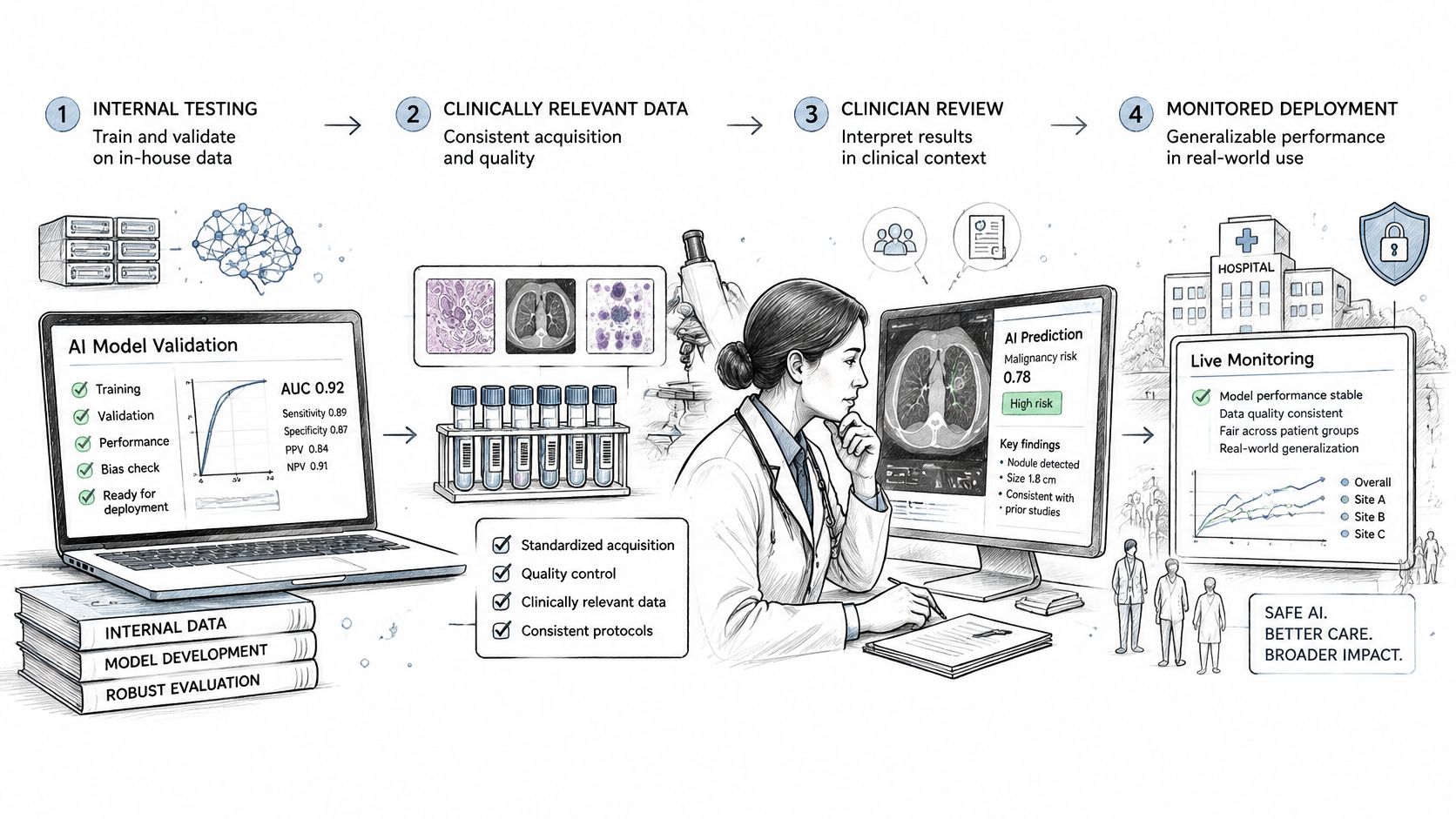
The table is the part often left unwritten, and it is the part that settles arguments later about who was supposed to catch a regression.
| Stage | Data used | Evidence to keep | Owner |
|---|---|---|---|
| 1. Freeze and define scope | Development data and a frozen model version | Intended-use statement, success criteria, model version hash | Clinical lead with engineering |
| 2. Internal validation | Held-out test set never used for tuning | Discrimination, calibration, confidence intervals | Data science lead |
| 3. External validation | Data from other sites, periods or devices | Performance by site and period, calibration shift | Engineering with clinical partner |
| 4. Prospective or silent-mode evaluation | Live inputs with outputs hidden from clinicians | Predicted versus observed outcomes, workflow fit | Clinical operations with IT |
| 5. Monitored deployment | Production inputs and observed outcomes | Drift reports, alert and override logs | Vendor and provider governance, jointly |
Teams integrating a model into an existing EHR or clinical workflow often need help before the first gate closes, which is where Ekipa's AI implementation support fits. The build itself runs under our AI-assisted delivery framework, which keeps code, tests and validation records aligned as the model changes.
Write it down first. If the acceptance threshold for a stage isn't recorded before the stage runs, the stage produces a justification rather than a decision.
A random split of one hospital's records counts as internal testing, whatever the holdout fraction. External validation means data from a different institution, geography, time period, device or care setting, and the published record shows how rarely it happens. A 2021 systematic review of machine-learning models that predict orthopedic surgical outcomes screened 4,682 studies and found 18 studies that externally validated 10 machine-learning prediction models, although 59 models were available for validation. The median external-validation dataset held just 274 patients, with an interquartile range of 178 to 552, according to the review of external validation in orthopedic prediction models.
The same review found that only 7 of 17 datasets with reported country information came from the United States, and it points to FDA's position that validation is best performed using institutions different from those that supplied training data. A single-site split overestimates discrimination and conceals the losses caused by differences in patient demographics, disease prevalence, clinical workflows, data quality, coding practices and equipment.
For each external source, document the case mix, the referral pathway, the coding practice, the scanner or lab equipment, and the time window relative to the training cutoff. Map every field to the model inputs, whether that's a FHIR R4 Observation with a LOINC code or a local code that means roughly the same thing, and record each mapping difference next to the performance result it explains.
The working sequence for a multi-site run is short enough to put on a wall:
Pick two or three external sources whose case mix differs from development data in different ways.
Write a data dictionary for each source and log every mapping decision.
Freeze the decision threshold on internal data before any external site is scored.
Report performance per site with confidence intervals, and per period where the source spans years.
Decide whether the gaps change the clinical threshold before silent-mode testing starts.
Health systems and vendors running these studies across several sites need the integration plumbing on both sides to be repeatable, and our healthcare AI and integration work covers the mapping, testing and data lineage that makes a second and third site cheaper than the first.
Start with the axis most likely to change the decision. For a deterioration model in a hospital that just switched lab assays, that axis is the device or the calendar period, not ethnicity, and testing every axis with equal weight burns the event budget you have.
A strong average hides a subgroup failure. A recent review of clinical AI notes that EHR-based models can be affected by missing data, coding variation and changes in clinical practice, lists dataset shift among the main validation gaps, and calls for reporting fairness across subgroups alongside sensitivity, specificity and calibration, as the review of clinical AI validation gaps describes. In practice, stratify results by site, calendar period, sex, age, ethnicity where legally and ethically appropriate, disease severity and missing-data pattern, compare calibration as well as ranking performance, and agree on acceptable subgroup gaps before testing.
The reporting record is thin in a specific way. One evidence base reviewed there reported AUCs ranging from 0.67 to 0.92 while calibration and overall error went largely unreported. An AUC can stay flat while predicted probabilities drift into unsafe territory after a prevalence change, which is why a subgroup review that only checks ranking proves very little.
| Subgroup axis | Metrics to compare | Risk it can reveal |
|---|---|---|
| Age band | Sensitivity, calibration slope, false-negative rate | Under-prediction in pediatric or older patients |
| Sex | Sensitivity, specificity, calibration-in-the-large | Differences in presentation or referral patterns |
| Ethnicity, where legally and ethically appropriate | Discrimination and calibration per group | Uneven data quality or disease prevalence |
| Site | AUC, calibration plot, decision-curve net benefit | Different case mix or coding practice |
| Device or scanner | Input distribution, sensitivity at fixed threshold | Acquisition protocol shift |
| Calendar period | Calibration over time | Practice, coding or referral change |
| Disease severity | Sensitivity at fixed threshold | Easy cases inflating averages |
Methodological work on this problem argues that validation should test two separate properties: performance invariance across the relevant in-distribution subgroups, and increased uncertainty when inputs fall outside the distribution, with abstention and human review designed in as expected behavior rather than treated as failure, as the analysis of subgroup and out-of-distribution validation describes. That framing gives you release gates you can implement: a minimum sensitivity per subgroup, an uncertainty threshold that triggers abstention, and a named clinical fallback for deferred cases.
PROBAST+AI is the structure to use for the bias review itself, covering participants and data sources, predictors, outcomes and analysis. Then count cases in each cell before computing anything.
A subgroup with 40 cases and a sensitivity estimate spanning 30 points hasn't been shown to be safe or unsafe. Mark it indeterminate in the report and say what data would settle it.
The sequence is: list the axes, count cases per cell, compute metrics per cell, compare each cell against the predefined gap, then record the mitigation, restriction or stop decision in the validation file.
Choose the guideline by what the study evaluates. A model that outputs a risk score used in a clinical decision is a prediction-model study, and TRIPOD+AI (2024) is the reporting standard. A randomized trial of an AI-supported pathway is reported under CONSORT-AI (2020), and its protocol under SPIRIT-AI (2020).
| Guideline | Study type | Applies when |
|---|---|---|
| TRIPOD+AI (2024) | Prediction model development or validation | The model output informs a clinical decision |
| CONSORT-AI (2020) | Randomized trial of an AI intervention | Reporting the results of the trial |
| SPIRIT-AI (2020) | Trial protocol for an AI intervention | Writing the protocol before the trial starts |
The metrics a reviewer checks first are discrimination with confidence intervals, calibration plots with slope and intercept, overall error, sensitivity and specificity at a stated threshold, positive and negative predictive values at the local prevalence, and decision-curve or net-benefit results across a range of thresholds. An AUC answers a narrower question than the one the clinical lead is being asked to sign.
Structure the report in the order a reviewer reads it:
Intended use, population and the clinical decision.
Data sources, inclusion rules and missingness.
Model version, threshold and preprocessing.
Metrics with confidence intervals.
Subgroup results, including cells too small to judge.
Known limitations and failure modes.
Every claim should point to a dataset and a model version. A metric without those two identifiers can't be reproduced, and a reviewer will treat it as unverified.
In October 2021, FDA, Health Canada and the UK MHRA published 10 Good Machine Learning Practice guiding principles for medical device development, listed on the FDA's Good Machine Learning Practice page. Several shape validation design directly: multidisciplinary expertise across the lifecycle, good software engineering and security practice, representative clinical datasets, and training and test data kept independent. The rest run from clinically relevant testing conditions through to monitoring of deployed models.
The Predetermined Change Control Plan turns those principles into an engineering artifact. FDA's 2025 guidance defines a PCCP as a plan specifying the planned modifications, the protocol for developing, validating and implementing them, and an assessment of their impacts. It's reviewed as part of the original marketing submission, so covered changes can ship without a new application each time, as the FDA guidance on predetermined change control plans sets out, and it applies to AI-enabled device software functions reviewed through the 510(k), De Novo and PMA pathways.
The three regulators also set out five principles for PCCPs, including that planned modifications stay within the original intended use or intended purpose, that performance metrics are scientifically and clinically justified and proportionate to risk, and that the plan specifies verification and validation methods plus mechanisms to detect, revert or stop an implementation that fails defined performance criteria, as the PCCP guiding principles describe. An update that raises AUROC but increases false negatives in a clinically important subgroup fails that protocol even though its headline metric improved, and the release gate should say so before anyone runs the retraining job.
The working sequence for a change: define the change boundary, write a validation protocol per change type, set acceptance thresholds per subgroup, test the rollback path, and record the impact assessment in the validation file. In Europe, the EU AI Act applies alongside medical-device rules. European Commission guidance on that interaction states that training, validation and test data for high-risk medical-device AI must be relevant, representative of the intended purpose, as free from errors and bias as possible and sufficiently thorough, and links lifecycle validation to cybersecurity, including protection against data and model poisoning, per the Commission guidance on the AI Act and medical devices. That document is non-binding guidance, while the AI Act itself is law.
For SaMD teams, the change boundary and the validation protocol belong in the same document set, which is work our Software as a Medical Device engineering team does alongside product and regulatory stakeholders.
FDA frames AI-enabled medical devices across the total product lifecycle, from development and validation through deployment, monitoring, maintenance and modification, as described on the FDA's AI-enabled medical device page. A premarket test set is the first evidence point. Calibration typically moves before discrimination does, and alert volume or clinician override patterns move before either, which means a monitoring plan built only on AUROC will notice a problem late.
The agency has sought public comment on methods for measuring real-world performance, detecting performance changes, defining monitoring triggers, evaluating human-AI interaction and establishing response protocols, which tells you these operational questions are not yet standardized, as its request for public comment on measuring AI performance shows. Your plan has to settle them locally, in writing, with names attached.
| Monitored signal | Predefined action | Owner |
|---|---|---|
| Input data drift | Investigate, then confirm the change sits inside the approved PCCP | Vendor, with provider data team |
| Missing or malformed clinical fields | Pause affected inputs and correct the mapping | Provider and vendor engineering |
| Shifts in patient mix | Run subgroup review against predefined gaps | Clinical governance |
| Calibration degradation | Roll back to the prior version if acceptance criteria fail | Vendor, with clinical sign-off |
| False-negative rate by subgroup | Restrict workflow use or roll back | Clinical governance |
| Alert volume and clinician overrides | Review workflow fit | Provider clinical operations |
Ownership is the part that fails without notice. The vendor owns the model and its releases, the provider owns the workflow and the clinical review, and clinical governance decides when use gets restricted. An alert without an owner is an alert nobody answers.
Related reading: our medical device software regulation guide, the predetermined change control plan guide, monitoring clinical AI in production, how hospitals evaluate AI solutions and our healthcare AI governance and compliance guide.
Validation is a lifecycle capability built from engineering controls, not a report produced once before launch. The gates and the monitoring signals should be designed together, because the threshold that releases a model is the same threshold that triggers a rollback twelve months later. Teams that write the stage table, the subgroup gaps and the drift actions before data collection spend far less time in arguments after go-live.
No. Internal validation on a locked test set tells you the model fits its own development population, and it says little about a different hospital, a later year or a new scanner. Generalizability claims need external data and subgroup results, and regulated products need both analytical and clinical evidence.
There's no fixed number. The deciding factors are the precision of the estimate you need and how different the sites are from the intended-use population, so set the confidence-interval width first and pick sites for heterogeneity rather than volume. Two or three deliberately different sites usually teach more than ten similar ones.
Silent-mode evaluation is the expected route when the output could change a decision or an outcome, because it shows how the model behaves on live inputs while nobody acts on the result. Where the output only prioritizes a worklist with no clinical consequence, external retrospective validation plus monitoring can be proportionate. Record the reasoning either way.
Yes, when the output is a prediction that informs a clinical decision, the study counts as a prediction-model study and TRIPOD+AI (2024) is the reporting standard. CONSORT-AI (2020) applies when you randomize patients to an AI-supported pathway, and SPIRIT-AI (2020) covers the protocol for that trial.
They were published jointly by FDA, Health Canada and the UK MHRA in October 2021, so teams selling into those markets should map them to local requirements. The principles describe expected practice rather than a legal test, and binding obligations still come from each jurisdiction's device rules.
The vendor owns the model and its releases, the provider owns the workflow and the clinical review, and clinical governance decides when use gets restricted. Put names, thresholds and response times in the deployment record before launch.
If you're assembling a validation plan and want a technical review of your stage gates, subgroup thresholds and drift actions before the next release, book a consultation with Ekipa's HealthTech engineers.
Learn what EHR integration services include, from HL7 v2 and FHIR R4 to SMART on FHIR, security, timelines and how to vet a partner.

The full journey from AI strategy to scaled implementation in four stages: align and assess, choose and plan, prove and build, govern and scale.

How HealthTech companies meet security and compliance expectations: HIPAA safeguards, business associate agreements, safe data handling, and SOC 2 or HITRUST.
Connect with our team to explore how AI expertise can transform your business.