
AI Adoption
AI Strategy and Implementation: A Complete Guide
The full journey from AI strategy to scaled implementation in four stages: align and assess, choose and plan, prove and build, govern and scale.
November 10, 2026Read more
How medical device software is regulated in the US and EU: device status, classification, routes to market, the engineering standards and what changes for AI.
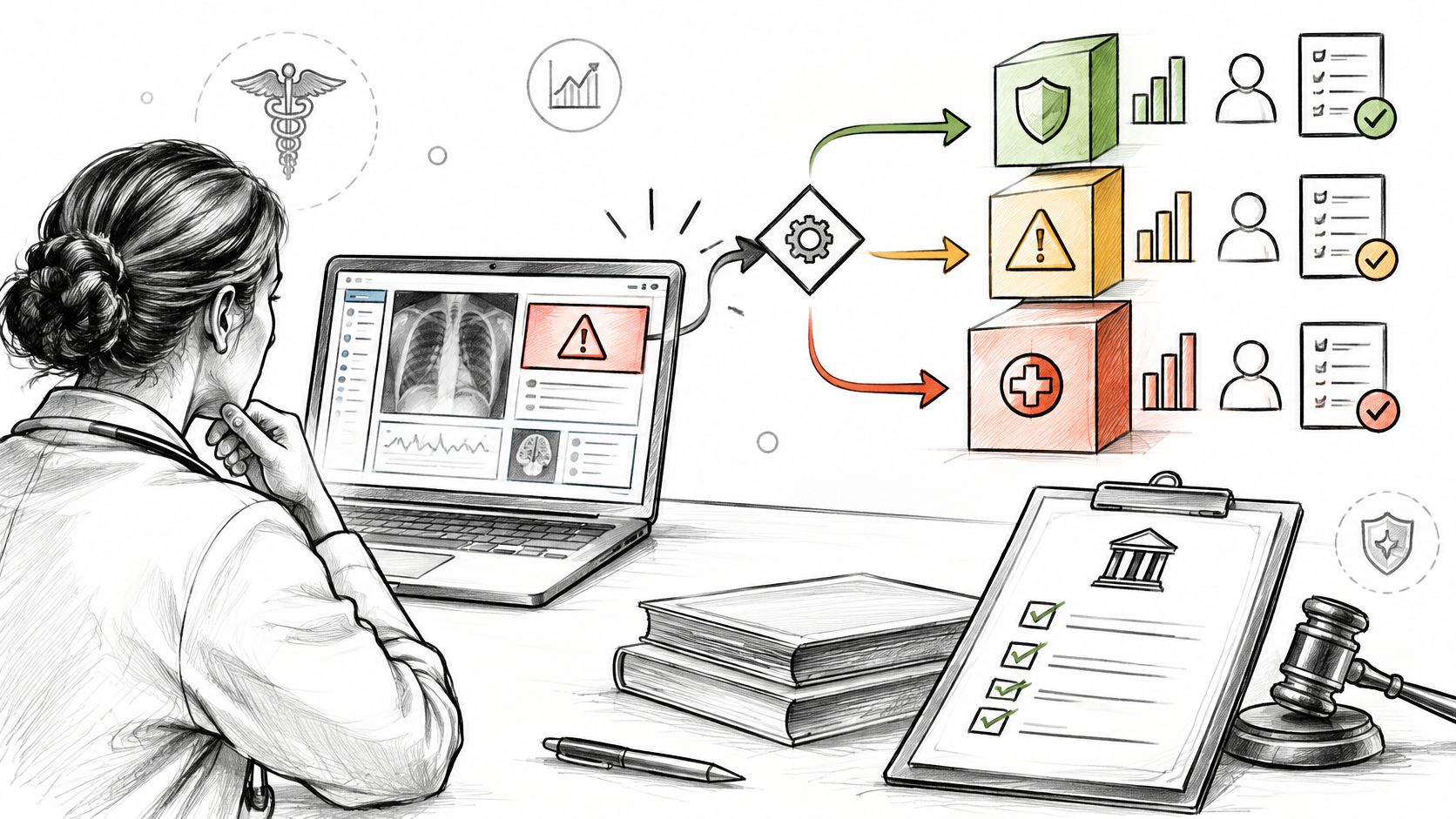
Software now diagnoses, monitors, and guides treatment, and when it does, it is regulated as a medical device. The FDA reports that it has authorized over 1,600 AI-enabled medical devices for the US market, and the EU regulates medical device software under the Medical Device Regulation. For HealthTech and MedTech teams, regulation shapes the product from the first line of the intended use statement to postmarket monitoring. This guide brings the topic together: how to tell whether your software is a device, how it is classified in the US and EU, the routes to market, the engineering standards behind a compliant product, and what changes when the software uses AI. Each section links to a detailed guide.
Intended use decides. Software intended to diagnose, treat, mitigate, monitor, or prevent disease is generally a medical device, whether it runs on its own as Software as a Medical Device (SaMD) or inside hardware. The FDA's Policy for Device Software Functions and Mobile Medical Applications explains which software functions the agency focuses on and which lower-risk functions it does not intend to enforce requirements against.
Two important exclusions apply in the US. Clinical decision support software that meets all four criteria in section 520(o)(1)(E) of the Federal Food, Drug, and Cosmetic Act is not a device, and products intended only for general wellness fall outside device regulation under the FDA's General Wellness guidance, updated in January 2026. Marketing claims matter: a wellness app that starts claiming to detect a condition can become a device without any code change.
Both systems classify by risk, but they use different rules and the classes do not map one to one.
| United States (FDA) | European Union (MDR) | |
|---|---|---|
| Legal basis | Federal Food, Drug, and Cosmetic Act and 21 CFR | Regulation (EU) 2017/745, applied since May 26, 2021 |
| Classes | Class I, II, III | Class I, IIa, IIb, III |
| Software rule | Classification regulations and product codes, informed by the IMDRF SaMD framework | Annex VIII Rule 11, with MDCG 2019-11 guidance (revised June 2025) |
| Typical result for clinical decision software | Often Class II | At least Class IIa, rising to IIb or III with severity |
| Who reviews | FDA, unless the device is exempt | A notified body for Class IIa and above |
For the detail, see our guides to FDA SaMD classification and EU MDR Rule 11.
Device class sets the usual FDA route. Most Class I devices are exempt from premarket review, most Class II devices need 510(k) clearance against a predicate, novel low-to-moderate-risk devices without a suitable predicate can use De Novo, and most Class III devices need Premarket Approval (PMA). The FDA's premarket software guidance asks for Basic or Enhanced documentation depending on the risk of the software function, which is assessed separately from IEC 62304 safety classes. Our guide to FDA pathways for AI-enabled medical devices explains how to choose between 510(k), De Novo, and PMA.
| Area | Standard or rule | What it requires of software teams | Our guide |
|---|---|---|---|
| Quality system | ISO 13485:2016 and the FDA QMSR | Design controls, document control, supplier and change management inside a quality system. The QMSR, effective February 2, 2026, incorporates ISO 13485:2016 by reference | ISO 13485 design controls |
| Software lifecycle | IEC 62304:2006 with Amendment 1:2015 | Assign safety Class A, B, or C and apply the matching planning, design, verification, and maintenance rigor | IEC 62304 safety classification |
| Risk management | ISO 14971:2019 | Identify hazards across the lifecycle and show how each risk is controlled | AI in MedTech engineering |
| Usability | IEC 62366-1 | Test how users interpret and act on the software's output | AI in MedTech engineering |
| Cybersecurity | FD&C Act section 524B | Since March 29, 2023, premarket submissions for cyber devices must include a vulnerability management plan and a software bill of materials | AI in MedTech engineering |
AI adds work on top of the standards above: documenting training and test data, versioning models, planning for updates, and monitoring performance after release.
For HIPAA, business associate agreements, SOC 2, and HITRUST, see our HealthTech Security and Compliance guide.
Medical device software regulation follows a clear sequence: decide whether the software is a device, classify it in each market, choose the route to market, and build it inside a quality system using IEC 62304, ISO 14971, usability, and cybersecurity requirements. AI adds data documentation, planned change control, and postmarket monitoring, plus EU AI Act obligations from August 2028. Teams that settle intended use and classification first, and build the evidence as they develop, reach market faster and with fewer surprises. To build compliant medical device software, explore Ekipa's SaMD solutions or book a consultation.
When its intended use is to diagnose, treat, mitigate, monitor, or prevent disease. In the US, clinical decision support that meets all four statutory criteria and products intended only for general wellness are excluded.
SaMD performs its medical purpose on its own, without being part of a hardware device. Software in a medical device is part of a hardware device, such as firmware in an infusion pump, and is reviewed with that device.
No. The FDA uses Classes I to III with product codes and predicates, while the EU MDR uses Classes I, IIa, IIb, and III under Rule 11. Clinical decision software often lands in FDA Class II and EU Class IIa or higher, but each market needs its own analysis.
The core set is ISO 13485 for the quality system, IEC 62304 for the software lifecycle, ISO 14971 for risk management, and IEC 62366-1 for usability. US cyber devices must also meet section 524B cybersecurity requirements.
In the US, a predetermined change control plan authorized with the device lets you make the modifications it describes without a new submission for each one. Changes outside the plan usually need a new regulatory review.
The full journey from AI strategy to scaled implementation in four stages: align and assess, choose and plan, prove and build, govern and scale.
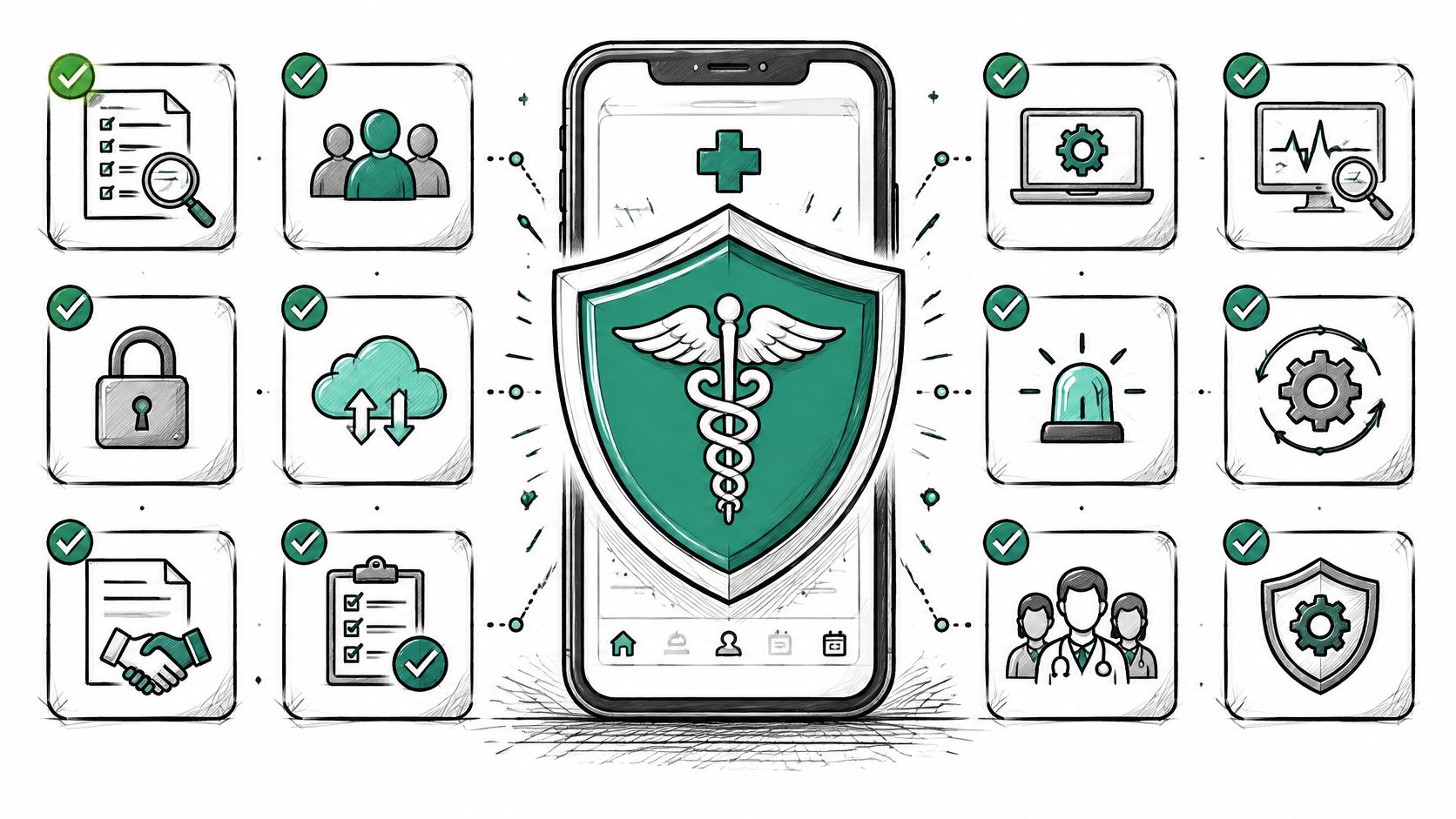
How HealthTech companies meet security and compliance expectations: HIPAA safeguards, business associate agreements, safe data handling, and SOC 2 or HITRUST.
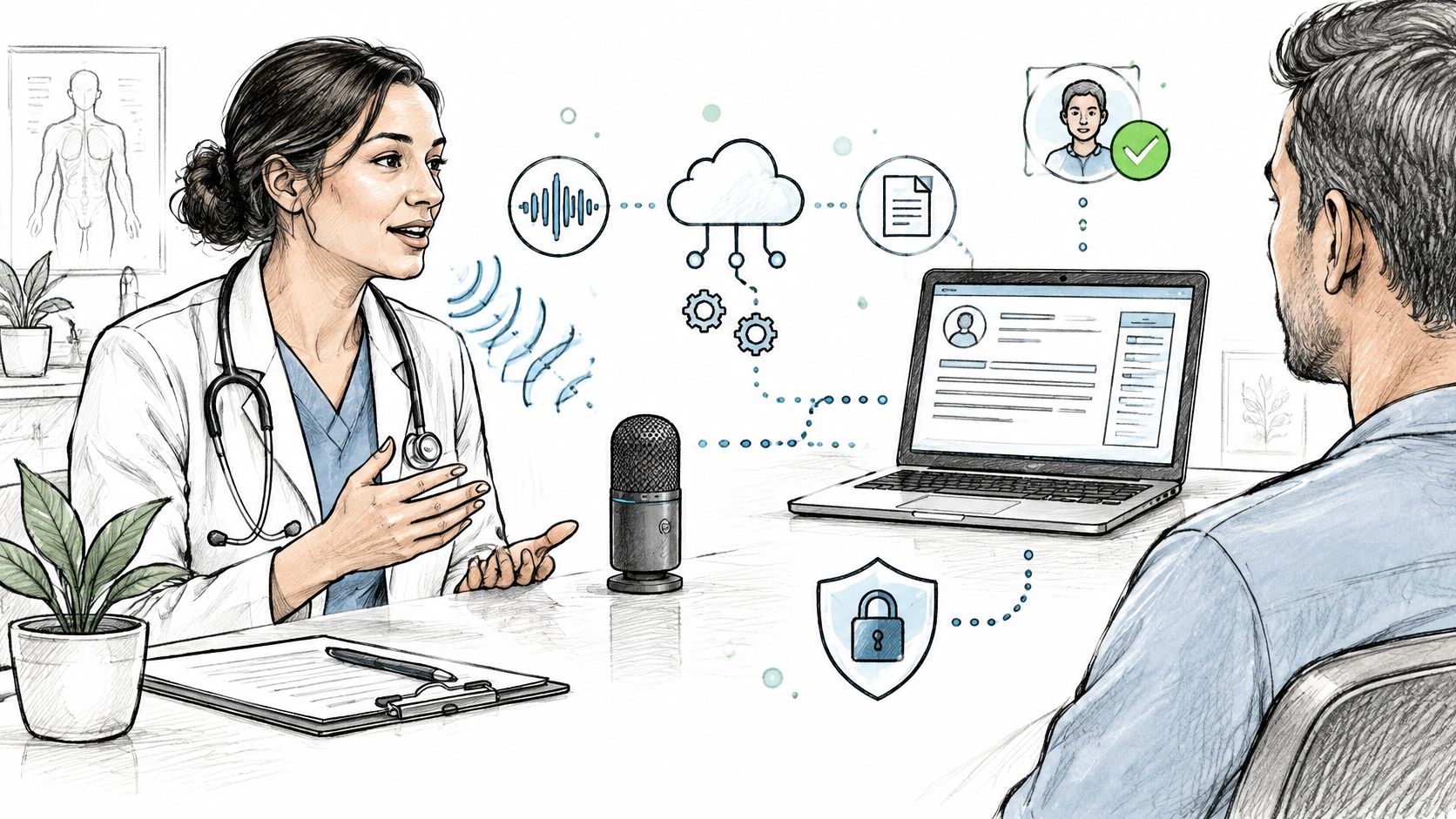
Ambient Clinical Documentation EHR Integration: write-back options, SMART scopes, consent rules and quality checks for teams building AI scribes.
Connect with our team to explore how AI expertise can transform your business.