AI in Healthcare
HIPAA-Compliant AI: How to Use LLMs With PHI Safely
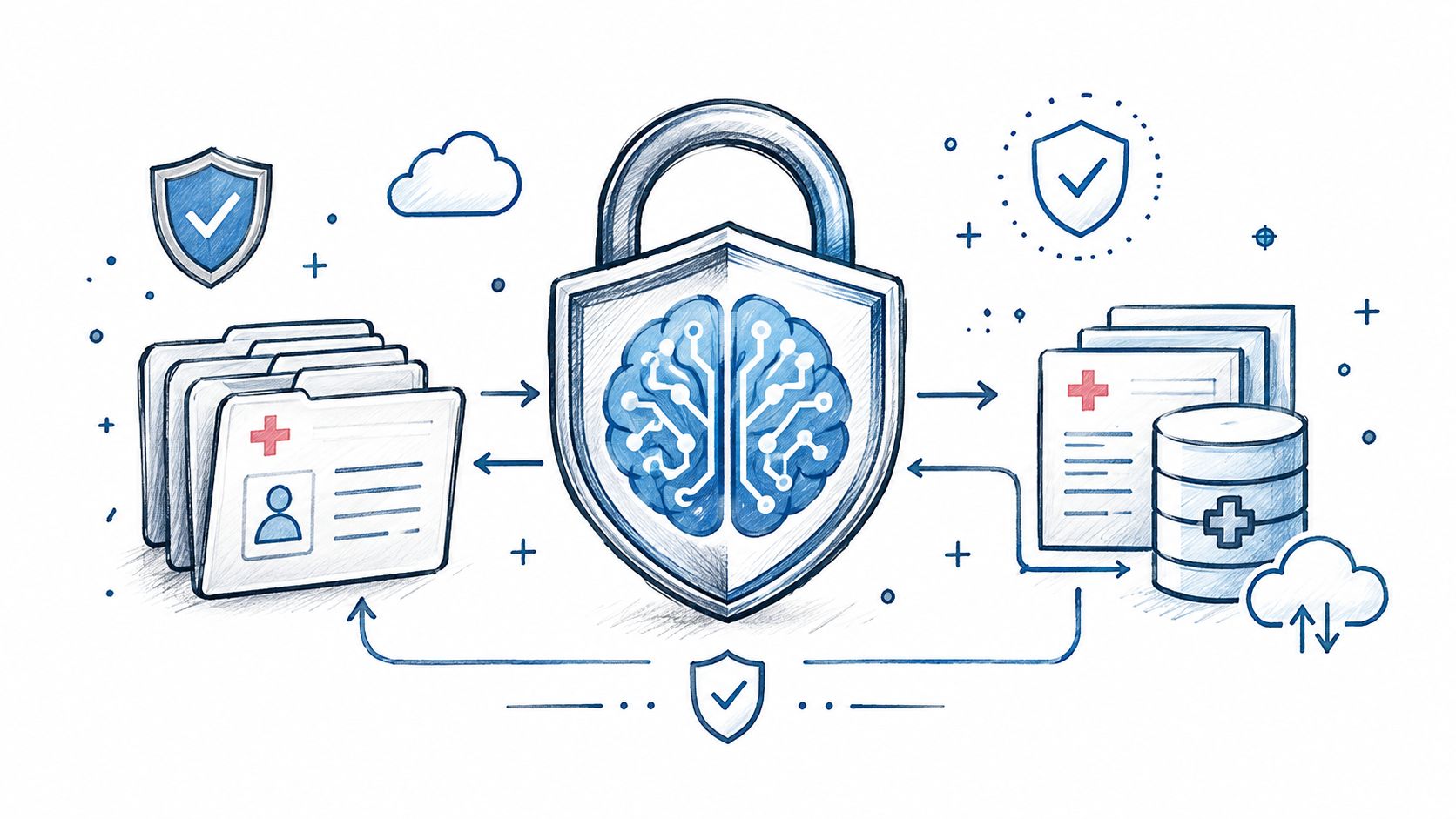
How to build HIPAA-compliant AI: when LLM providers need a BAA, data minimization, de-identification, audit controls and a reference architecture.
October 16, 2026Read more
AI transformation roadmap healthcare: Unlock a 2026 blueprint to scale AI, create value, and achieve measurable ROI.

An AI transformation roadmap in healthcare isn't just another strategic document—it's your organization's detailed guide for weaving artificial intelligence into the very fabric of your operations. Think of it as the master plan that takes you from initial curiosity to full-scale, value-driven implementation, making sure every AI project aligns with your core goals, whether that's improving patient outcomes or driving down operational costs.
Here in 2026, the conversation around AI in healthcare has changed. We're no longer asking if we should adopt it, but how fast we can integrate it effectively. For any CEO, CTO, or operations leader, AI has shifted from a "nice-to-have" technology to a fundamental part of the business engine. Knowing how to leverage artificial intelligence for growth in 2026 is the first step, and a clear roadmap is what turns that knowledge into action.
The numbers don't lie. The global AI in healthcare market was valued at $39 billion in 2025 and is on a trajectory to hit an incredible $504 billion by 2032. This isn't just market hype; it’s driven by tangible adoption, with 37% of healthcare organizations already using AI extensively. With North America holding a dominant 49% market share in 2024, the pressure is on for leaders here to either lead the charge or risk being left behind.
This push toward AI isn't happening by choice alone. It’s a direct answer to the immense challenges the healthcare industry faces every single day.
Crushing Inefficiencies: Administrative overhead and clunky manual processes are no longer sustainable. AI is the most direct way to automate the routine tasks that bog down your best people.
The Demand for Better Outcomes: From predictive diagnostics that spot disease earlier to personalized treatment plans, AI is giving clinicians the AI tools for business they need to elevate the quality and precision of patient care.
The Bottom-Line Imperative: With costs spiraling, AI has become a crucial lever for financial stability. In fact, 42% of organizations are already reporting a high return on investment from their AI projects.
A thoughtfully constructed AI roadmap is what separates the successful organizations from those just running scattered, disconnected experiments. It provides the framework to build a cohesive, enterprise-wide strategy. The journey typically moves through distinct phases, as shown below.

This methodical approach—moving from high-level strategy to on-the-ground execution—is the key to making transformation stick.
To bring this all together, here is a high-level summary of what a comprehensive AI roadmap looks like. This table breaks down the entire journey into manageable phases, each with its own clear objective and activities.
| Phase | Primary Objective | Key Activities | Expected Outcome |
|---|---|---|---|
| 1. Assess & Strategize | Align AI goals with overall business strategy. | Current state analysis, stakeholder interviews, market research, defining high-level vision. | A clear business case for AI and executive buy-in. |
| 2. Identify & Prioritize | Pinpoint high-impact, feasible use cases. | Brainstorming workshops, ROI/feasibility scoring, data source identification, creating a prioritized project backlog. | A short-list of 2-3 pilot projects with the best potential for success. |
| 3. Build & Pilot | Develop and test the initial AI solutions in a controlled environment. | Data preparation, model development, building a minimum viable product (MVP), user acceptance testing. | A functional AI pilot that demonstrates tangible value. |
| 4. Scale & Govern | Integrate successful pilots into operations and establish long-term management. | Full-scale integration, change management, performance monitoring (KPIs), creating a governance framework. | Enterprise-wide AI adoption and a culture of continuous improvement. |
This table serves as a quick-reference guide for executives and project leads, ensuring everyone understands their role in the bigger picture and what success looks like at each stage.
The good news is that early adopters are already proving the model. If you're looking for quick wins, the data is compelling: 50% of organizations are now using AI for everyday operations like scheduling, revenue cycle management (RCM), and clinical documentation. These aren't futuristic concepts; they are practical, off-the-shelf solutions delivering real value right now.
I always tell my clients that an AI roadmap is your organization’s GPS. Without it, you're driving in the dark, hoping you stumble upon your destination. With it, you have a clear, turn-by-turn route to achieving outcomes you can actually measure.
From smarter diagnostic tools that give clinicians a head start to automated back-office workflows that combat staff burnout, the benefits are real and measurable. The organizations winning with AI are the ones treating it as a core business transformation, not just a series of IT projects. You can see practical examples of this in our Healthcare AI Services.
The message is clear: the time to build and execute your AI roadmap is now. The rest of this guide will show you exactly how to do it.
Everyone wants to jump straight into the exciting tech, but the most successful AI initiatives I've seen all start with something far less glamorous: strategy. Before a single line of code is written, you have to anchor every potential project to your organization's real-world goals. Are you trying to improve patient outcomes, slash operational overhead, or supercharge your research? Answering that question is the real starting point.
This initial spadework is what separates a successful AI transformation roadmap from a collection of expensive, disconnected science projects. It’s about building a rock-solid business case and a clear mandate that everyone, from the C-suite to the clinic floor, can get behind.

Your first move is to get the leadership team aligned. This isn't just about getting a nod of approval; it's about moving past the buzzwords and defining what "success" actually looks like in concrete, measurable terms. Without a unified executive vision and a dedicated budget, even the most promising AI pilots will fizzle out.
Get your key stakeholders in a room and hash out the answers to these questions:
What are our top 3 headaches right now? Zero in on the biggest operational pains. Is it crippling administrative burdens, long patient wait times, or frustrating diagnostic delays?
How will we know if this is working? You need to define the Key Performance Indicators (KPIs) from day one. Will you be measuring a drop in costs, a rise in patient satisfaction scores, or shorter research cycles? Be specific.
What are we willing to commit? Lock down a realistic budget and identify the internal champions who will own this and drive it forward.
This is often where bringing in outside help can make a huge difference. Getting an expert perspective from AI strategy consulting can help facilitate these tough conversations and translate high-level goals into a plan that actually works. It ensures everyone understands the why behind the work.
Once your goals are clear, it's time to establish the rules of the game. An AI governance framework isn't bureaucracy—it's your safety net. It’s what allows you to innovate without taking on unnecessary risk, especially when dealing with HIPAA and Protected Health Information (PHI). This framework should dictate how data is handled, how models are tested and validated, and who is ultimately accountable for the results.
A smart governance model doesn't stifle innovation; it enables it safely. It gives your teams the confidence to experiment within clear, secure guardrails, which is how you avoid incredibly costly compliance mistakes later on.
At the same time, you need to pull together your team. And it can't just be data scientists and IT. You absolutely need clinical leaders, operations managers, legal counsel, and, most importantly, the front-line staff who live these workflows every day. Their real-world experience is what will make or break your ability to find practical use cases and navigate the messy reality of implementation.
Finally, you need a reality check. An initial readiness assessment is all about taking an honest inventory of your current capabilities. It’s the only way to map a realistic path from where you are today to where you want to be. This means evaluating everything from your data quality and infrastructure to the skills of your people.
To get a truly clear picture, we recommend consolidating these findings into a Custom AI Strategy report. This document becomes your baseline—a foundational analysis that highlights your strengths and shines a bright light on the gaps you need to fill before you can confidently move forward.
Alright, you’ve got your strategic vision. Now comes the hard part—and the most important one. It's time to shift from broad goals to concrete actions. We need to find the exact problems within your healthcare organization where AI can make a real difference, right now.
This isn’t a scavenger hunt for the flashiest new technology. It’s a disciplined search for opportunities where AI delivers clear, measurable value. The goal is to build a balanced project portfolio—a mix of quick wins that build momentum and more ambitious projects that secure your future.
First, you need to cast a wide net. Get your teams together and start looking for friction points, bottlenecks, and frustrations across every single department.
On the Clinical Side: Where are diagnostic delays causing the biggest headaches? Can we get better at predicting which patients are at high risk for deterioration or readmission? How could smart tools like SaMD solutions give our clinicians the support they need without adding to their workload?
On the Administrative Side: Is your revenue cycle a mess of manual data entry and claim denials? Is your staff buried under an avalanche of paperwork? What if we could finally fix patient scheduling or optimize how we allocate expensive resources?
Once you have a long list of potential ideas, you need a simple way to sift through them. I’ve found that scoring each use case against three core criteria works incredibly well:
Strategic Alignment: Does this project directly support the big-picture goals you already set, like improving patient outcomes or cutting operational costs?
Feasibility: Let's be realistic. Do we have the right data? Is the technology mature enough to be reliable? And critically, do we have the in-house talent or the right HealthTech engineering partner to actually build and implement it?
Potential ROI: What’s the payoff? This isn’t always about dollars and cents. The impact could be financial (saving money, boosting revenue) or clinical (reducing medical errors, improving patient safety).
A classic mistake I see all the time is chasing the most technically complex ideas first. Your best bet is almost always starting with a proven, high-impact application that solves a widespread and expensive problem. This builds credibility and generates the ROI to fund your next, more ambitious project.
For example, implementing AI scribes is a fantastic first move. The technology is solid, the financial return is well-documented, and it directly tackles clinician burnout—a massive pain point for nearly every health system.
The good news is you don’t have to figure this all out in a vacuum. The healthcare industry is full of organizations that are already seeing huge wins from their AI initiatives. Take a look at these real-world use cases to see what's actually working for your peers and benchmark your own ideas.
The data makes a compelling case. Early adopters aren't just experimenting; they're getting tangible results. For instance, projections show that by 2026, the adoption of ambient AI scribes will have scaled to 92% of provider health systems. Those who got in early have already reported 10-15% improvements in revenue capture in the first year alone, simply from more accurate coding.
And it’s not just administrative tasks. In clinical settings, 65% of organizations are now using AI for predictive analytics, and 42% are applying it for clinical decision support. The financial return is becoming undeniable, with 31% already reporting moderate ROI. You can dig into these findings and more on the state of health AI at bvp.com.
This evidence helps remove the guesswork. It confirms that focusing on well-understood areas like clinical documentation, predictive modeling, and decision support is a safe and highly effective strategy.
Finally, you need to formalize your choices. Document the handful of use cases you’ve selected, along with their expected ROI, required resources, and key milestones. Creating a Custom AI Strategy report gives everyone—from the C-suite to the engineering team—a single source of truth for what you're building, why you're building it, and the value you expect to deliver.
Let's be blunt: your AI strategy is only as good as the technical foundation it’s built on. An AI initiative without a solid, secure, and accessible data infrastructure is like building a hospital with no plumbing. This is where we roll up our sleeves and tackle the technical debt that so often stalls progress before it even begins.
From my experience, the biggest roadblock most IT leaders hit is trying to get new AI tools to talk to their existing legacy systems, especially Electronic Health Records (EHRs). These systems were never designed for the kind of data throughput that AI demands, which creates a massive integration headache. A realistic roadmap doesn't ignore this; it confronts it with a clear plan for achieving data interoperability.

The architectural decisions you make now will have long-term consequences. You’re essentially deciding where your data will live and where your AI models will run.
On-Premise: This gives you maximum control, which is comforting when you're dealing with sensitive PHI. The trade-off is a hefty capital investment and the need for a skilled in-house team to keep it all running.
Cloud: You get incredible scalability and the ability to spin resources up or down on demand. Major cloud providers offer HIPAA-compliant services, but the responsibility for configuring them correctly—and keeping them that way—is entirely on you.
Hybrid: This is often the sweet spot. You can keep highly sensitive data on-premise while using the cloud's power for model training or less sensitive workloads. It’s a balance of security and flexibility.
No matter which path you take, data governance is not optional. You need to establish concrete policies for data quality, access controls, and security from the start. This means actually cleaning, standardizing, and structuring your data so it’s ready for AI. A detailed AI requirements analysis is essential to make sure the system you build today can handle what you want to do tomorrow.
In healthcare, compliance isn't a feature you add at the end—it has to be woven into the very fabric of your tech stack. The only way to avoid devastating legal and financial blowback is to design for HIPAA and other regulations from the ground up.
This is more important than ever. A 2026 report paints a complicated picture: while 57% of clinicians say AI significantly improves their decision-making and 60% of developers are deploying advanced LLMs, privacy remains the number one concern for 57%. What’s worrying is that only 43% feel even moderately confident in their compliance measures. This insight, detailed in a global AI in healthcare report, points to a dangerous gap between adopting AI and being ready for its risks.
Building a compliant architecture isn't about adding a security layer at the end. It's about designing every data pipeline, storage solution, and API with privacy and security as a fundamental requirement. It's the only way to innovate responsibly.
Almost no healthcare organization has a perfect, AI-ready tech stack right out of the box. You're going to find gaps, whether in your infrastructure or your team's skillset. This is the point where smart partnerships can make all the difference.
For instance, bringing in AI Automation as a Service can help you automate complex data processing without a massive upfront investment in new hires or technology. In other cases, you might need to build custom internal tooling to create the specific bridges between your old EHR and a new AI platform. This foundational work isn’t just about getting a single pilot off the ground; it’s about preparing to scale your AI wins securely across the entire organization.
This is where the rubber meets the road. All the planning, strategizing, and infrastructure work you’ve done comes together as you move from theory to a live, in-the-wild application. But this isn't the time for a big-bang, high-risk launch across the entire organization.
The smartest path forward is to think big, start small, and scale fast. This begins with a pilot project—your controlled laboratory for testing an AI solution in a real-world clinical or administrative setting. It's how you prove your assumptions, get honest feedback from the people who will actually use the tool, and build an undeniable business case for a full-scale rollout.

A pilot isn’t just about flipping a switch and seeing what happens. It needs to be designed like a scientific experiment, structured to give you clear, actionable answers. Think of it as a self-contained mini-project.
For your pilot to be truly effective, it must have:
Hard-Nosed Success Metrics: Before you even begin, you need to know what success looks like in black and white. Is it a 15% reduction in charting time? A measurable lift in diagnostic accuracy? A 90% user satisfaction score? Define these KPIs upfront.
A Hand-Picked User Group: Don't open the floodgates. Select a small, diverse group of end-users. You want a mix of tech-savvy enthusiasts who will push the limits and pragmatic skeptics who will point out every flaw. Their combined feedback is gold.
A Firm Timeline: Pilots that drag on lose momentum. Set a clear start and end date, usually between 30 and 90 days. This creates focus and ensures you get the data you need without letting the project drift.
An Open Feedback Channel: Make it incredibly easy for users to tell you what they think. Whether it’s a dedicated Slack channel, weekly 15-minute check-ins, or simple feedback forms, you need a constant stream of input.
This disciplined pilot framework is a crucial component of any successful AI Product Development Workflow. The lessons learned here are what prevent you from making a costly mistake on a much larger scale.
When the pilot ends, the real work begins: analysis. It’s time to dig into both the quantitative data and the qualitative feedback. Did you hit your KPIs? What did the nurses love? What drove the radiologists crazy? Where did the AI shine, and where did it stumble?
This is the raw material for your business case. Forget theoretical ROI projections. Walking into a leadership meeting and saying, "Our 20-nurse pilot saved a total of 40 hours of administrative work per week," is how you get the green light to scale. That’s a story backed by real data.
The point of a pilot isn't perfection; it's learning. Every issue uncovered and every piece of user feedback is an insight that de-risks the enterprise-wide rollout. Think of it as your most valuable insurance policy against large-scale failure.
A successful pilot is your ticket to the next level. But scaling isn't just a bigger pilot—it's a completely different discipline. The challenge shifts from proving the technology works to making sure the organization actually adopts it.
This is a complex phase that involves juggling multiple priorities at once. The focus moves from the tool itself to the people and processes around it.
Deep System Integration: Now the serious technical work happens. Your AI solution has to be woven into the fabric of your core systems, most notably the EHR. This often requires deep expertise in areas like custom healthcare software development to ensure everything communicates seamlessly and securely.
Proactive Change Management: This is the human side of the equation, and it’s non-negotiable. You have to get out ahead of the narrative. Constantly communicate how the tool helps clinicians and patients, framing it as a co-pilot that handles tedious work so they can focus on what matters most.
Meaningful Training: Don't just demo the features. Your training needs to cover the why. Help users understand how the AI works and how to interpret its outputs correctly. A great tactic is to turn your pilot participants into "super-user" champions who can then help train their colleagues.
Constant Performance Monitoring: Once the system is live, you need to keep a close eye on it. Use dashboards and analytics to track your original KPIs, monitor user adoption rates, and calculate the ongoing ROI. This data justifies the investment and helps you spot opportunities for further optimization.
Getting this transition right is what turns a promising pilot into a genuine enterprise asset. It proves the value of AI in your organization and builds the momentum you need to tackle the next big challenge.
Think of your AI transformation roadmap in healthcare not as a static blueprint, but as a living, breathing plan. Getting started is one thing; achieving lasting success is another entirely. The real work begins after launch, building a culture that constantly improves on what you've built and scans the horizon for what's next.
This isn't about simply using AI. It's about creating a system that learns and adapts, turning your organization into one that gets smarter with every patient interaction and clinical decision.
The most effective AI-powered healthcare systems I've seen treat their models as dynamic tools, not fire-and-forget solutions. This means creating strong feedback channels where real-world performance data constantly flows back to the development team to refine and retrain the algorithms.
When a predictive model’s accuracy drops or a clinician points out a flaw, that’s not a failure. It’s an invaluable piece of feedback for making the system better.
This iterative process breaks down into a few key activities:
Constant Model Monitoring: Keep a close eye on performance metrics, measuring them against the benchmarks you set before you went live.
Gathering User Feedback: Don't wait for complaints. Actively ask your clinicians and staff how the tools are working for them in their day-to-day workflows.
Scheduled Retraining: Plan for regular model updates. Feeding them fresh data is the only way to prevent "concept drift" and ensure they stay accurate over time.
I've seen too many organizations fall into the 'launch and forget' trap. The moment an AI model goes live, its performance starts to degrade. Without a clear strategy for refining it with real-world data, its value will inevitably drop. Your goal should be to make your AI smarter tomorrow than it is today.
The world of AI moves incredibly fast. What feels like science fiction today will be a standard feature tomorrow. Your roadmap needs the flexibility to absorb new developments, from generative AI to ambient clinical intelligence, without derailing your core mission.
A perfect example is the rise of agentic AI—autonomous systems that can reason, plan, and act with little human intervention. As we explored in our AI adoption guide, these agents can connect fragmented data points into a cohesive care journey, proactively addressing patient needs. This shift from passively analyzing data to proactively delivering care is where the industry is heading.
Navigating this ever-changing environment is tough. Working with a dedicated partner for AI strategy consulting gives you the expertise to adapt your roadmap quickly and distinguish real opportunities from industry hype.
Ultimately, bringing your AI vision to life and making it stick is about more than just technology. It’s about the human expertise that guides, builds, and refines it. To successfully navigate the road ahead, connect with our expert team and let us help you build a forward-thinking strategy for long-term success.
The most critical first step isn't technical—it's strategic alignment. Before anything else, you must achieve executive buy-in and define what success looks like in measurable business terms. This means answering questions like, "Are we aiming to reduce operational costs, improve patient outcomes, or accelerate research?" This foundational work, often facilitated by an AI strategy consulting tool, ensures that every future AI initiative is directly tied to a core organizational goal.
Proving ROI starts with defining Key Performance Indicators (KPIs) before you launch a pilot project. For a clinical AI tool, this could be a reduction in diagnostic errors or improved patient throughput. For an administrative tool, it might be saved labor hours or a decrease in claim denials. The key is to start with a high-impact, low-complexity "quick win" to build momentum. Then, translate your results into financial terms—for example, "Our AI-powered scheduling tool saved 200 administrative hours, equating to $X,XXX in operational savings."
The three biggest hurdles are almost always data, regulations, and people.
Data: Healthcare data is often siloed in legacy systems (like EHRs) and can be of inconsistent quality. A modern data infrastructure is essential.
Regulations: Navigating HIPAA and protecting Protected Health Information (PHI) is non-negotiable. Compliance must be built into your architecture from day one.
People: Gaining adoption requires effective change management. Involve clinicians and staff early, demonstrate how AI tools will help them (not replace them), and provide thorough training.
The best approach is to score potential use cases against three criteria: strategic alignment, technical feasibility, and potential ROI. Look for problems that are causing significant friction and are expensive to your organization. Prioritize use cases where the technology is mature and the data is readily available. Common starting points with proven success include AI for revenue cycle management, clinical documentation, and predictive analytics for patient risk stratification.
This depends on your internal capabilities, budget, and timeline.
Building: Gives you a fully customized solution tailored to your exact workflows but requires significant in-house expertise, time, and investment.
Partnering: A HealthTech engineering partner can accelerate your timeline, provide specialized expertise you lack (especially around compliance and integration), and reduce upfront risk. A hybrid approach is often effective, where you partner for foundational elements while building specific, strategic applications in-house.
How to build HIPAA-compliant AI: when LLM providers need a BAA, data minimization, de-identification, audit controls and a reference architecture.
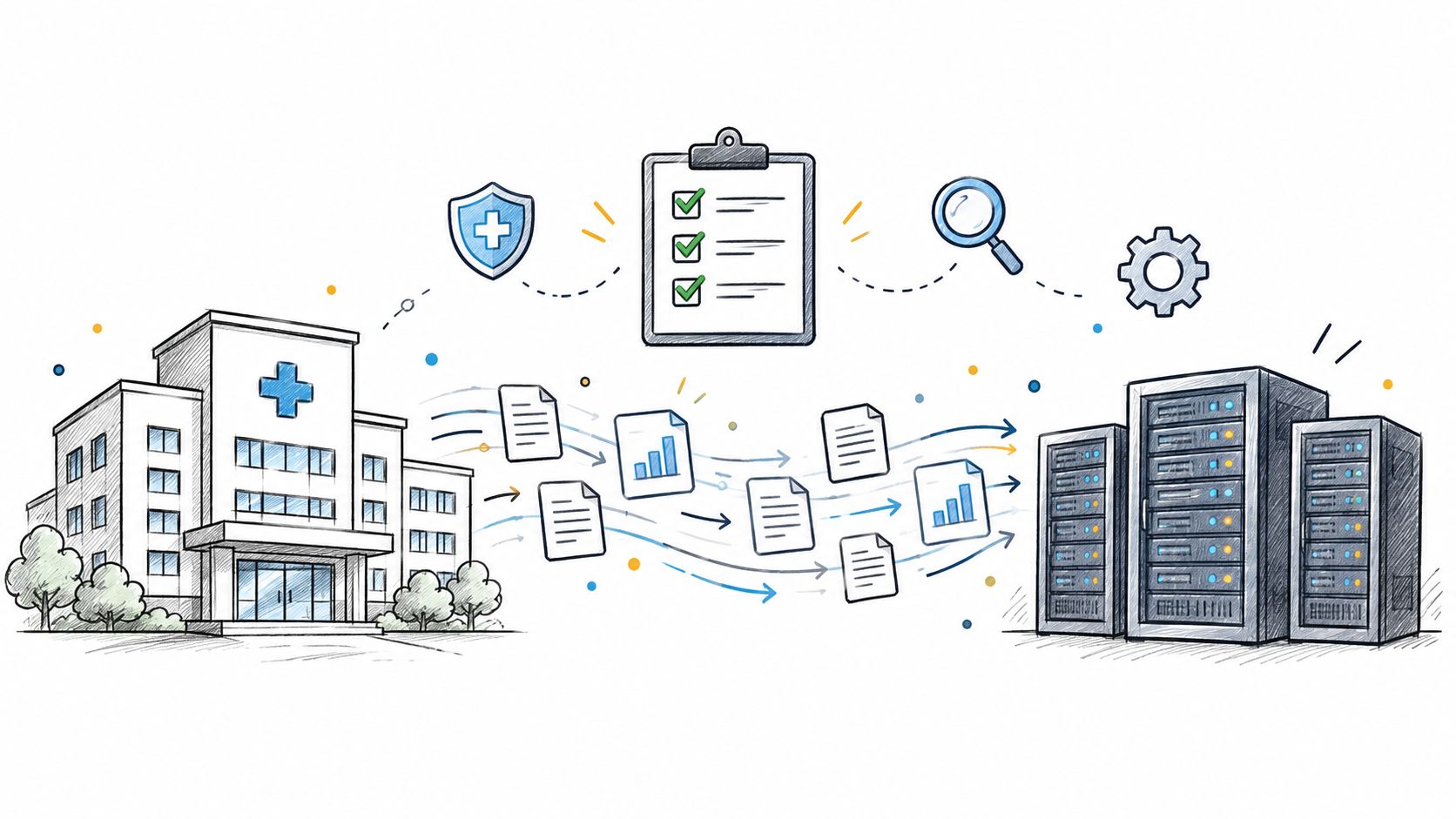
Practical data migration planning guide for healthcare teams. Scope, mapping, compliance, validation, cutover and rollback decisions explained end to end.

Smart on FHIR guide for healthtech engineers. Learn the OAuth 2.0 launch model, scope syntax, backend services, and US regulatory requirements.
Connect with our team to explore how AI expertise can transform your business.