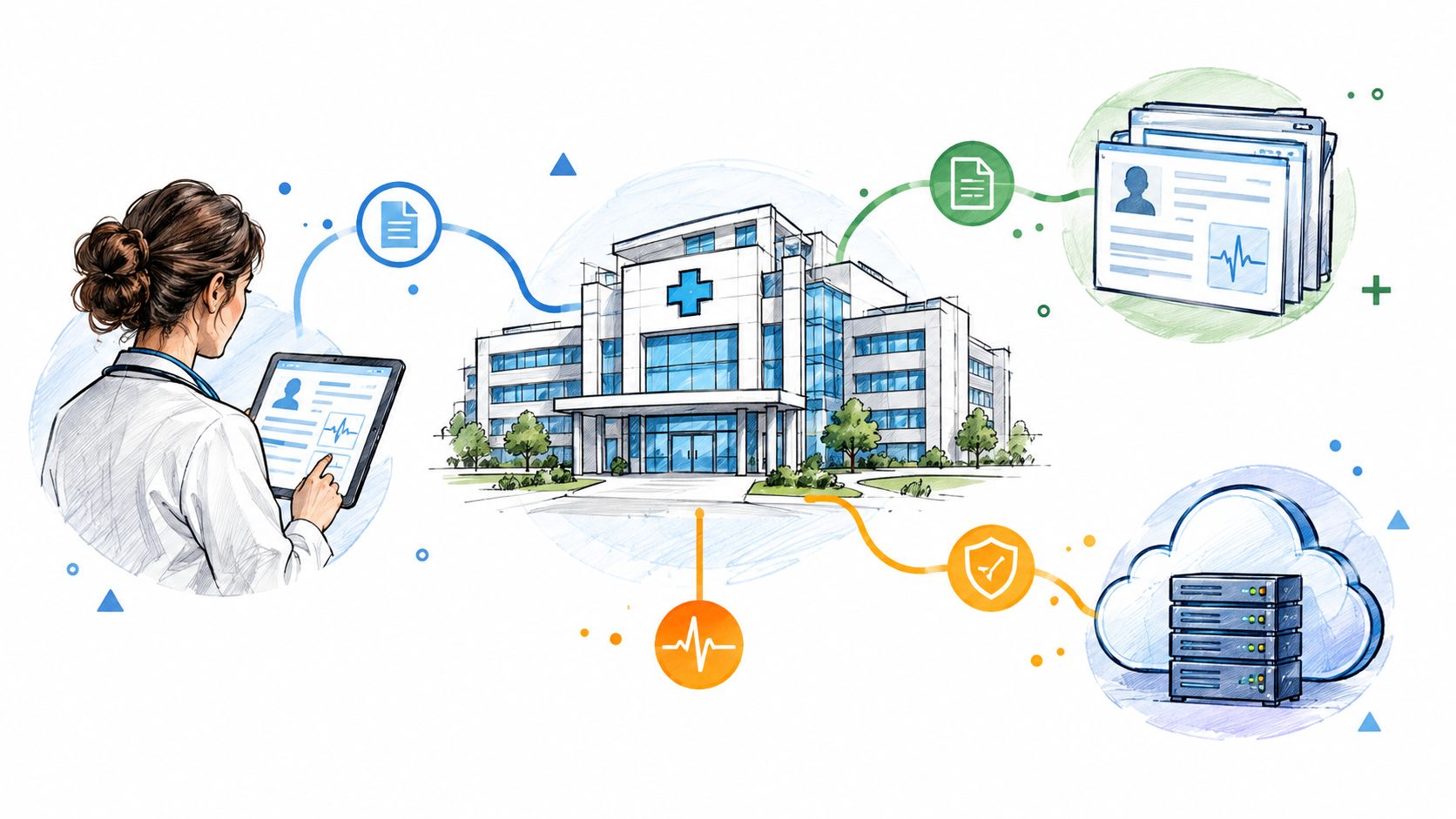
AI Integration
Oracle Health Integration: A Practical Guide
Oracle Health integration guide: FHIR R4 APIs, HL7 v2 interfaces, SMART app types, sandbox testing and customer activation for HealthTech teams.
October 24, 2026Read more
Learn how a care operations maturity model helps digital health teams benchmark workflows, governance, and AI safety, plus KPIs and roadmaps.

A Tuesday morning in care operations can feel like a control room assembled from leftovers. Three EHR dashboards are open, two AI draft queues need review, a staffing spreadsheet is already out of date, and a compliance ticket has been escalated without a clear owner. Two senior nurses know how to handle the difficult cases because they've carried the knowledge for years. Leadership still can't answer a basic question: how many patients are waiting for AI review right now?
This isn't primarily a technology gap. It's an operating discipline gap. A care operations maturity model gives leaders a way to name that friction, sequence the fix, and stop buying tools before defining the problem. Healthcare maturity models have developed into established frameworks across operations, infrastructure, telemedicine, care pathways, digital imaging, PACS, and facilities management, according to a 2020 multivocal literature review.
By the end, you'll be able to identify the maturity level your team most likely occupies, find the domain limiting progress, and choose the single next move that creates a more reliable care operation.
The symptoms usually appear before anyone talks about maturity. Schedules change in one system, coverage lives in a spreadsheet, patient messages arrive through a separate queue, and AI-generated drafts sit in an inbox that nobody formally owns. When something goes wrong, staff ask the same two experienced people what to do.
That arrangement can survive while demand is predictable. It breaks when visit volume shifts, clinical labor becomes constrained, virtual care expands, or a new automation vendor adds another workflow. Each tool may work as designed, but the overall operation becomes harder to see and harder to control. A healthcare organization can have modern software and still run on memory, workarounds, and personal escalation networks.
Before scoring anything, list the friction in five places:
A practical assessment differs from a vanity scorecard. Its purpose isn't to announce that a team is “advanced.” The aim is to expose the next operational constraint.
Practical rule: Score the way work behaves on a difficult day, not the way the process appears in a policy document.
The Healthcare AI Services perspective is useful here because care operations sit at the intersection of clinical workflow, software integration, governance, and delivery. A model should help leaders decide what to stabilize first, whether that means queue ownership, EHR integration, staffing rules, or AI review controls.
The first move is simple: choose one high-friction care journey and trace it from intake to resolution. Don't assess the entire enterprise at once. A narrow workflow reveals more actionable truth than a broad survey that labels every capability as important.
A care operations maturity model is a stage-based assessment of how predictably a clinical operation runs, governs information, manages risk, and improves its workflows. It describes the current state, then points to the next investment. It isn't a certification, accreditation, or award.
The distinction matters because many organizations confuse installed technology with operational maturity. An EMRAM-style assessment can help describe the presence and use of clinical information technology. That's useful, but it doesn't tell you whether nurses know who owns an AI escalation, whether a patient can move across a broken handoff, or whether a governance group can make a timely decision.
General operational excellence frameworks have a similar limitation. They can improve flow, standardization, and waste reduction, but clinical operations also need safety constraints, accountable decision rights, auditability, and human oversight. A care operations maturity model combines those requirements instead of treating them as separate workstreams.
Clinical staging helps clinicians choose an appropriate intervention based on the observed state of a condition. Operations leaders can use the same logic. If a workflow is reactive, adding an advanced optimization layer won't solve the underlying instability. If the process is defined but poorly measured, the next intervention is instrumentation, not more automation.
A useful model contains three building blocks:
Healthcare literature supports this staged approach. A review identified 45 distinct maturity models across healthcare domains and described maturity models as frameworks with discrete levels that map a current state to a desired future state (review of healthcare maturity models). Many healthcare models use five levels, including models for clinical decision support operations and demand and capacity management.
The practical benefit is sequencing. Leaders don't need to ask, “How do we become optimized?” They need to ask, “What artifact or behavior is missing, and what must we establish before the next investment can work?”
A five-level ladder becomes useful only when each level describes visible behavior. Consider AI governance in a clinical workflow.
At Level 1, Reactive, staff review AI outputs when someone has spare capacity. There may be a broad expectation that clinicians should check the work, but no consistent reviewer, queue owner, audit trail, or override process exists. The organization depends on heroics.
At Level 2, Defined, leaders write the operating rules. A policy names approvers, specifies what gets logged, identifies who may override an output, and sets an escalation route. The process is still mostly manual, but people no longer need to reconstruct the rules from memory.
At Level 3, Measured, the organization tracks how the workflow performs. Teams review override rates, time to review, and disagreement with the clinician's final decision on a regular basis. The important change is the operating rhythm: named owners examine the evidence and act on it.
At Level 4, Managed, thresholds trigger intervention. The team can place an automated hold when a defined risk signal appears, and periodic reviews compare AI performance with control cases. Governance becomes part of workflow management rather than a meeting that happens outside it.
At Level 5, Optimized, the organization runs controlled experiments, retires degraded models proactively, and feeds operational learning into procurement and design decisions. The team doesn't treat deployment as the finish line. It manages the model as part of a living care process.
A peer-reviewed clinical decision support operations model, informed by discussions with 80 organizations, uses three pillars, Content Creation, Analytics and Reporting, and Governance and Management, with five levels in each pillar (clinical decision support operations model). The structure reinforces a key point: maturity depends on content, measurement, and management together.
| Level | Operating Behavior | AI Governance Artifact | Risk Profile |
|---|---|---|---|
| Level 1, Reactive | Review depends on availability and personal judgment | Informal guidance or scattered messages | Hidden variation and unclear escalation |
| Level 2, Defined | Staff follow a documented review and override process | Policy, approver list, and logging rule | Known gaps, but basic control exists |
| Level 3, Measured | Owners review performance and exceptions routinely | Dashboard, review record, and action log | Risks become visible and manageable |
| Level 4, Managed | Thresholds pause or redirect unsafe workflow states | Automated holds, control comparisons, and review cadence | Risk is actively controlled |
| Level 5, Optimized | Teams test, retire, and improve models using evidence | Experiment record, retirement criteria, and procurement feedback | Learning and prevention are embedded |
Most digital health teams sit between Level 1 and Level 2 in at least one domain. Progress beyond Level 3 is where AI safety becomes durable because the organization can detect drift, assign action, and prove what happened.
A single maturity score hides operational asymmetry. Score six domains separately, then treat the weakest domain as a serious constraint.
Clinical workflow integrity asks whether care pathways are followed without workarounds. If staff must maintain private checklists to complete a workflow, the process isn't stable.
Data and EHR integration asks whether information moves across systems without manual re-entry. An excellent AI model still creates operational risk if its recommendation doesn't reach the right EHR location, lacks context, or requires duplicate documentation.
Governance and decision rights asks who owns decisions and how quickly unresolved issues are closed. A committee can have a charter and still fail if nobody has authority to approve a change.
AI and automation safety asks whether automation has human oversight, validation, monitoring, and clear stop conditions. Safety isn't satisfied by adding a clinician somewhere in the process. The handoff must be explicit and observable.
Workforce and operating model asks whether roles, staffing, and capacity match demand. Demand and capacity research uses categories that include Meetings, Processes, Information Technology, Management Support, Organizational Development, and Mindset/Culture, showing that operational maturity extends beyond software (demand and capacity maturity model).
Patient experience and access asks whether patients can obtain timely, understandable, and equitable care. For virtual workflows, the assessment should include platform selection and clinical handoffs. A resource on choosing a telehealth platform can support that technology decision, but platform choice should remain subordinate to workflow and governance requirements.

An organization may have measured analytics and a well-integrated workflow, yet remain immature overall if escalation ownership is informal. Strong reporting can mask a dangerous gap. Leaders see the queue, but nobody has authority to act when the queue becomes unsafe.
Plot the six scores together in a radar view. The visual isn't decorative. It helps executives spot a Level 4 workflow domain sitting beside a Level 1 governance domain before the mismatch produces a near-miss, delayed care, or compliance finding.
HAIRA, a healthcare AI governance maturity model, uses five levels across seven governance domains and applies a weakest-link rule, meaning the overall maturity is capped by the lowest-scoring domain (HAIRA framework). That principle fits care operations: balanced control is safer than excellence concentrated in one function.
A COO shouldn't review a dashboard because it contains many measures. The dashboard should answer whether work is arriving, moving, escalating, and closing safely.
Early-stage teams need leading indicators of instability. Review escalation closure time, EHR double-documentation rate, and decision-queue age. These measures reveal whether the operation is stuck before a polished outcome metric hides the delay.
As the operation matures, the questions change. AI override rate can reveal whether the model fits the workflow. Governance exception frequency can show whether policies reflect reality. Time to decision on policy changes can expose a leadership bottleneck even when frontline performance looks acceptable.
Don't keep every metric forever. A queue-age measure may be essential while leaders are establishing ownership, then become less central once work routes reliably and the team needs to monitor model behavior or policy exceptions.
| Maturity Level | Primary KPIs | Trigger Threshold | Typical Owner | Diagnostic Question |
|---|---|---|---|---|
| Level 1, Reactive | Queue age, unresolved escalations, duplicate documentation | Any unowned or aging case | Operations lead | Where does work stop moving? |
| Level 2, Defined | Policy adherence, named-owner coverage, review completion | A required step lacks an owner or record | Service-line manager | Do staff follow one process? |
| Level 3, Measured | Review time, override rate, clinician disagreement | A measure moves outside the agreed operating range | Analytics and clinical operations | What changed, and who acts? |
| Level 4, Managed | Exception frequency, automated holds, control-case comparison | A safety or performance signal activates intervention | Head of AI and clinical owner | Does the system stop unsafe work? |
| Level 5, Optimizing | Experiment outcomes, model retirement signals, procurement feedback | Evidence shows the workflow or model should change | Executive governance group | What should be redesigned next? |
The table uses trigger language rather than invented universal cutoffs. Each organization must set its own thresholds based on clinical risk, workflow type, staffing, and policy. A trigger is valuable when it creates an action, not when it merely changes a chart color.
A KPI without a named decision owner is a notification, not a control.
Cut vanity dashboards aggressively. Patient satisfaction composites and ticket counts can be useful context, but they often conceal operational drift. Pair them with measures that expose handoff failure, decision latency, documentation burden, and AI disagreement.
Consider a representative virtual care program serving patients across several clinical pathways. Its first problem isn't AI. Schedules are inconsistent, on-call coverage isn't clear, and staff resolve urgent cases through personal messages.
The program should stabilize in sequence:

A practical 12-month roadmap can use four operating checkpoints. The opening phase establishes schedules and coverage. The next phase assigns escalation ownership and tests the path with real exceptions. The third phase introduces AI-assisted triage inside the core workflow, with clinicians retaining final control. The final phase closes the loop through EHR documentation, outcome review, and workflow refinement.
The common derailers are predictable:
A downloadable-style working pack should contain three pages: a domain scorecard with evidence fields, an action register with owner and next decision, and an executive briefing that shows the weakest link, current risk, and next checkpoint. For teams implementing the workflow, an AI Product Development Workflow can help organize requirements, integration work, testing, and release controls.
A mature end state isn't a collection of impressive pilots. It's a COO who can answer a safety question, a finance question, and a clinical operations question from the same source of truth without assembling a war room. For specialized workflows, operators may also review resources such as PI tools for nursing home cases when assessing how evidence, documentation, and escalation requirements should fit a care setting.
Executives should leave the maturity review with named signatories, not general agreement. Assign each control to the leader who can change the operating system.
The AI maturity roadmap for health systems organizes capability into six focus areas, Culture, Governance, Business Implementation, Value, Maintenance and Operations, and Information Architecture, with five levels from Awareness at Level 1 to Transformational at Level 5 (AI maturity roadmap). That structure reinforces the need to connect AI strategy with maintenance, operations, information architecture, and organizational behavior.
Ask the leadership group to write down the current level for each domain, name the weakest link, define the 90-day move, assign one accountable owner, and pre-commit the failure metric that triggers escalation. Don't allow “improve governance” as an action. Require an artifact, such as a signed decision-rights map, an exception log, an EHR field map, or a model review record.
AI-era guardrails should include a defined bias-monitoring cadence, human checkpoints for clinical decisions, model drift review triggers, and contractual review of EHR vendor clauses on data portability. The AI delivery framework can be used as a reference point when translating those controls into delivery stages.
Two traps repeatedly stall progress beyond Level 4:
For visual context on governance controls, teams can also use this AI governance and compliance shield as a prompt for reviewing accountability, compliance, and control coverage.
| Checklist Item | Level 1-2 Reactive | Level 3 Defined | Level 4 Managed | Level 5 Optimizing |
|---|---|---|---|---|
| Decision rights | Informal escalation and personal judgment | Owners and routes documented | Thresholds trigger accountable action | Decision patterns improve the operating model |
| Governance cadence | Meetings react to incidents | Reviews follow a defined schedule | Reviews change workflow controls | Governance informs procurement and design |
| AI safety gates | Human review is inconsistent | Review and override rules exist | Holds and monitoring activate automatically | Models are tested, retired, and replaced proactively |
| EHR integration ownership | Manual re-entry and unclear accountability | Interfaces and documentation owners named | Exceptions are monitored and resolved | Data architecture guides continuous improvement |
| Labor model reset | Staffing absorbs volatility through heroics | Coverage and capacity rules documented | Demand signals shape deployment | Workforce design adapts to operating evidence |
Ekipa AI works with digital health teams on care workflows, EHR integration, AI adoption, compliance engineering, and software delivery. If your assessment exposes an integration, governance, or automation gap, visit Ekipa AI to discuss the next practical build step with the team.
Oracle Health integration guide: FHIR R4 APIs, HL7 v2 interfaces, SMART app types, sandbox testing and customer activation for HealthTech teams.
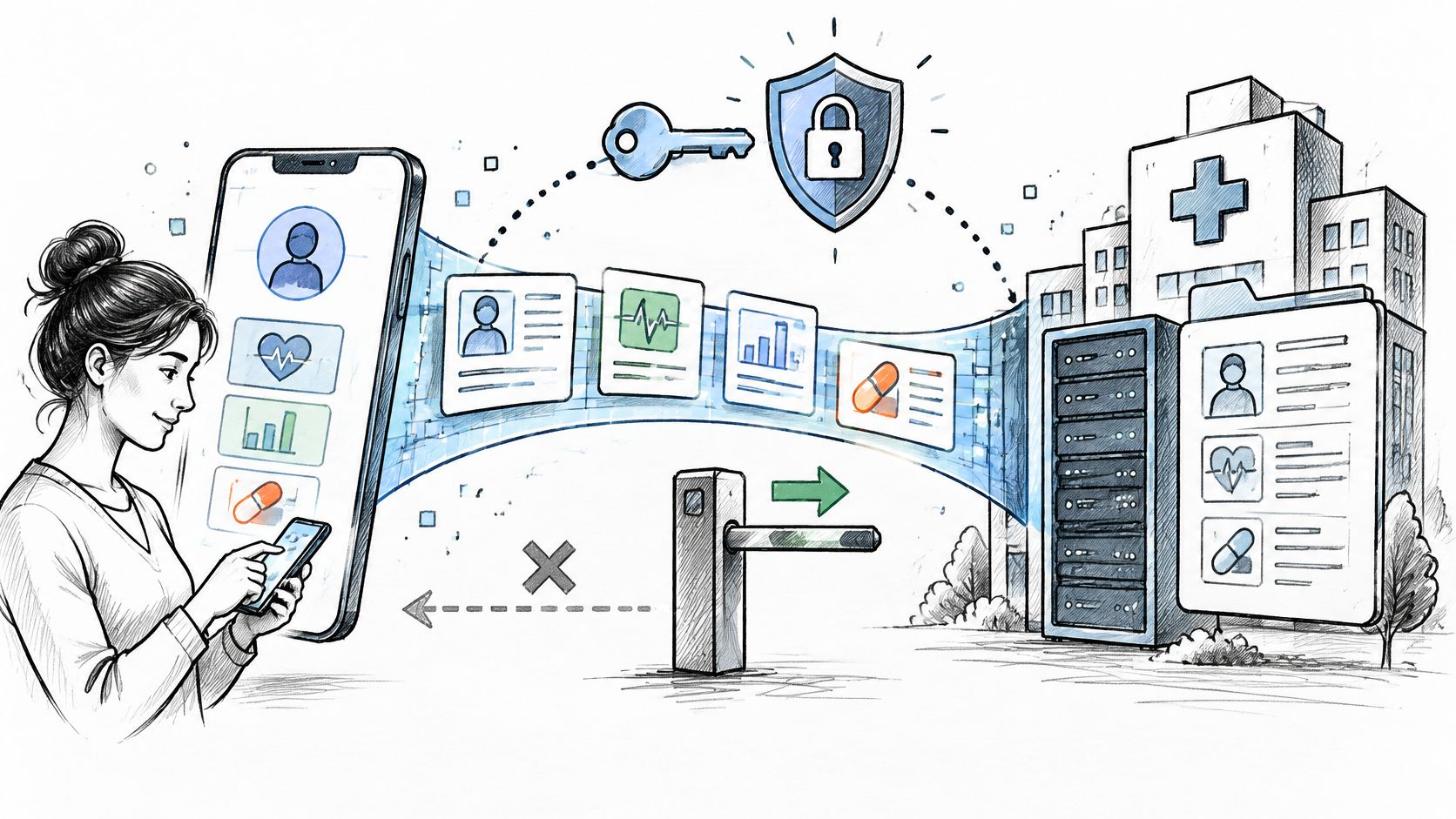
Epic FHIR API capabilities and limits for healthtech teams. Covers FHIR R4 resources, SMART on FHIR auth, sandbox testing, write access, and HL7 v2 gaps.
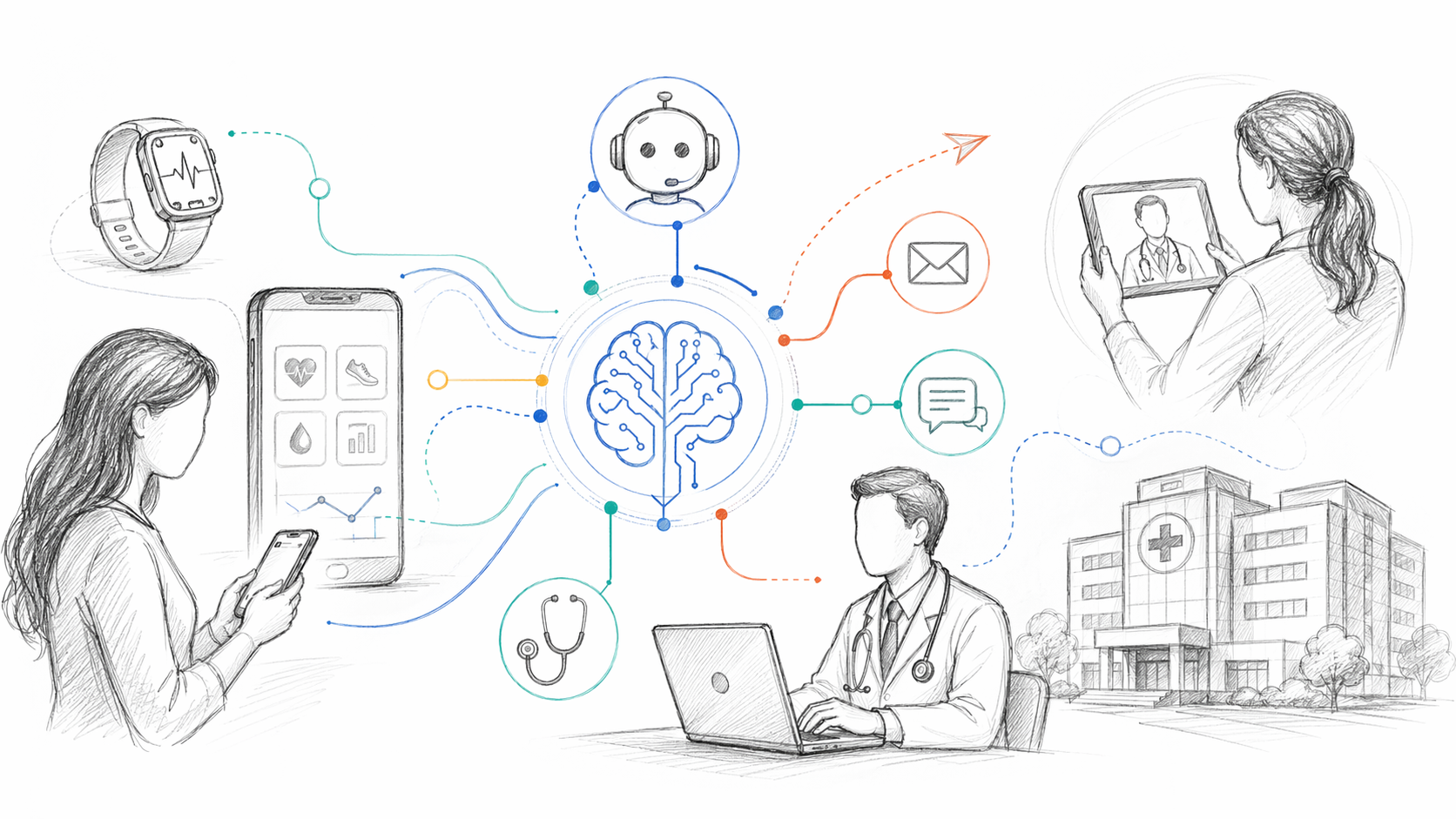
Our guide to AI for patient engagement: conversational assistants, intake, messaging, personalization, platforms and measurement.
Connect with our team to explore how AI expertise can transform your business.