
AI Integration
Oracle Health Integration: A Practical Guide
Oracle Health integration guide: FHIR R4 APIs, HL7 v2 interfaces, SMART app types, sandbox testing and customer activation for HealthTech teams.
October 24, 2026Read more
Choosing home care agency software? Compare must-have features, compliance, AI, and ROI to pick the right platform for your agency in 2026.

At 6:14 a.m., a multi-state agency director is rerouting a missed visit, clearing an EVV exception, and answering a finance manager who has found a Medicare claim denied because the documentation timestamp doesn't match the visit record. Each system appears to work. The operation still fails.
That pattern is why home care agency software selection should start with the operating model, not a feature checklist. The right platform treats every visit as one auditable unit, from assignment and caregiver clock-in through documentation, authorization, billing, and claim submission. The wrong platform creates another place for staff to re-key information.
I've helped agencies evaluate software this year, and my recommendation is consistent: buy for visit-to-claim integrity, multi-payer complexity, and implementation discipline first. Scheduling polish, AI dashboards, and attractive mobile screens matter, but they won't rescue disconnected workflows.
A missed visit isn't only a scheduling problem. It can trigger a scramble among the scheduler, branch manager, caregiver, client, payroll team, and billing department. If the replacement caregiver's assignment doesn't update the EVV record, the agency may have a visit that happened but can't be supported cleanly for reimbursement.
The same issue appears in documentation. A caregiver may complete a note in a mobile app, while billing works from a separate visit record and the payer expects a different authorization reference. When those records don't reconcile automatically, staff discover the defect during month-end review, after the opportunity to correct it has narrowed.
Practical rule: Treat the visit as the primary business object. Every downstream record should inherit its identity, time, service, authorization, caregiver, and client context.
Before reviewing vendors, write the actual chain used by your agency:
This map exposes the buying question. You're not asking whether a vendor has scheduling, EVV, billing, or documentation. You're asking whether the platform preserves the same visit identity across each stage without manual reconstruction.
A mature operating model surfaces problems while a visit can still be corrected. A late clock-in should reach the scheduler and supervisor quickly. A missing credential should block assignment before the caregiver travels. An authorization mismatch should appear before claim generation, not inside a spreadsheet review.
The rest of this guide follows that pipeline. It examines the market's actual center of gravity, the modules that must work together, Medicaid and Medicare differences, AI readiness, vendor evaluation, implementation, and the KPI framework executives need before signing an MSA.
Home care agency software is the operating layer for coordinating people, visits, documentation, reimbursement, and compliance outside a traditional facility. It may include scheduling, caregiver management, mobile point-of-care documentation, EVV, billing, payroll, reporting, telehealth, remote patient monitoring, and integrations with clinical or payer systems.
The category has expanded beyond a basic calendar. One independent market report values the broader home healthcare software market at USD 5.08 billion in 2026 and projects USD 9.27 billion by 2031, at a 12.74% CAGR. The report identifies North America as the largest market and Asia Pacific as the fastest-growing region. Mordor Intelligence's home healthcare software market analysis places agency workflows inside that wider software stack.
Another independent report values the market at USD 6.8 billion in 2025 and forecasts USD 15.3 billion by 2034. It also attributes 67.2% of revenue to cloud-based deployment and 58.3% of total market share to software in its market framing. The same market research source supports the practical conclusion: cloud-first delivery is now the dominant operating model, not an optional side deployment.
Agency management and scheduling sit closer to daily operating pain than broad clinical functionality. One 2026 market estimate places home care agency management software at USD 1.96 billion in 2025, rising to USD 2.13 billion in 2026 and USD 3.72 billion by 2032, with a 9.53% CAGR. The agency management market estimate shows why scheduling, staffing, and operational coordination deserve priority during evaluation.
A separate scheduling market study values the subsegment at USD 0.8 billion in 2025 and projects USD 2.4 billion by 2034. It assigns home care agencies 48.7% of end-user share and cloud deployment 74.8%. The scheduling software market study reinforces the point. Start with the workflow that determines whether a visit happens, is documented, and can be paid.
| Segment | Share of Spend | Maturity |
|---|---|---|
| Agency management and scheduling | Core buyer spend | Mature and specialized |
| EVV and visit compliance | Core reimbursement control | Mature, state-dependent |
| Billing and revenue cycle | Core financial workflow | Mature but integration-sensitive |
| Clinical documentation and EHR connectivity | Important adjacent capability | Established, varies by agency type |
| Telehealth, RPM, and AI copilots | Growing adjacent capability | Developing and readiness-dependent |
A vendor that leads with clinical add-ons but can't demonstrate authorization, scheduling, EVV, and billing continuity is solving the wrong problem first.
The core modules should behave like connected layers, not separate products sharing a logo. A scheduler creates an assignment. EVV proves the visit. Mobile documentation records the service. Billing uses the validated record. Payroll and claims inherit the same facts.

Scheduling needs more than open-shift alerts. It should evaluate caregiver skills, credentials, availability, client preferences, geography, authorization limits, and travel implications. If it doesn't, the agency creates avoidable conflicts, overtime, late arrivals, and assignments that compliance later rejects.
Caregiver management supplies the constraints. Profiles should hold credentials, training status, service capabilities, employment details, and relevant availability. The integration point is assignment validation. The system should prevent an unqualified or unavailable caregiver from becoming a confirmed visit.
EVV must capture service type, client identity, caregiver identity, location, date, and start and end times. The EVV software guidance from AlayaCare explains why those six visit-level elements matter for Medicaid-reimbursed in-home care and auditability.
Mobile point-of-care should let caregivers document at the bedside, support offline operation where connectivity is limited, and collect required signatures or attestations. Missing offline support can turn a completed visit into a documentation backlog. The mobile record must connect directly to the scheduled visit and EVV event, rather than creating a second note with a different identifier.
Telehealth can extend the care model, but it shouldn't sit outside the operational record. If a virtual interaction changes the care plan or creates a billable event, the platform needs a defined path into documentation and reimbursement workflows.
EHR or EMR integration matters when clinical records live elsewhere. Ask whether the connection exchanges structured data, preserves identifiers, records failures, and supports reconciliation. A one-way export isn't interoperability if staff still manually compare records.
Billing and RCM should validate authorization, service codes, payer rules, documentation completeness, and EVV status before submission. Agencies evaluating claims operations can also review how to streamline your revenue cycle when designing pre-submission edits and denial workflows.
A genuinely integrated suite passes one test: take a real visit from assignment through claim preparation and identify every point where a human must re-key, download, rename, or reconcile data. Fewer manual handoffs usually matter more than a longer feature list.
Medicaid and Medicare shouldn't be forced through one generic compliance workflow. Medicaid personal care and home health services may require EVV aggregation under federal rules, while Medicare-certified home health operations depend on assessment and payment structures such as OASIS-E and PDGM.
For Medicaid, the software needs a reliable connection to approved state workflows. Multi-state agencies may work with aggregators and capture methods including mobile GPS, telephony, and FOB devices. Platforms that expose standard interfaces to Sandata, HHAeXchange, Netsmart, Tellus, and CareBridge can reduce manual reconciliation when state submission requirements differ. CareVoyant's home care software overview describes the integration-layer requirement and the role of normalized visit data.
Medicaid EVV isn't universal across every home health billing context. The 21st Century Cures Act EVV mandate applies to Medicaid personal care services and Medicaid home health care services, not Medicare home health. AveeCare's home health software guidance explains why buyers need separate Medicaid and Medicare workflow logic.
| Dimension | Medicaid, Personal Care | Medicare Home Health, OASIS-E and PDGM |
|---|---|---|
| Primary control | EVV proof of service | Assessment, clinical documentation, and payment classification |
| Core data concern | Service, client, caregiver, location, date, and start/end times | OASIS-E timing, plan of care, diagnosis coding, and visit documentation |
| System dependency | State aggregator or approved submission path | Medicare-oriented assessment and reimbursement workflow |
| Common defect | EVV mismatch, missing authorization, incomplete visit event | Timestamp mismatch, incomplete assessment, coding or plan-of-care inconsistency |
| Buyer requirement | State-aware aggregation and exception handling | Assessment timing, downstream payment logic, and clinical documentation support |
For Medicare-certified home health, OASIS-E is required at Start of Care, Resumption of Care, Recertification, and Discharge, and it feeds PDGM payment classification and HHVBP quality measurement. Deelo's home health software analysis connects assessment timing to reimbursement and quality workflows.
Ask vendors to process one representative visit through Medicaid and Medicare scenarios. Check whether the system carries the authorization, service, diagnosis, plan-of-care, assessment, signature, and timestamp context without forcing staff into a spreadsheet.
Security belongs in the same test. Require HIPAA safeguards, role-based access, audit logs, documented retention practices, and clear answers about data location and residency. Real-time exception handling costs less operationally than month-end discovery because staff can correct the source record while the client, caregiver, and manager still remember what happened.
For broader healthcare implementation and compliance work, agencies can review Healthcare AI Services as a reference point for integration, workflow, and regulated-system requirements.
AI can improve operations, but only after the agency has made its underlying records dependable. A model can't reliably optimize assignments when caregiver credentials are stale, availability is incomplete, routes are missing, or EVV events don't map to scheduled visits.
The strongest use cases are narrow and operational:
The failure modes are just as concrete. A documentation assistant can produce an inaccurate note when source data is incomplete. A scheduling model can favor efficient routes while repeatedly assigning undesirable shifts to the same caregivers. A denial model can encode historical bias if prior claims reflected inconsistent practices rather than valid payer logic.
AI should recommend, explain, and surface exceptions. It shouldn't silently change a visit record or make an irreversible staffing decision.
Before buying an AI module, require evidence that the agency has:
Ask where the model runs, what data trains it, how outputs are logged, and how staff correct an incorrect recommendation. Test rural routes, offline mobile use, unusual schedules, and incomplete records. A vendor that only demonstrates a clean urban scenario hasn't demonstrated production readiness.
If the workflow is stable and the controls are documented, AI Automation as a Service can be evaluated as an implementation layer for targeted automation rather than as a promise of broad transformation.
A polished demo proves that a vendor knows how to present software. It doesn't prove that your agency can submit clean claims across payers and states.
Use a weighted evaluation that reflects operational risk. I'd score vendors across four dimensions:
The weights should reflect your agency's exposure. A private-pay agency may emphasize scheduling, payroll, and caregiver experience. A multi-state Medicaid operator should put claim integrity, EVV aggregation, authorization handling, and exception management at the top.
Run a practical proof-of-concept:
Look for hidden per-claim fees, vague AI roadmaps, unclear training-data practices, and references that celebrate go-live without discussing steady-state denial performance. A vendor that can't explain its failure handling is asking you to become its integration test.
For agencies building differentiated workflows instead of buying every module, custom healthcare software development may be appropriate around the core system. Use it selectively. Customization should close a defined operational gap, not recreate scheduling and billing without a clear ownership plan.
Implementation should be managed as an operating change, not an installation project. The software can be configured quickly while the agency remains unprepared to use it safely.

Clean caregiver, client, payer, authorization, rate, credential, and visit data. Validate payer rosters and secure EVV aggregator credentials. Document every required integration and name the five workflows most likely to break first.
Write a change-impact assessment that assigns owners. Include scheduling, caregiver mobile use, documentation, finance reconciliation, and exception management. If the team can't describe the current process, it can't validate the replacement.
Configure the sandbox against real scenarios, not sample records. Pilot the caregiver mobile app in one region, train super-users, wire the denial dashboard, and run a parallel period in which the legacy system remains authoritative.
Use the pilot to test late visits, missing signatures, offline documentation, authorization changes, and payer-specific edits. The implementation team should record each defect, its owner, resolution, and retest status.
The AI Product Development Workflow is a useful reference for structured discovery, validation, and implementation support when AI or automation forms part of the rollout.
Cut over by branch or payer line rather than switching every workflow at once. Use a written go or no-go checklist covering visit verification, authorization synchronization, claim edits, mobile adoption, payroll outputs, and open exceptions.
Hold weekly steering meetings with operations, finance, compliance, IT, and frontline representatives. Review the first post-cutover period after implementation and document what requires configuration, training, or process change.
Early warning signs include training completion under 80%, EVV clock-in failures above 5%, or finance staff still exporting to spreadsheets past week six. Those thresholds are operating gates, not universal industry benchmarks. If they appear, pause expansion and fix the workflow.
ROI should appear on an executive dashboard, not only in a vendor proposal. Track three layers: whether visits are valid, whether revenue moves cleanly, and whether the workforce can sustain the schedule.
| KPI Layer | Metric | 12-Month Target | Est. $ Impact per Visit |
|---|---|---|---|
| Visit integrity | EVV match rate | Set from your baseline, then improve consistently | Model recovered or protected revenue per valid visit |
| Visit integrity | Missed-visit percentage | Reduce from the current baseline | Model lost service value and replacement labor |
| Visit integrity | On-time clock-in | Improve against current branch performance | Model overtime and exception handling cost |
| Revenue cycle | Clean claim rate | Establish a payer-specific baseline | Model avoided rework and faster payment |
| Revenue cycle | Days in A/R | Reduce from the current baseline | Model cash-flow carrying cost |
| Revenue cycle | Denial overturn rate | Track by payer and root cause | Model recovered reimbursement |
| Revenue cycle | Authorization burn-down | Keep approved hours visible before service | Model unreimbursed service exposure |
| Workforce | Caregiver retention | Compare cohorts against the current baseline | Model recruiting, onboarding, and coverage cost |
| Workforce | Overtime ratio | Reduce avoidable overtime | Model premium labor expense |
| Workforce | Miles per visit | Improve route efficiency without harming care | Model travel cost |
| Workforce | Schedule fill rate | Improve open-shift coverage | Model service capacity and missed-visit exposure |
Don't accept a generic “break-even” promise. Build the model from your own visit volume, payer mix, denial categories, overtime, mileage, payroll effort, and implementation cost. The vendor should help you expose assumptions, not hide them.
Should we buy a suite or best-of-breed tools?
Buy a suite when one vendor can prove the visit-to-claim chain. Choose best-of-breed only when an open integration layer, clear data ownership, and accountable reconciliation process already exist.
How should a multi-state agency handle EVV aggregation?
Use a platform with state-aware aggregator connections and normalized visit data. Confirm how it handles rejected submissions, resubmissions, clock-in methods, and state rule changes.
Which AI capabilities are mature enough to consider?
Targeted scheduling assistance, documentation support, and pre-submission exception detection are more practical than autonomous decision-making. Require human review and measurable error handling.
How long until break-even?
Calculate it from your baseline. Include implementation costs, subscription fees, internal training, denied revenue, overtime, rework, and recovered or protected reimbursement. Don't use a vendor's generic payback period.
What belongs in the MSA?
Require data portability, audit rights, security obligations, service levels, integration responsibilities, incident procedures, exit assistance, and access to records after termination. A regulatory compliance partner can help review the compliance responsibilities that sit around the software contract.
For an implementation partner, define whether you need AI strategy consulting, internal tooling, SaMD solutions, or a focused Custom AI Strategy report. Review real-world use cases and meet our expert team before assigning responsibility for regulated workflow design.
Ekipa AI helps healthcare organizations evaluate workflows, plan integrations, and implement targeted AI and automation around scheduling, EVV, documentation, billing, and compliance. Visit Ekipa AI to discuss your current visit-to-claim gaps and build a practical software decision and implementation plan with a healthtech engineering partner.
Oracle Health integration guide: FHIR R4 APIs, HL7 v2 interfaces, SMART app types, sandbox testing and customer activation for HealthTech teams.
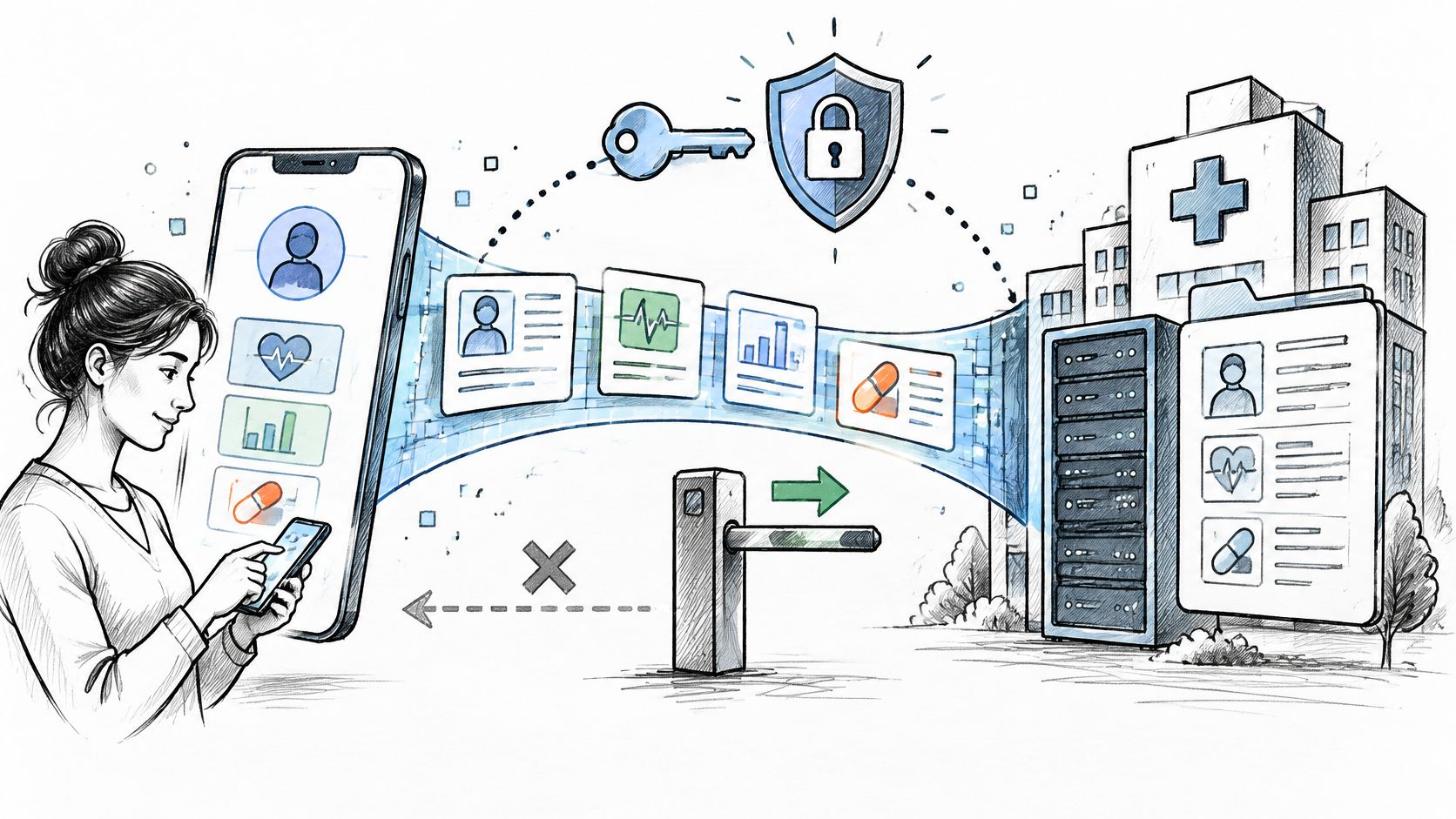
Epic FHIR API capabilities and limits for healthtech teams. Covers FHIR R4 resources, SMART on FHIR auth, sandbox testing, write access, and HL7 v2 gaps.
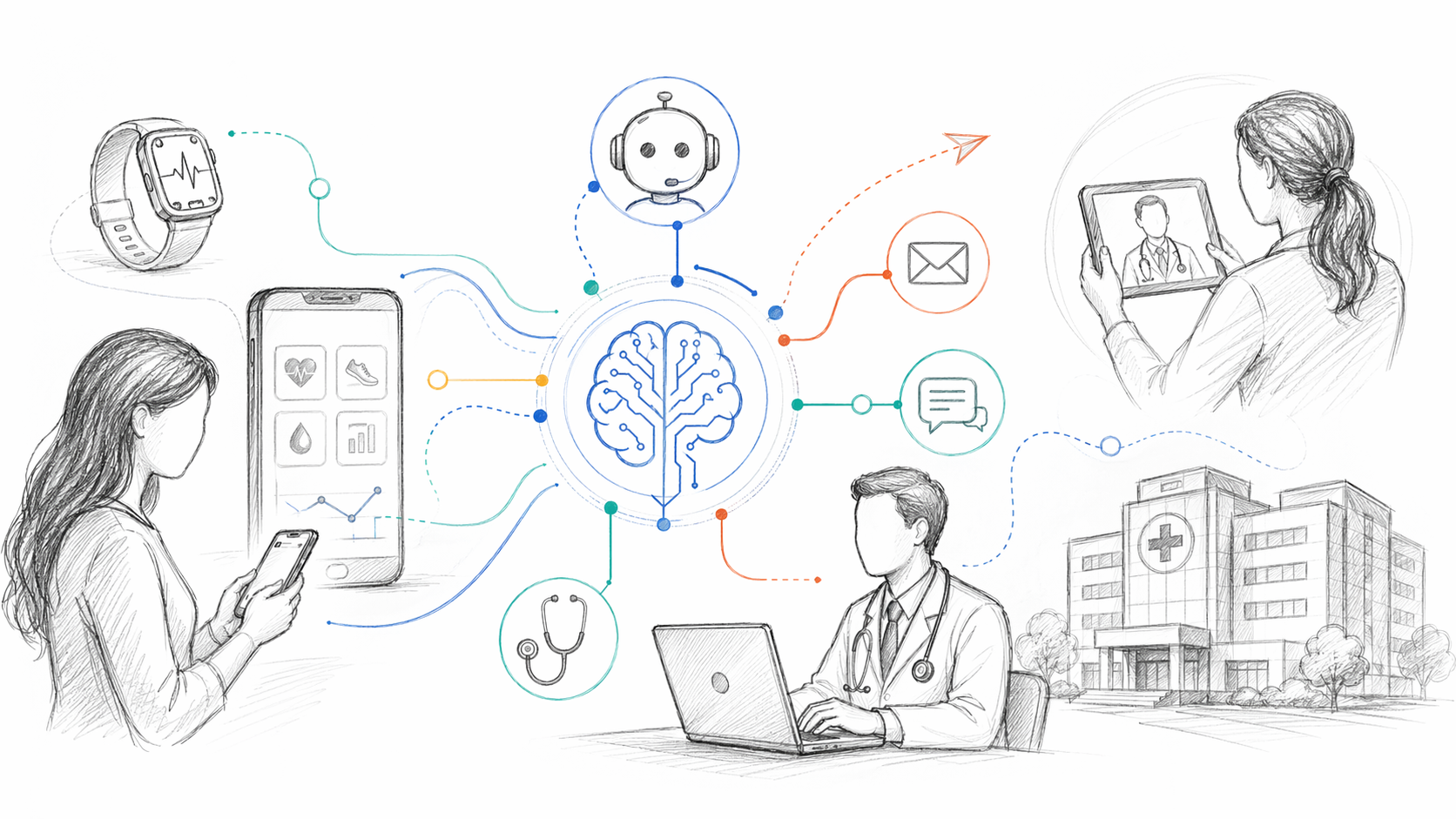
Our guide to AI for patient engagement: conversational assistants, intake, messaging, personalization, platforms and measurement.
Connect with our team to explore how AI expertise can transform your business.