
AI Integration
Oracle Health Integration: A Practical Guide
Oracle Health integration guide: FHIR R4 APIs, HL7 v2 interfaces, SMART app types, sandbox testing and customer activation for HealthTech teams.
October 24, 2026Read more
Executive roadmap for healthcare operational excellence: define KPIs, optimize processes, integrate AI, and drive continuous improvement in 2026.

A hospital can have a modern EHR, advanced clinical AI, and a full dashboard suite, yet still lose hours to fragmented scheduling, repeated data entry, delayed approvals, and poor handoffs. Physicians may benefit from ambient documentation while administrative teams continue working across disconnected queues. That gap is where healthcare operational excellence either succeeds or fails.
Operational excellence isn't a lean project owned by one department. It's an enterprise operating model that connects patient flow, clinical delivery, revenue-cycle work, staffing, technology, governance, and accountability. The 2026 roadmap is clear: measure the system, redesign the work, extend AI beyond the bedside, and govern every change as part of daily operations.
Healthcare operational excellence means delivering reliable care through processes that are measurable, repeatable, safe, and adaptable. It covers the full operating chain, from appointment access and registration to clinical assessment, discharge, billing, compliance documentation, and post-acute coordination. The standard isn't maximum activity. It's dependable performance without creating hidden work, avoidable risk, or downstream bottlenecks.
The intellectual foundation is well established. In 1966, Avedis Donabedian published the Structure–Process–Outcome framework, which created a standard way to evaluate medical care through the conditions supporting care, the work performed, and the results produced. The framework helped move healthcare management away from vague definitions of “good care” toward operational measurement, benchmarking, continuous improvement, and accountability across hospitals and health systems. You can review the historical development in this peer-reviewed overview of Donabedian's framework.
Earlier milestones shaped the same transition. The Joint Commission was established in 1951 to create voluntary hospital accreditation standards. The modern quality-improvement movement later accelerated after the 1999 Institute of Medicine report To Err Is Human, which estimated that nearly 100,000 preventable deaths per year occurred in U.S. hospitals because of medical error, as documented in the same history of healthcare quality measurement.
Practical rule: If a leadership team can't connect a board priority to a process owner and a measurable outcome, it hasn't defined an operating goal yet.
Executives should start with the friction patients and staff experience repeatedly. Long queues, unfilled appointment capacity, authorization delays, preventable rework, inconsistent discharge preparation, and billing backlogs are rarely isolated problems. They usually cross clinical and administrative boundaries, which is why a healthtech engineering partner can help translate operating principles into integrated workflows, internal applications, and scalable healthcare software.
For a concise introduction to the broader discipline, Matil's guide on operational efficiency is useful because it distinguishes day-to-day efficiency from the larger management system required to sustain performance.
Operational goals fail when they describe ambition without defining a measurable operating change. “Improve patient experience” is a direction. “Reduce registration friction for scheduled outpatient visits while preserving identity and consent controls” is a usable mandate.
Build goals through five decisions:
The SMART framework helps teams avoid broad promises. A specific goal might target emergency-department intake rather than “access.” A measurable goal needs a defined metric, such as median wait time, abandonment, incomplete registration, or handoff defects. An achievable target must reflect staffing, integration constraints, and patient demand. A relevant goal should support a strategic priority. A time-bound goal needs a review date and a decision point.

A single efficiency metric can reward the wrong behavior. Faster discharge may increase avoidable returns if clinical readiness and follow-up aren't measured. Higher appointment utilization may worsen access if urgent capacity disappears. Pair operational indicators with quality and experience measures.
| Executive concern | Useful KPI families | Decision the KPI supports |
|---|---|---|
| Patient access | Scheduling lead time, appointment completion, intake queue behavior | Whether capacity and scheduling rules match demand |
| Patient flow | Wait-time distribution, length of stay, transfer delays, discharge readiness | Where queues and handoffs constrain throughput |
| Clinical reliability | Defects, safety events, protocol adherence, follow-up completion | Whether speed is compromising care |
| Administrative performance | Authorization aging, claim rework, coding exceptions, unanswered work queues | Which back-office processes need redesign |
| Financial health | Cost per episode, labor productivity, denial exposure, service-line contribution | Where operating changes affect sustainability |
| Workforce | Overtime pressure, task burden, training completion, escalation volume | Whether the model is sustainable for staff |
Every board KPI should cascade into line-of-business measures without losing its meaning. A chief operating officer might track system-wide patient flow, while an operating-room leader tracks turnover variation, delay reasons, and readiness defects. The measures should connect, but they shouldn't all be identical.
An AI requirements analysis should happen before tool selection. Ask which decision the system will improve, which data it needs, who will act on its output, how quickly the action must occur, and what failure looks like. This prevents teams from buying an attractive model that produces predictions nobody owns.
The financial case deserves equal attention. McKinsey's healthcare operations analysis reports that most hospitals can reduce operating costs by 5% or more through clinical operations excellence initiatives. That figure isn't a reason to cut indiscriminately. It's a reason to connect KPI design to throughput, staffing, bed utilization, supply discipline, and the cost of rework.
The fastest way to find operational waste is to follow the work rather than the org chart. Start with one patient journey and document every action, queue, decision, handoff, system, and exception. Include work performed by clinicians, schedulers, registration teams, case managers, coders, billers, pharmacists, and patients themselves.
A current-state map should answer practical questions:
Don't map only the visible clinical pathway. A consultation may look efficient while authorization, referral intake, documentation, coding, and billing create delays outside the clinical department. The patient experiences the combined system, not the department that produced the bottleneck.

Lean Six Sigma gives teams a disciplined way to improve the mapped process:
A healthcare operations study reported that a Six Sigma intervention increased Process Cycle Efficiency from 35.42% to 42.47%, reduced value-added time from 34 to 31 minutes, and reduced non-value-added time from 62 to 42 minutes. The results are documented in the Six Sigma study on patient wait times and no-show rates.
The lesson is more important than the individual figures. Teams should measure what patients and staff experience, not just what a department averages. Median wait time, variation, defects, queue spikes, and rework often reveal problems that average cycle time conceals.
Use internal tooling for workflows that are organization-specific, such as escalation queues, capacity dashboards, referral coordination, and exception management. Keep the tool close to the work, but connect it to authoritative clinical and administrative data. A standalone dashboard that requires manual updates is a new burden, not operational excellence.
Run improvement events with frontline staff in the room. A scheduler can identify a failure mode that an executive dashboard hides. A nurse can explain why a theoretically efficient handoff creates unsafe interruptions. A biller can show that the actual issue isn't staff effort, but incomplete upstream information.
The best process map includes the work people perform to compensate for the official process.
Technology selection should begin with the operating constraint, not the vendor demonstration. Compare each option against interoperability, scalability, security, workflow fit, vendor support, implementation effort, and total cost of ownership. The right choice may be an EHR configuration, an integration layer, an AI application, robotic process automation, or a smaller internal tool. It won't always be the most advanced product.

EHR modules offer proximity to clinical records, existing identity controls, and established user access. Their trade-off is dependence on vendor configuration, release cycles, and the boundaries of the core platform.
Interoperable platforms can connect EHRs, devices, laboratories, pharmacies, payers, and operational applications. They improve data movement, but they require disciplined information governance and clear ownership of interfaces.
AI-driven analytics can identify patterns in demand, staffing, patient flow, documentation, and revenue-cycle work. Their value depends on data quality, alert design, model monitoring, and a person who can act on the output.
Robotic process automation works well for repetitive, rules-based tasks across systems that lack clean integration. It can reduce manual navigation, but brittle screen-based automation becomes expensive when upstream interfaces or policies change.
A practical evaluation matrix should score each option against the same workflow. For example, a predictive capacity model may forecast demand, but it won't improve flow unless staffing, bed assignment, environmental services, transport, and escalation rules respond to the forecast. An RPA bot may move information between systems, but it won't fix an unclear authorization policy.
Clinical AI has created visible value for physicians, yet those gains often don't extend to scheduling, staffing, and back-office workflows. Becker's Hospital Review's coverage of healthcare operations describes this gap and the need to change both technology and the operating model.
Use API-led architecture where feasible, define authoritative sources, and establish clear data contracts. Standards such as FHIR can support exchange, but interoperability isn't automatic. Teams still need identity matching, consent handling, error management, monitoring, and an owner for every interface.
Leaders should also decide whether they need a product, a managed capability, or custom engineering. Ekipa AI's clinic AI assistant is one example of a healthcare AI product category, while broader Healthcare AI Services can support workflow design and implementation across clinical and administrative contexts. For organizations that want speed without building every automation capability internally, AI Automation as a Service can be evaluated against the same security, integration, and ownership requirements.
As we explored in our AI adoption guide, adoption should be treated as an operating decision. Define the user, workflow, data boundary, escalation path, and success measure before approving deployment. That approach reduces tech sprawl and makes it easier to retire tools that don't change performance.
Healthcare AI governance should function as an operating system, not a one-time approval project. The framework needs risk tiers, interdisciplinary decision-making, lifecycle controls, monitoring, and scheduled policy review. HealthStream's governance framework for health systems recommends defining enterprise scope and risk categories, chartering an interdisciplinary committee, publishing policies for data use and deployment, maintaining a model registry, and reviewing governance on a recurring basis.
Start with an executive steering committee that sets risk appetite and resolves conflicts. Under it, create an AI and operations governance committee with clinical, operational, technical, privacy, compliance, security, legal, and patient-safety representation. Sub-committees can review clinical workflows and administrative use cases separately, but both should report through the same enterprise structure.

Every model or AI-enabled workflow should have an owner, purpose, data sources, risk tier, validation record, user population, vendor dependency, monitoring plan, incident route, and retirement condition. Treat third-party tools with the same seriousness as internally developed systems. Procurement cannot replace operational accountability.
Your policy set should cover:
There isn't one federal law that governs every healthcare AI use case. A 2026 healthcare AI compliance guide explains that HIPAA, HITECH, OIG expectations, CMS, FDA, HHS Section 1557, state law, and accreditor requirements may apply depending on the use case and data flow. For regulated software, a regulatory compliance partner such as MedQair can support compliance planning for SaMD solutions, but the health system still owns the operational decision and implementation controls.
Use a metrics register alongside the model register. HelpWithMetrics' explanation of metrics governance provides useful context for defining metric ownership, calculation rules, data lineage, and change control. Without that discipline, teams can govern the algorithm while debating what the KPI means.
A redesigned workflow won't survive if staff learn about it through a slide deck after the decision has already been made. Change management starts with the people who perform the work. Invite representatives from clinical, administrative, technical, compliance, and patient-facing teams to test the current-state map and challenge assumptions.
Give each group a defined role. Executives remove barriers and protect the priority. Operational owners make decisions close to the workflow. Frontline champions test the design, explain the reason for change, and surface failure modes. IT and data teams make the workflow reliable. Compliance and safety leaders define mandatory controls.
Use a communication plan that answers four questions: what is changing, why it is changing, what staff must do differently, and where they can get help. Training should use realistic cases, exception handling, and role-specific practice. A clinician doesn't need the same instruction as a scheduler, coder, or analyst.
Build a super-user network before launch. Super-users can coach peers, collect issues, distinguish training gaps from product defects, and route urgent problems. Publish a visible backlog with owners and decisions. Staff are more likely to report friction when they can see that someone is acting on it.
Daily huddles and dashboard-driven stand-ups should focus on decisions, not performance theater. Review the most important exception, identify the process owner, agree on an action, and set the next check. Avoid turning every metric into an individual score. That encourages workarounds and suppresses useful reporting.
If staff must create a workaround to keep patients moving, treat the workaround as process evidence, not employee failure.
Use AI Product Development Workflow practices to keep discovery, implementation, feedback, and support connected. Continuous improvement needs a defined release process, not an endless stream of informal requests. At each review, ask whether the change improved the intended outcome, shifted work downstream, introduced a safety issue, or created a new burden.
Protect gains with standard work, onboarding materials, ownership updates, and recurring audits. Continuous improvement isn't constant change. It's controlled learning that makes the next version of the process safer and more useful.
Choose use cases where a measurable operational constraint meets a clear decision owner. Emergency-department flow, prior-authorization coordination, referral intake, discharge readiness, staffing escalation, pharmacy distribution, and billing exception management can all be candidates. The right starting point isn't the use case with the most impressive demo. It's the one with reliable data, visible pain, an accountable owner, and a practical path to action.
For emergency-department flow, map arrival, registration, clinical assessment, diagnostics, disposition, transport, and bed assignment. An AI system might identify rising demand or predict capacity pressure, but operations leaders must define the actions that follow. Those actions may involve staffing adjustments, bed coordination, transport escalation, or communication with downstream services.
For prior authorization, the opportunity may sit in document collection, eligibility checks, payer-specific rules, status tracking, and exception routing. Automation should handle stable, rules-based work while routing ambiguous cases to trained staff. Measure completion time, rework, escalation volume, and patient communication quality together.
For billing operations, don't start with a generic automation target. Find where missing documentation, coding ambiguity, eligibility issues, or handoff failures create rework. A workflow tool can surface exceptions and assign ownership, but finance, clinical documentation, and compliance leaders must agree on the control points.
Explore additional real-world use cases before selecting a pilot. Then evaluate each candidate across five questions:
Discovery: Document the current state, baseline the KPI, interview users, identify data dependencies, define the risk tier, and select the accountable owner. The deliverable should be a signed problem statement and a measurement specification.
Pilot: Limit scope to a defined service line, workflow, or user group. Test the integration, training, exception handling, and governance controls. Hold stakeholder reviews at agreed checkpoints rather than waiting for a final launch decision.
Scale: Expand only after the pilot demonstrates operational fit. Standardize the workflow, strengthen support, integrate adjacent teams, and update policies and documentation. Scaling a broken process spreads the problem faster.
Sustain: Review performance, incidents, staff feedback, model behavior, and total cost. Retire features that don't produce useful action. Feed lessons into the next improvement cycle.
The wider strategic question is whether to customize every site or standardize the core. Enterprise-wide patient-flow orchestration, service-line rationalization, and cross-organization workflow harmonization can matter more than another isolated dashboard. A 2025 hospital operations survey cited capacity challenges among 30% of executives, operating-room efficiency and workforce shortages among 26% each, and specialist and nursing gaps among 49% and 46% respectively, according to Care Logistics' reporting on healthcare operations trends. Those pressures favor deliberate simplification, not unlimited local customization.
Healthcare leaders can use custom healthcare software development when standard products can't support the required workflow, or evaluate AI tools for business when a configurable capability is sufficient. The decision should follow the operating model, data controls, and ownership structure.
For organizations building regulated products, SaMD solutions, AI strategy consulting, a Custom AI Strategy report, or internal tooling may address different points in the roadmap. Use them selectively. The technology should serve the process, and the process should serve patient care.
Start with one workflow you can own end to end, then scale the operating discipline before you scale the software.
Ekipa AI helps healthcare organizations connect clinical and administrative workflows through AI strategy, integration engineering, automation, internal applications, and implementation support. If you're ready to turn a fragmented process into a governed operating roadmap, visit Ekipa AI and connect with our expert team.
Oracle Health integration guide: FHIR R4 APIs, HL7 v2 interfaces, SMART app types, sandbox testing and customer activation for HealthTech teams.

Epic FHIR API capabilities and limits for healthtech teams. Covers FHIR R4 resources, SMART on FHIR auth, sandbox testing, write access, and HL7 v2 gaps.
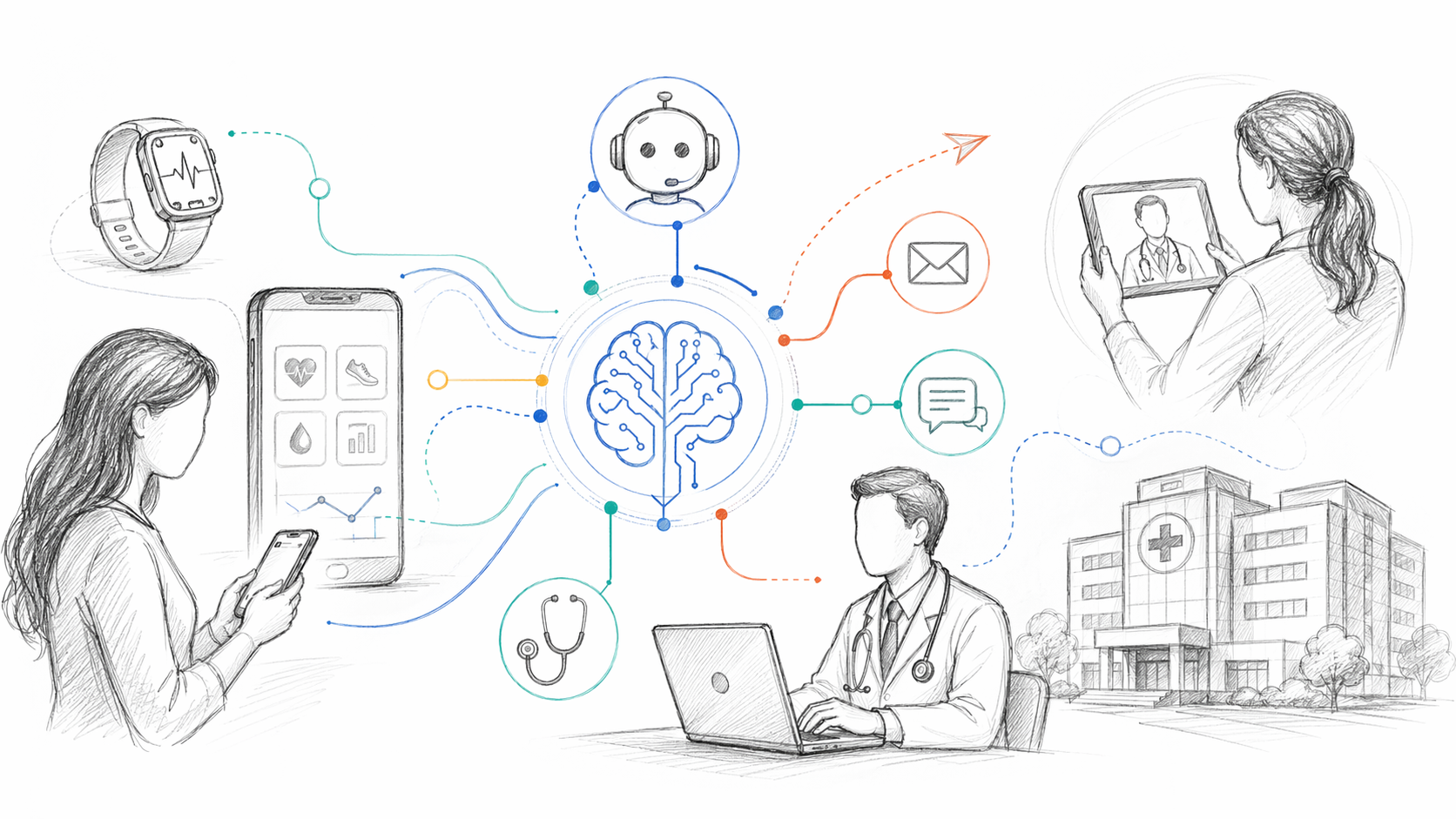
Our guide to AI for patient engagement: conversational assistants, intake, messaging, personalization, platforms and measurement.
Connect with our team to explore how AI expertise can transform your business.