
AI in Healthcare
HIPAA-Compliant AI: How to Use LLMs With PHI Safely
How to build HIPAA-compliant AI: when LLM providers need a BAA, data minimization, de-identification, audit controls and a reference architecture.
October 16, 2026Read more
Choosing the right AI partner is key to successful healthcare innovation. A strong partner helps align strategy, ensure compliance, and deliver scalable solutions that improve outcomes and efficiency.
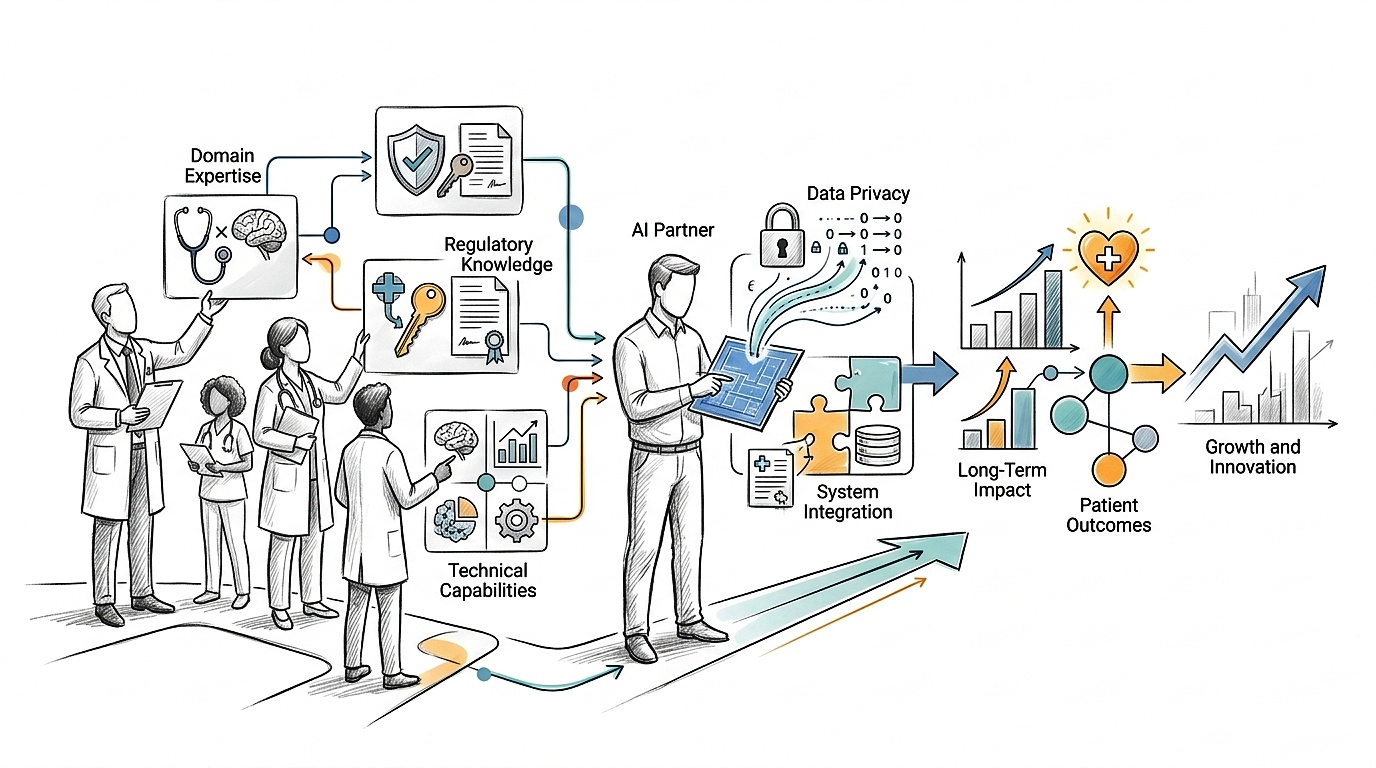
Healthcare systems are moving toward data-driven care, where clinical decisions depend on accurate information and rapid analysis. Artificial intelligence plays an increasing part in this change, affecting how hospitals spot illnesses, run daily operations, and improve patient results. Choosing the right healthcare AI partner shapes how well these tools work in real care settings.
A good partner boosts efficiency across departments, reduces delays in decision-making, and lifts clinical accuracy. On the flip side, a poor choice can bring system failures, compliance risks, and wasted money. The difference often comes down to how well the partner grasps both the technology and the realities of healthcare.
An AI partner in healthcare works beyond simple software development. Their work covers planning, design, development, and ongoing alignment with hospital goals. A skilled healthtech engineering partner brings structured thinking to complex clinical problems and matches technology with operational needs. These partners guide organisations through testing ideas, designing systems, building models, and rolling them out. Their job connects medical data with smart systems that sharpen decisions across departments.
They also take charge of understanding data sources like patient records, diagnostic reports, and operational figures, then turn that information into useful insights. Their role continues after launch through system monitoring, performance tuning, and updates based on real use. This steady involvement keeps the AI solution accurate, relevant, and in step with changing clinical demands, which helps deliver consistent results across healthcare operations.

Healthcare systems run on detailed workflows that need accuracy and clear thinking. A partner must understand how clinicians interact with data, how diagnoses happen, and how delays affect patient care. A reliable AI vendor in a healthcare environment shows deep knowledge of these processes. Experience in clinical environments shapes how solutions are built. It prevents mistakes that come from a lack of medical know-how and makes the system more useful.
Healthcare data comes with strict legal rules. A partner must follow established standards and keep data safe at every stage of development. Many organisations turn to AI consulting healthcare services to guide their compliance planning and stay aligned with regulatory expectations. Clear knowledge of regulations lowers legal risks and builds confidence across stakeholders.
Patient data needs careful protection at every level. Secure design, limited access, and encryption practices form the base of any healthcare AI system. Organisations working with a healthtech AI company expect clear data governance and well-defined protocols that guard sensitive information from start to finish.
AI systems in healthcare need high accuracy and steady performance. A partner must show skill in machine learning models, predictive analytics, and data processing tools. Advanced healthcare AI services help build smart systems that assist with diagnosis, patient monitoring, and operational planning.
Hospitals depend on current systems like electronic records and management platforms. AI solutions must link smoothly with these systems to avoid disrupting daily work. A capable partner designs solutions that fit with existing infrastructure and keep clinical operations running without interruption.
Healthcare organisations grow over time, and data amounts rise with every patient interaction. AI systems must expand in a controlled way to handle increasing demand. Partners who work on SaMD solutions know how to build systems that keep up performance across large datasets and growing numbers of users.
Each healthcare organisation runs differently. A standard solution rarely meets every need. Customisation ensures that AI systems reflect specific workflows, patient types, and operational targets. Flexible design methods create systems that adjust to real clinical settings.
Experience offers insight into a partner's ability to deliver results. Case studies, project outcomes, and client comments show how solutions perform in real life. A solid track record builds confidence and reduces uncertainty when making a decision.
A thorough examination of past work offers a reliable view of the partner's capabilities. It demonstrates how they address complex challenges and the outcomes they deliver within healthcare environments. A well-documented custom AI strategy report from previous engagements can also reveal how the partner approaches long-term planning and goal alignment.
Open communication shapes how well any project turns out. A partner must grasp requirements, ask the right questions, and stay open throughout the process. Strong teamwork builds a good fit between technical staff and healthcare professionals.
A well-structured development approach improves how a project runs. Defined schedules, clear milestones, and regular updates create a steady path from idea to launch.
Choosing based only on cost: A low price may seem appealing at first. However, it often leads to limited features, poor quality, and higher expenses later due to rework and missing functionality.
Ignoring healthcare domain expertise: Technical skill alone does not work in healthcare. Without clinical knowledge, solutions may fail to align with actual workflows and patient care needs.
Overlooking compliance and security standards: Healthcare data demands strong protection and regulatory adherence. Ignoring these requirements can create legal liabilities and damage internal trust.
Not evaluating scalability and long-term support: AI systems must expand as data and usage grow. A lack of scalability and ongoing guidance can cause performance problems and system constraints over time.
Strong healthcare experience: A reliable partner brings proven experience across healthcare projects. Their work reflects familiarity with clinical environments, patient data, and real operational challenges.
Clear understanding of hospital workflows: They understand how hospitals function daily, including patient journeys, staff coordination, and data flow across departments. This clarity leads to solutions that fit naturally within existing processes.
Focus on security and compliance: A dependable partner follows strict data protection practices and aligns with healthcare regulations. Their approach reflects careful management of sensitive information and structured governance.
Ability to deliver measurable outcomes: They focus on results that can be tracked, such as improved efficiency, reduced errors, and better clinical decisions. Their past work demonstrates clear, outcome-driven performance.
Long-term partnership mindset: A reliable partner stays engaged beyond initial delivery. They provide continuous improvements, adapt systems as needs change, and maintain alignment with long-term healthcare goals.
Shortlisting potential companies: Start by identifying companies that have proven healthcare experience, relevant project work, and clear technical skills. This step removes options that do not fit healthcare requirements.
Conducting technical discussions: Have detailed conversations to understand their approach to AI development, data usage, system design, and compliance practices. These discussions show how well they grasp healthcare challenges.
Evaluating demos or prototypes: Review working models or sample solutions to judge real-world performance. This provides a clear picture of how their solutions behave in actual situations.
Comparing capabilities and value delivery: Examine each option based on expertise, approach, scalability, and expected results. This comparison helps select a partner that matches both technical needs and business objectives.
Choosing the right partner shapes the future of healthcare innovation within any organisation. A strategic approach leads to better efficiency, sounder decisions, and improved patient outcomes. The right healthcare AI partner brings clarity, direction, and measurable value at every stage of implementation.
A thoughtful selection process creates lasting impact across clinical and operational areas. It connects technology with real healthcare needs, closes gaps in execution, and raises the overall quality of patient care. Organisations that invest time in selecting the right partner build a foundation for steady performance, data-driven insights, and long-term growth.
Contact us to explore how a well-aligned AI partner can transform healthcare operations and deliver meaningful progress.
A healthcare AI partner helps design, build, and deploy AI solutions using healthcare AI services aligned with clinical and operational goals.
The right AI vendor in healthcare ensures better performance, compliance, and long-term success, often supported by AI consulting healthcare expertise.
A healthtech engineering partner connects data, workflows, and technology to deliver scalable solutions, including SaMD solutions for clinical use.
They should review case studies, technical expertise, and a custom AI strategy report to assess real-world capabilities and value delivery.
They should provide end-to-end healthcare AI services, from strategy and development to deployment and ongoing optimization.
How to build HIPAA-compliant AI: when LLM providers need a BAA, data minimization, de-identification, audit controls and a reference architecture.

Practical data migration planning guide for healthcare teams. Scope, mapping, compliance, validation, cutover and rollback decisions explained end to end.

Smart on FHIR guide for healthtech engineers. Learn the OAuth 2.0 launch model, scope syntax, backend services, and US regulatory requirements.
Connect with our team to explore how AI expertise can transform your business.