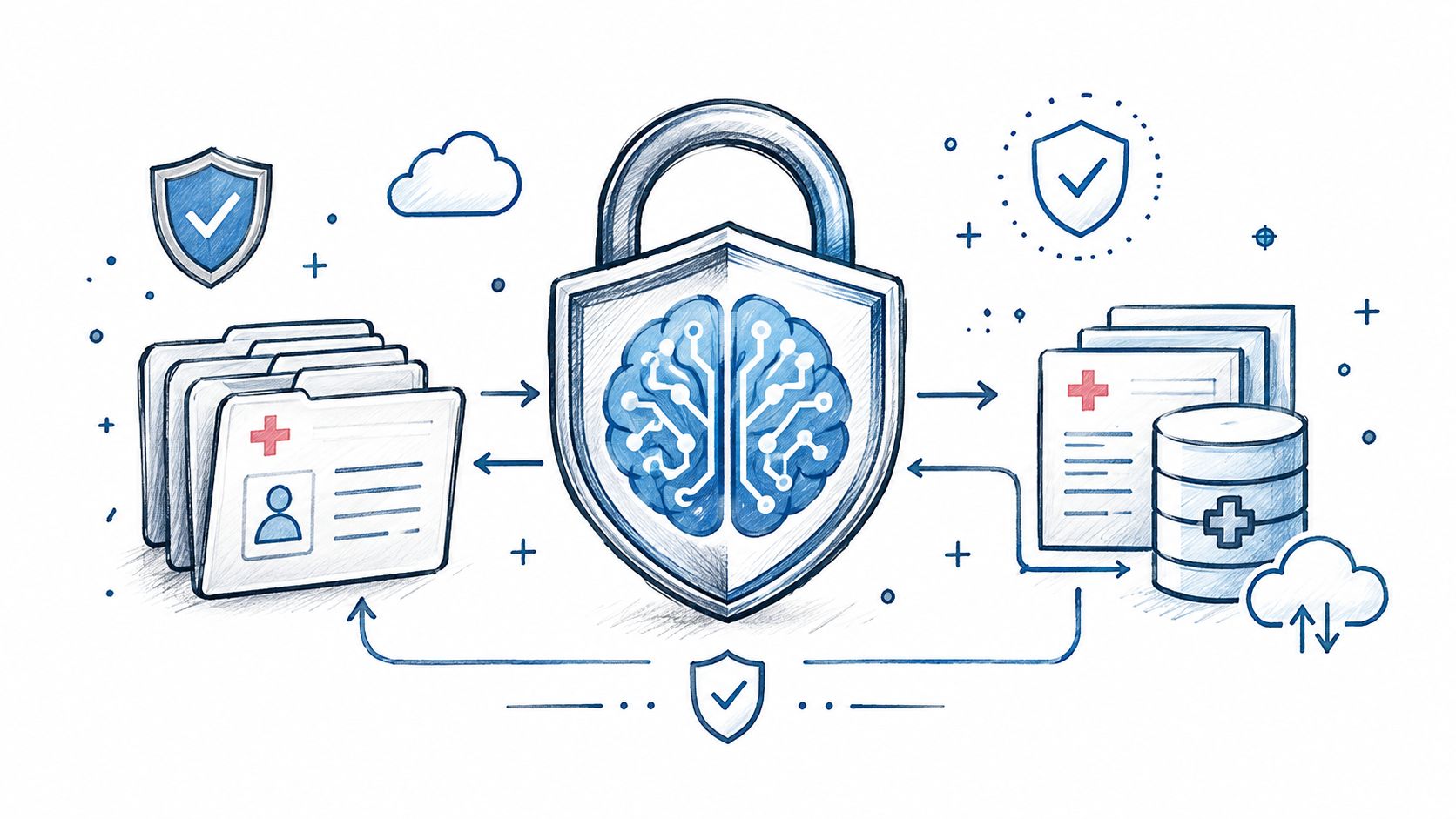
AI in Healthcare
HIPAA-Compliant AI: How to Use LLMs With PHI Safely
How to build HIPAA-compliant AI: when LLM providers need a BAA, data minimization, de-identification, audit controls and a reference architecture.
October 16, 2026Read more
Explore our 2026 guide to clinical documentation software. Learn key features, ROI, AI opportunities, and vendor selection for healthcare leaders.

Clinical documentation software now sits at the center of routine care delivery across health systems. That alone should end the old debate about whether it is a back-office tool. It is operational infrastructure that shapes clinical throughput, reimbursement accuracy, compliance exposure, and the quality of management decisions.
For hospital leadership, the primary decision is not whether to buy documentation software. Instead, it is whether to treat it as a procurement exercise or as a strategic redesign of how clinical information is captured, used, and governed. Teams that buy on features alone usually inherit the same problems in a newer interface. Teams that choose based on workflow fit, integration discipline, and measurable ROI get faster documentation, cleaner coding, stronger audit readiness, and better data for service-line and workforce planning.
A slow or poorly configured system adds clicks, delays note completion, frustrates clinicians, and weakens downstream billing. A well-implemented system reduces avoidable friction and gives leaders tighter control over documentation quality at scale.
AI raises the stakes further. It can reduce manual work and improve timeliness, but it also introduces new risks around accuracy, trust, governance, and adoption. Leadership teams need a clear framework for selection, implementation, and ROI tracking, not another feature checklist.
That is the standard I recommend using when evaluating healthcare AI strategy and execution tools. The organizations that move first with discipline will shorten implementation time, avoid common rollout failures, and capture value sooner.
Clinical documentation software sits in the middle of care delivery, revenue integrity, and compliance control. That makes it core hospital infrastructure, not an administrative add-on. When documentation breaks down, the effects show up fast. Clinicians spend more time finishing notes, handoffs lose detail, coders work from incomplete records, and leaders lose confidence in the data used for staffing, quality, and service-line decisions.
Hospital executives should evaluate this category with one question in mind: will this system improve how information moves through the organization from encounter to claim to audit? If the answer is unclear, do not treat the purchase as complete.
Clinical documentation software captures clinical input, structures it for downstream use, and preserves the record needed for treatment, billing, reporting, and review. A weak system creates friction at every step. A strong one reduces rework across clinical operations, CDI, coding, revenue cycle, and compliance.
Adoption is already standard across health systems, as noted earlier. The strategic issue now is not whether to use documentation software. It is whether your organization chooses a platform that supports actual care delivery, produces usable structured data, and can absorb AI without creating new governance problems.
Leadership teams should test every option against four decision criteria:
One rule matters here. If frontline staff describe the platform as extra documentation work, the implementation plan is failing.
Hospitals rarely fail because they bought no documentation tool. They fail because they bought one that looked good in a demo and collapsed under real clinical pressure. Common mistakes are predictable: weak physician input during design, poor specialty configuration, limited integration planning, vague ownership, and no baseline for ROI. Those failures turn a software decision into an operating margin problem.
This is also where AI changes the adoption process. Ambient documentation, summarization, and prompt-based workflows can reduce manual effort, but only if leaders set clear rules for validation, exception handling, and accountability. If AI-generated content enters the record without governance, your organization trades typing time for clinical and legal risk.
The right response is disciplined selection, measured rollout, and hard operational targets. Many teams use external support from a healthcare AI strategy and execution partner to align clinical design, technical delivery, and ROI tracking before rollout begins.
If you are making this decision in 2026, treat clinical documentation software as a platform investment with direct consequences for care quality, workforce efficiency, and cash flow. That is the level of scrutiny it deserves.
The best clinical documentation software doesn't impress in demos. It disappears into the encounter. Clinicians shouldn't have to think about the tool. They should move through the visit while the system captures, structures, and routes information with as little friction as possible.
A feature checklist is useful, but workflow fit matters more. If the platform can't support the actual sequence of intake, exam, assessment, ordering, coding, and follow-up, the feature list won't save you.

Modern platforms need a tight combination of input tools, structured capture, and automation support. In practice, the core feature set usually includes:
What separates good from bad is how these capabilities work together. A template without governance turns into clutter. Voice capture without structured extraction creates cleanup work. Automation without clinician trust gets bypassed.
One real-world EHR study found that reusable content-importing phrases were used in 95% of visits, with most imported content coming from structured data through data-links rather than generic boilerplate (PMC). That should change how leaders buy and govern documentation systems.
The implication is straightforward. Template architecture is not a minor configuration detail. It's a major operational lever.
Here's where many organizations go wrong:
The fastest path to clinician frustration is a documentation platform with no template discipline.
Ask vendors to walk through a real encounter, not a polished demo script. Start with patient intake and end with a signed note, coded output, and follow-up task generation. Watch for handoffs. Watch for duplicate entry. Watch for what happens when the encounter doesn't follow the ideal script.
A hospital should also look at solutions shaped for actual ambient and clinician-assist workflows, such as a Clinic AI Assistant, if the goal is to reduce manual documentation while keeping clinicians in control of the final record.
If your organization needs deeper adaptation for specialty workflows, legacy systems, or multi-role input models, that usually calls for custom healthcare software development, not just configuration inside a generic tool.
Most business cases for clinical documentation software are too soft. They promise efficiency, happier clinicians, and smarter workflows, but they don't tie those promises to hard operating outcomes. Leadership teams should reject that framing.
The return on investment comes from three places. Financial integrity, operational capacity, and documentation quality.
Start with the revenue side. Better documentation supports cleaner coding, fewer ambiguities, and faster downstream review. That matters because weak documentation creates payment risk, rework, and audit exposure. If your finance team is already focused on sealing healthcare revenue leaks, documentation should sit near the top of that agenda, not below denials management.
Operationally, the largest gain usually comes from reducing clinician time spent finishing charts, hunting for information, and correcting note inconsistencies. Even when leaders can't assign a universal number in advance, they can still model value through internal baselines such as after-hours charting, unsigned notes, delayed encounter closure, and coding queries per service line.
Quality ROI matters too. Clean, timely documentation improves handoffs, supports care continuity, and gives quality teams more reliable data to work with.
Use a simple decision frame.
| ROI area | What to measure internally | Why it matters |
|---|---|---|
| Financial | Coding queries, claim rework, payer documentation requests | Better records support reimbursement and reduce avoidable rework |
| Operational | Time to close charts, documentation backlog, clinician after-hours work | Less friction improves throughput and staff experience |
| Clinical | Note consistency, handoff clarity, structured data completeness | Better information supports safer care and stronger reporting |
| Compliance | Audit preparation effort, unsupported diagnoses, traceability | Documentation quality affects defensibility |
This is also where many homegrown systems disappoint. Basic internal tooling can patch a local workflow problem, but it often lacks the governance, interoperability, support model, and compliance rigor needed for enterprise deployment.
Don't approve documentation software because the demo looks efficient. Approve it because the operating model behind it improves revenue integrity, clinician capacity, and audit readiness.
The most common mistake is buying for note creation alone. That narrows the value discussion too early. The note is only the visible artifact. The actual value sits in what that note enables across coding, quality reporting, clinical review, and management visibility.
If your procurement process treats this as a front-end usability purchase only, you'll underinvest in the parts that create lasting return.
Integration failures are one of the fastest ways to turn a promising documentation purchase into an expensive cleanup project. If the system cannot exchange data cleanly, preserve clinical context, and show exactly who changed what, the hospital absorbs the cost through clinician frustration, delayed coding, audit exposure, and rework.
Leaders should evaluate documentation software as part of the clinical and revenue infrastructure. A tool that performs well in isolation can still fail in production if write-back rules are unclear, reconciliation breaks, or the legal record becomes inconsistent.

Modern platforms should support HL7 FHIR APIs for real-time EHR interoperability and use NLP to turn notes into structured, coded data, reducing duplicate entry and workflow errors (Combine Health). That is the baseline. Anything less creates downstream friction that your clinicians and HIM teams will pay for every day.
Push vendors on the details. Ask how encounter data is exchanged, which elements write back to the chart, how version conflicts are resolved, and what happens when source systems disagree. Integration quality determines whether clinicians trust the output or work around it.
During technical review, validate four points:
Security reviews often stop at encryption and access controls. That is too narrow. Documentation software also needs to support audit defensibility, data provenance, role-based editing, retention controls, and a complete history of user actions.
Poor documentation integrity creates direct financial risk. Industry guidance tied to CMS estimates says a large share of improper payments stem from insufficient documentation. Leadership should treat that as a revenue integrity problem with compliance consequences, not a checkbox exercise.
Hospitals should require:
If a system makes documentation faster but weakens the record, it increases risk and shifts the cost to coding, compliance, and appeals.
Strong vendors answer hard questions directly. Weak vendors redirect to feature demos.
Ask these five:
For teams assessing voice capture and speech-enabled workflows, this guide offers useful insights for healthcare transcription that can sharpen vendor questions around accuracy, review steps, and integration boundaries.
Organizations deploying adjacent regulated products should also make sure documentation architecture can support future SaMD solutions and broader care-platform needs without introducing new compliance gaps.
A 2024 review found that AI speech recognition systems cut documentation time by 19.0% to 92.0%, and the same review reported a sharp rise in AI-powered clinical decision support integration between 2023 and 2025 (PMC). That scale of improvement gets leadership attention. It should. Documentation AI can improve physician capacity, reduce after-hours charting, and strengthen data capture for coding and analytics.
It can also create expensive failure at scale.

The highest-value AI use cases sit inside the encounter, where every extra click and every delayed note create cost.
The pattern in the market is clear. Vendors are concentrating on workflow support and structured data capture, not on replacing clinician judgment. That is the right priority. Hospitals get ROI when AI removes clerical friction and improves record completeness without creating a new review burden.
The implementation risk is not theoretical. It shows up in note accuracy, legal defensibility, clinician trust, and revenue integrity.
Common failure modes include:
Use AI to reduce clerical work and improve data quality. Keep clinical judgment, final attribution, and chart accountability with the treating clinician.
For leaders evaluating audio-based workflows, Typist's audio transcription workflow is a useful reference point for assessing how raw audio becomes draft text before clinical review.
Start narrow. Pick one documentation workflow with high pain, high volume, and a clear economic case. Good starting points include ambulatory follow-ups, ED notes, or specialty clinics with heavy dictation volume. Define the operating model before go-live. What can the AI draft, what must remain clinician-authored, what requires explicit confirmation, and how corrections will be tracked.
Then measure what matters. Time saved per encounter is only one metric. Track edit rate, clinician acceptance rate, note completion lag, coding impact, compliance exceptions, and user drop-off by specialty. If those numbers do not improve together, the rollout is not working.
Execution discipline determines whether AI becomes margin improvement or another stalled pilot. Teams need workflow-specific acceptance criteria, clear governance, and support during rollout. Hospitals that want a faster path from evaluation to adoption should use AI implementation support for healthcare workflows to define review checkpoints, success metrics, and integration decisions before expanding beyond an initial use case.
The right strategy is simple. Buy AI for a documented operational problem, not for a demo. Expand only after the first workflow proves clinical acceptance, record quality, and financial value.
Vendor selection fails when hospitals buy software the same way they buy office systems. Clinical documentation software touches physician behavior, revenue integrity, and legal record quality. It needs a tougher evaluation standard.
The right buying process is part technical due diligence, part workflow design, part change management.

Use these questions in every vendor discussion:
A vendor that can't answer these clearly is giving you implementation risk in advance.
The rollout plan matters as much as product quality. Strong implementations usually share a few traits:
One more point. Training can't be generic. Specialty-specific training beats broad platform orientation every time because clinicians need to see their actual note patterns and patient flows reflected in the system.
Good implementation doesn't try to force adoption. It removes reasons to resist.
Hospitals planning a build, integration, or staged rollout should map the work into a formal AI Product Development Workflow so requirements, validation, and deployment decisions stay connected from the start.
Clinical documentation software should be treated as a strategic operating decision. It affects care delivery, coding quality, compliance exposure, clinician workload, and the usability of the data your organization depends on. Leaders who reduce this category to a feature comparison usually end up buying friction.
The better approach is structured discovery first. Define the workflows that matter most. Identify where documentation failure creates financial or clinical drag. Decide where structured data is essential, where narrative flexibility still matters, and where AI can assist without weakening control.
That's where a focused strategy process helps. A HealthTech engineering partner can help leadership teams connect product decisions to operating realities instead of treating documentation as a standalone software purchase. The same applies to broader AI strategy consulting when you're evaluating ambient documentation, coding assistance, or workflow automation as part of a larger transformation agenda.
Ekipa AI offers a Custom AI Strategy report for organizations that want a faster way to identify the highest-value AI opportunities and execution path. For teams still shaping the problem, an AI Strategy consulting tool and early-stage AI requirements analysis can help narrow scope before budget and vendor decisions harden.
What matters most is speed with discipline. You want to compress discovery, not skip it. You want a roadmap that leadership, clinicians, and technical teams can all use.
If documentation is on your strategic roadmap for 2026, treat it like the enterprise initiative it is. Then put the right people around it, including our expert team, so the decision turns into measurable execution rather than another stalled platform project.
It's the software clinicians and care teams use to capture encounter details, create structured records, support coding, and maintain documentation inside or alongside the EHR. In practice, it includes templates, dictation support, structured fields, workflow prompts, and interoperability capabilities.
The EHR is the broader system of record. Clinical documentation software focuses on how information gets created, structured, and finalized during care delivery. Sometimes it's embedded inside the EHR. Sometimes it works as an integrated layer around it.
Start with workflow fit, governance, and integration. If those are weak, added features won't matter. Hospitals often over-prioritize front-end convenience and under-prioritize template discipline, structured output, and audit defensibility.
It can, but only when the workflow and controls are clear. AI is useful for ambient note drafting, speech recognition, structured extraction, and completion support. It becomes risky when organizations skip human review rules or push AI into workflows they haven't standardized first.
Use internal baseline measures rather than broad vendor promises. Look at chart completion lag, coding queries, rework, clinician after-hours documentation burden, and audit preparation effort. Those indicators usually tell you more than a polished savings estimate.
The biggest mistakes are buying on demo quality, allowing template sprawl, underinvesting in change management, and treating documentation as an IT project instead of an enterprise workflow initiative. Another common problem is rolling out AI support before the organization has clear rules for review, editing, and sign-off.
Most hospitals should buy a strong core capability and customize where necessary. Full custom builds create long-term maintenance and governance burdens unless you have a very specific workflow need or a product strategy that justifies the investment. Build where differentiation matters. Buy where maturity and compliance discipline already exist.
Ask them to walk through real specialty workflows, explain their governance model, describe how they handle audit trails, and show how structured data moves through the system. If they stay at the level of general automation claims, keep looking.
If your team is evaluating documentation platforms, ambient AI workflows, or a broader healthcare transformation plan, Ekipa AI can help you scope the problem, prioritize the highest-value use cases, and move from strategy to execution with healthcare-specific context.
How to build HIPAA-compliant AI: when LLM providers need a BAA, data minimization, de-identification, audit controls and a reference architecture.
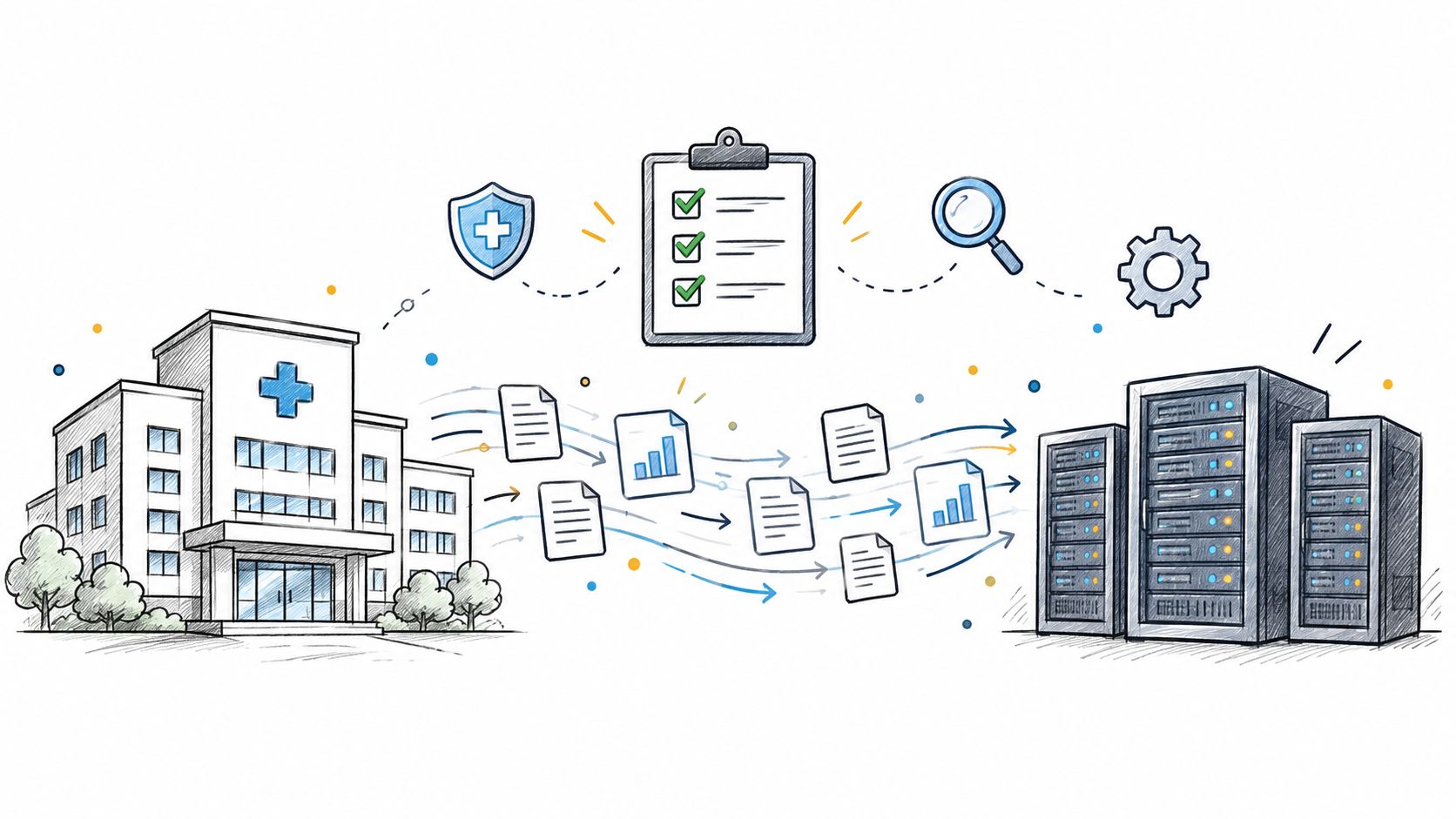
Practical data migration planning guide for healthcare teams. Scope, mapping, compliance, validation, cutover and rollback decisions explained end to end.
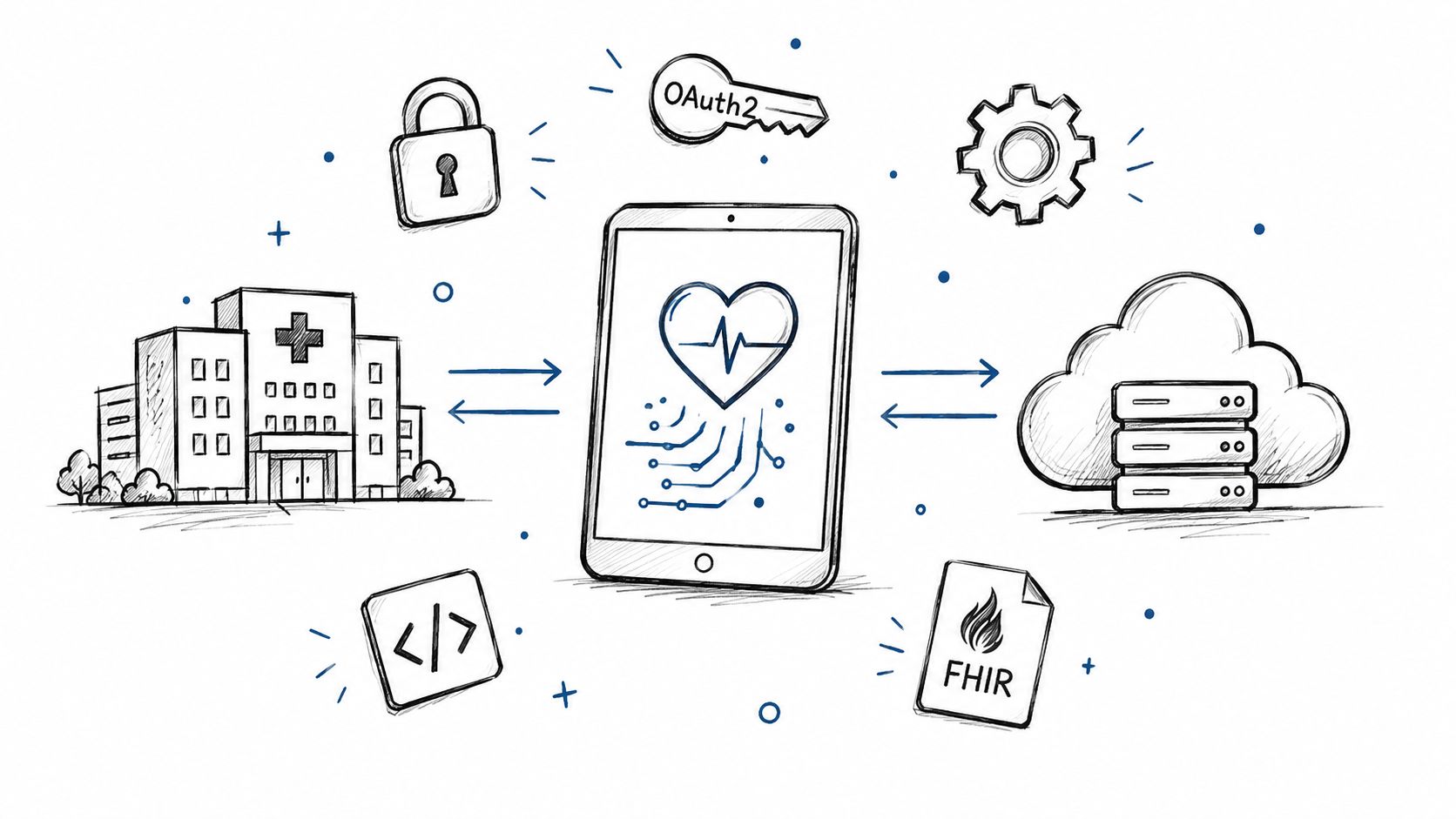
Smart on FHIR guide for healthtech engineers. Learn the OAuth 2.0 launch model, scope syntax, backend services, and US regulatory requirements.
Connect with our team to explore how AI expertise can transform your business.