AI in Healthcare
HIPAA-Compliant AI: How to Use LLMs With PHI Safely
How to build HIPAA-compliant AI: when LLM providers need a BAA, data minimization, de-identification, audit controls and a reference architecture.
October 16, 2026Read more
Build a future-proof healthcare AI strategy. This guide offers a practical roadmap for assessing readiness, prioritizing use cases, and scaling AI.
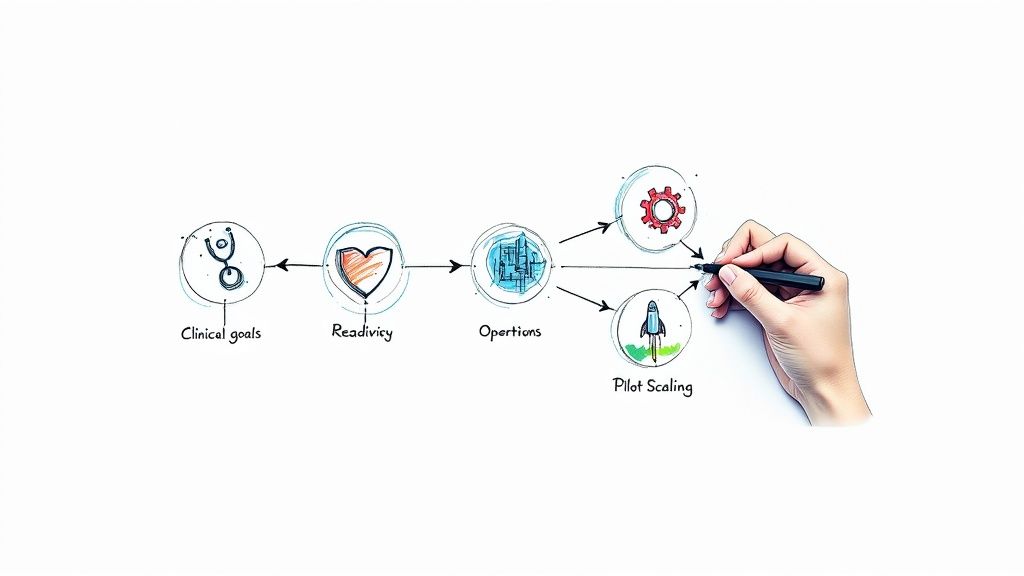
Dipping your toes into AI with a few scattered, disconnected projects just doesn't cut it anymore. A formal healthcare AI strategy is what separates the real innovators from those running costly, dead-end experiments. It’s the roadmap that connects the tech to what actually matters: clinical goals, patient outcomes, and financial stability.
Healthcare is facing a perfect storm of staff shortages, soaring patient expectations, and immense operational pressure. In this environment, "winging it" with AI is a surefire way to burn through cash, frustrate your clinical teams, and see little to no impact on the bottom line.
A real strategy forces you to move from just tinkering with technology to executing a deliberate plan. It's the framework that helps you decide where to place your bets, how to manage the inherent risks, and, most importantly, how to scale the things that actually work.
This guide is designed to be a practical playbook, not a theoretical exercise. We'll walk through the essential pillars you need to get right, from gauging your organization's readiness to building a governance structure that actually works.
Think of your AI strategy less as an IT document and more as a core business plan. The benefits go way beyond just making a few processes more efficient.
A solid strategy delivers tangible advantages:
Adopting a strategic mindset means you stop treating AI as a collection of cool tools. Instead, you see it as a powerful capability that needs careful planning, smart governance, and rigorous measurement to deliver on its promise.
Ultimately, a healthcare AI strategy is about building a future where technology genuinely empowers clinicians, elevates patient care, and makes the whole system more resilient. For a closer look at how these principles are applied, you can explore our insights on AI for the healthcare industry.
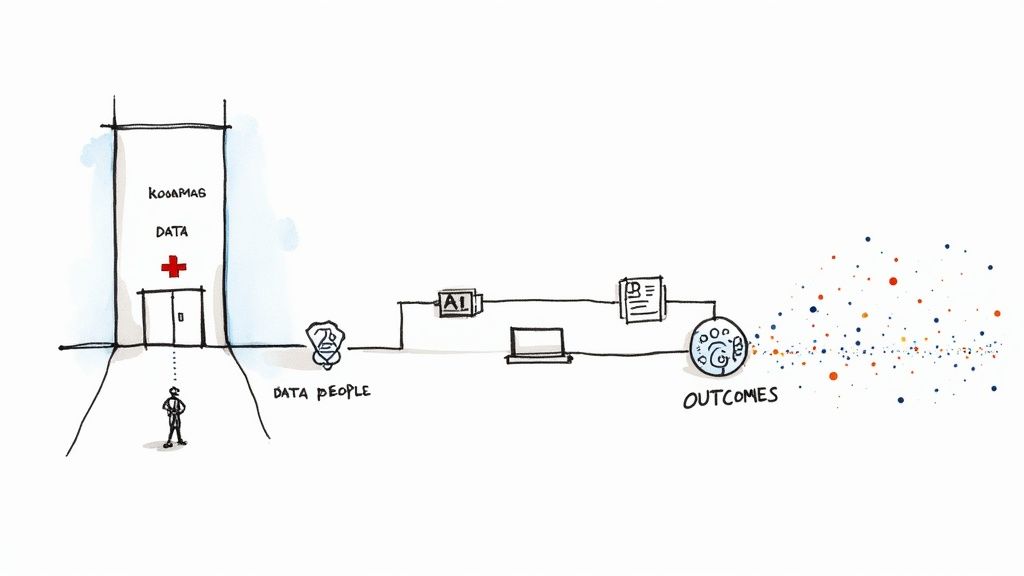
Before you even think about building an ambitious healthcare AI strategy, you have to get a clear picture of what you're working with. So many organizations get caught up in the AI hype and jump straight into projects without this crucial first step. It's a recipe for disaster, a bit like performing surgery without a diagnosis—you’re just guessing, and the results are rarely good.
A real readiness assessment gives you a solid, realistic baseline. It helps you build a plan that will actually work in your hospital or health system, not just look good on a PowerPoint slide. This isn't just about ticking off boxes on a technical checklist. It's a deep dive into four critical areas: your tech, your data, your people, and your processes. The insights you gather here will shape every single decision you make down the line, from which problems you decide to tackle first to how you'll roll out the solution. This foundational audit is a central part of how we conduct a thorough AI requirements analysis to set organizations up for success from day one.
AI runs on data. It’s that simple. Without a steady stream of high-quality, accessible, and secure data, even the most sophisticated algorithm is completely worthless. You need to start by asking some hard questions about your data ecosystem. Is all your critical patient data locked away in siloed, legacy EHR systems, or have you managed to integrate it so it can actually be used for analysis? This is a challenge often solved through custom healthcare software development that prioritizes interoperability.
Here’s what to zero in on:
Beyond the data itself, take a hard look at your overall tech stack. Do you have the cloud computing power, the MLOps platforms, and the right analytics tools to actually support building and deploying AI models at scale? Finding these gaps now will save you from hitting a major wall later.
Technology is only half the battle. Your people—and your organization's culture—are what will ultimately make or break your AI initiatives. Your readiness audit has to include an honest look at whether your organization is culturally prepared for the massive changes AI is about to bring.
Start at the top. Is there real, genuine buy-in from leadership for innovation, or is "AI" just the latest buzzword they're throwing around in board meetings? You absolutely need a champion in the C-suite to secure the budget, resources, and political capital to push through the inevitable resistance. To get a better handle on where your organization stands, a structured AI Strategy Workshop can bring incredible clarity.
With leadership assessed, turn your attention to your teams on the ground.
A culture that punishes failure will kill innovation before it even starts. Your audit needs to gauge if your organization provides the psychological safety for teams to experiment, learn from small-scale pilots, and adapt. That’s the secret sauce for any successful AI journey.
By methodically auditing your technology, data, people, and processes, you stop guessing. You end up with an evidence-based snapshot of your strengths, your weaknesses, and—most importantly—your exact starting point for building a healthcare AI strategy that delivers real results.
Once you have a good handle on where your organization stands, the big question becomes: "Where do we start?" The possibilities for AI in healthcare are nearly endless, and that can be paralyzing. If you try to do everything at once, you'll end up doing nothing well.
The secret isn't chasing every shiny new AI model. It's about zeroing in on real, well-defined problems where you can make a tangible difference. I've found the most successful strategies build a smart portfolio of projects. You need some quick wins to build momentum and prove the value, alongside bigger, more ambitious projects that set you up for the long haul. Those early successes are gold—they build trust with skeptical leaders and earn you the political capital needed for the tougher climbs ahead.
To move from a long list of "what ifs" to a concrete action plan, you need a structured way to evaluate your options. A simple prioritization matrix is perfect for this. It takes the decision out of the realm of gut feelings and into a more objective, data-informed space.
This isn't about complex algorithms; it's about forcing a conversation around a few key questions for every potential project:
When you score your ideas against these pillars, the best starting points often jump right off the page. You're looking for that sweet spot of high impact and low complexity. Those are your initial targets. If you need some inspiration, browsing through a library of real-world use cases can spark some fantastic ideas.
To make this more concrete, here’s a simple framework you can adapt to evaluate and rank potential AI initiatives.
This table helps healthcare organizations systematically evaluate potential AI projects. By scoring each use case against key business and clinical drivers, you can create a clear, defensible priority list that aligns everyone on the path forward.
| Use Case Example | Clinical Impact (High/Med/Low) | Operational ROI (High/Med/Low) | Implementation Complexity (High/Med/Low) | Priority Score |
|---|---|---|---|---|
| Automated Prior Authorization | Low | High | Low | High |
| Predictive Sepsis Alerts | High | High | High | High |
| AI-Assisted Radiology Reading | High | Medium | High | Medium |
| Optimized OR Scheduling | Medium | High | Medium | High |
| Automated Clinical Note Coding | Low | High | Low | High |
| Patient No-Show Predictions | Low | Medium | Low | Medium |
By mapping out your options like this, you can quickly see where to focus your energy first. The goal is to identify a few high-priority projects that offer the best blend of immediate value and strategic importance.
When you look at the landscape, AI adoption in healthcare is already well underway. By 2025, it's expected that 63% of healthcare professionals will be actively using AI, with another 31% testing the waters. That's a huge leap compared to the 50% average across other industries. And the focus varies—medical tech companies are all-in on imaging and diagnostics (71%), while providers are doubling down on workflow automation (48%). You can read more about these healthcare AI trends to see where the momentum is.
This data really points to two main buckets of opportunity for your own strategy.
Operational and Administrative Wins: These are often the fastest way to show value. Think about the soul-crushing, repetitive tasks that burn out your staff—patient scheduling, medical coding, and the endless back-and-forth of prior authorizations. Automating these workflows delivers a clear, almost immediate ROI and, just as importantly, frees up your team for more meaningful, patient-focused work. Solutions like AI Automation as a Service are designed to deliver these kinds of results quickly.
Clinical and Diagnostic Enhancements: These are the game-changers. We're talking about predictive models that flag high-risk patients before they crash, AI that helps radiologists spot subtle signs of disease on a scan, or clinical decision support tools that give physicians evidence-based guidance in real time. They’re harder to build and deploy, no question. But the potential to fundamentally improve care is enormous.
My advice? Build a roadmap that does both. Kick things off with an operational project to get a quick win on the board. Then, use the credibility and lessons learned from that success to fund and tackle a more ambitious clinical challenge. This step-by-step approach builds confidence and makes the entire journey far less risky.
Ultimately, smart prioritization is an act of discipline. It’s about saying "no" to a hundred good ideas so you can say "yes" to the two or three great ones that will truly matter to your patients, your staff, and your bottom line. If you're looking for a partner to help build that focused plan, a Custom AI Strategy report can provide an expert, outside-in view to create a roadmap tailored specifically to you.
Once you’ve identified promising AI use cases, the real work begins. In healthcare, even the most brilliant idea has to be built on an ironclad foundation of trust and safety. Think of your governance and data framework not as a compliance hurdle, but as the essential operating system that allows your healthcare AI strategy to run safely, ethically, and effectively.
Without clear rules of the road, you're not innovating—you're gambling with patient outcomes and sensitive data. This framework is all about defining accountability, protecting patient privacy at every turn, and drawing firm ethical lines in the sand. It’s the difference between controlled, sustainable progress and chaotic, risky experiments.
Let's be clear: compliance with regulations like the Health Insurance Portability and Accountability Act (HIPAA) is the absolute bare minimum. Any time you're dealing with protected health information (PHI), you need strict controls in place. But genuine data governance is about more than just checking legal boxes; it’s about fostering a deep-seated culture of data stewardship across your entire organization.
Your framework needs to cover a few critical areas:
This isn't a theoretical risk. A recent advisory from the California Attorney General put healthcare organizations on notice, signaling heightened scrutiny of their AI systems. The message was clear: you can be held liable for using AI tools that you should have known were unlawful.
This chart drives home just how quickly AI is being adopted in healthcare compared to other industries, highlighting why strong governance is so urgent.
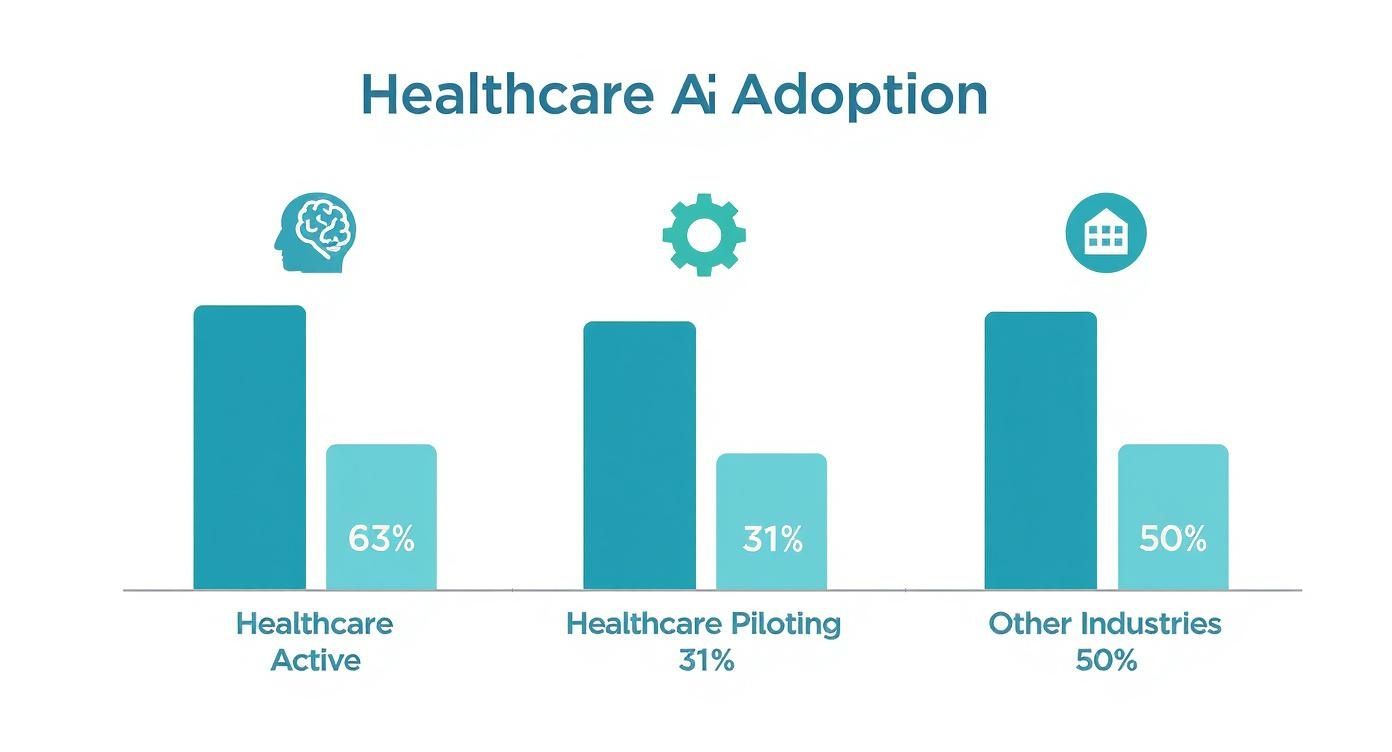
The numbers speak for themselves. With 63% of healthcare organizations actively using AI and another 31% already in the pilot phase, the industry is moving fast. This pace makes establishing a formal governance framework more critical than ever before.
Legal compliance is one thing, but the ethical territory of AI is far more complex. An algorithm can be perfectly compliant with the law and still produce biased or unfair results. In healthcare, algorithmic bias is a serious danger. A model trained on a non-diverse dataset can easily perpetuate—or even worsen—existing health disparities.
Your governance framework has to be proactive about fairness and equity. This means setting clear ethical principles that guide every AI project, from concept to deployment. It also means committing to continuous monitoring to catch and fix bias before it can harm a single patient.
A practical first step is to form an AI governance committee. This shouldn't just be a group of IT folks; it needs to be a cross-functional team with clinical, technical, legal, and ethics experts. Their job is to review and sign off on AI initiatives, acting as the essential oversight body that ensures every project aligns with your organization's core values. For more insight into creating this kind of oversight, resources on Artificial Intelligence Governance can be incredibly helpful.
Your governance policies are only as strong as the data infrastructure supporting them. A modern data strategy is the technical engine for your AI ambitions. This means getting out of the world of siloed, legacy systems and moving toward an integrated, accessible data ecosystem.
A key piece of this puzzle is Machine Learning Operations (MLOps). MLOps gives you a structured way to manage the entire AI model lifecycle—from development and deployment to ongoing monitoring and maintenance. It’s what prevents a model's performance from "drifting" or degrading over time, a critical safety measure when that model is influencing clinical decisions.
This complete approach—combining strict compliance, proactive ethics, and a robust data infrastructure—is what creates a governance framework that enables innovation instead of stifling it. This is the bedrock you need to build a successful and sustainable healthcare AI strategy.
A brilliant healthcare AI strategy is meaningless if it stays on paper. The real test is execution—taking a promising idea from a small-scale pilot and weaving it into the very fabric of your organization. This isn't a single leap; it's a carefully planned journey from controlled experiment to daily operational reality.

It all starts with designing a pilot program that’s built to succeed. Forget vague goals. You need crystal-clear metrics from day one. Are you trying to slash diagnostic report turnaround times by 15%? Or maybe cut the administrative drag on prior authorizations by 20%? These tangible, measurable targets are your north star.
Just as critical is picking the right environment and team. Look for a clinical or administrative unit that’s not just wrestling with the problem you're trying to solve, but is also genuinely open to new ways of working. An enthusiastic group of early adopters will give you priceless feedback and become your biggest champions when it’s time to expand.
Honestly, the technology is often the easy part. The real challenge? Changing human behavior. The difference between a successful AI rollout and an expensive flop almost always comes down to thoughtful change management. You can't just drop a new tool into a workflow and expect clinicians and staff to embrace it.
Getting people on board is a delicate process that requires empathy and clear communication:
As you navigate this transition, seeing how to use AI in business and take it to the next level in other industries can offer some surprisingly relevant insights for managing this complex shift.
Once your pilot delivers real results, it’s time to create a blueprint for scaling. This means tackling both the technical and the human side of the equation. Technically, you need to be sure your infrastructure can handle the increased load and that the AI model works reliably across diverse patient groups.
Operationally, you’ll need to standardize the new workflows, update all your training materials, and roll out a clear communication plan for the wider launch. Having a structured AI Product Development Workflow is a game-changer here. It gives you a repeatable framework to turn successful pilots into enterprise-grade solutions.
A successful pilot doesn't just validate a piece of technology; it validates a new way of working. The lessons learned about workflow integration, user training, and stakeholder communication are the most valuable assets you gain for future scaling efforts.
This scaling phase is happening at a time of incredible momentum. Investment in healthcare AI is surging within the $4.9 trillion U.S. healthcare sector. Healthcare organizations are deploying AI solutions at more than twice the rate of the broader economy, growing 2.2 times faster.
From 2023 to 2025, the adoption of domain-specific AI in healthcare is expected to jump tenfold, with health systems leading the charge. This rapid expansion highlights just how crucial a deliberate, phased approach to scaling is. By proving value in a controlled pilot and then methodically working through the change management and operational hurdles, you build a sustainable path for AI to deliver on its promise across your entire organization.
Building a successful healthcare AI strategy is a massive undertaking, and honestly, you shouldn't try to go it alone. I've seen too many organizations try to build a comprehensive AI program entirely in-house, only to get bogged down by costly delays, a constant scramble for talent, and unforeseen technical roadblocks.
Bringing in the right partner isn't a sign of weakness—it's one of the smartest strategic moves you can make. It’s an accelerator.
Engaging with experts in AI strategy consulting gives you an immediate injection of experience. A good partner has seen this all before. They bring lessons learned from countless other implementations, helping you navigate the thorny complexities of compliance, data infrastructure, and tricky clinical workflow integrations right from the start.
The right collaboration delivers much more than just advice; it provides tangible resources that push your journey forward. For example, getting a detailed Custom AI Strategy report can give you a clear, actionable roadmap in weeks, a process that might take an internal team months. This frees up your people to focus on what they do best: execution.
A good partner can also help you build out core capabilities much faster. Think of it like this:
This approach is all about finding someone who genuinely understands your specific clinical and operational challenges. They work alongside you to build sustainable, long-term momentum.
The need to move quickly is amplified by enormous global pressures. The World Health Organization projects a staggering shortfall of 10 million healthcare workers by 2030. AI is widely seen as essential for closing that gap, whether by supporting clinical decisions or automating routine tasks.
Despite the clear potential to improve care for the 4.5 billion people who currently lack essential services, healthcare's AI adoption still trails other industries. This reality makes building a smart, effective strategy more urgent than ever. You can learn more about how AI is transforming global health on weforum.org.
A partnership isn't just about outsourcing a project. It’s about building a symbiotic relationship where an external expert becomes an extension of your team, dedicated to helping you achieve your strategic goals faster and more effectively.
If your organization is ready to shift from planning to making a real impact, the next step is a conversation. Talking through your specific needs with our expert team can bring the clarity and direction you need to move your healthcare AI strategy forward with confidence.
When it comes to building a healthcare AI strategy, a lot of the same questions pop up. Let's tackle some of the most common ones I hear from organizations just getting started.
Everyone wants to jump straight to building models, but the absolute first step is a frank and thorough readiness assessment. You have to know where you are before you can map out where you're going, as we explored in our AI adoption guide.
This means getting real about your current state. What does your data infrastructure actually look like? Do your teams have the right skills? Is your organizational culture ready to embrace this kind of change? An honest assessment, often part of a detailed AI requirements analysis, gives you the solid ground you need to build a strategy that works in the real world, not just on paper.
This is non-negotiable. HIPAA compliance can't be an afterthought; it has to be baked into your AI strategy from day one. It's way more than just a checklist.
You need a multi-layered approach that includes:
Beyond that, you should be de-identifying patient data for model training wherever possible and bringing in independent auditors regularly to check your work.
I've seen a few common pitfalls trip up even the most well-intentioned AI initiatives. One of the biggest is trying to boil the ocean—tackling a massive, high-risk project right out of the gate. A much better approach is to aim for a few quick wins to build momentum and earn trust from stakeholders.
Another huge mistake is failing to get genuine buy-in from your clinical staff from the very beginning. AI in healthcare is not just an IT project; it’s a clinical transformation. If you don't treat it that way and involve clinicians deeply in the process, it’s doomed. Finally, never, ever underestimate how much of a challenge poor-quality or siloed data can be. It's a frequent and very expensive error.
An AI Strategy consulting tool acts as a centralized platform to guide your strategic planning. It helps you assess your current capabilities, identify high-impact use cases based on your specific goals, and create a structured roadmap for implementation. This ensures your efforts are aligned, data-driven, and focused on delivering measurable value to patients and staff.
Ready to move from vision to a concrete plan? Ekipa AI helps organizations build tailored AI strategies and provides the hands-on support to make them a reality. Take a look at our AI solutions to see how we can help you get there faster, or connect with our expert team to start the conversation.
How to build HIPAA-compliant AI: when LLM providers need a BAA, data minimization, de-identification, audit controls and a reference architecture.
Practical data migration planning guide for healthcare teams. Scope, mapping, compliance, validation, cutover and rollback decisions explained end to end.

Smart on FHIR guide for healthtech engineers. Learn the OAuth 2.0 launch model, scope syntax, backend services, and US regulatory requirements.
Connect with our team to explore how AI expertise can transform your business.