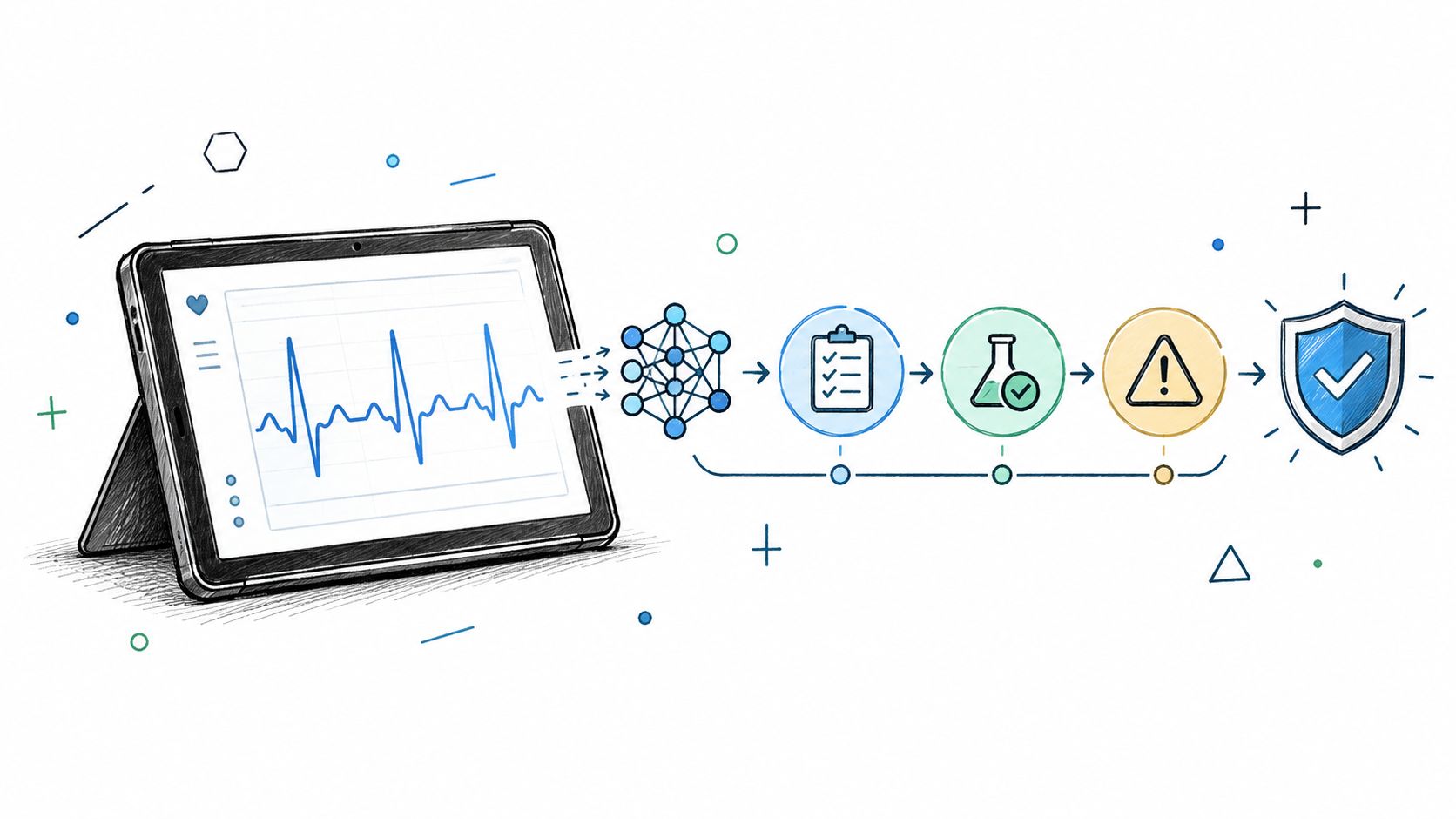
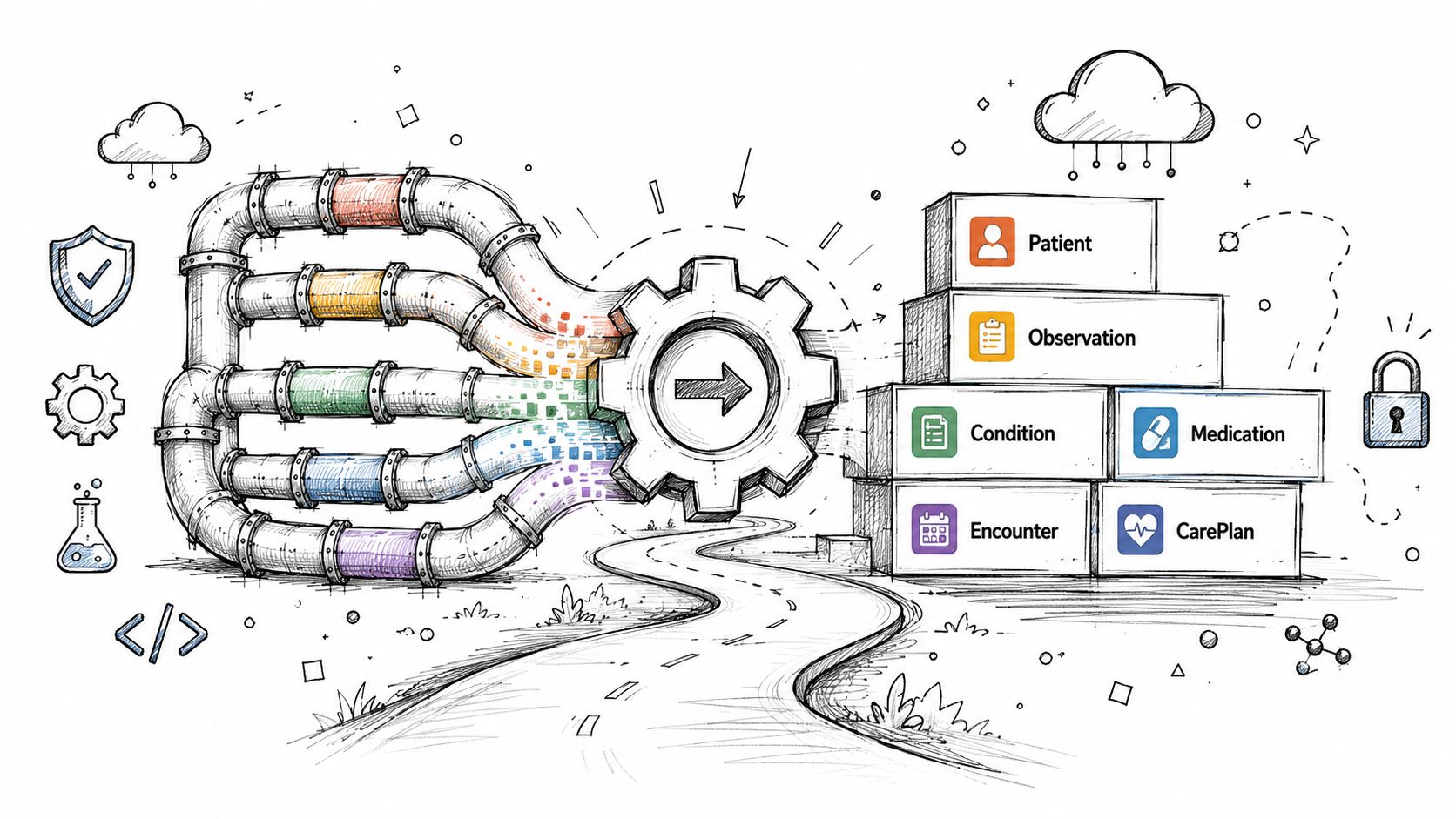
Think of healthcare analytics engineering as the essential, behind-the-scenes work that turns messy, raw health data into something truly useful. It’s the discipline of building solid data pipelines that take chaotic information from countless sources and transform it into clean, reliable data ready for analysis. This field is the critical link between highly technical data teams and the clinicians or administrators who need to make informed decisions.
What Is Healthcare Analytics Engineering?

Picture a bustling hospital. It’s constantly generating a tidal wave of data—EHRs, lab results, billing codes, real-time feeds from medical devices, and patient satisfaction surveys. In its raw form, this data is like a contaminated water source: full of potential, but unsafe to drink. It's inconsistent, disorganized, and can’t be trusted for critical decisions.
Healthcare analytics engineering is the sophisticated filtration system. It builds the pipelines that collect, clean, organize, and deliver this data to where it’s needed most. Its job is to turn that murky water into a pure, reliable resource—clean, trustworthy datasets that are ready for action.
The goal is much bigger than just storing data. It's about making that data consistently accessible and genuinely useful. This process creates high-quality "data products" that can power anything from a simple dashboard tracking ER wait times to a sophisticated AI model that predicts patient readmission risks.
The Bridge Between Data and Decisions
Analytics engineering fits neatly between the worlds of big data infrastructure and actual business intelligence. To get a feel for its role, it helps to know the difference between related fields like data engineering vs data science, as both feed into this process.
While data engineers are the ones who build the massive systems to move raw data around, analytics engineers handle the crucial "last mile." They are the artisans who refine that raw material into polished, business-ready information that clinicians, analysts, and hospital leaders can depend on without a second thought.
Healthcare analytics engineering is all about building trust in the data. When people on the front lines have access to information they can rely on, they make faster, more confident decisions that have a direct, positive impact on patient care and hospital efficiency.
This involves a few key steps:
- Data Modeling: Thinking through how to structure complex health data so it’s intuitive and easy for anyone to query.
- Transformation: Applying business logic to clean, merge, and summarize data from disparate sources like patient records and billing systems.
- Testing and Validation: Setting up automated checks to guarantee the data is accurate, consistent, and complete every step of the way.
- Documentation: Creating a clear "data dictionary" so everyone in the organization speaks the same language and understands what the numbers actually mean.
The Four Pillars of Healthcare Analytics
To understand how this all comes together, we can look at analytics as a journey. Each stage answers a more complex question, building on the one before it.
| Type of Analytics |
Core Question It Answers |
Practical Healthcare Example |
| Descriptive |
What happened? |
A dashboard showing the number of patient admissions per day last month. |
| Diagnostic |
Why did it happen? |
Analyzing patient data to find that a spike in admissions correlates with a local flu outbreak. |
| Predictive |
What will happen? |
Using historical data to forecast staffing needs for the upcoming holiday season. |
| Prescriptive |
What should we do about it? |
An AI model recommending specific interventions for high-risk patients to prevent readmission. |
This progression from simple reporting to advanced recommendations is only possible when you have a solid foundation of clean, reliable data—which is exactly what analytics engineering provides.
Why It Matters More Than Ever
Without a dedicated analytics engineering function, data teams often end up working in silos. This leads to wasted effort, conflicting metrics, and a deep-seated mistrust of the numbers. One department’s report on "average length of stay" might completely contradict another's, causing confusion and derailing any real progress.
By creating a central, well-governed system for transforming data, healthcare analytics engineering builds a single source of truth. This foundation is non-negotiable for any organization that wants to scale its data efforts and truly improve outcomes. Building this system right requires deep domain knowledge, which is why partnering with experts in Healthcare AI Services can be the key to unlocking your data's full potential.
The Real-World Payoff of Smart Data Infrastructure
Think of data infrastructure as the hidden plumbing of a hospital. When it works well, you don't even notice it. But when it's clogged or leaky, everything grinds to a halt. A well-oiled data system does more than just shuffle information around; it becomes a direct source of value that you can see on the front lines of patient care and in the organization's bottom line.
So, how does a clean data pipeline actually make a difference? It’s what allows hospital administrators to make smarter calls on where to put their resources, helps clinical teams slash patient wait times, and provides the foundation for preventing costly medical mistakes. This is where analytics engineering stops being a technical exercise and starts generating tangible improvements.
The financial impact isn't trivial, either. In the United States alone, some estimates suggest that better use of data could save the healthcare system a mind-boggling $300 billion each year. That's about 8% of the country's total healthcare spending. As the market for big data in healthcare continues its explosive growth—projected to fly past $105 billion by 2031—it’s clear that turning raw data into sharp insights is the key to cutting waste and boosting financial health.
If You Can't Measure It, You Can't Manage It
To truly understand the impact of your analytics engineering efforts, you have to measure it. While standard business metrics still apply, this specific discipline brings its own set of key performance indicators (KPIs) to the table. These KPIs give you a direct reading on the health and efficiency of your entire data ecosystem.
Tracking these metrics ensures your data work isn't just happening in a silo. It connects the technical team's output directly to the organization's most important goals.
The ultimate goal is to shrink the gap between a business question and a data-driven answer. The faster and more reliably you can do this, the more agile and effective your organization becomes.
This is where a thoughtful approach, guided by an AI strategy consulting mindset, can really pay dividends.
Key Performance Indicators for Analytics Engineering
Here are a few of the most important KPIs your team should be watching:
Time to Insight: How long does it take to get a reliable answer once a stakeholder asks a question? A shorter Time to Insight means your organization can react immediately to challenges and opportunities. For example, you can pinpoint the source of a sudden spike in hospital-acquired infections in hours instead of weeks.
Data Quality Score: This is a combined score measuring the accuracy, completeness, and consistency of your most critical datasets. Hitting a 99.5% accuracy rate for patient demographic data, for instance, builds trust and ensures every report, analysis, and AI model is built on solid ground.
Data Downtime: This tracks any period when your data is inaccurate, missing, or just plain wrong. In healthcare, this isn't just an inconvenience; flawed data can lead to dangerous clinical decisions and serious operational blunders. Keeping this number as close to zero as possible is non-negotiable.
Adoption of Data Products: Are people actually using the dashboards, reports, and datasets the team is building? Tracking how many clinicians, analysts, and executives are actively using these tools is a fantastic barometer for whether your team is delivering real value.
Focusing on these KPIs creates a clear line of sight from technical work to business outcomes. When you improve your Data Quality Score, for example, you directly enable more accurate billing and see fewer rejected claims. When you shrink your Time to Insight, you empower managers to adjust operating room schedules on the fly, improving patient flow and getting the most out of expensive resources.
Getting these KPIs right from the start can be a challenge. Working with an experienced HealthTech engineering partner can help you define and track the metrics that matter most. With tools like a Custom AI Strategy report, you can identify the highest-impact opportunities and fast-track your return on investment, turning your data infrastructure from a cost center into a powerful strategic asset.
Building Your Healthcare Data Powerhouse
Turning raw healthcare data into a strategic asset takes more than just good intentions. It requires a solid technical foundation, and that’s what we’re here to map out. Think of it less like a rigid factory and more like a sophisticated data refinery, with four core stages: Ingestion, Transformation, Storage, and Activation.
This layered approach is how you safely and efficiently guide data from its messy, raw state into a polished "data product." At every step, security and compliance are paramount, ensuring sensitive patient information is protected from start to finish. Done right, this foundational work is what allows your organization to see real-world gains.
This is how solid analytics engineering translates directly into operational wins and, most importantly, better patient outcomes.

As you can see, robust engineering is the bedrock. It supports everything above it, from finding financial efficiencies to making critical improvements in patient care.
The Four Layers of a Modern Healthcare Data Platform
A modern data platform isn't just one piece of software; it's an entire ecosystem of tools working together. Let’s break down the role each layer plays in this data powerhouse.
1. The Ingestion Layer
This is your system’s front door, responsible for collecting data from a vast and varied landscape of sources. Think about all the different types of information you need to bring in:
- Structured data like billing codes from financial systems.
- Semi-structured data like JSON files from third-party APIs.
- Unstructured data like free-text clinical notes from Electronic Health Records (EHRs).
The goal here is simple but critical: get all this data into your system reliably, without losing or corrupting anything. This first step sets the stage for all the valuable work that comes next.
2. The Transformation Layer
Once the raw data is in, it heads to the transformation layer. This is where the real work of analytics engineering shines. Raw, messy data is cleaned up, standardized, and reshaped into a clean, trustworthy format.
This layer is the heart of data quality. It's where you apply business logic to turn confusing, disparate data points into a cohesive, single source of truth that everyone in the organization can rely on.
This is where you’ll tackle challenges like de-duplicating patient records, standardizing medical codes (like converting all temperature readings to Celsius), and linking a single patient’s data across different systems. The process can be incredibly complex, which is why we’ve detailed how to simplify it with our AI Automation as a Service.
3. The Storage Layer
After being transformed, the clean data needs a safe and accessible home. This is the job of the storage layer. Most modern healthcare organizations use a combination of two solutions:
- Data Lake: A massive repository that can hold all your data—raw, semi-structured, and structured—in its original format. It’s a flexible and cost-effective way to store huge volumes of information.
- Data Warehouse: A highly structured database built for fast querying and analysis. This is where you keep the curated, analysis-ready datasets that fuel business intelligence and reporting.
As you build out infrastructure for more advanced AI, understanding components like what a feature store is also becomes crucial for organizing and serving data to machine learning models.
4. The Activation Layer
Finally, we have the activation layer. This is where all your hard work pays off and your data is put to use. It’s the delivery hub of your data refinery, getting valuable insights into the hands of the people who need them.
This is where analysts run queries, data scientists build predictive models, and executives view dashboards to guide strategy. The activation layer connects your powerful data engine to real-world applications, driving improvements in everything from patient scheduling to clinical trial recruitment. Building powerful internal tooling at this stage ensures your teams can leverage data effectively.
Assembling Your Analytics Engineering Dream Team

The best technology in the world is useless without the right people to run it. When it comes to healthcare analytics, building an effective team means bringing together a group of specialists who each own a critical piece of the data puzzle. Without this clear division of labor, even the most promising projects descend into chaos.
Think of it like building a house. You wouldn’t ask your electrician to frame the walls or your plumber to install the windows. You need distinct experts working from the same blueprint. The same is true for your data team, which typically centers around three core roles: the data engineer, the analytics engineer, and the data scientist.
Core Roles in a Healthcare Analytics Engineering Team
While the titles can sometimes blur, these roles have very different, and equally important, responsibilities. Understanding how they connect is the first step toward building a team that can consistently turn raw data into a strategic asset.
The table below breaks down who does what and the tools they typically use.
| Role |
Primary Responsibility |
Key Tools & Technologies |
| Data Engineer |
Builds and maintains the core infrastructure to move raw data from various sources (EHRs, billing systems, etc.) into a central data lake or warehouse. They are the "plumbers" of the data world. |
Fivetran, Airbyte, Python, Kafka, Spark, Cloud platforms (AWS, GCP, Azure) |
| Analytics Engineer |
Takes the raw data and transforms it into clean, trusted, and easy-to-use datasets for analysis. They bridge the gap between data engineering and business intelligence. |
dbt, SQL, Snowflake, BigQuery, Databricks, Looker |
| Data Scientist |
Uses the curated datasets to build predictive models, run statistical analyses, and uncover deep insights. They answer complex questions and forecast future outcomes. |
Python (Pandas, Scikit-learn), R, Jupyter, Databricks, SageMaker |
These roles aren't just colleagues; they're dependencies. The data scientist's models are only as good as the clean data provided by the analytics engineer. And the analytics engineer is completely stuck without the raw data pipelines built and maintained by the data engineer.
This structured workflow is what creates a single source of truth. It’s the foundation for everything from basic operational reports to the advanced AI tools for business that are reshaping healthcare in 2026.
Bridging the Talent Gap: To Build or to Buy?
Here’s the challenge: assembling this team from scratch is tough. The market for proven data talent is incredibly competitive, and the hiring process can easily stall your projects for months, if not years. This reality forces many organizations into a classic "build vs. buy" decision.
But it doesn't have to be all or nothing. For many healthcare organizations, the fastest path to results is a hybrid approach. You can augment your existing team by partnering with outside specialists who have seen these challenges before and know how to solve them.
Working with our expert team gives you immediate access to seasoned professionals who can fill critical gaps. This strategy helps you accelerate your roadmap, deliver value sooner, and sidestep the common pitfalls that come with building a data team from the ground up.
Your Practical Roadmap From Strategy To Execution
Jumping into healthcare analytics engineering can feel like a massive undertaking, but the secret is to break it down. You don't need to build a perfect, all-knowing system from day one. Real success comes from starting small, getting a quick win, and building momentum from there.
Think of it as a clear, step-by-step process. This roadmap will walk you through turning that initial idea into a data engine that delivers real value. Following a structured AI Product Development Workflow is key to minimizing risk and making sure every effort directly supports your most critical business goals.
Phase 1: The Discovery Phase
Before anyone writes a single line of code, you have to agree on what "success" actually means. This first phase is all about strategy and getting everyone on the same page. It’s where you conduct a thorough AI requirements analysis to find the exact spot where analytics can make the biggest impact.
Here’s what you need to nail down:
- Identify High-Impact Problems: Don’t start with the data. Start with the pain. Are you trying to cut down on patient no-shows? Get more out of your operating rooms? Find better candidates for clinical trials?
- Get Stakeholder Alignment: Pull your clinical, operational, and financial leaders into a room. Your goal is to get them to agree on one, focused objective for your very first project. This builds buy-in from the get-go.
- Define Your Metrics: How will you know if you've won? Set clear KPIs, like achieving a 15% drop in patient wait times or boosting operating room throughput by 10%.
Getting this discovery work right is like creating a blueprint for the entire project. It’s what keeps you from building a technically brilliant solution that ultimately just gathers dust.
Phase 2: The Foundation Phase
With a clear goal in hand, it’s time to start laying the technical groundwork. In this phase, you’ll stand up the basic infrastructure for your pilot project. The focus isn't on perfection; it's on building a minimum viable platform—just enough to get the job done right without over-engineering it.
Your key activities here will be:
- Choosing Core Technologies: Make your initial picks for the tech stack you'll use to ingest, store, and transform data.
- Establishing Data Connections: Build the first few pipelines to pull data from the one or two sources that are absolutely critical for your pilot, like the EHR and a scheduling system.
- Implementing Security Protocols: Embed data privacy and security from the very beginning. This means things like data masking and role-based access controls are part of the initial build, not an afterthought.
Phase 3: The Pilot Phase
Now for the fun part—proving it works. Using the foundation you just built, you'll run a focused pilot project designed to deliver a quick, tangible win. The project needs to be small enough to wrap up in a few months but significant enough to make leadership sit up and take notice.
For example, you might build a single dashboard that gives schedulers a real-time view of operating room availability. This directly tackles the goal of improving utilization and shows immediate value. A successful pilot creates the political and social capital you need to get the resources for what comes next.
Your pilot project is the most powerful tool you have for building momentum. A clear, measurable success story is always more convincing than a slide deck.
Phase 4: The Scale and Govern Phase
With a win under your belt, it's time to think bigger. This phase is all about building on your initial success by tackling more complex problems and pulling in more data. But as you grow, solid governance becomes absolutely essential.
This involves a few key things:
- Expanding Data Sources: Methodically connect new data sources—like pharmacy, labs, or billing systems—to your platform.
- Developing Data Products: Build out a portfolio of trusted, curated datasets and dashboards that can serve different departments across the organization.
- Formalizing Governance: Put data catalogs, automated quality checks, and crystal-clear documentation in place. This is what keeps your data trustworthy as you scale.
The demand for this capability is exploding. The global healthcare analytics market is expected to jump from $69.12 billion in 2026 to an incredible $263.36 billion by 2032. This growth is driven by the urgent need to solve massive problems, like the fact that over 80% of healthcare errors are administrative—issues that robust analytics can directly fix. Organizations that get their data strategy right are poised for immense opportunity.
And in a regulated world, compliance is everything. For any software that acts as a medical device, this means implementing specialized SaMD solutions. This guarantees your innovations are not only powerful but also fully validated and safe for clinical use.
Real-World Impact and What Can Go Wrong
So, what does all this data work actually do? It's one thing to talk about data pipelines in the abstract, but the real magic happens when they solve tangible problems. We're talking about predictive staffing models that finally put an end to ER overcrowding or supply chain optimizations that stop critical drug shortages before they start. These aren't futuristic concepts; they’re real-world use cases happening right now.
This is what happens when data drives action. It’s the engine behind innovation in everything from hospital administration to the way we approach custom healthcare software development. Take public health, for example. Analytics engineering is completely changing the game by helping experts spot isolated disease cases before they spiral into a crisis. Countries like Norway are using big data to monitor national health trends, while Australia’s DIPA system can flag adverse drug reactions in almost real-time.
It's a global shift. In fact, 41% of healthcare professionals now rely on operational big data to fine-tune everything from inventory management to patient flow. This work is what’s fueling a market projected to jump from $67 billion in 2023 to over $105 billion by 2031. You can explore more data engineering use cases at PHDATA to see just how widespread this has become.
Of course, getting to that point is rarely a straight line. The road to successful implementation is littered with projects that looked great on paper but fell flat in reality. It's usually not the technology that fails—it's the strategy. Knowing the common traps is the best way to avoid them.
Common Pitfalls in Analytics Engineering
You need more than just technical chops to navigate the complexities of healthcare data; you need foresight. A smart, strategic approach, often sharpened through AI strategy consulting, helps leaders see these common traps coming and steer clear.
Starting Without a Clear "Why": It’s easy to get excited about the technology and start building pipelines without a concrete business problem to solve. The result? A sophisticated system that helps no one. The fix: Always start with a focused discovery phase. Pinpoint a specific pain point—like high patient readmission rates—and make sure every technical decision directly serves that goal.
Treating Data Governance as an Afterthought: As your data grows, so does the potential for chaos. If you don't set clear rules for data quality, access, and documentation from the beginning, your "single source of truth" will quickly become a swamp of conflicting, untrustworthy information. The fix: Weave a data governance framework into your project from day one. That means creating a data catalog, automating quality checks, and assigning clear data ownership.
Ignoring the "Last Mile" of Adoption: You can build the most brilliant predictive model in the world, but it’s worthless if nobody uses it. If a tool is too complicated or doesn't fit into a doctor's existing workflow, it will be abandoned. The fix: Bring your end-users—the clinicians, nurses, and administrators—into the development process early and often. Their feedback is crucial for building tools that are intuitive and actually make their jobs easier, as we explored in our AI adoption guide.
By keeping these challenges in mind, you can guide your analytics engineering projects toward delivering real, lasting value instead of becoming another expensive, forgotten initiative. These strategies are backed by years of experience, and you can get to know our expert team to see who’s behind them.
Frequently Asked Questions
Have a few lingering questions? Let's clear up some of the most common points about healthcare analytics engineering.
What Is The Difference Between A Data Engineer And An Analytics Engineer?
Think of it this way: a data engineer is like the civil engineer who builds the massive data superhighways. They’re responsible for the heavy lifting—constructing the large-scale infrastructure to move enormous volumes of raw data from source systems into a central repository.
An analytics engineer, on the other hand, works much closer to the business teams. They take that raw data from the highways and build the well-paved city roads that lead to specific destinations. They transform, clean, and model the data into reliable, analysis-ready datasets that analysts and data scientists can actually trust and use.
How Does This Field Handle HIPAA And Data Privacy?
In healthcare analytics engineering, privacy isn't an afterthought; it's baked into the process from day one. Compliance is designed directly into the data pipelines to make security a core, non-negotiable feature of the entire system.
This is accomplished through several critical techniques:
- Data De-identification: Systematically stripping or obscuring personal identifiers from patient records.
- Data Masking: Hiding sensitive data fields so they can't be viewed during analysis, protecting patient privacy.
- Role-Based Access Controls: Implementing strict permissions so people can only access the specific data they absolutely need to do their jobs.
- Detailed Audit Logs: Keeping a meticulous record of who accessed what data and when, ensuring complete traceability.
What Is The Best First Step To Get Started?
Whatever you do, don't try to boil the ocean. The most successful teams start with a focused AI strategy consulting phase to pinpoint a single, high-impact business problem. Maybe it's tackling patient no-shows or finding efficiencies in operating room schedules.
The key is to build a targeted pilot solution around this problem. This approach demonstrates value quickly, secures buy-in from leadership, and creates the momentum needed for larger-scale investment in your data initiatives.
By starting small, you prove what's possible and build a solid foundation. Understanding the entire landscape can feel overwhelming, which is why our expert team is here to provide the guidance you need to navigate the journey successfully.